-
1C
-
Agda
-
Agile/Scrum
-
Alef
-
APL
-
Assembler
-
AWK
-
Basic
-
Beta Programming Language
-
Big Data/DataScience
-
C
-
C#
-
C++
-
Cobol
-
Crystal
-
CSS
-
D
-
Dart
-
DataBase (SQL)
-
Delphi
-
F#
-
Flutter
-
Fortran
-
GameDev
-
Git
-
Go (Golang)
-
GPT/AI/ИИ
-
Hacking and Security
-
Haskell
-
HTML
-
Java
-
JavaScript (JS)
-
Julia
-
Kotlin
-
Machine Learning (ML)
-
Natural language processing (NLP)
-
.NET (.NET Core)
-
Pascal
-
PHP
-
Python
-
R
-
Ruby
-
Rust
-
Scratch
-
Swift
-
UML
-
UX/UI
-
Visual Basic
-
Wolfram
-
XML
-
АСУ
-
Проектирование/System Design
-
Сети/Network
-
Статьи
-
Схемотехника/электронные схемы
-
1C
-
Agda
-
Agile/Scrum
-
Alef
-
APL
-
Assembler
-
AWK
-
Basic
-
Beta Programming Language
-
Big Data/DataScience
-
C
-
C#
-
C++
-
Cobol
-
Crystal
-
CSS
-
D
-
Dart
-
DataBase (SQL)
-
Delphi
-
F#
-
Flutter
-
Fortran
-
GameDev
-
Git
-
Go (Golang)
-
GPT/AI/ИИ
-
Hacking and Security
-
Haskell
-
HTML
-
Java
-
JavaScript (JS)
-
Julia
-
Kotlin
-
Machine Learning (ML)
-
Natural language processing (NLP)
-
.NET (.NET Core)
-
Pascal
-
PHP
-
Python
-
R
-
Ruby
-
Rust
-
Scratch
-
Swift
-
UML
-
UX/UI
-
Visual Basic
-
Wolfram
-
XML
-
АСУ
-
Проектирование/System Design
-
Сети/Network
-
Статьи
-
Схемотехника/электронные схемы
Меню
Python and SQL Bible: From Beginner to World Expert
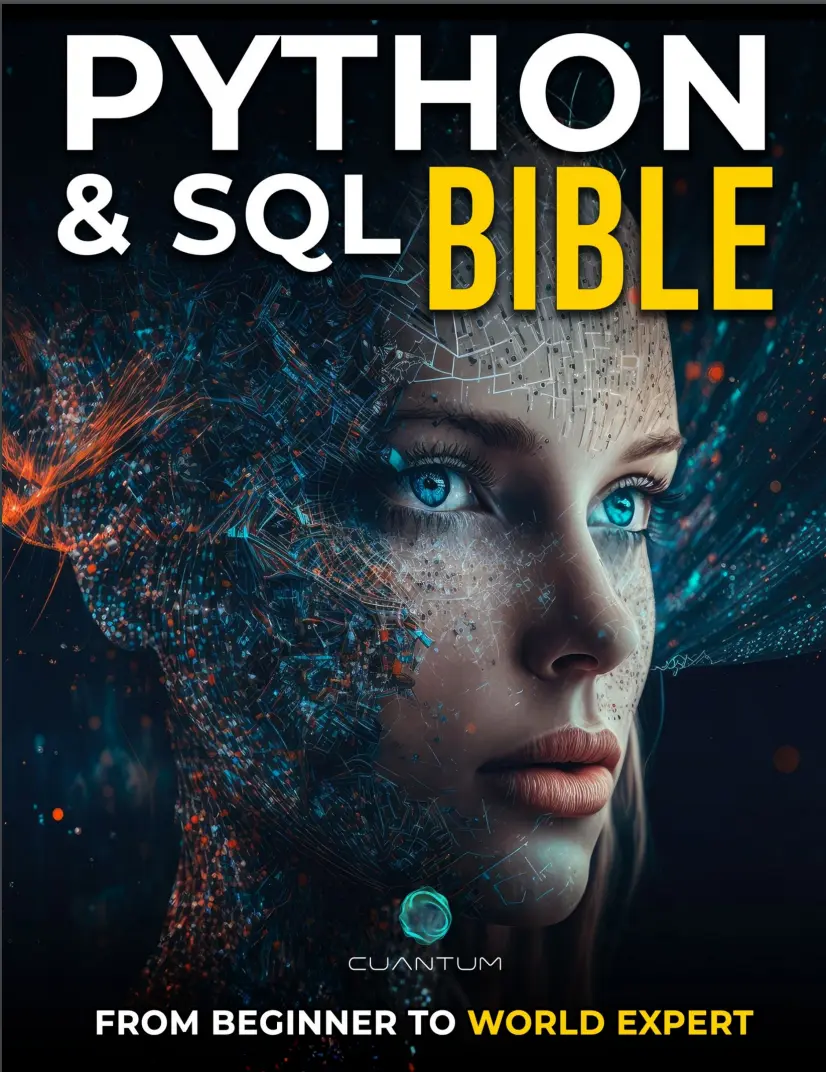
Автор: Cuantum Technologies
Дата выхода: 2023
Издательство: Independent publishing
Количество страниц: 655
Размер файла: 6,5 МБ
Тип файла: PDF
Добавил: codelibs
Проверить на вирусыWho we are....7
Our Philosophy:....8
Our Expertise:....8
Introduction....39
Chapter 1: Python: An Introduction....44
1.1 Brief History of Python....44
1.2 Benefits of Python....46
1.2.1 Readability and Simplicity....46
1.2.2 High-Level Language....48
1.2.3 Extensive Libraries....48
1.2.4 Cross-Platform Compatibility....49
1.2.5 Dynamically Typed....50
1.2.6 Support for Multiple Programming Paradigms....51
1.2.7 Strong Community and Widespread Adoption....52
1.2.8 Integration with Other Languages....53
1.2.9 Versatility....54
1.3 Python Applications....54
1.3.1 Web Development....55
1.3.2 Data Analysis and Data Visualization....56
1.3.3 Machine Learning and Artificial Intelligence....58
1.3.4 Game Development....59
1.3.5 Automation and Scripting....60
1.3.6 Cybersecurity....61
1.3.7 Internet of Things (IoT)....62
1.3.8 Robotics....62
1.3.9 Bioinformatics and Computational Biology....63
1.3.10 Education....64
1.4 Setting up the Python Environment and Writing Your First Python Program....64
1.4.1 Setting up Python Environment....65
1.4.2 Your First Python Program....69
Chapter 1 Conclusion....71
Chapter 2: Python Building Blocks....74
2.1 Python Syntax and Semantics....75
2.1.1 Python Syntax....76
2.1.2 Python Semantics....85
2.2 Variables and Data Types....95
2.2.1 Integers....96
2.2.2 Floating-Point Numbers....97
2.2.3 Strings....98
2.2.4 Booleans....98
2.2.5 Lists....99
2.2.6 Tuples....100
2.2.7 Dictionaries....101
2.2.8 Type Conversion....102
2.2.9 Dynamic Typing....103
2.2.10 Variable Scope....105
2.3 Basic Operators....108
2.3.1 Arithmetic Operators....108
2.3.1 Comparison Operators....109
2.3.2 Logical Operators....110
2.3.3 Assignment Operators....111
2.3.4 Bitwise Operators....113
2.3.5 Membership Operators....114
2.3.6 Identity Operators....114
2.3.6 Operator Precedence....116
2.4 Practice Exercises....118
Chapter 2 Conclusion....122
Chapter 3: Controlling the Flow....125
3.1 Control Structures in Python....126
3.1.1 Conditional Statements (if, elif, else)....127
3.1.2 Loop Structures (for, while)....138
3.2 Error and Exception Handling....148
3.2.1 Handling Exceptions with try and except....150
3.2.2 The else and finally Clauses....151
3.2.3 Raising Exceptions....152
3.2.4 The assert Statement....154
3.3 Understanding Iterables and Iterators....155
3.3.1 Iterators in Python....157
3.3.2 The for loop and Iterators....158
3.3.3 Iterators and Built-in Types....160
3.3.4 Python's itertools Module....161
3.3.5 Python Generators....163
3.4 Practice Exercises....166
Exercise 1: Conditional Statements....166
Exercise 2: Loops....166
Exercise 3: Error and Exception Handling....167
Exercise 4: Iterables and Iterators....167
Chapter 3 Conclusion....169
Chapter 4: Functions, Modules, and Packages....171
4.1 Function Definition and Call....172
4.1.1 Function Definition....172
4.1.2 Function Call....173
4.1.3 Function Parameters....175
4.1.4 Docstrings....177
4.1.5 Local and Global Variables....179
4.2 Scope of Variables....181
4.2.1 Global Scope....182
4.2.2 Local Scope....182
4.2.3 Nonlocal Scope....183
4.2.4 Built-In Scope....184
4.2.5 Best Practices for Variable Scope....186
4.3 Modules and Packages....190
4.3.1 Modules in Python....191
4.3.2 Packages in Python....192
4.3.3 Python's import system....196
4.4 Recursive Functions in Python....197
4.4.1 Understanding Recursion....198
4.4.2 Recursive Functions Must Have a Base Case....200
4.4.3 The Call Stack and Recursion....200
4.5 Practical Exercises....203
Exercise 1: Writing and Calling a Function....203
Exercise 2: Understanding Variable Scope....203
Exercise 3: Importing and Using a Module....204
Exercise 4: Recursive Function....204
Exercise 5: Error Handling....204
Chapter 4 Conclusion....206
Chapter 5: Deep Dive into Data Structures....209
5.1 Advanced Concepts on Lists, Tuples, Sets, and Dictionaries....210
5.1.1 Advanced Concepts on Lists....211
5.1.2 Advanced Concepts on Tuples....216
5.1.3 Advanced Concepts on Sets....218
5.1.4 Advanced Concepts on Dictionaries....219
5.1.5 Combining Different Data Structures....221
5.1.6 Immutable vs Mutable Data Structures....222
5.1.7 Iterating over Data Structures....225
5.1.8 Other Built-in Functions for Data Structures....227
5.2 Implementing Data Structures (Stack, Queue, Linked List, etc.)....228
5.2.1 Stack....229
5.2.2 Queue....230
5.2.3 Linked Lists....231
5.2.4 Trees....232
5.3 Built-in Data Structure Functions and Methods....234
5.4 Python's Collections Module....236
5.5 Mutability and Immutability....238
5.6 Practical Exercises....239
Exercise 1: Implementing a Stack....239
Exercise 2: Implementing a Queue....241
Exercise 3: Using List Comprehensions....241
Exercise 4: Implementing a Linked List....241
Chapter 5 Conclusion....243
Chapter 6: Object-Oriented Programming in Python....245
6.1 Classes, Objects, and Inheritance....246
6.2 Polymorphism and Encapsulation....252
6.2.1 Polymorphism....252
6.2.2 Encapsulation....254
6.3 Python Special Functions....258
6.4 Abstract Base Classes (ABCs) in Python....265
6.4.1 ABCs with Built-in Types....267
6.5 Operator Overloading....269
6.6 Metaclasses in Python....271
6.7 Practical Exercises....273
Exercise 6.7.1: Class Definition and Object Creation....273
Exercise 6.7.2: Inheritance and Polymorphism....273
Exercise 6.7.3: Encapsulation....274
Chapter 6 Conclusion....276
Chapter 7: File I/O and Resource Management....279
7.1 File Operations....280
7.1.1 Opening a file....281
7.1.2 Exception handling during file operations....283
7.1.3 The with statement for better resource management....284
7.1.4 Working with Binary Files....285
7.1.5 Serialization with pickle....286
7.1.6 Working with Binary Files....288
7.1.7 Serialization with pickle....289
7.1.8 Handling File Paths....290
7.1.9 The pathlib Module....292
7.2 Context Managers....293
7.3 Directories and Filesystems....295
7.4 Working with Binary Data: The pickle and json modules....298
7.5 Working with Network Connections: The socket Module....301
7.6 Memory Management in Python....304
7.6.1 Reference Counting....306
7.6.2 Garbage Collection....307
7.7 Practical Exercises....309
Exercise 1....309
Exercise 2....309
Exercise 3....310
Chapter 7 Conclusion....312
Chapter 8: Exceptional Python....315
8.1 Error and Exception Handling....315
8.1.1 Else Clause....318
8.1.2 Finally Clause....319
8.1.3 Custom Exceptions....321
8.2 Defining and Raising Custom Exceptions....322
8.2.1 Defining Custom Exceptions....323
8.2.2 Adding More Functionality to Custom Exceptions....324
8.2.3 Raising Custom Exceptions....325
8.3 Good practices related to raising and handling exceptions....326
8.4 Logging in Python....328
8.5 Practical Exercises....332
Exercise 1: Creating a custom exception....332
Exercise 2: Adding exception handling....333
Exercise 3: Logging....333
Exercise 4: Advanced logging....334
Chapter 8 Conclusion....336
Chapter 9: Python Standard Library....338
9.1 Overview of Python Standard Library....338
9.1.1 Text Processing Services....339
9.1.2 Binary Data Services....339
9.1.3 Data Types....340
9.1.4 Mathematical Modules....341
9.1.5 File and Directory Access....342
9.1.6 Functional Programming Modules....344
9.1.7 Data Persistence....346
9.1.8 Data Compression and Archiving....350
9.1.9 File Formats....353
9.2 Exploring Some Key Libraries....355
9.2.1 numpy....356
9.2.2 pandas....357
9.2.3 matplotlib....358
9.2.4 requests....358
9.2.5 flask....360
9.2.6 scipy....361
9.2.7 scikit-learn....362
9.2.8 beautifulsoup4....363
9.2.9 sqlalchemy....364
9.2.10 pytorch and tensorflow....365
9.3 Choosing the Right Libraries....367
9.3.1 Suitability for Task....368
9.3.2 Maturity and Stability....369
9.3.3 Community and Support....369
9.3.4 Documentation and Ease of Use....370
9.3.5 Performance....370
9.3.6 Community Support....372
9.4 Practical Exercises....374
Exercise 1: Exploring the Math Library....374
Exercise 2: Data Manipulation with Pandas....375
Exercise 3: File Operations with os and shutil Libraries....375
Chapter 9 Conclusion....377
Chapter 10: Python for Scientific Computing and Data Analysis....380
10.1 Introduction to NumPy, SciPy, and Matplotlib....381
10.1.1 Understanding NumPy Arrays....384
10.1.2 Efficient Mathematical Operations with NumPy....385
10.1.3 Linear Algebra with SciPy....387
10.1.4 Data Visualization with Matplotlib....387
10.2 Digging Deeper into NumPy....389
10.2.1 Array slicing and indexing....389
10.2.2 Array reshaping and resizing....390
10.3 Working with SciPy....391
10.3.1 Optimization with SciPy....392
10.3.2 Statistics with SciPy....393
10.4 Visualizing Data with Matplotlib....393
10.4.1 Basic Plotting with Matplotlib....394
10.4.2 Creating Subplots....395
10.4.3 Plotting with Pandas....396
10.5 Exploring Pandas for Data Analysis....397
10.5.1 Creating a DataFrame....398
10.5.2 Data Selection....399
10.5.3 Data Manipulation....400
10.5.4 Reading Data from Files....400
10.6 Introduction to Scikit-Learn....401
10.7 Introduction to Statsmodels....403
10.8 Introduction to TensorFlow and PyTorch....404
10.9 Practical Exercises....409
Exercise 10.1....410
Exercise 10.2....410
Exercise 10.3....411
Exercise 10.4....411
Chapter 10: Conclusion....413
Chapter 11: Testing in Python....415
11.1 Unit Testing with unittest....416
11.1.1 setUp and tearDown....418
11.1.2 Test Discovery....419
11.1.3 Testing for Exceptions....420
11.2 Mocking and Patching....422
11.2.1 Mock and Side Effects....425
11.2.2 PyTest....428
11.3 Test-Driven Development....429
11.4 Doctest....432
11.5 Practical Exercises....435
Exercise 1: Unit Testing....435
Exercise 2: Mocking and Patching....436
Exercise 3: Test-Driven Development....437
Chapter 11 Conclusion....438
Chapter 12: Introduction to SQL....441
12.1 Brief History of SQL....441
12.2 SQL Syntax....443
12.2.1 Basic Query Structure....444
12.2.2 SQL Keywords....445
12.2.3 SQL Statements....446
12.2.4 SQL Expressions....446
12.3 SQL Data Types....448
12.3.1 Numeric Types....449
12.3.2 Date and Time Types....449
12.3.3 String Types....449
12.3.4 SQL Constraints....450
12.4 SQL Operations....452
12.4.1 Data Definition Language (DDL)....452
12.4.2 Data Manipulation Language (DML)....453
12.5 SQL Queries....455
12.5.1 Filtering with the WHERE clause....456
12.5.2 Sorting with the ORDER BY clause....457
12.5.3 Grouping with the GROUP BY clause....458
12.5.4 Joining Tables....459
12.6 Practical Exercises....460
Exercise 1....460
Exercise 2....461
Exercise 3....461
Exercise 4....461
Exercise 5....462
Exercise 6....462
Exercise 7....462
Chapter 12 Conclusion....463
Chapter 13: SQL Basics....465
13.1 Creating Databases and Tables....466
13.2 Inserting Data into Tables....468
13.3 Selecting Data from Tables....469
13.4 Updating Data in Tables....471
13.5 Deleting Data from Tables....472
13.6 Filtering and Sorting Query Results....473
13.7 NULL Values....474
13.8 Practical Exercises....476
Exercise 1: Creating Databases and Tables....476
Exercise 2: Inserting Data....477
Exercise 3: Updating and Deleting Data....477
Exercise 4: Querying Data....478
Exercise 5: Working with NULL....478
Chapter 13 Conclusion....480
Chapter 14: Deep Dive into SQL Queries....482
14.1 Advanced Select Queries....482
14.1.1 The DISTINCT Keyword....483
14.1.2 The ORDER BY Keyword....484
14.1.3 The WHERE Clause....485
14.1.4 The LIKE Operator....486
14.1.5 The IN Operator....487
14.1.6 The BETWEEN Operator....488
14.2 Joining Multiple Tables....489
14.2.1 LEFT JOIN and RIGHT JOIN....492
14.2.2 FULL OUTER JOIN....495
14.2.3 UNION and UNION ALL....497
14.2.4 Subqueries....498
14.3 Aggregate Functions....499
14.4 Practical Exercises....503
Exercise 1 - Advanced Select Queries....503
Exercise 2 - Joining Multiple Tables....503
Exercise 3 - Aggregate Functions....504
Chapter 14 Conclusion....506
Chapter 15: Advanced SQL....508
15.1 Subqueries....509
15.1.1 Scalar Subquery....511
15.1.2 Correlated Subquery....511
15.1.3 Common Table Expressions (CTEs)....513
15.2 Stored Procedures....514
15.2.1 Different Types of Stored Procedures....519
15.3 Triggers....523
15.3.1 Additional Details....526
15.4 Practical Exercises....528
Exercise 1: Working with Subqueries....528
Exercise 2: Creating and Using Stored Procedures....529
Exercise 3: Triggers....530
Chapter 15 Conclusion....531
Chapter 16: SQL for Database Administration....533
16.1 Creating, Altering, and Dropping Tables....534
16.1.1 Creating Tables....534
16.1.2 Altering Tables....535
16.1.3 Dropping Tables....536
16.2 Database Backups and Recovery....537
16.2.1 Database Backups....537
16.2.2 Database Recovery....538
16.2.3 Point-In-Time Recovery (PITR)....539
16.3 Security and Permission Management....540
16.3.1 User Management....541
16.3.2 Granting Permissions....542
16.3.3 Revoking Permissions....543
16.3.4 Deleting Users....544
16.4 Practical Exercises....545
Exercise 1: Creating, Altering, and Dropping Tables....545
Exercise 2: Database Backups and Recovery....546
Exercise 3: Security and Permission Management....546
Chapter 16 Conclusion....548
Chapter 17: Python Meets SQL....551
17.1 Python's sqlite3 Module....552
17.1.1 Inserting Data....554
17.1.2 Fetching Data....555
17.2 Python with MySQL....557
17.3 Python with PostgreSQL....559
17.4 Performing CRUD Operations....561
17.4.1 Create Operation....561
17.4.2 Read Operation....562
17.4.3 Update Operation....562
17.4.4 Delete Operation....563
17.4.5 MySQL....563
17.4.6 PostgreSQL....564
17.5 Handling Transactions in Python....566
17.6 Handling SQL Errors and Exceptions in Python....570
17.7 Practical Exercises....574
Exercise 17.7.1....574
Exercise 17.7.2....575
Exercise 17.7.3....575
Exercise 17.7.4....575
Exercise 17.7.5....575
Exercise 17.7.6....576
Chapter 17 Conclusion....577
Chapter 18: Data Analysis with Python and SQL....579
18.1 Data Cleaning in Python and SQL....580
18.2 Data Transformation in Python and SQL....584
18.2.1 Data Transformation in SQL....585
18.2.2 Data Transformation in Python....587
18.3 Data Visualization in Python and SQL....589
18.3.1 Data Visualization in SQL....589
18.3.2 Data Visualization in Python....591
18.4 Statistical Analysis in Python and SQL....592
18.4.1 Statistical Analysis in SQL....592
18.4.2 Statistical Analysis in Python....593
18.5 Integrating Python and SQL for Data Analysis....594
18.5.1 Querying SQL Database from Python....595
18.5.2 Using pandas with SQL....596
18.5.3 Using SQLAlchemy for Database Abstraction....597
18.6 Practical Exercises....598
Exercise 1: Data Cleaning....598
Exercise 2: Data Transformation....599
Exercise 3: Querying SQL Database from Python....600
Chapter 18 Conclusion....601
Chapter 19: Advanced Database Operations with SQLAlchemy....603
19.1 SQLAlchemy: SQL Toolkit and ORM....603
19.2 Connecting to Databases....605
19.3 Understanding SQLAlchemy ORM....609
19.4 CRUD Operations with SQLAlchemy ORM....611
19.4.1 Creating Records....612
19.4.2 Reading Records....612
19.4.3 Updating Records....613
19.4.4 Deleting Records....613
19.5 Managing Relationships with SQLAlchemy ORM....614
19.6 Querying with Joins in SQLAlchemy....616
19.7 Transactions in SQLAlchemy....618
19.8 Managing Relationships in SQLAlchemy....620
19.9 SQLAlchemy SQL Expression Language....623
19.10 Practical Exercise....625
Exercise 19.1....625
Chapter 19 Conclusion....627
Appendix A: Python Interview Questions....630
Appendix B: SQL Interview Questions....634
Appendix C: Python Cheat Sheet....637
Basic Python Syntax....637
Data Structures....638
List Comprehensions....639
Appendix D: SQL Cheat Sheet....641
SQL Syntax....641
CRUD Operations....643
References....645
Conclusion....647
Where to continue?....651
Know more about us....653
Are you eager to break into the thrilling world of data analysis? Do you want to master Python, the leading programming language for data science, and SQL, the gold standard for managing relational databases? Your search ends here. Welcome to "Python and SQL Bible: From Beginner to World Expert", the only resource you need to navigate the versatile landscapes of Python and SQL, the powerful data duo.
Enter the exciting world of data with Python and SQL! Unleash the true potential of data analysis and manipulation. Dive into the intricate yet thrilling journey of data discovery, processing, and storytelling. With "Python and SQL Bible: From Beginner to World Expert", you'll explore the fascinating world of data analysis and become a master of these two powerful tools.
This book is designed to take you from a beginner-level to a world expert in Python and SQL. You'll learn how to harness the power of Python's flexibility and SQL's structured accuracy to extract, clean, analyze, and visualize data. With each chapter, you'll unravel new concepts and build on your knowledge, from the foundational basics to advanced operations. Through practical examples and exercises, you'll test your learning and build your expertise.
This comprehensive guide combines the ease of Python with the structured accuracy of SQL, two essential tools in today's data-driven landscape. Whether you're starting from scratch, solidifying your skills, or seeking to delve deeper into advanced concepts, this book is your ideal companion. It takes you on an incredible journey from the basics of Python and SQL to expert-level knowledge, empowering you to confidently handle real-world data challenges.


