-
.NET (.NET Core)
-
1C
-
APL
-
AWK
-
Agda
-
Agile/Scrum
-
Alef
-
Assembler
-
Basic
-
Beta Programming Language
-
Big Data/DataScience
-
C
-
C#
-
C++
-
CSS
-
Cobol
-
Crystal
-
D
-
Dart
-
DataBase (SQL)
-
Delphi
-
F#
-
Flutter
-
Fortran
-
GPT/AI/ИИ
-
GameDev
-
Git
-
Go (Golang)
-
HTML
-
Hacking and Security
-
Haskell
-
Java
-
JavaScript (JS)
-
Julia
-
Kotlin
-
Machine Learning (ML)
-
Natural language processing (NLP)
-
PHP
-
Pascal
-
Python
-
R
-
Ruby
-
Rust
-
Scratch
-
Swift
-
UML
-
UX/UI
-
Visual Basic
-
Wolfram
-
XML
-
АСУ
-
Проектирование/System Design
-
Сети/Network
-
Схемотехника/электронные схемы
-
.NET (.NET Core)
-
1C
-
APL
-
AWK
-
Agda
-
Agile/Scrum
-
Alef
-
Assembler
-
Basic
-
Beta Programming Language
-
Big Data/DataScience
-
C
-
C#
-
C++
-
CSS
-
Cobol
-
Crystal
-
D
-
Dart
-
DataBase (SQL)
-
Delphi
-
F#
-
Flutter
-
Fortran
-
GPT/AI/ИИ
-
GameDev
-
Git
-
Go (Golang)
-
HTML
-
Hacking and Security
-
Haskell
-
Java
-
JavaScript (JS)
-
Julia
-
Kotlin
-
Machine Learning (ML)
-
Natural language processing (NLP)
-
PHP
-
Pascal
-
Python
-
R
-
Ruby
-
Rust
-
Scratch
-
Swift
-
UML
-
UX/UI
-
Visual Basic
-
Wolfram
-
XML
-
АСУ
-
Проектирование/System Design
-
Сети/Network
-
Схемотехника/электронные схемы
Меню
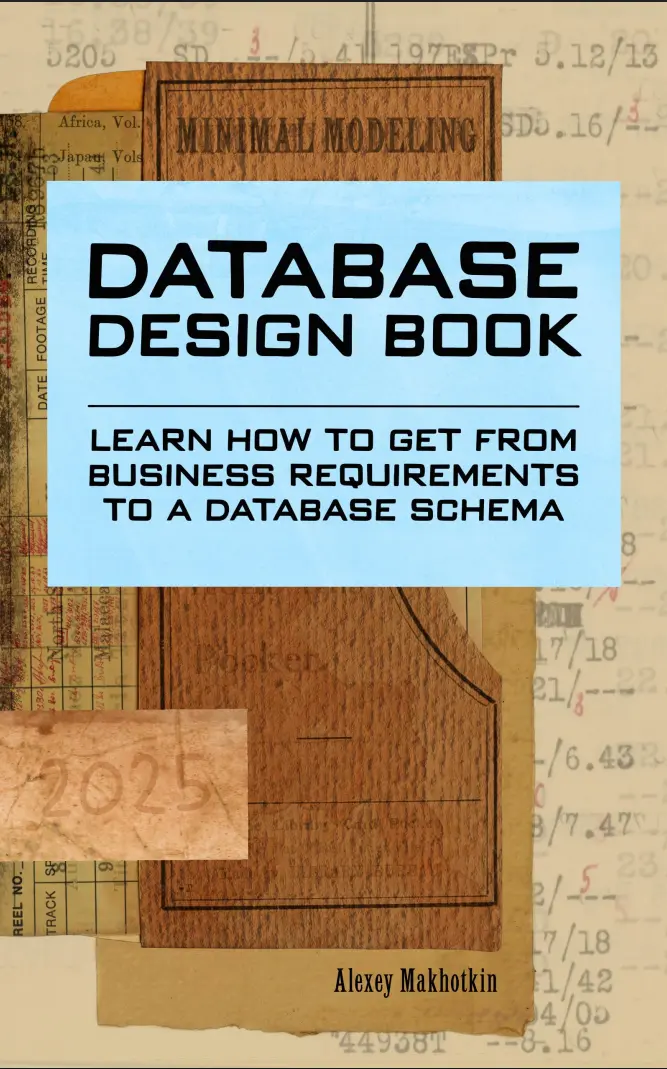
Database Design Book: Learn how to get from business requirements to a database schema
Автор: Makhotkin Alexey
Дата выхода: 2025
Издательство: Independent publishing
Количество страниц: 146
Размер файла: 653,0 КБ
Тип файла: PDF
Добавил: codelibs
Introduction....8
Who is this book for?....8
What level of understanding is this book aimed at?....8
What you would get from reading this book....9
Who I am....10
Building a logical model....11
System requirements as input....11
Who do we write the logical model for?....12
For yourself....12
For software developers....13
For the project group....13
Can I skip the logical model?....14
Can I use an ERD instead?....14
Elements of a logical model....15
The process....15
Anchors: introduction....16
Example: posts....16
A list of anchors....17
Example: invoices....17
Anchor IDs....19
Attributes: introduction....20
Attributes: definition....20
Attributes and anchors....22
Human-readable questions....22
Example values....22
Data types and types of data....23
What is not an attribute?....24
How to confirm that all the attributes have been listed?....24
Links: introduction....25
Links: definition....25
Links: pair of anchors....26
Links: cardinality....27
Cardinality is a business concern....28
Links: sentences....29
False links and unique pairs of IDs....30
More on anchors....31
Unique attributes....31
Optional unique attributes....33
External IDs....33
External ID enumeration....34
Several unique IDs....35
Implementing physical IDs....36
Handling time in the logical model....36
Hello world'' use case: podcast catalog....41
Business requirements....41
Anchors....43
Attributes....43
Links....46
Cross-checking the requirements....50
A diagram....51
Are we there yet?....51
Evolving the system....52
Building a physical schema....53
Many table design strategies are possible....53
Table-per-anchor table design strategy....55
Action plan....55
Anchors: choosing table names....56
Attributes: choosing column names....57
Attributes: choose column data types....59
Recommended physical types for SQL databases: summary....61
Strings....62
Integer numbers....63
Monetary amounts....63
Numeric values....63
Yesno values....64
Eitheroror values....64
Dates....65
Date with time in UTC timezone....65
Date with time in a specific timezone....65
Timezone names....65
Binary blobs....66
Links....66
One-to-many (1:M) links....66
An ID cannot be an attribute value....67
Many-to-many (M:N) links....68
Podcast catalog: a complete physical schema....70
CREATE TABLE statements....73
Audio file and cover images....74
Physical ID design....75
Case study: a tiny CMS....75
The maximum number of items....77
Reaching the maximum number of items....77
Space taken by IDs....78
Disk space is time....79
Storage density....79
UUIDs as anchor IDs....80
Countries, currencies, languages: well-known anchors....81
Countries, currencies, and languages in your business....82
Handling time in the physical model....83
Other table design strategies....86
Table design concerns....86
Is there a recommended table strategy?....87
Table-per-anchor, revisited....88
Side tables....89
Naming and composition of side tables....90
A stopgap table....91
JSON columns....92
Dealing with absent data....95
Use case: user's bio....95
Sentinel values: NULL....96
Other sentinel values....97
Sentinel values exist only on a physical level....98
Explicit reasons for missing data....99
Summary....101
Secondary data....103
Cached column example....104
There is no free lunch....105
Cached column is not an attribute....106
Discovering secondary data....106
Evolving your database....108
Elementary database migrations....109
Table rewrite....110
Adding an attribute....113
Step 1: Update logical model....114
Step 2. Run database migration....115
Step 3. Update code....115
Dealing with table rewrite....115
Movie tickets: repeated sales pattern....118
Business requirements....118
Per-department modeling....119
Movies department....121
Maintenance department....121
Movie schedule department....123
Tickets department....125
A diagram....128
Conclusion....128
Books and washing machines: polymorphic data pattern....129
Business requirements....129
Per-department modeling....130
Key insight: generic anchor vs specific anchors....130
Multiplexing on item type....132
Tangled links....133
A diagram....134
Table-per-anchor approach....135
Polymorphic table design strategy....136
JSON-based columns....136
Physical schema....136
Storing links in JSON....137
Table design concerns, revisited....138
Documenting physical storage....138
Practicalities....142
Document-based catalog....142
Spreadsheet-based catalog....142
How much to write....144
Lightweight designs....146
Learn how to get from business requirements to a database schema
The goal of this book is to help you get from a vague idea of what you need to implement (e.g.: “I need to build a website to manage schedule and instructor appointments for our gym”), to the comprehensive definition of database tables.
To achieve the goal, first we show how to build a structured list of anchors, attributes and links. To understand the business requirements, we spell out what each element does, using carefully designed formalized sentences. After that, we can build a physical model based on the logical model, in a straightforward way.
- database design case studies;
- SQL;
- classic relational modeling topics;
- graphical notation.


