-
1C
-
Agda
-
Agile/Scrum
-
Alef
-
APL
-
Assembler
-
AWK
-
Basic
-
Beta Programming Language
-
Big Data/DataScience
-
C
-
C#
-
C++
-
Cobol
-
Crystal
-
CSS
-
D
-
Dart
-
DataBase (SQL)
-
Delphi
-
F#
-
Flutter
-
Fortran
-
GameDev
-
Git
-
Go (Golang)
-
GPT/AI/ИИ
-
Hacking and Security
-
Haskell
-
HTML
-
Java
-
JavaScript (JS)
-
Julia
-
Kotlin
-
Machine Learning (ML)
-
Natural language processing (NLP)
-
.NET (.NET Core)
-
Pascal
-
PHP
-
Python
-
R
-
Ruby
-
Rust
-
Scratch
-
Swift
-
UML
-
UX/UI
-
Visual Basic
-
Wolfram
-
XML
-
АСУ
-
Проектирование/System Design
-
Сети/Network
-
Статьи
-
Схемотехника/электронные схемы
-
1C
-
Agda
-
Agile/Scrum
-
Alef
-
APL
-
Assembler
-
AWK
-
Basic
-
Beta Programming Language
-
Big Data/DataScience
-
C
-
C#
-
C++
-
Cobol
-
Crystal
-
CSS
-
D
-
Dart
-
DataBase (SQL)
-
Delphi
-
F#
-
Flutter
-
Fortran
-
GameDev
-
Git
-
Go (Golang)
-
GPT/AI/ИИ
-
Hacking and Security
-
Haskell
-
HTML
-
Java
-
JavaScript (JS)
-
Julia
-
Kotlin
-
Machine Learning (ML)
-
Natural language processing (NLP)
-
.NET (.NET Core)
-
Pascal
-
PHP
-
Python
-
R
-
Ruby
-
Rust
-
Scratch
-
Swift
-
UML
-
UX/UI
-
Visual Basic
-
Wolfram
-
XML
-
АСУ
-
Проектирование/System Design
-
Сети/Network
-
Статьи
-
Схемотехника/электронные схемы
Меню
Data Analysis Foundations with Python: Master Python and Data Analysis using NumPy, Pandas, Matplotlib, and Seaborn: A Hands-On Guide with Projects. From Basics to Real-World Applications
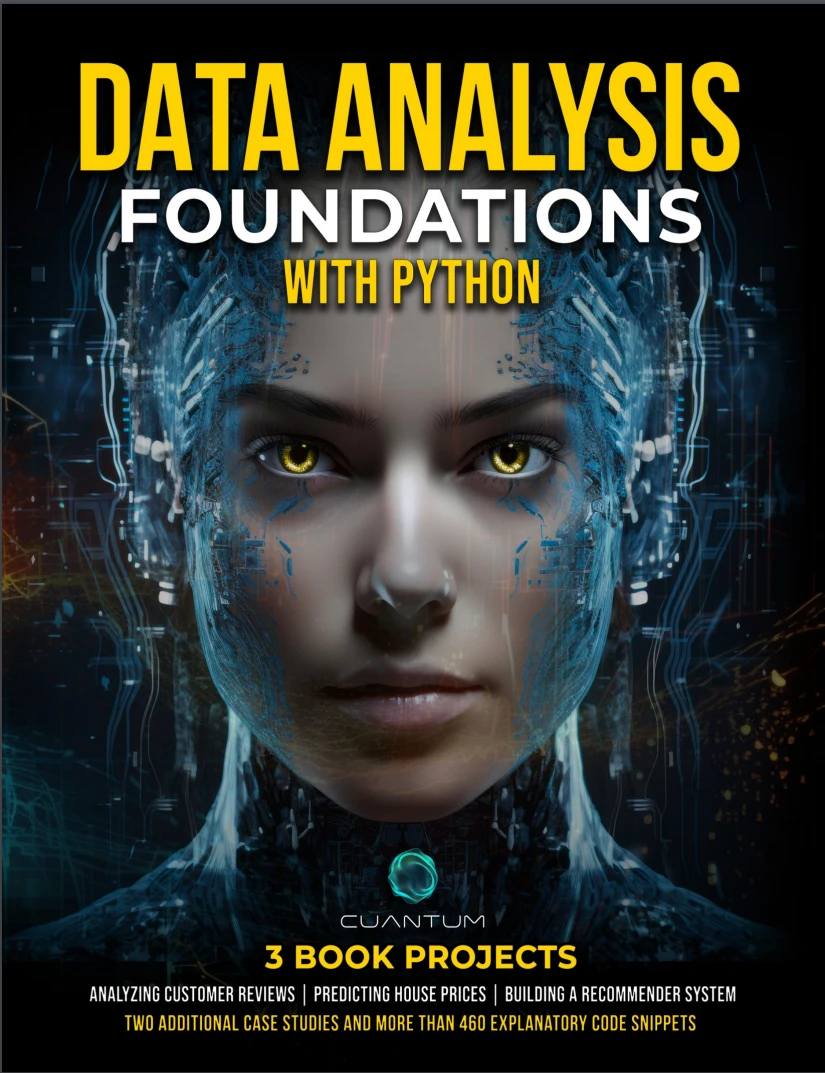
Автор: Cuantum Technologies
Дата выхода: 2023
Издательство: Independent publishing
Количество страниц: 551
Размер файла: 2,1 МБ
Тип файла: PDF
Добавил: codelibs
Проверить на вирусыCode Blocks Resource....4
Premium Customer Support....4
Who we are....5
Our Philosophy....5
Our Expertise....6
Introduction....27
Who is This Book For?....29
Beginners and Students....29
Career Changers....29
Professionals in Data-Adjacent Roles....29
Aspiring Data Scientists and AI Engineers....30
Educators and Trainers....30
How to Use This Book....31
Start at the Beginning....31
Work Through the Exercises....31
Take the Quizzes....31
Participate in Projects....32
Utilize Additional Resources....32
Collaborate and Share....32
Experiment and Explore....32
Acknowledgments....34
Chapter 1: Introduction to Data Analysis and Python....37
1.1 Importance of Data Analysis....38
1.1.1 Informed Decision-Making....38
1.1.2 Identifying Trends....39
1.1.3 Enhancing Efficiency....40
1.1.4 Resource Allocation....41
1.1.5 Customer Satisfaction....42
1.1.6 Social Impact....43
1.1.7 Innovation and Competitiveness....43
1.2 Role of Python in Data Analysis....45
1.2.1 User-Friendly Syntax....46
1.2.2 Rich Ecosystem of Libraries....46
1.2.3 Community Support....47
1.2.4 Integration and Interoperability....48
1.2.5 Scalability....49
1.2.6 Real-world Applications....51
1.2.7 Versatility Across Domains....52
1.2.8 Strong Support for Data Science Operations....52
1.2.9 Open Source Advantage....54
1.2.10 Easy to Learn, Hard to Master....54
1.2.11 Cross-platform Compatibility....55
1.2.12 Future-Proofing Your Skillset....56
1.2.13 The Ethical Aspect....57
1.3 Overview of the Data Analysis Process....59
1.3.1 Define the Problem or Question....59
1.3.2 Data Collection....60
1.3.3 Data Cleaning and Preprocessing....61
1.3.4 Exploratory Data Analysis (EDA)....62
1.3.5 Data Modeling....63
1.3.6 Evaluate and Interpret Results....63
1.3.7 Communicate Findings....64
1.3.8 Common Challenges and Pitfalls....65
1.3.9 The Complexity of Real-world Data....66
1.3.10 Selection Bias....67
1.3.11 Overfitting and Underfitting....68
Practical Exercises for Chapter 1....70
Exercise 1: Define a Data Analysis Problem....70
Exercise 2: Data Collection with Python....70
Exercise 3: Basic Data Cleaning with Pandas....70
Exercise 4: Create a Basic Plot....71
Exercise 5: Evaluate a Simple Model....71
Conclusion for Chapter 1....73
Quiz for Part I: Introduction to Data Analysis and Python....75
Chapter 2: Getting Started with Python....79
2.1 Installing Python....79
2.1.1 For Windows Users:....80
2.1.2 For Mac Users:....80
2.1.3 For Linux Users:....81
2.1.4 Test Your Installation....81
2.2 Your First Python Program....82
2.2.1 A Simple Print Function....82
2.2.2 Variables and Basic Arithmetic....83
2.2.3 Using Python's Interactive Mode....84
2.3 Variables and Data Types....86
2.3.1 What is a Variable?....87
2.3.2 Data Types in Python....87
2.3.3 Declaring and Using Variables....88
2.3.4 Type Conversion....89
2.3.5 Variable Naming Conventions and Best Practices....90
Practical Exercises for Chapter 2....94
Exercise 1: Install Python....94
Exercise 2: Your First Python Script....94
Exercise 3: Working with Variables....94
Exercise 4: Type Conversion....94
Exercise 5: Explore Data Types....94
Exercise 6: Variable Naming....95
Chapter 2 Conclusion....96
Chapter 3: Basic Python Programming....98
3.1 Control Structures....98
3.1.1 If, Elif, and Else Statements....99
3.1.2 For Loops....100
3.1.3 While Loops....101
3.1.4 Nested Control Structures....102
3.2 Functions and Modules....103
3.2.1 Functions....103
3.2.2 Parameters and Arguments....104
3.2.3 Return Statement....104
3.2.4 Modules....105
3.2.5 Creating Your Own Module....106
3.2.6 Lambda Functions....107
3.2.7 Function Decorators....108
3.2.8 Working with Third-Party Modules....109
3.3 Python Scripting....110
3.3.1 Writing Your First Python Script....111
3.3.2 Script Execution and Command-Line Arguments....111
3.3.3 Automating Tasks....112
3.3.4 Debugging Scripts....113
3.3.5 Scheduling Python Scripts....114
3.3.6 Script Logging....115
3.3.7 Packaging Your Scripts....116
Practical Exercises Chapter 3....118
Exercise 1: Your First Script....118
Exercise 2: Command-Line Arguments....118
Exercise 3: CSV File Reader....118
Exercise 4: Simple Task Automation....119
Exercise 5: Debugging Practice....119
Exercise 6: Script Logging....119
Chapter 3 Conclusion....121
Chapter 4: Setting Up Your Data Analysis Environment....123
4.1 Installing Anaconda....123
4.1.1 For Windows Users:....124
4.1.2 For macOS Users:....124
4.1.3 For Linux Users:....125
4.1.4 Troubleshooting and Tips....125
4.2 Jupyter Notebook Basics....127
4.2.1 Launching Jupyter Notebook....127
4.2.2 The Notebook Interface....128
4.2.3 Writing and Running Code....128
4.2.4 Markdown and Annotations....129
4.2.5 Saving and Exporting....130
4.2.6 Advanced Features of Jupyter Notebook....130
4.3 Git for Version Control....133
4.3.1 Why Use Git?....134
4.3.2 Installing Git....135
4.3.3 Basic Git Commands....135
4.3.4 Git Best Practices for Data Analysis....136
Practical Exercises Chapter 4....140
Exercise 4.1: Installing Anaconda....140
Exercise 4.2: Jupyter Notebook Basics....140
Exercise 4.3: Git for Version Control....140
Chapter 4 Conclusion....142
Quiz for Part II: Python Basics for Data Analysis....144
Chapter 5: NumPy Fundamentals....148
5.1 Arrays and Matrices....148
5.1.1 Additional Operations on Arrays....150
5.2 Basic Operations....156
5.2.1 Arithmetic Operations....156
5.2.2 Aggregation Functions....157
5.2.3 Boolean Operations....158
5.2.4 Vectorization....160
5.3 Advanced NumPy Functions....161
5.3.1 Aggregation Functions....162
5.3.2 Indexing and Slicing....163
5.3.3 Broadcasting with Advanced Operations....164
5.3.4 Logical Operations....164
5.3.5 Handling Missing Data....165
5.3.6 Reshaping Arrays....166
Practical Exercises for Chapter 5....169
Exercise 1: Create an Array....169
Exercise 2: Array Arithmetic....169
Exercise 3: Handling Missing Data....169
Exercise 4: Advanced NumPy Functions....170
Chapter 5 Conclusion....171
Chapter 6: Data Manipulation with Pandas....173
6.1 DataFrames and Series....173
6.1.1 DataFrame....174
6.1.2 Series....175
6.1.3 DataFrame vs Series....176
6.1.4 DataFrame Methods and Attributes....177
6.1.5 Series Methods and Attributes....178
6.1.6 Changing Data Types....178
6.2 Data Wrangling....179
6.2.1 Reading Data from Various Sources....180
6.2.2 Handling Missing Values....181
6.2.3 Data Transformation....181
6.2.4 Data Aggregation....182
6.2.5 Merging and Joining DataFrames....183
6.2.6 Applying Functions....183
6.2.7 Pivot Tables and Cross-Tabulation....184
6.2.8 String Manipulation....185
6.2.9 Time Series Operations....186
6.3 Handling Missing Data....186
6.3.1 Detecting Missing Data....187
6.3.2 Handling Missing Values....188
6.3.3 Advanced Strategies....190
6.4 Real-World Examples: Challenges and Pitfalls in Handling Missing Data....192
6.4.1 Case Study 1: Healthcare Data....193
6.4.2 Case Study 2: Financial Data....194
6.4.3 Challenges and Pitfalls:....194
Practical Exercises Chapter 6....196
Exercise 1: Creating DataFrames....196
Exercise 2: Missing Data Handling....196
Exercise 3: Data Wrangling....197
Chapter 6 Conclusion....198
Chapter 7: Data Visualization with Matplotlib and Seaborn....200
7.1 Basic Plotting with Matplotlib....200
7.1.1 Installing Matplotlib....201
7.1.2 Your First Plot....201
7.1.3 Customizing Your Plot....202
7.1.4 Subplots....203
7.1.5 Legends and Annotations....204
7.1.6 Error Bars....205
7.2 Advanced Visualizations....206
7.2.1 Customizing Plot Styles....207
7.2.2 3D Plots....207
7.2.3 Seaborn's Beauty....208
7.2.4 Heatmaps....209
7.2.5 Creating Interactive Visualizations....210
7.2.6 Exporting Your Visualizations....211
7.2.7 Performance Tips for Large Datasets....212
7.3 Introduction to Seaborn....215
7.3.1 Installation....215
7.3.2 Basic Plotting with Seaborn....215
7.3.3 Categorical Plots....216
7.3.4 Styling and Themes....217
7.3.5 Seaborn for Exploratory Data Analysis....218
7.3.6 Facet Grids....222
7.3.7 Joint Plots....223
7.3.8 Customizing Styles....223
Practical Exercises - Chapter 7....225
Exercise 1: Basic Line Plot....225
Exercise 2: Bar Chart with Seaborn....225
Exercise 3: Scatter Plot Matrix....225
Exercise 4: Advanced Plot - Heatmap....226
Exercise 5: Customize Your Plot....226
Chapter 7 Conclusion....227
Quiz for Part III: Core Libraries for Data Analysis....229
Chapter 8: Understanding EDA....232
8.1 Importance of EDA....232
8.1.1 Why is EDA Crucial?....233
8.1.2 Code Example: Simple EDA using Pandas....235
8.1.3 Importance in Big Data....236
8.1.4 Human Element....237
8.1.5 Risk Mitigation....237
8.1.6 Examples from Different Domains....238
8.1.7 Comparing Datasets....238
8.1.8 Code Snippets for Visual EDA....239
8.2 Types of Data....240
8.2.1 Numerical Data....240
8.2.2 Categorical Data....242
8.2.3 Textual Data....244
8.2.4 Time-Series Data....244
8.2.5 Multivariate Data....245
8.2.6 Geospatial Data....247
8.3 Descriptive Statistics....248
8.3.1 What Are Descriptive Statistics?....249
8.3.2 Measures of Central Tendency....249
8.3.3 Measures of Variability....250
8.3.4 Why Is It Useful?....251
8.3.6 Example: Analyzing Customer Reviews....252
8.3.7 Skewness and Kurtosis....254
Practical Exercises for Chapter 8....255
Exercise 1: Understanding the Importance of EDA....255
Exercise 2: Identifying Types of Data....255
Exercise 3: Calculating Descriptive Statistics....255
Exercise 4: Understanding Skewness and Kurtosis....256
Chapter 8 Conclusion....257
Chapter 9: Data Preprocessing....259
9.1 Data Cleaning....259
9.1.1 Types of 'Unclean' Data....260
9.1.2 Handling Missing Data....261
9.1.3 Dealing with Duplicate Data....263
9.1.4 Data Standardization....264
9.1.5 Outliers Detection....265
9.1.6 Dealing with Imbalanced Data....266
9.1.7 Column Renaming....266
9.1.8 Encoding Categorical Variables....267
9.1.9 Logging the Changes....268
9.2 Feature Engineering....268
9.2.1 What is Feature Engineering?....268
9.2.2 Types of Feature Engineering....269
9.2.3 Key Considerations....272
9.2.4 Feature Importance....274
9.3 Data Transformation....277
9.3.1 Why Data Transformation?....277
9.3.2 Types of Data Transformation....278
9.3.3 Inverse Transformation....281
Practical Exercises: Chapter 9....284
Exercise 9.1: Data Cleaning....284
Exercise 9.2: Feature Engineering....284
Exercise 9.3: Data Transformation....285
Chapter 9 Conclusion....286
Chapter 10: Visual Exploratory Data Analysis....288
10.1 Univariate Analysis....288
10.1.1 Histograms....289
10.1.2 Box Plots....290
10.1.3 Count Plots for Categorical Data....290
10.1.4 Descriptive Statistics alongside Visuals....292
10.1.5 Kernel Density Plot....293
10.1.6 Violin Plot....294
10.1.7 Data Skewness and Kurtosis....294
10.2 Bivariate Analysis....295
10.2.1 Scatter Plots....295
10.2.2 Correlation Coefficient....296
10.2.3 Line Plots....297
10.2.4 Heatmaps....298
10.2.5 Pairplots....298
10.2.6 Statistical Significance in Bivariate Analysis....299
10.2.7 Handling Categorical Variables in Bivariate Analysis....300
10.2.8 Real-world Applications of Bivariate Analysis....301
10.3 Multivariate Analysis....302
10.3.1 What is Multivariate Analysis?....302
10.3.2 Types of Multivariate Analysis....303
10.3.3 Example: Principal Component Analysis (PCA)....304
10.3.4 Example: Cluster Analysis....305
10.3.5 Real-world Applications of Multivariate Analysis....305
10.3.6 Heatmaps for Correlation Matrices....306
10.3.7 Example using Multiple Regression Analysis....307
10.3.8 Cautionary Points....308
10.3.9 Other Dimensionality Reduction Techniques....308
Practical Exercises Chapter 10....310
Exercise 1: Univariate Analysis with Histograms....310
Exercise 2: Bivariate Analysis with Scatter Plot....310
Exercise 3: Multivariate Analysis using Heatmap....311
Chapter 10 Conclusion....313
Quiz for Part IV: Exploratory Data Analysis (EDA)....315
Project 1: Analyzing Customer Reviews....317
1.1 Data Collection....317
1.1.1 Web Scraping with BeautifulSoup....318
1.1.2 Using APIs....319
1.2: Data Cleaning....320
1.2.1 Removing Duplicates....320
1.2.2 Handling Missing Values....321
1.2.4 Outliers and Anomalies....322
1.3: Data Visualization....323
1.3.1 Distribution of Ratings....324
1.3.2 Word Cloud for Reviews....324
1.3.3 Sentiment Analysis....325
1.3.4 Time-Series Analysis....325
1.4: Basic Sentiment Analysis....326
1.4.1 TextBlob for Sentiment Analysis....326
1.4.2 Visualizing TextBlob Results....327
1.4.3 Comparing TextBlob Sentiments with Ratings....328
Chapter 11: Probability Theory....330
11.1 Basic Concepts....330
11.1.1 Probability of an Event....331
11.1.2 Python Example: Dice Roll....332
11.1.3 Complementary Events....333
11.1.4 Independent and Dependent Events....334
11.1.5 Conditional Probability....334
11.1.6 Python Example: Complementary Events....334
11.2: Probability Distributions....335
11.2.1 What is a Probability Distribution?....336
11.2.2 Types of Probability Distributions....336
11.2.3 Python Example: Plotting a Normal Distribution....337
11.2.4 Why are Probability Distributions Important?....338
11.2.5 Skewness....339
11.2.6 Kurtosis....339
11.2.7 Python Example: Calculating Skewness and Kurtosis....340
11.3: Specialized Probability Distributions....341
11.3.1 Exponential Distribution....341
11.3.2 Poisson Distribution....342
11.3.3 Beta Distribution....343
11.3.4 Gamma Distribution....344
11.3.5 Log-Normal Distribution....345
11.3.6 Weibull Distribution....346
11.4 Bayesian Theory....346
11.4.1 Basics of Bayesian Theory....347
11.4.2 Example: Diagnostic Test....348
11.4.3 Bayesian Networks....349
Practical Exercises for Chapter 11....351
Exercise 1: Roll the Die....351
Exercise 2: Bayesian Inference for a Coin Toss....351
Exercise 3: Bayesian Disease Diagnosis....352
Chapter 11 Conclusion....354
Chapter 12: Hypothesis Testing....356
12.1 Null and Alternative Hypotheses....356
12.1.1 P-values and Significance Level....358
12.1.2 Type I and Type II Errors....360
12.2 t-test and p-values....362
12.2.1 What is a t-test?....363
12.2.2 Types of t-tests....363
12.2.3 Understanding p-values....365
12.2.4 Paired t-tests....366
12.2.5 Assumptions behind t-tests....367
12.2.6 Multiple Comparisons and the Bonferroni Correction....369
12.3 ANOVA (Analysis of Variance)....371
12.3.1 What is ANOVA?....371
12.3.2 Why Use ANOVA?....372
12.3.3 One-way ANOVA....372
13.3.4 Example: One-way ANOVA in Python....373
12.3.5 Two-way ANOVA....374
12.3.6 Repeated Measures ANOVA....375
12.3.7 Assumptions of ANOVA....377
Practical Exercises Chapter 12....379
Exercise 1: Conducting a t-test....379
Exercise 2: Performing One-Way ANOVA....379
Exercise 3: Post-Hoc Analysis....380
Chapter 12 Conclusion....381
Quiz for Part V: Statistical Foundations....383
Chapter 13: Introduction to Machine Learning....386
13.1 Types of Machine Learning....386
13.1.1 Supervised Learning....387
13.1.2 Unsupervised Learning....388
13.1.3 Reinforcement Learning....389
13.1.4 Semi-Supervised Learning....391
13.1.5 Multi-Instance Learning....392
13.1.6 Ensemble Learning....393
13.1.7 Meta-Learning....394
13.2 Basic Algorithms....395
13.2.1 Linear Regression....395
13.2.2 Logistic Regression....396
13.2.3 Decision Trees....398
13.2.4 k-Nearest Neighbors (k-NN)....400
13.2.5 Support Vector Machines (SVM)....403
13.3 Model Evaluation....406
13.3.1 Accuracy....407
13.3.2 Confusion Matrix....407
13.3.3 Precision, Recall, and F1-Score....408
13.3.4 ROC and AUC....410
13.3.5 Mean Absolute Error (MAE) and Mean Squared Error (MSE) for Regression....412
Practical Exercises Chapter 13....416
Exercise 13.1: Types of Machine Learning....416
Exercise 13.2: Implement a Basic Algorithm....416
Exercise 13.3: Model Evaluation....417
Chapter 13 Conclusion....419
Chapter 14: Supervised Learning....421
14.1 Linear Regression....421
14.1.1 Assumptions of Linear Regression....423
14.1.2 Regularization....426
14.1.3 Polynomial Regression....427
14.1.4 Interpreting Coefficients....428
14.2 Types of Classification Algorithms....429
14.2.1. Logistic Regression....429
14.2.2. K-Nearest Neighbors (KNN)....430
14.2.3. Decision Trees....431
14.2.4. Support Vector Machine (SVM)....433
14.2.5. Random Forest....434
14.2.6 Pros and Cons....436
14.2.7 Ensemble Methods....437
14.3 Decision Trees....441
14.3.1 How Decision Trees Work....442
14.3.2 Hyperparameter Tuning....446
14.3.3 Feature Importance....446
14.3.4 Pruning Decision Trees....448
Practical Exercises Chapter 14....451
Exercise 1: Implementing Simple Linear Regression....451
Exercise 2: Classify Iris Species Using k-NN....451
Exercise 3: Decision Tree Classifier for Breast Cancer Data....451
Chapter Conclusion....454
Chapter 15: Unsupervised Learning....456
15.1 Clustering....456
15.1.1 What is Clustering?....456
15.1.2 Types of Clustering....457
15.1.3 K-Means Clustering....458
15.1.4 Evaluating the Number of Clusters: Elbow Method....460
15.1.5 Handling Imbalanced Clusters....462
15.1.6 Cluster Validity Indices....463
15.1.7 Mixed-type Data....464
15.2 Principal Component Analysis (PCA)....465
15.2.1 Why Use PCA?....466
15.2.2 Mathematical Background....467
15.2.3 Implementing PCA with Python....468
15.2.4 Interpretation....469
15.2.5 Limitations....470
15.2.6 Feature Importance and Explained Variance....470
15.2.7 When Not to Use PCA?....471
15.2.8 Practical Applications....472
15.3 Anomaly Detection....472
15.3.1 What is Anomaly Detection?....473
15.3.2 Types of Anomalies....473
15.3.3 Algorithms for Anomaly Detection....474
15.3.4 Pros and Cons....476
15.3.5 When to Use Anomaly Detection....476
15.3.6 Hyperparameter Tuning in Anomaly Detection....477
15.3.7 Evaluation Metrics....478
Practical Exercises Chapter 15....481
Exercise 1: K-means Clustering....481
Exercise 2: Principal Component Analysis (PCA)....482
Exercise 3: Anomaly Detection with Isolation Forest....482
Chapter 15 Conclusion....484
Quiz Part VI: Machine Learning Basics....486
Project 2: Predicting House Prices....489
Problem Statement....490
Installing Necessary Libraries....490
Data Collection and Preprocessing....491
Data Collection....491
Data Preprocessing....492
Handling Missing Values....492
Data Encoding....492
Feature Scaling....493
Feature Engineering....493
Creating Polynomial Features....493
Interaction Terms....494
Categorical Feature Engineering....494
Temporal Features....494
Feature Transformation....495
Model Building and Evaluation....495
Data Splitting....495
Model Selection....496
Model Evaluation....496
Fine-Tuning....497
Exporting the Trained Model....497
Chapter 16: Case Study 1: Sales Data Analysis....500
16.1 Problem Definition....500
16.1.1 What are we trying to solve?....500
16.1.2 Python Code: Setting up the Environment....501
16.2 EDA and Visualization....502
16.2.1 Importing the Data....502
16.2.2 Data Cleaning....502
16.2.3 Basic Statistical Insights....503
16.2.4 Data Visualization....503
16.3 Predictive Modeling....504
16.3.1 Preprocessing for Predictive Modeling....505
16.3.2 Model Selection and Training....505
16.3.3 Model Evaluation....506
16.3.4 Making Future Predictions....506
Practical Exercises: Sales Data Analysis....507
Exercise 1: Data Exploration....507
Exercise 2: Data Visualization....507
Exercise 3: Simple Predictive Modeling....508
Exercise 4: Advanced....509
Chapter 16 Conclusion....511
Chapter 17: Case Study 2: Social Media Sentiment Analysis....513
17.1 Data Collection....513
17.2 Text Preprocessing....515
17.2.1 Cleaning Tweets....515
17.2.2 Tokenization....516
17.2.3 Stopwords Removal....516
17.3 Sentiment Analysis....517
17.3.1 Naive Bayes Classifier....518
Practical Exercises....520
Exercise 1: Data Collection....520
Exercise 2: Text Preprocessing....521
Exercise 3: Sentiment Analysis with Naive Bayes....521
Chapter 17 Conclusion....523
Quiz Part VII: Case Studies....525
Project 3: Capstone Project: Building a Recommender System....528
Problem Statement....528
Objective....528
Why this Problem?....529
Evaluation Metrics....529
Data Requirements....529
Data Collection and Preprocessing....530
Data Collection....530
Data Preprocessing....531
Model Building....533
Installation and Importing Libraries....533
Preparing Data for the Model....534
Building the SVD Model....534
Making Predictions....535
Evaluation and Deployment....536
Model Evaluation....536
Deployment Considerations....537
Continuous Monitoring....538
Chapter 18: Best Practices and Tips....540
18.1 Code Organization....540
18.1.1 Folder Structure....540
18.1.2 File Naming....541
18.1.3 Code Comments and Documentation....541
18.1.4 Consistent Formatting....542
18.2 Documentation....543
18.2.1. Code Comments....544
18.2.2. README File....544
18.2.3. Documentation Generation Tools....545
18.2.4. In-line Documentation....545
Conclusion....547
Know more about us....550
Are you an aspiring data scientist or analyst with a passion for exploring the vast possibilities of Python-based data analysis? If so, you're in luck because "Data Analysis Foundations with Python" is the perfect guide for you.
This comprehensive and immersive book will not only provide you with a hands-on approach but also offer a detailed exploration of the fascinating world of Python-based data analysis. Whether you're a beginner or an experienced professional, this book will take you on a journey that will deepen your understanding and expand your skills in the field.
From Basics to Mastery: A Structured Learning Journey
This book is not just a mere compilation of Python codes and data sets. It goes beyond that, offering a comprehensive course that will guide you from being a Python beginner to becoming a highly skilled Data Analyst.
Throughout this book, you will not only acquire essential Python skills, but also gain practical experience in data manipulation techniques and learn about the latest advancements in machine learning. With its well-structured content and engaging learning activities, this book ensures that your journey towards becoming a proficient Data Analyst is both seamless and enjoyable.
Three Exceptional Projects and Two In-Depth Case Studies
- Project 1: Analyzing Customer Reviews: Learn how to extract, clean, and make sense of textual data from online customer reviews.
- Project 2: Predicting House Prices: Delve into the fascinating world of supervised learning, where you'll get to apply complex machine learning models to predict property prices.
- Project 3: Building a Recommender System: Uncover the secrets of unsupervised learning as you build and deploy a fully functioning recommender system.
Case Studies for Real-world Insight
- Case Study 1: Sales Data Analysis: Unearth the power of Python to transform raw sales data into actionable insights.
- Case Study 2: Social Media Sentiment Analysis: Venture into the realm of Natural Language Processing and learn how to analyze public sentiment from social media data.
Additional Features
- Practical Exercises: Each chapter concludes with practical exercises, designed to test your understanding and apply what you’ve learned in real-world scenarios.
- Best Practices and Tips: The final section of the book is devoted to best practices in the field, including code organization and how to continue learning and growing in your data analysis journey.
Who This Book Is For
Whether you're a student who is eager to expand your knowledge, a professional who is seeking to embark on a new career path, or an experienced analyst who is looking to enhance your skills and stay ahead in the industry—this comprehensive book is specifically tailored to meet your needs and provide valuable insights and guidance.
What Are You Waiting For?
Embark on a transformative journey to unlock Python's potential for data analysis. Gain a deep understanding of Python's capabilities and learn how to extract insights from complex datasets using libraries and tools. Develop skills through real-world case studies and hands-on exercises to confidently tackle analytical challenges.


