-
.NET (.NET Core)
-
1C
-
APL
-
AWK
-
Agda
-
Agile/Scrum
-
Alef
-
Assembler
-
Basic
-
Beta Programming Language
-
Big Data/DataScience
-
C
-
C#
-
C++
-
CSS
-
Cobol
-
Crystal
-
D
-
Dart
-
DataBase (SQL)
-
Delphi
-
F#
-
Flutter
-
Fortran
-
GPT/AI/ИИ
-
GameDev
-
Git
-
Go (Golang)
-
HTML
-
Hacking and Security
-
Haskell
-
Java
-
JavaScript (JS)
-
Julia
-
Kotlin
-
Machine Learning (ML)
-
Natural language processing (NLP)
-
PHP
-
Pascal
-
Python
-
R
-
Ruby
-
Rust
-
Scratch
-
Swift
-
UML
-
UX/UI
-
Visual Basic
-
Wolfram
-
XML
-
АСУ
-
Проектирование/System Design
-
Сети/Network
-
Схемотехника/электронные схемы
-
.NET (.NET Core)
-
1C
-
APL
-
AWK
-
Agda
-
Agile/Scrum
-
Alef
-
Assembler
-
Basic
-
Beta Programming Language
-
Big Data/DataScience
-
C
-
C#
-
C++
-
CSS
-
Cobol
-
Crystal
-
D
-
Dart
-
DataBase (SQL)
-
Delphi
-
F#
-
Flutter
-
Fortran
-
GPT/AI/ИИ
-
GameDev
-
Git
-
Go (Golang)
-
HTML
-
Hacking and Security
-
Haskell
-
Java
-
JavaScript (JS)
-
Julia
-
Kotlin
-
Machine Learning (ML)
-
Natural language processing (NLP)
-
PHP
-
Pascal
-
Python
-
R
-
Ruby
-
Rust
-
Scratch
-
Swift
-
UML
-
UX/UI
-
Visual Basic
-
Wolfram
-
XML
-
АСУ
-
Проектирование/System Design
-
Сети/Network
-
Схемотехника/электронные схемы
Меню
Time Series with PyTorch: Modern Deep Learning Toolkit for Real-World Forecasting Challenges
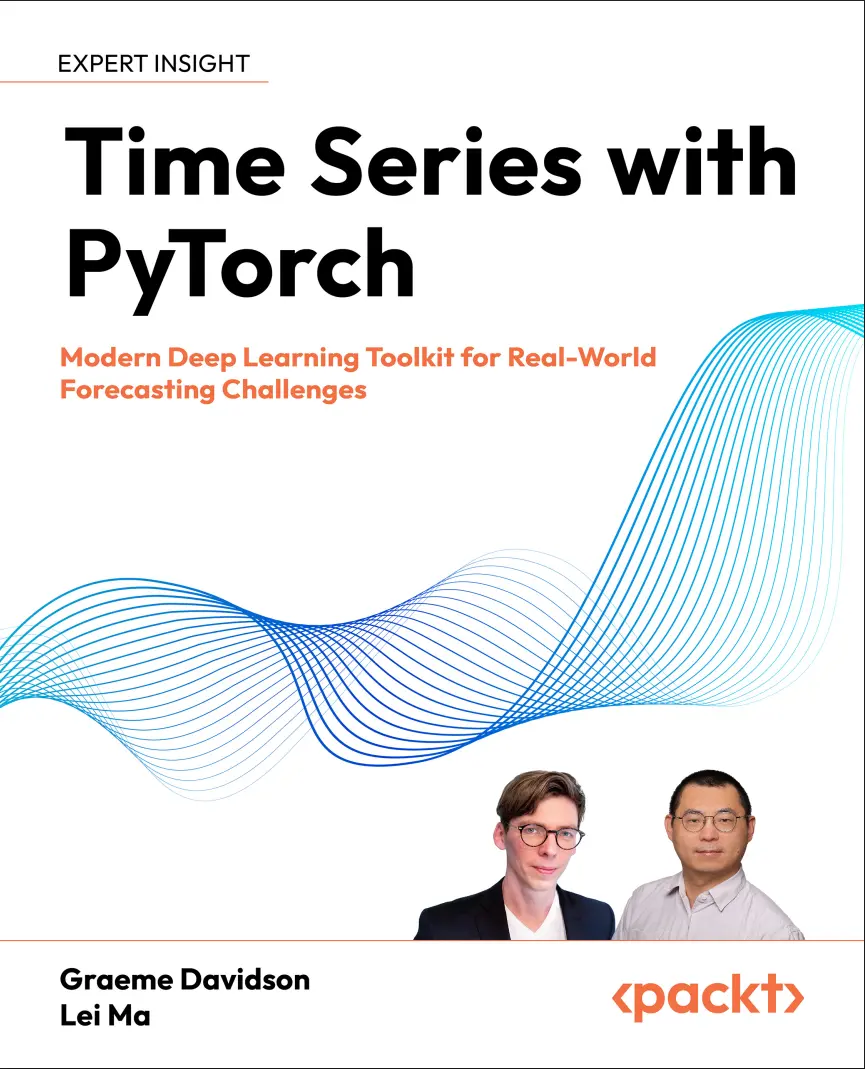
Автор: Davidson Graeme, Ma Lei
Дата выхода: 2026
Издательство: Packt Publishing Limited
Количество страниц: 606
Размер файла: 9,8 МБ
Тип файла: PDF
Добавил: codelibs
Cover....1
Title Page....2
Copyright and Credits....3
Dedication....4
Acknowledgments ....5
Contributors ....6
Table of Contents ....8
Preface....18
To get the most out of this book....21
Chapter 1: Time Series for Everyone....24
Why time series?....25
The early period....27
The classical era....28
The promise of deep learning....30
From language to time....31
Forecasting and performance....31
Summary....32
Get this books PDF version and more....33
Chapter 2: The Challenge of Time Series....34
What is time-series data?....35
Missing data....36
Types of missing data....36
Simple imputations....39
MICE imputation....42
Theoretical foundations of time series analysis....44
Patterns in time....44
Decomposition....45
Additive decomposition....46
Multiplicative decomposition....49
Alternative decompositions....50
Examples of decomposition....52
Seasonality plotting....53
Beyond decomposition patterns....55
Dependence in time series....55
Autocorrelation function....58
Partial autocorrelation....60
Stationarity....63
Passengers mean and variation split check....64
Tests for stationarity....66
Applying KPSS....66
Time series structures....71
Univariate....71
Multivariate....71
Multivariable....72
Panel data....73
Application of structures to models....73
Summary....74
Recommended reading....74
Join our community on Discord....75
Chapter 3: Evaluating Time-Series Models....76
Why we evaluate....77
Using validation to manage complexity....78
Partitioning data....80
Introducing the dataset....80
ACF and PACF plots....84
Conducting residual analysis....85
Fixed-origin design....85
Train-test split....85
Train-validation-test split....87
Cross-validation....89
Expanding windows....89
Rolling windows....90
Error metrics....91
Intrinsic metrics....92
Absolute error....92
Absolute percentage error (APE)....93
Squared error....97
Variations....99
Extrinsic metrics....100
Grouped error metrics....103
Multivariate forecasting....104
Which to use and when....105
Length of evaluation....105
Data leakage....106
Transformation-based leakage....107
Lookforward bias....108
Panel data leakage....109
Summary....111
Recommended reading....111
Get this books PDF version and more....112
Chapter 4: PyTorch Fundamentals....114
Introduction to PyTorch....115
Working with tensors....115
Stride....117
Basic tensor construction....118
Understanding computational graphs....123
Chain rule revisited....126
Backpropagation calculations....126
A brief look at autograd....127
Practicing PyTorch fundamentals....129
Pure PyTorch neural network....131
Lightning NN....132
Summary....135
Recommended reading....135
Join our community on discord....135
Chapter 5: Simple Neural Architecture....136
Basic structures of neural networks....137
Artificial neurons....143
Neural nets....152
From scalars to matrices....154
Forward propagation....155
Loss calculation....156
Backpropagation....156
Building a neural network....157
Summary....164
Recommended reading....164
Get this books PDF version and more....164
Chapter 6: Optimization....166
Optimization costs....167
Optimization of neural networks....168
Understanding activation functions....169
Taxonomy....170
Layer-wise activation functions....171
Fixed-shape activation functions....171
Sigmoid....171
Tanh....173
ReLU....175
Trainable activation functions....177
Comparing activation functions....179
Hidden layers....185
Gradient descent, loss functions, and regularization techniques....188
Loss functions....188
Optimizing hyperparameters....198
Learning rate scheduling....198
Epochs....200
Batch size....200
Dropout....201
Weight decay....203
Data splitting for neural networks....204
Approaches to splitting....205
Hyperparameter tuning....206
Summary....209
Recommended reading....209
Join our community on discord....210
Chapter 7: Conformal Prediction....212
Uncertainty quantification....213
Understanding conformal prediction....217
Intuition behind conformal prediction....217
Improving conformal intervals....221
Conformal intervals with quartiles....223
Mathematical notation....224
Approaches to splitting....227
Conformalized regression....227
Conformalized forecasting....228
Working with EnbPI....229
Applying EnbPI to our PyTorch model....231
Evaluating conformal interval quality....236
Summary....238
Recommended reading....238
Get this books PDF version and more....239
Chapter 8: Recurrent Neural Networks....240
Time-series data and states....240
Swing angle forecasting....240
Why recurrent models help....242
Introducing RNNs....243
Simple RNN....245
Theoretical background....245
RNNs and differential equations....246
Implementation....246
Introducing LSTM....251
Introducing GRUs....253
Stacking....254
Forecasting using RNNs....255
Summary....264
Recommended reading....264
Chapter 9: Transformers....266
The vanilla transformer....268
Encoder-decoder....268
Attention mechanism....269
Knowledge of temporal information....274
Implementation of transformers....277
The M5 competition....283
Summary....290
Recommended reading....290
Get this books PDF version and more....291
Chapter 10: Other Neural Structures....292
Setting up our M5 dataset....293
Exploring some neural network families....297
Multilayer perceptron....299
N-BEATS....301
N-HITS....305
Convolutional Neural Networks....307
Graph neural networks....309
Kolmogorov–Arnold networks....311
Foundation models....314
Summary....316
Recommended reading....317
Join our community on Discord....317
Chapter 11: Transfer Learning and Global Modelling....318
What is transfer learning?....319
Types of transfer learning....321
Applications of transfer learning....321
Structuring time series data for transfer learning....322
Temporal windowing and sequential organization....323
Scale normalization and feature transformation....323
Temporal feature engineering....324
Global modeling....324
Building GFMs with PyTorch....327
Feature integration mechanisms....329
Data organization and batching....333
Training and balanced sampling....334
Optimizers, learning rate scheduling, and batching....337
Transfer learning with NeuralForecast....339
Data preparation....339
Statistical baselines....340
Decision-tree global models....342
Neural network GFMs....344
Pretraining with external data....346
Summary....348
Recommended reading....349
Get this books PDF version and more....350
Chapter 12: Synthetic Time Series Data....352
The data-generating process....353
Data-driven synthetic time series....356
Generating time series data using variational autoencoders....357
Implementing TimeVAE....358
Implementing the model....364
Training the model....379
Generating synthetic data....380
Beyond VAE....383
Summary....383
Recommended reading....383
Join our community on discord....384
Chapter 13: Diffusion Models....386
Introduction to probabilistic forecasting....386
Diffusion as a real-world phenomenon....387
Simulating the diffusion process....389
Naive diffusion model applied on time series data....395
Denoising diffusion model....406
Summary....408
Recommended reading....409
Get this books PDF version and more....409
Chapter 14: Time Series Classification....410
Types of time-series comparisons....411
Distance-based measures....411
Norms....412
Dynamic time warping....412
Retrieving alignment paths....415
Applied distances....415
Elastic ensemble....417
Proximity forest....418
Comparing distance methods....419
Feature-based algorithms....420
Features built-in....421
Interpreting features....432
Building features....432
Shapelets....435
Dictionary-based classification....438
Convolution-based classification....441
Deep learning approaches....443
Convolutional neural networks....443
ResNet....444
InceptionTime....445
H-InceptionTime....447
LiteTime....448
Summary....449
Recommended reading....450
Join our community on discord....450
Chapter 15: Time Series Clustering....452
What is clustering?....454
Preprocessing for time series clustering....460
Defining time series clustering....461
The TSCL pipeline....462
Clustering approaches....463
Distance-based....463
Distribution-based....464
Subsequence-based....465
Representation learning....466
Deep-learning approaches to TSCL....467
Two-stage pipeline....467
End-to-end neural clustering....468
Applying featurization....469
Data preparation....470
Feature extraction....472
Scaling....475
Selecting the number of clusters....475
Building GFMs with cluster labels....479
Denoising with an autoencoder....481
Autoencoder hyperparameters....486
Evaluating clustering results....488
Summary....490
Recommended reading....491
Get this books PDF version and more....491
Chapter 16: Embeddings for Time Series....492
A dynamical systems perspective....492
Learned embeddings....495
The diversity of time series embeddings....499
Summary....500
Recommended reading....500
Join our community on discord....501
Chapter 17: Supervised and Unsupervised Anomaly Detection....502
What is an outlier or anomaly?....503
Evaluating TSAD systems....509
Rule-based approaches....511
Adaptive thresholds....515
Statistical profiling....519
Building profiles....520
Residuals as the detection signal....523
The One-Class gaussian....524
Isolation forest....524
Isolation forest – unsupervised....525
Standard isolation forest on residuals....527
Extended isolation forest....528
Local outlier factor....530
Matrix profile....532
Application to residuals....533
Multidimensional matrix profile....535
Choosing the window length....538
Matrix profile vs. Point-Based methods....540
Alternative approaches....541
AB-Join: comparing against a reference period....541
Window-Overlap evaluation....542
Where matrix profile fits....543
A comparative summary....544
Supervised anomaly detection....545
The label quality problem....545
Class imbalance....545
Gradient boosting on residual features....546
Threshold adjustment....550
Forecast-First anomaly detection....552
The pipeline....552
The iteration loop....553
Supervised extension....553
Composability in practice....554
Library ecosystem....554
Summary....555
Recommended reading....555
Get this books PDF version and more....556
Chapter 18: Self-Supervised Learning for Time Series....558
Why do we need representations of time series?....559
Self-supervised learning....559
Contrastive predictive coding....562
Data preparation....563
Model implementation....568
Training preparation....575
Training and evaluation....580
Summary....583
Recommended reading....584
Join our community on discord....584
Chapter 19: Unlock Your Exclusive Benefits....586
Unlock this Books Free Benefits in 3 Easy Steps....587
Other Books You May Enjoy....592
Index....596
Time series is far more than fit-predict forecasting. Real mastery comes from intuition and is built through experimentation. Walk the full range with two practitioners: forecasting, conformal prediction, transfer learning, and beyond.
Key Features
- Grasp core concepts through clear explanations that build genuine understanding rather than surface familiarity
- Work with realistic datasets and develop the judgement to choose the right approach for your problem
- Progress from neural network fundamentals to advanced techniques across a full range of time series challenges.
Book Description
Neural networks are powerful tools for time-series forecasting, but applying them effectively requires both practical experience and a clear understanding of architectures, training strategies, and evaluation methods. This book brings these ideas together in a structured and practical way.
Starting with PyTorch fundamentals, you will build neural networks from scratch and progress through recurrent networks, attention mechanisms, and transformers before exploring forecasting architectures such as N-BEATS, N-HiTS, and the Temporal Fusion Transformer. Along the way, you will learn robust hyperparameter tuning, conformal prediction for uncertainty estimation, and reliable evaluation practices.
Unlike most forecasting books, this text also explores topics often overlooked or treated separately, including transfer learning across collections of series, synthetic data generation with diffusion models, and self-supervised representation learning. Beyond forecasting, later chapters cover classification, clustering, anomaly detection, and embeddings for large-scale time-series modeling.
Throughout, the focus is pragmatic: theory is reinforced through experimentation and implementation so you can apply these methods confidently to real-world time-series problems.
What you will learn
- Build, train, and evaluate neural networks for time series using PyTorch and PyTorch Lightning. Tune models with Bayesian optimisation and validate them with suitable metrics and strategies.
- Progress from feedforward and recurrent networks to transformers and models such as N-BEATS, N-HiTS, and TFT.
- Learn how global models use cross- and transfer learning across many series.
- Generate synthetic series and representations with diffusion and self-supervised methods.
- Apply modern approaches to classification, clustering, and anomaly detection.
Who this book is for
This book is for data analysts, scientists, and students who want to know how to apply deep learning methods to time-series forecasting problems with PyTorch for real-world business problems.
While the book assumes some understanding of statistics and modeling, you won’t need in-depth knowledge of time series to follow along. Some familiarity with Python is important, but we do not assume any prior knowledge of PyTorch.
The main goal of this book is to be accessible to those with little or no experience with deep learning methods in time series.


