-
1C
-
Agda
-
Agile/Scrum
-
Alef
-
APL
-
Assembler
-
AWK
-
Basic
-
Beta Programming Language
-
Big Data/DataScience
-
C
-
C#
-
C++
-
Cobol
-
Crystal
-
CSS
-
D
-
Dart
-
DataBase (SQL)
-
Delphi
-
F#
-
Flutter
-
Fortran
-
GameDev
-
Git
-
Go (Golang)
-
GPT/AI/ИИ
-
Hacking and Security
-
Haskell
-
HTML
-
Java
-
JavaScript (JS)
-
Julia
-
Kotlin
-
Machine Learning (ML)
-
Natural language processing (NLP)
-
.NET (.NET Core)
-
Pascal
-
PHP
-
Python
-
R
-
Ruby
-
Rust
-
Scratch
-
Swift
-
UML
-
UX/UI
-
Visual Basic
-
Wolfram
-
XML
-
АСУ
-
Проектирование/System Design
-
Сети/Network
-
Статьи
-
Схемотехника/электронные схемы
-
1C
-
Agda
-
Agile/Scrum
-
Alef
-
APL
-
Assembler
-
AWK
-
Basic
-
Beta Programming Language
-
Big Data/DataScience
-
C
-
C#
-
C++
-
Cobol
-
Crystal
-
CSS
-
D
-
Dart
-
DataBase (SQL)
-
Delphi
-
F#
-
Flutter
-
Fortran
-
GameDev
-
Git
-
Go (Golang)
-
GPT/AI/ИИ
-
Hacking and Security
-
Haskell
-
HTML
-
Java
-
JavaScript (JS)
-
Julia
-
Kotlin
-
Machine Learning (ML)
-
Natural language processing (NLP)
-
.NET (.NET Core)
-
Pascal
-
PHP
-
Python
-
R
-
Ruby
-
Rust
-
Scratch
-
Swift
-
UML
-
UX/UI
-
Visual Basic
-
Wolfram
-
XML
-
АСУ
-
Проектирование/System Design
-
Сети/Network
-
Статьи
-
Схемотехника/электронные схемы
Меню
Agile Processes in Software Engineering and Extreme Programming – Workshops: XP 2025 Workshops, Brugg-Windisch, Switzerland, June 2–5, 2025, Revised Selected Papers
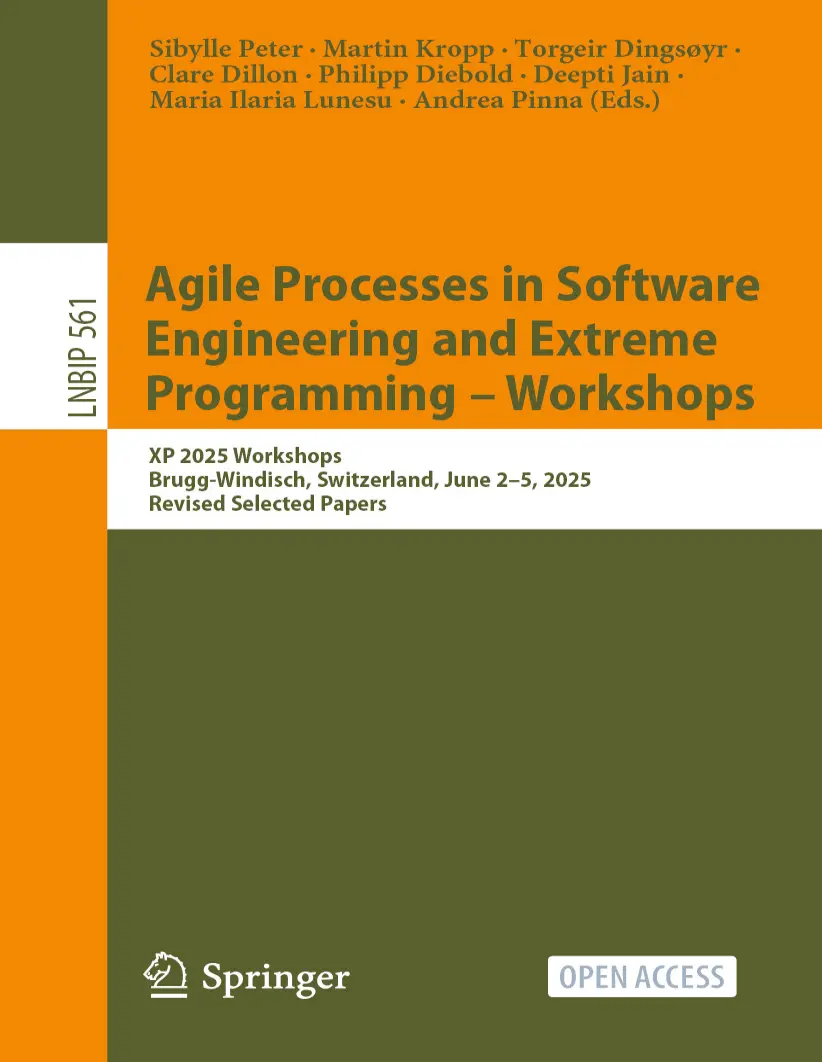
Автор: Diebold Philipp , Dillon Clare , Dingsøyr Torgeir , Jain Deepti , Kropp Martin , Lunesu Maria Ilaria , Peter Sibylle
Дата выхода: 2026
Издательство: Springer Nature
Количество страниц: 164
Размер файла: 2,5 МБ
Тип файла: PDF
Добавил: codelibs
Проверить на вирусыLecture Notes in Business Information Processing....2
Agile Processes in Software Engineering and Extreme Programming – Workshops....4
Preface....7
Organization....9
Conference Co-chairs....9
Workshops Co-chairs....9
Posters Track Co-chairs....9
Publication Co-chairs....9
Workshops Organizers....9
Agile Enterprise Architecture and Delivery....9
AI and Agile Software Development: From Frustration to Success....9
Third International Workshop on Global and Hybrid Work in Software Engineering (GoHyb)....10
Towards a closer collaboration between practice and research in Agile Software Development – What we learnt; and what not?....10
Program Committee....10
Steering Committee....11
Sponsoring Organization....12
Contents....13
AI and Agile Software Development: From Frustration to Success....15
AI and Agile Software Development: From Frustration to Success XP2025 Workshop Summary....16
1 Workshop Overview....17
2 Setting the Stage: Networking and Keynotes....19
3 Uncovering Collective Experience: The Retrospective Session....20
4 Sharing Current Practices: The Review and Ideation Session....22
5 Building the Future: The Research Roadmap Session....23
6 Conclusion and Call to Action....26
From Constraints to Capabilities: AI as a Force Multiplier....31
1 Introduction....32
2 Methodology....32
2.1 Research Design....32
2.2 Expert Panel Composition....32
2.3 Data Collection and Analysis....33
2.4 Ethical Considerations....33
3 Key Findings....34
3.1 The Promise of AI as a Force Multiplier....34
3.2 Organizational Constraints....34
3.3 Capability Gaps and the Realization Gap....35
4 Enabling Capabilities....36
4.1 Cultivating a Learning Organization....36
4.2 Unleashing Workflow Creatively....36
4.3 Sense and Respond Proactively....37
4.4 Prioritize. Prioritize. Prioritize.....37
4.5 Fund Work Dynamically....37
4.6 Realize Peoples Potential....37
4.7 Balancing Governance and Risk....38
5 Discussion....38
6 Conclusion....39
Why Adapt RAG for Agile? Challenges, Frameworks, and the Role of Evaluator Agent....42
1 Introduction....43
2 Related Work....44
3 Methodology....45
4 Results....47
4.1 RQ1: Existing Evaluation Frameworks for RAG Systems....47
4.2 RQ2: Adaptation of RAG Evaluation Frameworks to Agile....49
5 Discussion....50
6 Concluding Remarks....51
AI and Teamwork in Agile Software Development: A Systematic Mapping Study....55
1 Introduction....56
2 Related Work....56
3 Research Methodology....57
3.1 Research Questions....57
3.2 Search Protocol....58
3.3 Screening of Papers....58
3.4 Keywording....59
4 Results....59
5 Current Research Gaps in AI and Agile Teamwork....62
6 Conclusion....63
NLP and GenAI in Agile Project Management: A Systematic Mapping Study....66
1 Introduction....67
2 Related Work....67
3 Research Method....67
4 Results....70
4.1 RQ1: Evolution of the Research Landscape....70
4.2 RQ2: Use Cases of NLP in Agile Project Management....71
4.3 RQ3: Predominant NLP-Technologies in APM....72
5 Discussion....73
6 Limitations....74
7 Conclusion....75
The Third International Workshop on Global and Hybrid Work in Software Engineering (GoHyb)....78
Hybrid Work in Agile Software Engineering: Current Research and Future Directions....79
1 Introduction....80
2 Methodology....81
2.1 Workshop....81
2.2 Systematic Literature Review....82
3 Workshop Outcomes: Suggested Topics for Future Research....84
4 Investigated Research Topics in Primary Studies....87
5 Research Methodologies in Primary Studies....89
6 Future Research Directions....91
7 Final Remarks....94
Are there any Differences in the Way that Software Engineers Perceive their Productivity Depending on their Work Style?....99
1 Introduction....100
2 Related Work....101
3 Research Methodology....102
4 Results....103
4.1 Demographic Information....103
4.2 Practitioners Perception of Productivity....105
4.3 Threats to Validity....109
5 Conclusions....110
Understanding Factors Influencing Trust in Software Development Teams in Hybrid Work Settings: An Empirical Investigation....113
1 Introduction....114
2 Background....115
3 Research Method....117
4 Results....118
4.1 Leadership....118
4.2 Organizational....119
4.3 Personal Attributes....120
4.4 Digital Technology....120
4.5 Communication....121
5 Discussion and Conclusion....122
Towards a closer collaboration between practice and research in Agile Software Development – What we learnt; and what not?....126
Towards a Closer Collaboration Between Practice and Research in Agile Software Development Workshop: A Summary and Research Agenda....127
1 Introduction....128
2 Workshop Results....130
2.1 Panel Discussion....130
2.2 World Caf session....130
3 Agenda for Future Research....131
4 Conclusion....133
Posters Track....136
Lessons from a Big-Bang Integration: Challenges in Edge Computing and Machine Learning....137
1 Introduction....138
2 Observations and Insights....139
3 Conclusions....142
Novice Programmers Experiences with Hybrid vs. In-Person Pair Programming – A Comparative Study....146
1 Introduction....147
2 Background and Related Work....148
3 Methodology....148
4 Initial Results....149
4.1 Session Management and Participant Satisfaction in Programming Tasks....149
5 Preliminary Findings and Future Work....150
5.1 Task Completion and Session Duration....150
5.2 Breaks and Role Switching....151
5.3 Participant Satisfaction....151
Rethink Agile Scaling with Robotics Subsumption Architecture....154
1 Introduction....154
2 Background....155
2.1 Robotics Subsumption Architecture....155
2.2 Comparison with Established Agile Scaling Frameworks....157
3 Agile Scaling Through Subsumption....157
3.1 Building Blocks of Customer-Focused Organization....157
3.2 Applying the Model: eAuction....158
4 Outcomes and Benefits....161
Author Index....163
This open access book constitutes the proceedings of the 26th International Conference on Agile Software Development, XP 2025, which took place in Brugg-Windisch, Switzerland, during June 2-5, 2025.
XP is the premier agile software development conference combining research and practice. It is a unique forum where agile researchers, practitioners, thought leaders, coaches, and trainers get together to present and discuss their most recent innovations, research results, experiences, concerns, challenges, and trends. XP conferences provide an informal environment to learn and trigger discussions and welcome both people new to agile and seasoned agile practitioners. The theme for 2025 was "Adapt - Uncovering better ways to deliver valuable software products".
The 13 full papers and 4 short papers included in the proceedings were carefully reviewed and selected from 46 submissions. They were organized in topical sections as follows: Leadership and culture; business agility; engineering; and product and design.


