-
1C
-
Agda
-
Agile/Scrum
-
Alef
-
APL
-
Assembler
-
AWK
-
Basic
-
Beta Programming Language
-
Big Data/DataScience
-
C
-
C#
-
C++
-
Cobol
-
Crystal
-
CSS
-
D
-
Dart
-
DataBase (SQL)
-
Delphi
-
F#
-
Flutter
-
Fortran
-
GameDev
-
Git
-
Go (Golang)
-
GPT/AI/ИИ
-
Hacking and Security
-
Haskell
-
HTML
-
Java
-
JavaScript (JS)
-
Julia
-
Kotlin
-
Machine Learning (ML)
-
Natural language processing (NLP)
-
.NET (.NET Core)
-
Pascal
-
PHP
-
Python
-
R
-
Ruby
-
Rust
-
Scratch
-
Swift
-
UML
-
UX/UI
-
Visual Basic
-
Wolfram
-
XML
-
АСУ
-
Проектирование/System Design
-
Сети/Network
-
Статьи
-
Схемотехника/электронные схемы
-
1C
-
Agda
-
Agile/Scrum
-
Alef
-
APL
-
Assembler
-
AWK
-
Basic
-
Beta Programming Language
-
Big Data/DataScience
-
C
-
C#
-
C++
-
Cobol
-
Crystal
-
CSS
-
D
-
Dart
-
DataBase (SQL)
-
Delphi
-
F#
-
Flutter
-
Fortran
-
GameDev
-
Git
-
Go (Golang)
-
GPT/AI/ИИ
-
Hacking and Security
-
Haskell
-
HTML
-
Java
-
JavaScript (JS)
-
Julia
-
Kotlin
-
Machine Learning (ML)
-
Natural language processing (NLP)
-
.NET (.NET Core)
-
Pascal
-
PHP
-
Python
-
R
-
Ruby
-
Rust
-
Scratch
-
Swift
-
UML
-
UX/UI
-
Visual Basic
-
Wolfram
-
XML
-
АСУ
-
Проектирование/System Design
-
Сети/Network
-
Статьи
-
Схемотехника/электронные схемы
Меню
The Statistics and Calculus with Python Workshop: A comprehensive introduction to mathematics in Python for artificial intelligence applications
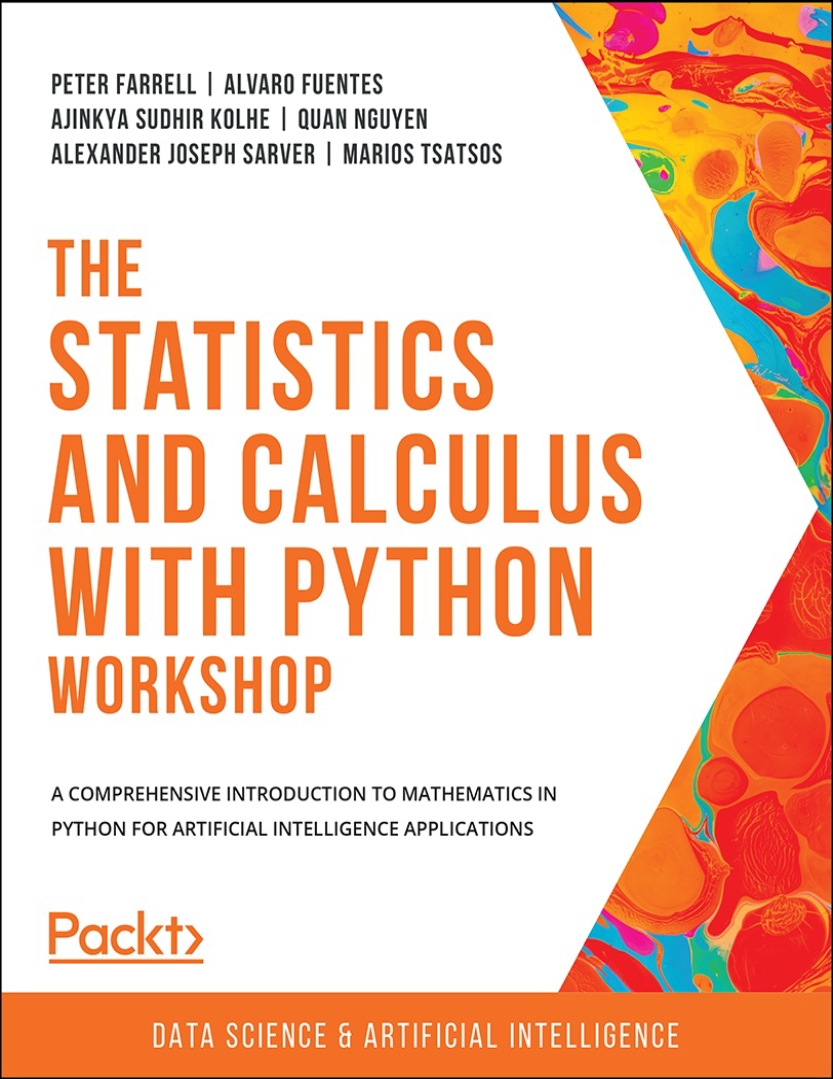
Автор: Farrell Peter , Fuentes Alvaro , Kolhe Ajinkya Sudhir , Nguyen Quan , Sarver Alexander Joseph , Tsatsos Marios
Дата выхода: 2020
Издательство: Packt Publishing Limited
Количество страниц: 456
Размер файла: 3,4 МБ
Тип файла: PDF
Добавил: codelibs
Проверить на вирусы Дополнительные материалыThe Statistics and Calculus with Python Workshop....2
Preface....20
About the Book....20
Audience....20
About the Chapters....20
Conventions....21
Code Presentation....22
Setting up Your Environment....22
Software Requirements....22
Installation and Setup....22
Installing Python....23
Project Jupyter....23
Installing Libraries....25
Accessing the Code Files....25
1. Fundamentals of Python....27
Introduction....27
Control Flow Methods....27
if Statements....27
Exercise 1.01: Divisibility with Conditionals....28
Loops....30
The while Loop....30
The for Loop....30
Exercise 1.02: Number Guessing Game....31
Data Structures....34
Strings....34
Lists....35
Exercise 1.03: Multi-Dimensional Lists....36
Tuples....38
Sets....38
Dictionaries....39
Exercise 1.04: Shopping Cart Calculations....40
Functions and Algorithms....42
Functions....42
Exercise 1.05: Finding the Maximum....44
Recursion....45
Exercise 1.06: The Tower of Hanoi....46
Algorithm Design....47
Exercise 1.07: The N-Queens Problem....47
Testing, Debugging, and Version Control....51
Testing....51
Debugging....52
Exercise 1.08: Testing for Concurrency....53
Version Control....57
Exercise 1.09: Version Control with Git and GitHub....58
Activity 1.01: Building a Sudoku Solver....61
Summary....63
2. Python's Main Tools for Statistics....64
Introduction....64
Scientific Computing and NumPy Basics....64
NumPy Arrays....65
Vectorization....69
Exercise 2.01: Timing Vectorized Operations in NumPy....69
Random Sampling....71
Working with Tabular Data in pandas....74
Initializing a DataFrame Object....74
Accessing Rows and Columns....75
Manipulating DataFrames....78
Exercise 2.02: Data Table Manipulation....78
Advanced Pandas Functionalities....82
Exercise 2.03: The Student Dataset....84
Data Visualization with Matplotlib and Seaborn....87
Scatter Plots....88
Line Graphs....89
Bar Graphs....91
Histograms....94
Heatmaps....96
Exercise 2.04: Visualization of Probability Distributions....96
Visualization Shorthand from Seaborn and Pandas....98
Activity 2.01: Analyzing the Communities and Crime Dataset....100
Summary....101
3. Python's Statistical Toolbox....103
Introduction....103
An Overview of Statistics....103
Types of Data in Statistics....104
Categorical Data....104
Exercise 3.01: Visualizing Weather Percentages....107
Numerical Data....109
Exercise 3.02: Min-Max Scaling....112
Ordinal Data....114
Descriptive Statistics....115
Central Tendency....115
Dispersion....116
Exercise 3.03: Visualizing Probability Density Functions....116
Python-Related Descriptive Statistics....118
Inferential Statistics....121
T-Tests....122
Correlation Matrix....124
Exercise 3.04: Identifying and Testing Equality of Means....125
Statistical and Machine Learning Models....127
Exercise 3.05: Model Selection....129
Python's Other Statistics Tools....132
Activity 3.01: Revisiting the Communities and Crimes Dataset....133
Summary....134
4. Functions and Algebra with Python....135
Introduction....135
Functions....135
Common Functions....136
Domain and Range....138
Function Roots and Equations....138
The Plot of a Function....138
Exercise 4.01: Function Identification from Plots....140
Function Transformations....141
Shifts....141
Scaling....142
Exercise 4.02: Function Transformation Identification....143
Equations....145
Algebraic Manipulations....145
Factoring....146
Using Python....148
Exercise 4.03: Introduction to Break-Even Analysis....149
Systems of Equations....151
Systems of Linear Equations....152
Exercise 4.04: Matrix Solution with NumPy....154
Systems of Non-Linear Equations....157
Activity 4.01: Multi-Variable Break-Even Analysis....159
Summary....160
5. More Mathematics with Python....161
Introduction....161
Sequences and Series....161
Arithmetic Sequences....162
Generators....164
Exercise 5.01: Determining the nth Term of an Arithmetic Sequence and Arithmetic Series....166
Geometric Sequences....168
Exercise 5.02: Writing a Function to Find the Next Term of the Sequence....169
Recursive Sequences....171
Exercise 5.03: Creating a Custom Recursive Sequence....172
Trigonometry....174
Basic Trigonometric Functions....174
Exercise 5.04: Plotting a Right-Angled Triangle....175
Inverse Trigonometric Functions....177
Exercise 5.05: Finding the Shortest Way to the Treasure Using Inverse Trigonometric Functions....179
Exercise 5.06: Finding the Optimal Distance from an Object....180
Vectors....182
Vector Operations....182
Exercise 5.07: Visualizing Vectors....185
Complex Numbers....188
Basic Definitions of Complex Numbers....189
Polar Representation and Euler's Formula....191
Exercise 5.08: Conditional Multiplication of Complex Numbers....194
Activity 5.01: Calculating Your Retirement Plan Using Series....196
Summary....196
6. Matrices and Markov Chains with Python....198
Introduction....198
Matrix Operations on a Single Matrix....198
Basic Operations on a Matrix....199
Inspecting a Matrix....201
Exercise 6.01: Calculating the Time Taken for Sunlight to Reach Earth Each Day....202
Operations and Multiplication in Matrices....205
Axes in a Matrix....208
Exercise 6.02: Matrix Search....209
Multiple Matrices....211
Broadcasting....212
Operations on Multiple Matrices....213
Identity Matrix....213
The eye Function....213
Inverse of a Matrix....214
Logical Operators....214
Outer Function or Vector Product....215
Solving Linear Equations Using Matrices....216
Exercise 6.03: Use of Matrices in Performing Linear Equations....217
Transition Matrix and Markov Chains....219
Fundamentals of Markov Chains....220
Stochastic versus Deterministic Models....220
Transition State Diagrams....220
Transition Matrices....225
Exercise 6.04: Finding the Probability of State Transitions....226
Markov Chains and Markov Property....229
Activity 6.01: Building a Text Predictor Using a Markov Chain....230
Summary....231
7. Doing Basic Statistics with Python....232
Introduction....232
Data Preparation....232
Introducing the Dataset....232
Introducing the Business Problem....233
Preparing the Dataset....234
Exercise 7.01: Using a String Column to Produce a Numerical Column....239
Calculating and Using Descriptive Statistics....240
The Need for Descriptive Statistics....240
A Brief Refresher of Statistical Concepts....241
Using Descriptive Statistics....245
Exercise 7.02: Calculating Descriptive Statistics....247
Exploratory Data Analysis....248
What Is EDA?....249
Univariate EDA....250
Bi-variate EDA: Exploring Relationships Between Variables....255
Exercise 7.03: Practicing EDA....257
Activity 7.01: Finding Out Highly Rated Strategy Games....259
Summary....260
8. Foundational Probability Concepts and Their Applications....261
Introduction....261
Randomness, Probability, and Random Variables....261
Randomness and Probability....262
Foundational Probability Concepts....262
Introduction to Simulations with NumPy....263
Exercise 8.01: Sampling with and without Replacement....266
Probability as a Relative Frequency....267
Defining Random Variables....270
Exercise 8.02: Calculating the Average Wins in Roulette....274
Discrete Random Variables....276
Defining Discrete Random Variables....276
The Binomial Distribution....278
Exercise 8.03: Checking If a Random Variable Follows a Binomial Distribution....280
Continuous Random Variables....282
Defining Continuous Random Variables....282
The Normal Distribution....284
Some Properties of the Normal Distribution....287
Exercise 8.04: Using the Normal Distribution in Education....291
Activity 8.01: Using the Normal Distribution in Finance....293
Summary....294
9. Intermediate Statistics with Python....295
Introduction....295
Law of Large Numbers....295
Python and Random Numbers....296
Exercise 9.01: The Law of Large Numbers in Action....296
Exercise 9.02: Coin Flipping Average over Time....297
A Practical Application of the Law of Large Numbers Seen in the Real World....299
Exercise 9.03: Calculating the Average Winnings for a Game of Roulette If We Constantly Bet on Red....300
Central Limit Theorem....303
Normal Distribution and the CLT....304
Random Sampling from a Uniform Distribution....304
Exercise 9.04: Showing the Sample Mean for a Uniform Distribution....304
Random Sampling from an Exponential Distribution....306
Exercise 9.05: Taking a Sample from an Exponential Distribution....307
Confidence Intervals....310
Calculating the Confidence Interval of a Sample Mean....310
Exercise 9.06: Finding the Confidence Interval of Polling Figures....313
Small Sample Confidence Interval....314
Confidence Interval for a Proportion....315
Hypothesis Testing....316
Parts of a Hypothesis Test....316
The Z-Test....317
Exercise 9.07: The Z-Test in Action....318
Proportional Z-Test....320
The T-Test....321
Exercise 9.08: The T-Test....322
2-Sample T-Test or A/B Testing....325
Exercise 9.09: A/B Testing Example....326
Introduction to Linear Regression....327
Exercise 9.10: Linear Regression....328
Activity 9.01: Standardized Test Performance....330
Summary....331
10. Foundational Calculus with Python....332
Introduction....332
Writing the Derivative Function....332
Exercise 10.01: Finding the Derivatives of Other Functions....334
Finding the Equation of the Tangent Line....335
Calculating Integrals....336
Using Trapezoids....339
Exercise 10.02: Finding the Area Under a Curve....339
Using Integrals to Solve Applied Problems....340
Exercise 10.03: Finding the Volume of a Solid of Revolution....341
Using Derivatives to Solve Optimization Problems....343
Exercise 10.04: Find the Quickest Route....344
Exercise 10.05: The Box Problem....345
Exercise 10.06: The Optimal Can....346
Exercise 10.07: Calculating the Distance between Two Moving Ships....346
Activity 10.01: Maximum Circle-to-Cone Volume....347
Summary....348
11. More Calculus with Python....349
Introduction....349
Length of a Curve....349
Exercise 11.01: Finding the Length of a Curve....352
Exercise 11.02: Finding the Length of a Sine Wave....353
Length of a Spiral....353
Exercise 11.03: Finding the Length of the Polar Spiral Curve....355
Exercise 11.04: Finding the Length of Insulation in a Roll....356
Exercise 11.05: Finding the Length of an Archimedean Spiral....356
Area of a Surface....357
The Formulas....357
Exercise 11.06: Finding the Area of a 3D Surface – Part 1....361
Exercise 11.07: Finding the Area of a 3D Surface – Part 2....362
Exercise 11.08: Finding the Area of a Surface – Part 3....363
Infinite Series....363
Polynomial Functions....363
Series....364
Convergence....365
Exercise 11.09: Calculating 10 Correct Digits of π....366
Exercise 11.10: Calculating the Value of π Using Euler's Expression....367
A 20th Century Formula....367
Interval of Convergence....368
Exercise 11.11: Determining the Interval of Convergence – Part 1....369
Exercise 11.12: Determining the Interval of Convergence – Part 2....371
Exercise 11.13: Finding the Constant....372
Activity 11.01: Finding the Minimum of a Surface....372
Summary....373
12. Intermediate Calculus with Python....375
Introduction....375
Differential Equations....375
Interest Calculations....376
Exercise 12.01: Calculating Interest....376
Exercise 12.02: Calculating Compound Interest – Part 1....378
Exercise 12.03: Calculating Compound Interest – Part 2....380
Exercise 12.04: Calculating Compound Interest – Part 3....381
Exercise 12.05: Becoming a Millionaire....381
Population Growth....383
Exercise 12.06: Calculating the Population Growth Rate – Part 1....384
Exercise 12.07: Calculating the Population Growth Rate – Part 2....386
Half-Life of Radioactive Materials....386
Exercise 12.08: Measuring Radioactive Decay....386
Exercise 12.09: Measuring the Age of a Historical Artifact....387
Newton's Law of Cooling....389
Exercise 12.10: Calculating the Time of Death....389
Exercise 12.11: Calculating the Rate of Change in Temperature....391
Mixture Problems....392
Exercise 12.12: Solving Mixture Problems – Part 1....393
Exercise 12.13: Solving Mixture Problems – Part 2....395
Exercise 12.14: Solving Mixture Problems – Part 3....397
Exercise 12.15: Solving Mixture Problems – Part 4....398
Euler's Method....398
Exercise 12.16: Solving Differential Equations with Euler's Method....398
Exercise 12.17: Using Euler's Method to Evaluate a Function....400
Runge-Kutta Method....401
Exercise 12.18: Implementing the Runge-Kutta Method....402
Pursuit Curves....403
Exercise 12.19: Finding Where the Predator Catches the Prey....403
Exercise 12.20: Using Turtles to Visualize Pursuit Curves....405
Position, Velocity, and Acceleration....406
Exercise 12.21: Calculating the Height of a Projectile above the Ground....406
An Example of Calculating the Height of a Projectile with Air Resistance....409
Exercise 12.22: Calculating the Terminal Velocity....411
Activity 12.01: Finding the Velocity and Location of a Particle....412
Summary....413
Appendix....414
1. Fundamentals of Python....414
Activity 1.01: Building a Sudoku Solver....414
2. Python's Main Tools for Statistics....418
Activity 2.01: Analyzing the Communities and Crime Dataset....418
3. Python's Statistical Toolbox....423
Activity 3.01: Revisiting the Communities and Crimes Dataset....423
4. Functions and Algebra with Python....427
Activity 4.01: Multi-Variable Break-Even Analysis....427
5. More Mathematics with Python....432
Activity 5.01: Calculating Your Retirement Plan Using Series....432
6. Matrices and Markov Chains with Python....435
Activity 6.01: Building a Text Predictor Using a Markov Chain....436
7. Doing Basic Statistics with Python....438
Activity 7.01: Finding Out Highly Rated Strategy Games....438
8. Foundational Probability Concepts and Their Applications....440
Activity 8.01: Using the Normal Distribution in Finance....441
9. Intermediate Statistics with Python....443
Activity 9.01: Standardized Test Performance....444
10. Foundational Calculus with Python....448
Activity 10.01: Maximum Circle-to-Cone Volume....448
11. More Calculus with Python....449
Activity 11.01: Finding the Minimum of a Surface....449
12. Intermediate Calculus with Python....453
Activity 12.01: Finding the Velocity and Location of a Particle....453
Are you looking to start developing artificial intelligence applications? Do you need a refresher on key mathematical concepts? Full of engaging practical exercises, The Statistics and Calculus with Python Workshop will show you how to apply your understanding of advanced mathematics in the context of Python.
The book begins by giving you a high-level overview of the libraries you'll use while performing statistics with Python. As you progress, you'll perform various mathematical tasks using the Python programming language, such as solving algebraic functions with Python starting with basic functions, and then working through transformations and solving equations. Later chapters in the book will cover statistics and calculus concepts and how to use them to solve problems and gain useful insights. Finally, you'll study differential equations with an emphasis on numerical methods and learn about algorithms that directly calculate values of functions.
By the end of this book, you'll have learned how to apply essential statistics and calculus concepts to develop robust Python applications that solve business challenges.
What you will learn
- Get to grips with the fundamental mathematical functions in Python
- Perform calculations on tabular datasets using pandas
- Understand the differences between polynomials, rational functions, exponential functions, and trigonometric functions
- Use algebra techniques for solving systems of equations
- Solve real-world problems with probability
- Solve optimization problems with derivatives and integrals
Who this book is for
If you are a Python programmer who wants to develop intelligent solutions that solve challenging business problems, then this book is for you. To better grasp the concepts explained in this book, you must have a thorough understanding of advanced mathematical concepts, such as Markov chains, Euler's formula, and Runge-Kutta methods as the book only explains how these techniques and concepts can be implemented in Python.


