-
1C
-
Agda
-
Agile/Scrum
-
Alef
-
APL
-
Assembler
-
AWK
-
Basic
-
Beta Programming Language
-
Big Data/DataScience
-
C
-
C#
-
C++
-
Cobol
-
Crystal
-
CSS
-
D
-
Dart
-
DataBase (SQL)
-
Delphi
-
F#
-
Flutter
-
Fortran
-
GameDev
-
Git
-
Go (Golang)
-
GPT/AI/ИИ
-
Hacking and Security
-
Haskell
-
HTML
-
Java
-
JavaScript (JS)
-
Julia
-
Kotlin
-
Machine Learning (ML)
-
Natural language processing (NLP)
-
.NET (.NET Core)
-
Pascal
-
PHP
-
Python
-
R
-
Ruby
-
Rust
-
Scratch
-
Swift
-
UML
-
UX/UI
-
Visual Basic
-
Wolfram
-
XML
-
АСУ
-
Проектирование/System Design
-
Сети/Network
-
Статьи
-
Схемотехника/электронные схемы
-
1C
-
Agda
-
Agile/Scrum
-
Alef
-
APL
-
Assembler
-
AWK
-
Basic
-
Beta Programming Language
-
Big Data/DataScience
-
C
-
C#
-
C++
-
Cobol
-
Crystal
-
CSS
-
D
-
Dart
-
DataBase (SQL)
-
Delphi
-
F#
-
Flutter
-
Fortran
-
GameDev
-
Git
-
Go (Golang)
-
GPT/AI/ИИ
-
Hacking and Security
-
Haskell
-
HTML
-
Java
-
JavaScript (JS)
-
Julia
-
Kotlin
-
Machine Learning (ML)
-
Natural language processing (NLP)
-
.NET (.NET Core)
-
Pascal
-
PHP
-
Python
-
R
-
Ruby
-
Rust
-
Scratch
-
Swift
-
UML
-
UX/UI
-
Visual Basic
-
Wolfram
-
XML
-
АСУ
-
Проектирование/System Design
-
Сети/Network
-
Статьи
-
Схемотехника/электронные схемы
Меню
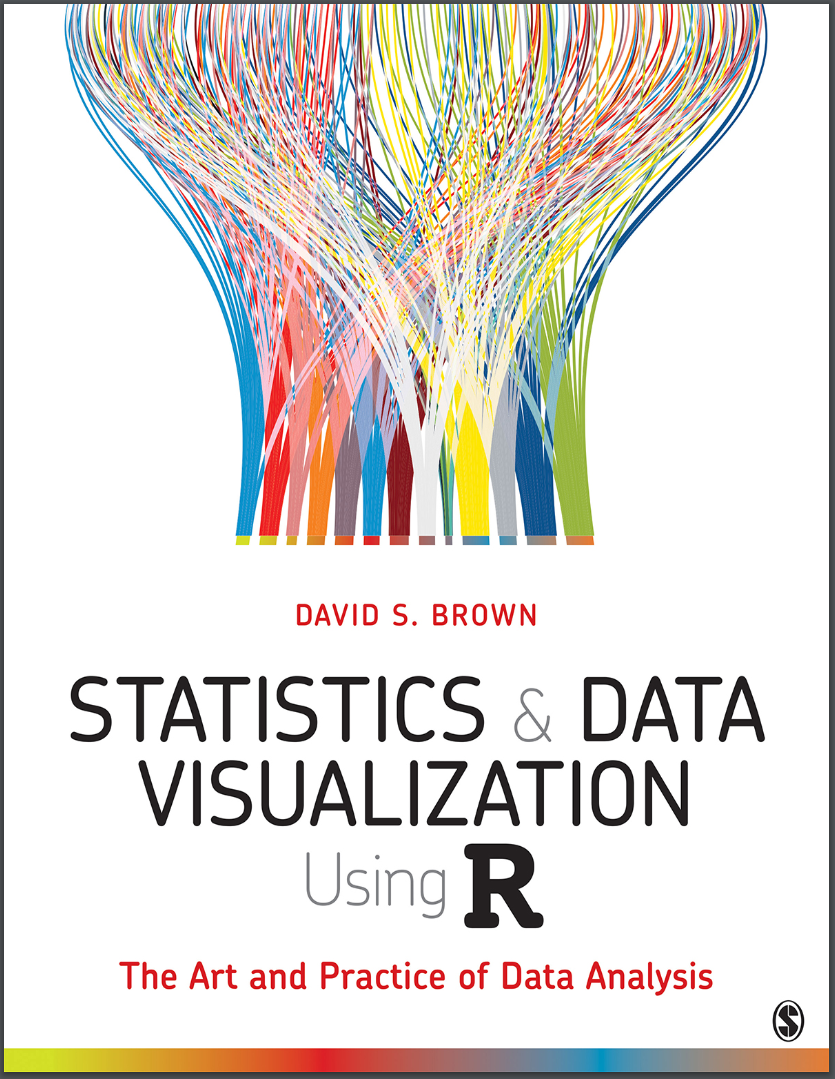
Statistics and Data Visualization Using R: The Art and Practice of Data Analysis
Автор: Brown David
Дата выхода: 2022
Издательство: SAGE Publications, Inc.
Количество страниц: 765
Размер файла: 10,8 МБ
Тип файла: PDF
Добавил: codelibs
Проверить на вирусыHalf Title....2
Acknowledgements....3
Publisher Note....4
Title Page....5
Copyright Page....6
Brief Contents....8
Detailed Contents....9
Preface....26
Acknowledgments....31
About the Author....34
1 Getting Started....35
2 An Introduction to Data Analysis....73
3 Describing Data....114
4 Central Tendency and Dispersion....146
5 Univariate and Bivariate Descriptions of Data....182
6 Transforming Data....227
7 Some Principles of Displaying Data....263
8 The Essentials of Probability Theory....300
9 Confidence Intervals and Testing Hypotheses....341
10 Making Comparisons....376
11 Controlled Comparisons....426
12 Linear Regression....471
13 Multiple Regression....508
14 Dummies and Interactions....542
15 Diagnostics I: Is Ordinary Least Squares Appropriate?....570
16 Diagnostics II: Residuals, Leverages, and Measures of Influence....601
17 Logistic Regression....631
Appendix: Developing Empirical Implications....667
Glossary....672
References....703
Index....721
Designed to introduce students to quantitative methods in a way that can be applied to all kinds of data in all kinds of situations, Statistics and Data Visualization Using R: The Art and Practice of Data Analysis by David S. Brown teaches students statistics through charts, graphs, and displays of data that help students develop intuition around statistics as well as data visualization skills. By focusing on the visual nature of statistics instead of mathematical proofs and derivations, students can see the relationships between variables that are the foundation of quantitative analysis. Using the latest tools in R and R RStudio® for calculations and data visualization, students learn valuable skills they can take with them into a variety of future careers in the public sector, the private sector, or academia. Starting at the most basic introduction to data and going through most crucial statistical methods, this introductory textbook quickly gets students new to statistics up to speed running analyses and interpreting data from social science research.


