-
1C
-
Agda
-
Agile/Scrum
-
Alef
-
APL
-
Assembler
-
AWK
-
Basic
-
Beta Programming Language
-
Big Data/DataScience
-
C
-
C#
-
C++
-
Cobol
-
Crystal
-
CSS
-
D
-
Dart
-
DataBase (SQL)
-
Delphi
-
F#
-
Flutter
-
Fortran
-
GameDev
-
Git
-
Go (Golang)
-
GPT/AI/ИИ
-
Hacking and Security
-
Haskell
-
HTML
-
Java
-
JavaScript (JS)
-
Julia
-
Kotlin
-
Machine Learning (ML)
-
Natural language processing (NLP)
-
.NET (.NET Core)
-
Pascal
-
PHP
-
Python
-
R
-
Ruby
-
Rust
-
Scratch
-
Swift
-
UML
-
UX/UI
-
Visual Basic
-
Wolfram
-
XML
-
АСУ
-
Проектирование/System Design
-
Сети/Network
-
Статьи
-
Схемотехника/электронные схемы
-
1C
-
Agda
-
Agile/Scrum
-
Alef
-
APL
-
Assembler
-
AWK
-
Basic
-
Beta Programming Language
-
Big Data/DataScience
-
C
-
C#
-
C++
-
Cobol
-
Crystal
-
CSS
-
D
-
Dart
-
DataBase (SQL)
-
Delphi
-
F#
-
Flutter
-
Fortran
-
GameDev
-
Git
-
Go (Golang)
-
GPT/AI/ИИ
-
Hacking and Security
-
Haskell
-
HTML
-
Java
-
JavaScript (JS)
-
Julia
-
Kotlin
-
Machine Learning (ML)
-
Natural language processing (NLP)
-
.NET (.NET Core)
-
Pascal
-
PHP
-
Python
-
R
-
Ruby
-
Rust
-
Scratch
-
Swift
-
UML
-
UX/UI
-
Visual Basic
-
Wolfram
-
XML
-
АСУ
-
Проектирование/System Design
-
Сети/Network
-
Статьи
-
Схемотехника/электронные схемы
Меню
Python Made Easy: A Beginner's Guide to Coding, Data Structures, and Practical Applications
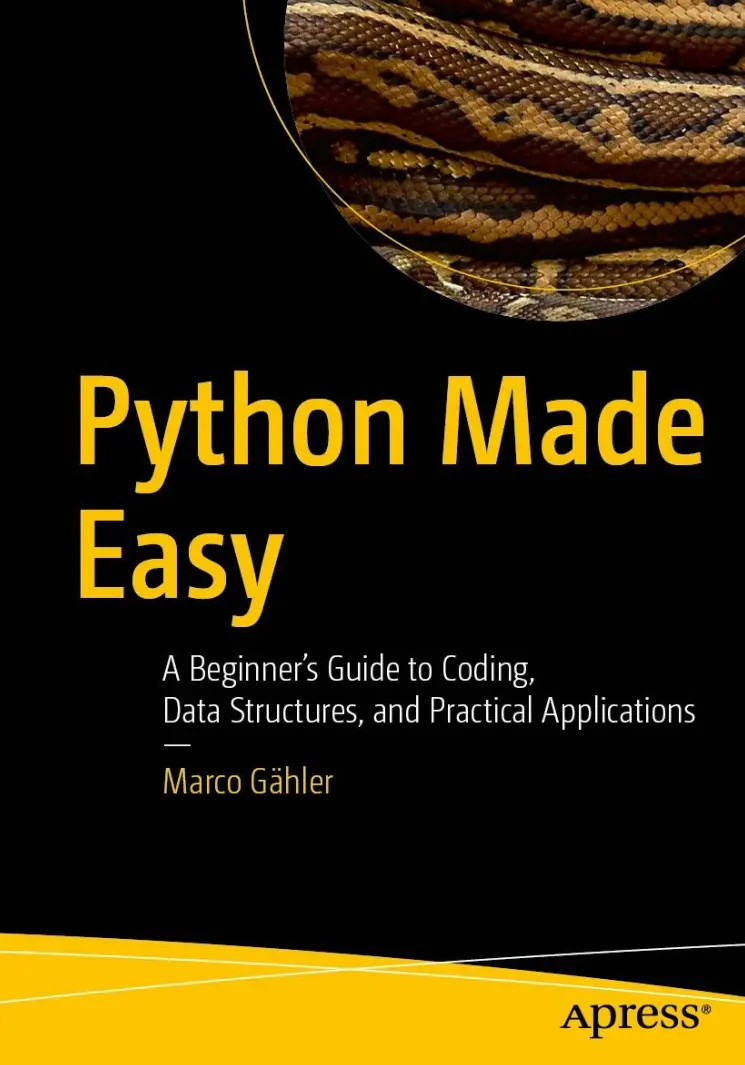
Автор: Gähler Marco
Дата выхода: 2026
Издательство: Apress Media, LLC.
Количество страниц: 135
Размер файла: 1,1 МБ
Тип файла: PDF
Добавил: Aleks-5
Проверить на вирусыDeclarations....5
Contents....6
About the Author....10
About the Technical Reviewer....11
Introduction....12
1 About Python....14
The REPL....14
Advantages and Drawbacks of Python....16
Importing Libraries....16
Style Guides....17
Software Engineering Made Easy....18
The Zen of Python....18
2 Naming....20
Naming Rules....22
Naming Conventions....22
Writing Readable Names....23
3 Components of Code....25
Mutable and Immutable Objects....25
Assignments....26
Types....27
Variables....27
Global Variables....28
None....28
Numbers....29
Floating Point Numbers....29
Integers....30
Strings and Numbers....31
Booleans....31
Lists....32
Creating Lists....32
List Comprehensions....33
Accessing Lists....34
Accessing Sublists....36
Multidimensional Lists....37
Sorting lists....38
Merging Lists....39
How to Continue....39
Strings....40
Various Types of Strings....41
String Operations....42
Dicts....42
Tuples....44
Tuples vs. Lists....45
Enums....46
Rarely Used Data Structures....47
Sets....47
Exceptions....47
Try, Catch, Else, Finally....48
When to Use Exceptions....49
Pitfalls....49
Custom Exceptions....50
Code Structure....51
Coupling and Cohesion....52
4 Loops and If Statements....54
Loops....54
Nested Loops....55
If Statements....55
Nested If Statements....56
Boolean Logic....57
Return, Break, and Continue....57
Return....58
Break....58
Continue....58
5 Basic Mathematics....59
Basic Mathematics with Python....59
Arithmetic Operations....59
The Math Module....60
NumPy....61
Matrices....61
Images....62
Advanced Filtering....63
Random Numbers....65
Calculating Pi....66
6 Functions and Methods....67
Keyword Arguments....68
Default Arguments....69
args and kwargs....70
Function Overloading....71
Control Flow....72
Function Definition Order....72
Cyclic Dependencies....73
Recursion....73
Trees....74
7 Classes....76
Classes and Objects....78
Special Methods....79
Example....80
Inheritance....84
Implementation Inheritance....84
Interface Inheritance....86
Encapsulation....87
Abstraction....88
8 Python Modules and Packages....89
Modules and Imports....89
Regular Packages....89
Namespace Packages....90
Installing Packages with Pip....91
The Virtual Environment....92
9 Util....93
Files....93
CSV....93
JSON and Co....94
HDF5....95
SQL....95
Summary....96
CSV....96
JSON....96
HDF5....97
SQL....97
Time....97
Timing Functions....97
10 Unit Tests....99
Why Tests?....99
How to Write Tests....100
What to Test....102
Test-Driven Development....102
Example of TDD....103
Dependency Injection....105
Mocking....109
Faking....109
11 Matplotlib....110
Simple Plots....110
Labeling....112
Histograms....112
Curve Fitting....113
Local Minima of Curve Fitting....115
12 Pandas....116
Pandas Example....116
13 Numerical Mathematics....122
Numerical Integration....123
Mathematical Derivation....123
Geometric Interpretation....124
Higher Order Integration....125
Estimating the Accuracy....126
Monte Carlo Integration....126
Numerical Solution of Differential Equations....127
Differential Equations....127
Coupled Differential Equations....129
14 Some Examples....131
Percolation....131
Python has become one of the most versatile and widely used programming languages, known for its simplicity and efficiency. Python Made Easy is designed to help beginner developers easily learn the fundamentals and intermediate concepts of Python. This book provides a structured approach to learning Python, covering essential topics from basic syntax to complex data structures and numerical computing.
The book starts with an introduction to Python, explaining its advantages, drawbacks, and the importance of style guides. It then delves into key programming concepts, including variables, lists, strings, dictionaries, tuples, and rare data structures, helping readers build a strong foundation. Readers will also explore loops, conditional statements, Boolean logic, essential mathematical operations, and NumPy's use for numerical computations. Complex topics such as object-oriented programming, inheritance, file handling, unit testing, and data visualization using Matplotlib are covered in depth. Additionally, the book introduces practical applications in numerical mathematics, including Monte Carlo integration and differential equations.
By the end, readers will have an understanding of Python’s core principles and practical applications, empowering them to write efficient, scalable, and well-structured code. This book is particularly helpful if you already know some other programming language and you want to kick start your Python knowledge.
What you will learn:
- Understand Python fundamentals, including variables, loops, and data structures.
- What is object-oriented programming, inheritance, and file handling.
- Explore numerical computing with NumPy and data visualization using Matplotlib.
- Gain hands-on experience with unit testing, Monte Carlo integration, and real-world applications.
Who this book is for:
Beginners and aspiring programmers, software professionals transitioning to Python and students


