-
1C
-
Agda
-
Agile/Scrum
-
Alef
-
APL
-
Assembler
-
AWK
-
Basic
-
Beta Programming Language
-
Big Data/DataScience
-
C
-
C#
-
C++
-
Cobol
-
Crystal
-
CSS
-
D
-
Dart
-
DataBase (SQL)
-
Delphi
-
F#
-
Flutter
-
Fortran
-
GameDev
-
Git
-
Go (Golang)
-
GPT/AI/ИИ
-
Hacking and Security
-
Haskell
-
HTML
-
Java
-
JavaScript (JS)
-
Julia
-
Kotlin
-
Machine Learning (ML)
-
Natural language processing (NLP)
-
.NET (.NET Core)
-
Pascal
-
PHP
-
Python
-
R
-
Ruby
-
Rust
-
Scratch
-
Swift
-
UML
-
UX/UI
-
Visual Basic
-
Wolfram
-
XML
-
АСУ
-
Проектирование/System Design
-
Сети/Network
-
Статьи
-
Схемотехника/электронные схемы
-
1C
-
Agda
-
Agile/Scrum
-
Alef
-
APL
-
Assembler
-
AWK
-
Basic
-
Beta Programming Language
-
Big Data/DataScience
-
C
-
C#
-
C++
-
Cobol
-
Crystal
-
CSS
-
D
-
Dart
-
DataBase (SQL)
-
Delphi
-
F#
-
Flutter
-
Fortran
-
GameDev
-
Git
-
Go (Golang)
-
GPT/AI/ИИ
-
Hacking and Security
-
Haskell
-
HTML
-
Java
-
JavaScript (JS)
-
Julia
-
Kotlin
-
Machine Learning (ML)
-
Natural language processing (NLP)
-
.NET (.NET Core)
-
Pascal
-
PHP
-
Python
-
R
-
Ruby
-
Rust
-
Scratch
-
Swift
-
UML
-
UX/UI
-
Visual Basic
-
Wolfram
-
XML
-
АСУ
-
Проектирование/System Design
-
Сети/Network
-
Статьи
-
Схемотехника/электронные схемы
Меню
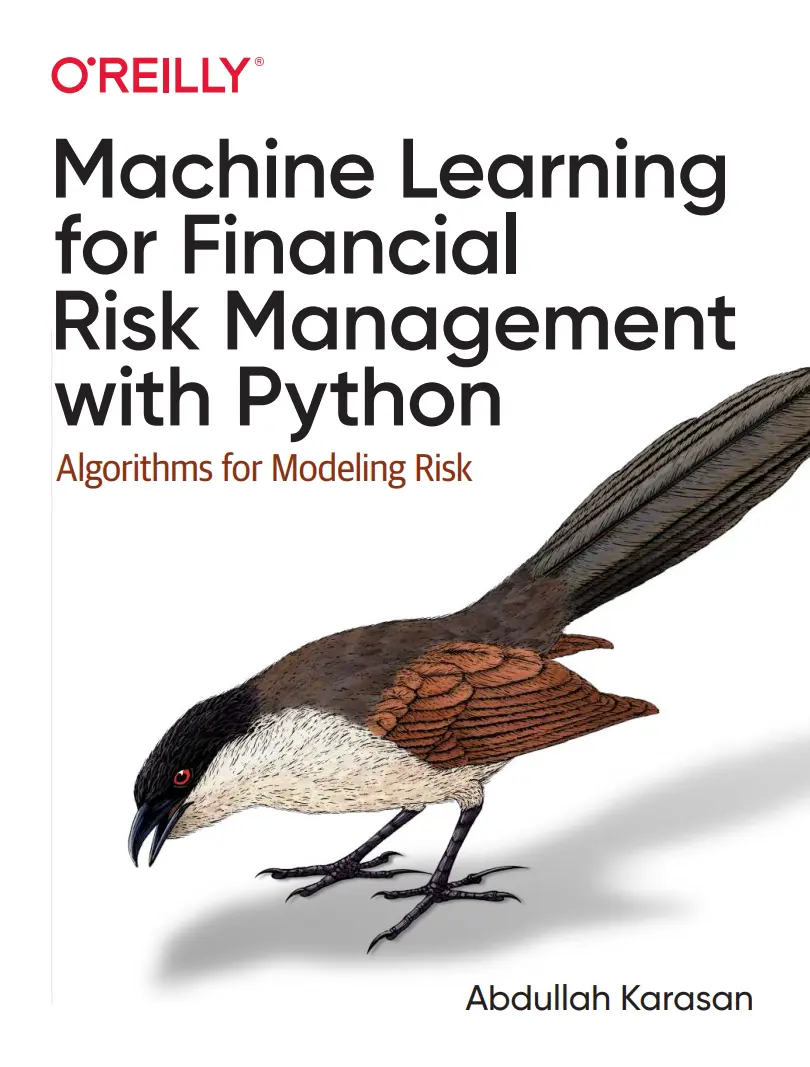
Machine Learning for Financial Risk Management with Python: Algorithms for Modeling Risk
Автор: Karasan Abdullah
Дата выхода: 2022
Издательство: O’Reilly Media, Inc.
Количество страниц: 334
Размер файла: 2,9 МБ
Тип файла: PDF
Добавил: codelibs
Проверить на вирусыCover....1
Copyright....6
Table of Contents....7
Preface....11
Conventions Used in This Book....14
Using Code Examples....15
O’Reilly Online Learning....16
How to Contact Us....16
Acknowledgements....17
Part I. Risk Management Foundations....19
Chapter 1. Fundamentals of Risk Management....21
Risk....22
Return....22
Risk Management....25
Main Financial Risks....26
Big Financial Collapse....27
Information Asymmetry in Financial Risk Management....29
Adverse Selection....29
Moral Hazard....32
Conclusion....33
References....33
Chapter 2. Introduction to Time Series Modeling....35
Time Series Components....38
Trend....39
Seasonality....43
Cyclicality....45
Residual....46
Time Series Models....52
White Noise....53
Moving Average Model....55
Autoregressive Model....60
Autoregressive Integrated Moving Average Model....66
Conclusion....72
References....73
Chapter 3. Deep Learning for Time Series Modeling....75
Recurrent Neural Networks....76
Long-Short Term Memory....83
Conclusion....89
References....90
Part II. Machine Learning for Market, Credit, Liquidity, and Operational Risks....91
Chapter 4. Machine Learning-Based Volatility Prediction....93
ARCH Model....96
GARCH Model....102
GJR-GARCH....108
EGARCH....110
Support Vector Regression: GARCH....113
Neural Networks....119
The Bayesian Approach....124
Markov Chain Monte Carlo....126
Metropolis–Hastings....128
Conclusion....133
References....134
Chapter 5. Modeling Market Risk....137
Value at Risk (VaR)....139
Variance-Covariance Method....140
The Historical Simulation Method....146
The Monte Carlo Simulation VaR....147
Denoising....151
Expected Shortfall....159
Liquidity-Augmented Expected Shortfall....161
Effective Cost....163
Conclusion....171
References....172
Chapter 6. Credit Risk Estimation....173
Estimating the Credit Risk....174
Risk Bucketing....176
Probability of Default Estimation with Logistic Regression....188
Probability of Default Estimation with the Bayesian Model....197
Probability of Default Estimation with Support Vector Machines....203
Probability of Default Estimation with Random Forest....205
Probability of Default Estimation with Neural Network....206
Probability of Default Estimation with Deep Learning....207
Conclusion....210
References....210
Chapter 7. Liquidity Modeling....211
Liquidity Measures....213
Volume-Based Liquidity Measures....213
Transaction Cost–Based Liquidity Measures....217
Price Impact–Based Liquidity Measures....221
Market Impact-Based Liquidity Measures....224
Gaussian Mixture Model....228
Gaussian Mixture Copula Model....234
Conclusion....237
References....237
Chapter 8. Modeling Operational Risk....239
Getting Familiar with Fraud Data....242
Supervised Learning Modeling for Fraud Examination....247
Cost-Based Fraud Examination....252
Saving Score....254
Cost-Sensitive Modeling....256
Bayesian Minimum Risk....258
Unsupervised Learning Modeling for Fraud Examination....261
Self-Organizing Map....262
Autoencoders....265
Conclusion....269
References....270
Part III. Modeling Other Financial Risk Sources....271
Chapter 9. A Corporate Governance Risk Measure: Stock Price Crash....273
Stock Price Crash Measures....275
Minimum Covariance Determinant....276
Application of Minimum Covariance Determinant....278
Logistic Panel Application....288
Conclusion....296
References....297
Chapter 10. Synthetic Data Generation and The Hidden Markov Model in Finance....299
Synthetic Data Generation....299
Evaluation of the Synthetic Data....301
Generating Synthetic Data....302
A Brief Introduction to the Hidden Markov Model....310
Fama-French Three-Factor Model Versus HMM....311
Conclusion....322
References....322
Afterword....323
Index....325
About the Author....333
Colophon....333
Financial risk management is quickly evolving with the help of artificial intelligence. With this practical book, developers, programmers, engineers, financial analysts, risk analysts, and quantitative and algorithmic analysts will examine Python-based machine learning and deep learning models for assessing financial risk. Building hands-on AI-based financial modeling skills, you'll learn how to replace traditional financial risk models with ML models.
Author Abdullah Karasan helps you explore the theory behind financial risk modeling before diving into practical ways of employing ML models in modeling financial risk using Python. With this book, you will:
- Review classical time series applications and compare them with deep learning models
- Explore volatility modeling to measure degrees of risk, using support vector regression, neural networks, and deep learning
- Improve market risk models (VaR and ES) using ML techniques and including liquidity dimension
- Develop a credit risk analysis using clustering and Bayesian approaches
- Capture different aspects of liquidity risk with a Gaussian mixture model and Copula model
- Use machine learning models for fraud detection
- Predict stock price crash and identify its determinants using machine learning models


