-
1C
-
Agda
-
Agile/Scrum
-
Alef
-
APL
-
Assembler
-
AWK
-
Basic
-
Beta Programming Language
-
Big Data/DataScience
-
C
-
C#
-
C++
-
Cobol
-
Crystal
-
CSS
-
D
-
Dart
-
DataBase (SQL)
-
Delphi
-
F#
-
Flutter
-
Fortran
-
GameDev
-
Git
-
Go (Golang)
-
GPT/AI/ИИ
-
Hacking and Security
-
Haskell
-
HTML
-
Java
-
JavaScript (JS)
-
Julia
-
Kotlin
-
Machine Learning (ML)
-
Natural language processing (NLP)
-
.NET (.NET Core)
-
Pascal
-
PHP
-
Python
-
R
-
Ruby
-
Rust
-
Scratch
-
Swift
-
UML
-
UX/UI
-
Visual Basic
-
Wolfram
-
XML
-
АСУ
-
Проектирование/System Design
-
Сети/Network
-
Статьи
-
Схемотехника/электронные схемы
-
1C
-
Agda
-
Agile/Scrum
-
Alef
-
APL
-
Assembler
-
AWK
-
Basic
-
Beta Programming Language
-
Big Data/DataScience
-
C
-
C#
-
C++
-
Cobol
-
Crystal
-
CSS
-
D
-
Dart
-
DataBase (SQL)
-
Delphi
-
F#
-
Flutter
-
Fortran
-
GameDev
-
Git
-
Go (Golang)
-
GPT/AI/ИИ
-
Hacking and Security
-
Haskell
-
HTML
-
Java
-
JavaScript (JS)
-
Julia
-
Kotlin
-
Machine Learning (ML)
-
Natural language processing (NLP)
-
.NET (.NET Core)
-
Pascal
-
PHP
-
Python
-
R
-
Ruby
-
Rust
-
Scratch
-
Swift
-
UML
-
UX/UI
-
Visual Basic
-
Wolfram
-
XML
-
АСУ
-
Проектирование/System Design
-
Сети/Network
-
Статьи
-
Схемотехника/электронные схемы
Меню
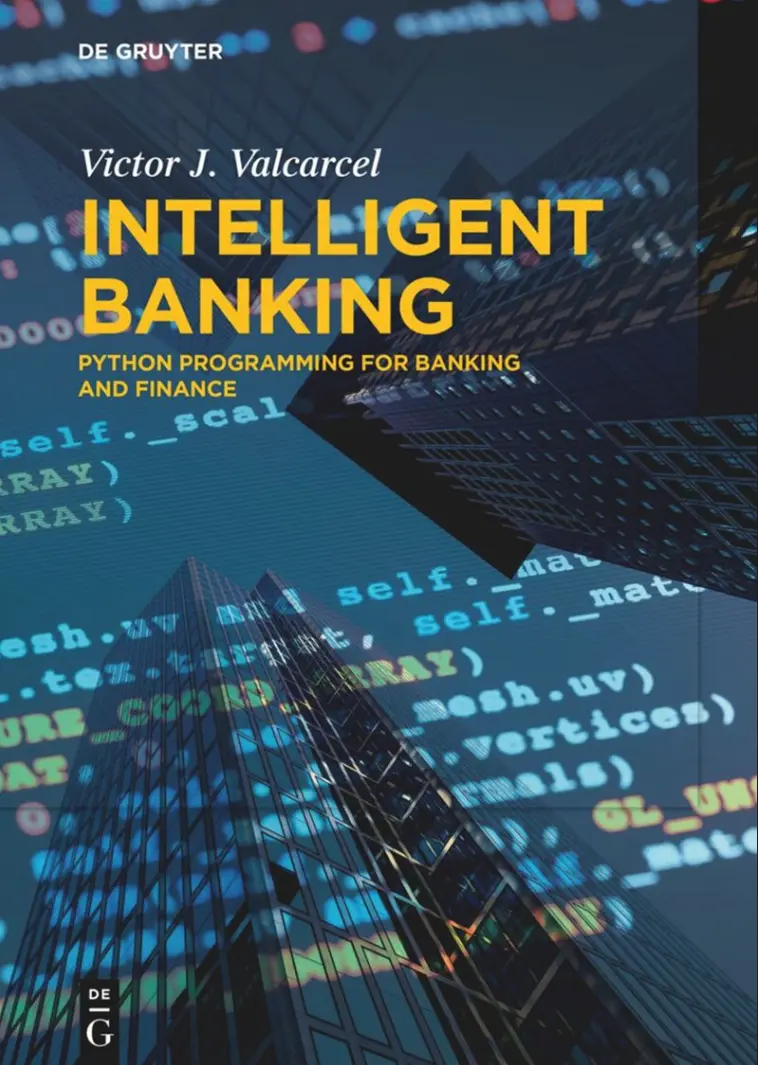
Intelligent Banking: Python Programming for Banking and Finance
Автор: Valcarcel Victor J.
Дата выхода: 2025
Издательство: De Gruyter Brill
Количество страниц: 245
Размер файла: 2,7 МБ
Тип файла: PDF
Добавил: codelibs
Проверить на вирусыAcknowledgments....8
Contents....10
List of Figures....14
List of Tables....18
Introduction....20
0.1 Structure and Treatments....21
0.2 Why Python?....23
0.3 Integrated Development Environments (IDEs)....24
0.4 Setting up a Python Environment....25
0.4.1 Laying the Groundwork: Installing Anaconda....26
0.4.2 Getting Started: Step-by-step....27
0.4.3 Working from the Miniconda Powershell....30
0.4.4 Python Environments with Conda....32
0.4.5 Python Libraries in Conda....35
0.4.6 (Re-)creating a Conda Environment via YAML....40
0.5 Working our Intelligent Banking Book with JupyterLab....43
Part I: Money and the Government....46
1 Debt and the U.S. Treasury....48
1.1 Debt Measurement....48
1.2 The United States Federal Government Debt....49
1.3 The United States Treasury Department....50
1.4 Residential (Household) Debt....50
1.5 Other Debt....52
1.6 Glossary....54
2 Money and the Federal Reserve....56
2.1 The Federal Reserve System....56
2.2 Monetary Aggregates and the Money Supply....58
2.3 Divisia Monetary Aggregates and Simple-Sum Monetary Aggregates....60
2.4 The Determinants of the Money Supply....62
2.5 The Monetary Base....65
The monetary base increases dollar-for-dollar by the same amount of a Fed's open market purchase....67
The monetary base decreases dollar-for-dollar by the same amount of a Fed's open market sale....68
Conclusion: Whenever the Fed purchases assets of any kind (whether treasuries or private debt), the monetary base increases....69
2.6 The Money Multiplier....70
2.7 The Last Tool of Monetary Policy: IOR Impact on the Money Multiplier....73
2.8 Glossary....81
Part II: Time, Probability, and Risk....84
3 Time Value of Money....86
3.1 Valuing Assets Over Time....86
3.2 Future Value....87
3.3 Compounding....88
3.4 Present Value....90
3.5 Time Variation and Risk....96
3.6 Glossary....97
4 Primer on Probability Theory....99
4.1 The Basics....99
4.2 Combinatorics....102
4.3 Averages, Expectations, and the Central Limit Theorem....106
4.4 Glossary....108
5 The Fundamentals of Risk....110
5.1 Measuring Risk: Expected Value....110
5.2 Measuring Risk: Variance and Standard Deviation....112
5.3 Measuring Risk: Value at Risk (VaR)....115
5.4 The Trade-offs Between Risk and Returns....116
5.5 The Basics of Risk Management....116
5.6 Glossary....120
Part III: Financial Markets....124
6 The Bond Market....126
6.1 Discount Bonds....126
6.2 Coupon Bonds....130
6.3 Interest Rates, Yields, and Bond Prices....137
6.4 Rates of Return....140
6.5 Bond Risk....147
6.6 Glossary....150
7 Interest Rates....152
7.1 Bond Supply and Bond Demand....152
7.2 Interest Rate Spreads and Bond Ratings....161
7.3 Term Structure of Interest Rates....164
7.4 Glossary....172
8 Equities and the Stock Market....174
8.1 Background on Common Stock....174
8.2 Measuring the Stock Market....175
8.3 Valuing Stocks....178
8.4 The Dividend Discount Model....178
8.5 Assessing Risk in Stocks....180
8.6 Portfolio Risk....182
8.7 Monte Carlo....189
8.8 Forecasting Stock Prices with MCS....191
8.9 Glossary....200
Part IV: Machine Learning....204
9 The Basics of Machine Learning....206
9.1 Neural Networks....206
9.2 Machine Learning Tasks....209
9.3 Linear Regression....211
9.4 Classification....218
9.5 Forward Propagation....223
9.6 Backward Propagation....225
9.7 Data Considerations....230
9.8 Inference and Prediction....231
9.9 A General Scaffolding for Machine Learning Algorithms....233
9.10 Glossary....238
Index....242
Traditional money and banking textbooks establish the central tenets of the economics of financial markets in a theoretical, academic fashion and rarely offer any knowledge of computer skills. Intelligent Banking bridges this gap by introducing the fundamentals of finance in tandem with the development of programming skills. This book leans heavily on Python programming, while teaching fundamental concepts of money and banking to undergraduate and masters level students.
Along with discussions on the fundamentals, including topics like debt measurement, monetary aggregates and money supply, asset value, risk management, bonds and stocks, the book also teaches the basics of coding and machine learning.
Intelligent Banking is a one-stop-shop for learning first-principle financial concepts with direct coding applications within the span of a college term. The detailed glossaries at the end of chapters and the Python code examples and coursework will help students be better prepared to meet the demands of today’s banking and financial companies who are increasingly demanding these skills from their job applicants.


