-
1C
-
Agda
-
Agile/Scrum
-
Alef
-
APL
-
Assembler
-
AWK
-
Basic
-
Beta Programming Language
-
Big Data/DataScience
-
C
-
C#
-
C++
-
Cobol
-
Crystal
-
CSS
-
D
-
Dart
-
DataBase (SQL)
-
Delphi
-
F#
-
Flutter
-
Fortran
-
GameDev
-
Git
-
Go (Golang)
-
GPT/AI/ИИ
-
Hacking and Security
-
Haskell
-
HTML
-
Java
-
JavaScript (JS)
-
Julia
-
Kotlin
-
Machine Learning (ML)
-
Natural language processing (NLP)
-
.NET (.NET Core)
-
Pascal
-
PHP
-
Python
-
R
-
Ruby
-
Rust
-
Scratch
-
Swift
-
UML
-
UX/UI
-
Visual Basic
-
Wolfram
-
XML
-
АСУ
-
Проектирование/System Design
-
Сети/Network
-
Статьи
-
Схемотехника/электронные схемы
-
1C
-
Agda
-
Agile/Scrum
-
Alef
-
APL
-
Assembler
-
AWK
-
Basic
-
Beta Programming Language
-
Big Data/DataScience
-
C
-
C#
-
C++
-
Cobol
-
Crystal
-
CSS
-
D
-
Dart
-
DataBase (SQL)
-
Delphi
-
F#
-
Flutter
-
Fortran
-
GameDev
-
Git
-
Go (Golang)
-
GPT/AI/ИИ
-
Hacking and Security
-
Haskell
-
HTML
-
Java
-
JavaScript (JS)
-
Julia
-
Kotlin
-
Machine Learning (ML)
-
Natural language processing (NLP)
-
.NET (.NET Core)
-
Pascal
-
PHP
-
Python
-
R
-
Ruby
-
Rust
-
Scratch
-
Swift
-
UML
-
UX/UI
-
Visual Basic
-
Wolfram
-
XML
-
АСУ
-
Проектирование/System Design
-
Сети/Network
-
Статьи
-
Схемотехника/электронные схемы
Меню
Information Architecture and UX Design: The Integration of Information Spaces (Synthesis Lectures on Information Concepts, Retrieval, and Services). 3 Ed
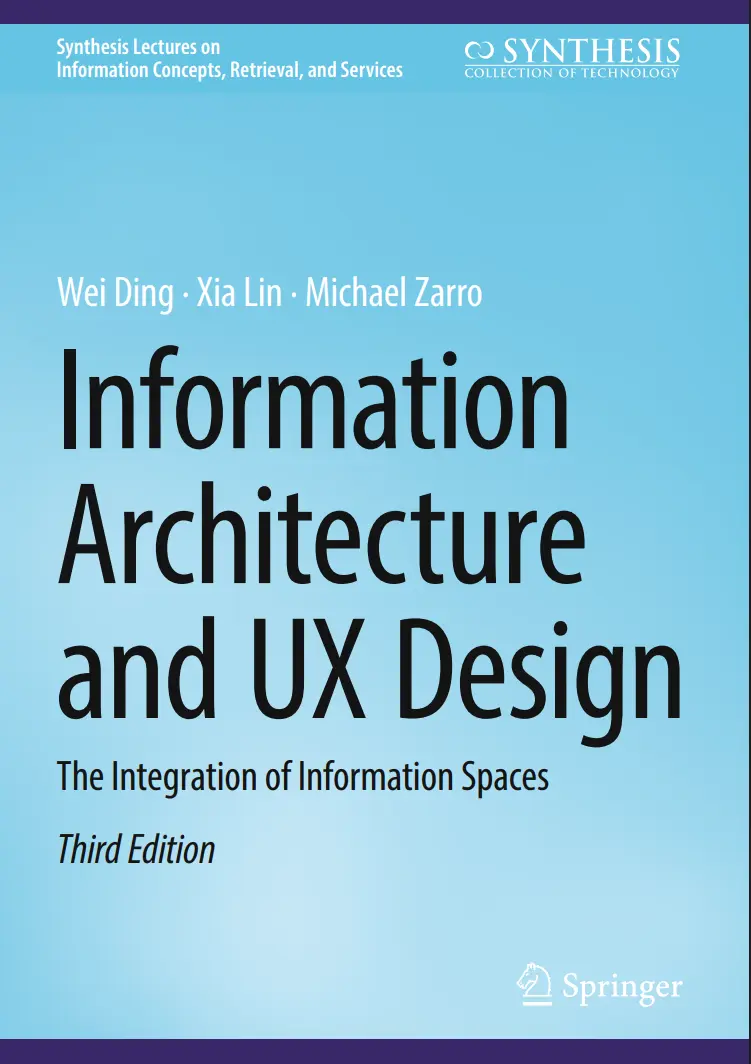
Автор: Ding Wei , Lin Xia , Zarro Michael
Дата выхода: 2025
Издательство: Springer Nature
Количество страниц: 175
Размер файла: 1,9 МБ
Тип файла: PDF
Добавил: codelibs
Проверить на вирусыPreface....6
Uses of the Book....7
Structure of the Book....7
Contents....9
About the Authors....15
1 Information Architecture and UX Design: Definitions and Scope....17
1.1 Definitions of Information Architecture....18
1.1.1 Our Definition of IA....19
1.2 Definitions of User Experience and UX Design....19
1.2.1 Our Definition of UX....20
1.3 From Web Design to Designing Information Spaces....20
1.3.1 Related Disciplines....21
1.3.2 Information Architects and UX Designers....22
1.3.3 AI Advancements in IA....23
1.3.4 Timeless Concepts....24
1.4 Summary....24
References....25
2 Information Architecture and Evolving Information Spaces....26
2.1 From the Web to Generative Information Spaces....27
2.1.1 From Foundation to Integration....27
2.1.2 Generations....28
2.1.3 Foundation....28
2.1.4 Web1.0....30
2.1.5 Web2.0....32
2.1.6 Mashups....32
2.1.7 Personalization and Aggregation....33
2.1.8 Rich Internet Apps and Web Office Apps....34
2.1.9 Tagging and Hashtags....35
2.1.10 Wikis, Blogs, and Social Media....36
2.2 Integrated Generation....36
2.2.1 Cloud....37
2.2.2 Mobile....37
2.2.3 Sensors and the Internet of Things (IoT)....38
2.2.4 Wearables....38
2.2.5 Ubiquity and Human-Centered....38
2.2.6 Artificial Intelligence, Automated Assistants....39
2.3 Generative Generation....39
2.4 Summary....40
References....41
3 Human-Centered Design....43
3.1 Human-Centered Design Background....43
3.2 Include Users in Research and Design....45
3.3 Increasing the Reach of HCD....46
3.3.1 Combines User Needs and Business Goals....46
3.3.2 HCD Helps New Technology Adoption....47
3.3.3 Guides Design Ideas....48
3.3.4 Human-Centered AI....48
3.4 ISO 9241....49
3.5 HCD Design Process....51
3.5.1 Front End UI Design....52
3.5.2 Behind the Scenes: Metadata and Controlled Vocabulary Design....52
3.5.3 Design Deliverables....53
3.6 Iterative Design....53
3.7 HCD Teams....54
3.8 Summary....56
References....57
4 Research and Evaluation....58
4.1 Research Framework....59
4.2 Evaluation....60
4.2.1 The Need for Evaluation....60
4.3 Research and Evaluation Methods....61
4.3.1 Qualitative and Quantitative Data....61
4.3.2 e-Commerce Shopping Cart Example....66
4.3.3 Research Standards....66
4.3.4 Heuristic Evaluation....67
4.3.5 Card Sorting....67
4.3.6 Usability Testing....68
4.3.7 Surveys and System Usability Scale (SUS)....68
4.3.8 Observation and Contextual Inquiry....69
4.3.9 Interviews....70
4.3.10 Usage Statistics and Log Analysis....70
4.4 Research Deliverables....71
4.4.1 User Personas....71
4.4.2 Use of Personas....71
4.4.3 Benefits of Personas....72
4.4.4 Personas Construction....72
4.4.5 User Journeys....73
4.4.6 Benefits of User Journeys....73
4.4.7 User Journey Construction....74
4.5 Research for AI....75
4.6 AI for Research....76
4.7 Summary....77
References....78
5 Information Organization and Navigation Design....80
5.1 Logical Organization....81
5.2 Semantic Organization....81
5.2.1 Metadata....82
5.2.2 Standardization....84
5.2.3 Indexing Quality....85
5.3 Controlled Vocabularies....85
5.3.1 Descriptor: Shirts....86
5.3.2 Advantages of Controlled Vocabularies....86
5.3.3 Taxonomies....87
5.3.4 Faceted Classification....87
5.3.5 Tagging....88
5.4 Navigation Systems....89
5.4.1 Navigation Types....90
5.5 Search Systems....91
5.5.1 AI Agents....91
5.6 Summary....92
References....93
6 Human Information Behavior and Design Implications....95
6.1 Understanding User Needs and Information Behavior....96
6.2 Human Information Behavior Theories and Principles....97
6.2.1 Basic Level Categories....97
6.2.2 Berry Picking Information Behavior Model....97
6.2.3 Bounded Rationality....97
6.2.4 Dual Process Theory....98
6.2.5 Exploratory Search....98
6.2.6 Fitts’ Law....99
6.2.7 Hick’s Law....99
6.2.8 Information Scent Theory....99
6.2.9 Miller’s Magic Number Seven....100
6.2.10 Paradox of Choice: Less Is More....100
6.2.11 How to Cope with Too Many Choices?....101
6.2.12 Time Scales....101
6.2.13 Powers of 10....102
6.2.14 Zipf’s Law, the Principle of Least Effort....103
6.2.15 Theories Summary....103
6.3 Design Implications....103
6.3.1 Web Use Considerations....104
6.3.2 Web Users Don’t Read Pages. They Scan....104
6.3.3 Web Users Don’t Make Optimal Choices. They Satisfice....104
6.3.4 How Do People Search the Web?....105
6.3.5 Design for Search Systems....106
6.4 AI for Search....107
6.5 Summary....108
References....108
7 Interaction Design and Design Patterns....110
7.1 Interaction Design Principles....110
7.1.1 Fitts’ Law: Design for Fitts’....111
7.1.2 Design for Affordance....112
7.1.3 Design for Efficiency....112
7.1.4 Design for Forgiveness....113
7.1.5 Easy Reversal of Actions....113
7.1.6 Error Prevention....114
7.1.7 Error Handling....114
7.1.8 Design for User Perceptions....114
7.1.9 Design for Help....115
7.1.10 Design for Inclusion....115
7.1.11 Design for Personalization and Customization....116
7.1.12 Interaction Design Components....116
7.1.13 Views, Forms, and Workflow....117
7.1.14 Filters and Controls....118
7.2 Design Patterns....119
7.2.1 Responsive Design....120
7.2.2 Industry Examples....121
7.3 Mobile Considerations....121
7.3.1 Smartphone Characteristics....122
7.3.2 Minimizing the Need for Text Entry....123
7.3.3 Prioritize Essential Information....123
7.3.4 Other Mobile Usability Best Practices....123
7.3.5 Mobile as the Platform....124
7.3.6 User’s Wallet....124
7.3.7 Mobile and Personalization....124
7.4 Design for AI....125
7.5 Research to Design Framework....126
7.5.1 Five Methods....127
7.5.2 Thinking and Experience....127
7.5.3 Theory....128
7.5.4 Patterns and Principles....128
7.5.5 Secondary Research....128
7.5.6 Primary Research....129
7.5.7 Using the Framework....129
7.6 Summary....130
References....130
8 Design Thinking to Systems Thinking....132
8.1 Human Centered Mindset....133
8.2 Zoom In and Zoom Out....133
8.3 Design Thinking....134
8.3.1 Definitions of Design Thinking....134
8.3.2 Design Thinking Process....135
8.3.3 Design Thinking in Practice....136
8.3.4 Systems Thinking....137
8.3.5 Mapping Process....140
8.3.6 Benefits of System Mapping....141
8.3.7 System Mapping Case Study....142
8.3.8 Mapping Process....142
8.3.9 Outcome....143
8.4 Summary....145
References....145
9 IA in Practice....146
9.1 Design and Development Teams....146
9.1.1 Makeup of a User Experience Design Team....146
9.1.2 Specialists, Generalists, and “T-Shaped” Professionals....148
9.1.3 Centralized Versus Distributed Organizational Models....148
9.1.4 Maximizing the IA Impact....149
9.1.5 Desired Competencies and Skill Sets for IAs....150
9.1.6 Being Strategic with Attention to Detail....151
9.1.7 Independent Thinker with Open Mind....151
9.1.8 Leader and Team Player....151
9.1.9 Problem Solver....151
9.1.10 Lifelong Learner with Passion for User Experience Design....151
9.1.11 Design Skills....152
9.2 Design Culture and DEI....153
9.2.1 Building a Strong Design Culture....153
9.2.2 Integrating DEI into Design Process....154
9.3 Agile, Lean UX and DesignOps....154
9.3.1 Agile....155
9.3.2 Lean UX....156
9.3.3 Rocket Surgery Made Easy....157
9.3.4 DesignOps....157
9.4 Summary....158
References....159
10 The Future of IA/UX Design....160
10.1 Global Considerations....160
10.1.1 Makeup of the World’s Internet Users....161
10.1.2 Languages Used on the Internet....162
10.1.3 Mobile Use....162
10.1.4 The Need for Internationalization and Localization....163
10.1.5 Cross-Culture Theories and Localization....164
10.1.6 High Context Versus Low-Context Culture Types....164
10.2 Hofstede’s Five Cultural Dimensions....165
10.2.1 Overview of the Five Dimensions....165
10.2.2 Implications of Cultural Dimensions on Design....165
10.2.3 Guidelines for Global IA and UX Design....166
10.3 The Future of IA and UX....167
10.3.1 Key Challenges....167
10.3.2 UX Community....167
10.3.3 Findability and Cross-Channel/Ubiquitous Access....169
10.3.4 Content Representation....169
10.3.5 Digital Preservation....170
10.3.6 Voice and Gesture....170
10.3.7 Inclusive Design....171
10.3.8 Customer Experience and Business Goals....171
10.3.9 Integrating Systems and Spaces....172
10.3.10 Human Centered AI....172
10.3.11 Higher Stakes....173
10.4 IA, UX Design and Beyond....174
References....174
This book explores integrated information spaces in the web context and beyond, with a focus on putting theories and principles into practice. The authors illustrate the heightened significance of Information Architecture (IA) and User Experience (UX) in industry and society. Building on foundational perspectives, the book explores advanced topics such as user research, the evolving role of Artificial Intelligence (AI), human information behaviors, and systems thinking. This Third Edition adopts a forward-looking approach to integrated web, social media, business tools, and more. Additionally, the book covers advancements in information technologies since the last release, including Generative AI and evolving IA/UX practices.


