-
1C
-
Agda
-
Agile/Scrum
-
Alef
-
APL
-
Assembler
-
AWK
-
Basic
-
Beta Programming Language
-
Big Data/DataScience
-
C
-
C#
-
C++
-
Cobol
-
Crystal
-
CSS
-
D
-
Dart
-
DataBase (SQL)
-
Delphi
-
F#
-
Flutter
-
Fortran
-
GameDev
-
Git
-
Go (Golang)
-
GPT/AI/ИИ
-
Hacking and Security
-
Haskell
-
HTML
-
Java
-
JavaScript (JS)
-
Julia
-
Kotlin
-
Machine Learning (ML)
-
Natural language processing (NLP)
-
.NET (.NET Core)
-
Pascal
-
PHP
-
Python
-
R
-
Ruby
-
Rust
-
Scratch
-
Swift
-
UML
-
UX/UI
-
Visual Basic
-
Wolfram
-
XML
-
АСУ
-
Проектирование/System Design
-
Сети/Network
-
Статьи
-
Схемотехника/электронные схемы
-
1C
-
Agda
-
Agile/Scrum
-
Alef
-
APL
-
Assembler
-
AWK
-
Basic
-
Beta Programming Language
-
Big Data/DataScience
-
C
-
C#
-
C++
-
Cobol
-
Crystal
-
CSS
-
D
-
Dart
-
DataBase (SQL)
-
Delphi
-
F#
-
Flutter
-
Fortran
-
GameDev
-
Git
-
Go (Golang)
-
GPT/AI/ИИ
-
Hacking and Security
-
Haskell
-
HTML
-
Java
-
JavaScript (JS)
-
Julia
-
Kotlin
-
Machine Learning (ML)
-
Natural language processing (NLP)
-
.NET (.NET Core)
-
Pascal
-
PHP
-
Python
-
R
-
Ruby
-
Rust
-
Scratch
-
Swift
-
UML
-
UX/UI
-
Visual Basic
-
Wolfram
-
XML
-
АСУ
-
Проектирование/System Design
-
Сети/Network
-
Статьи
-
Схемотехника/электронные схемы
Меню
Crafting Clean Code with JavaScript and React: A Practical Guide to Sustainable Front-End Development
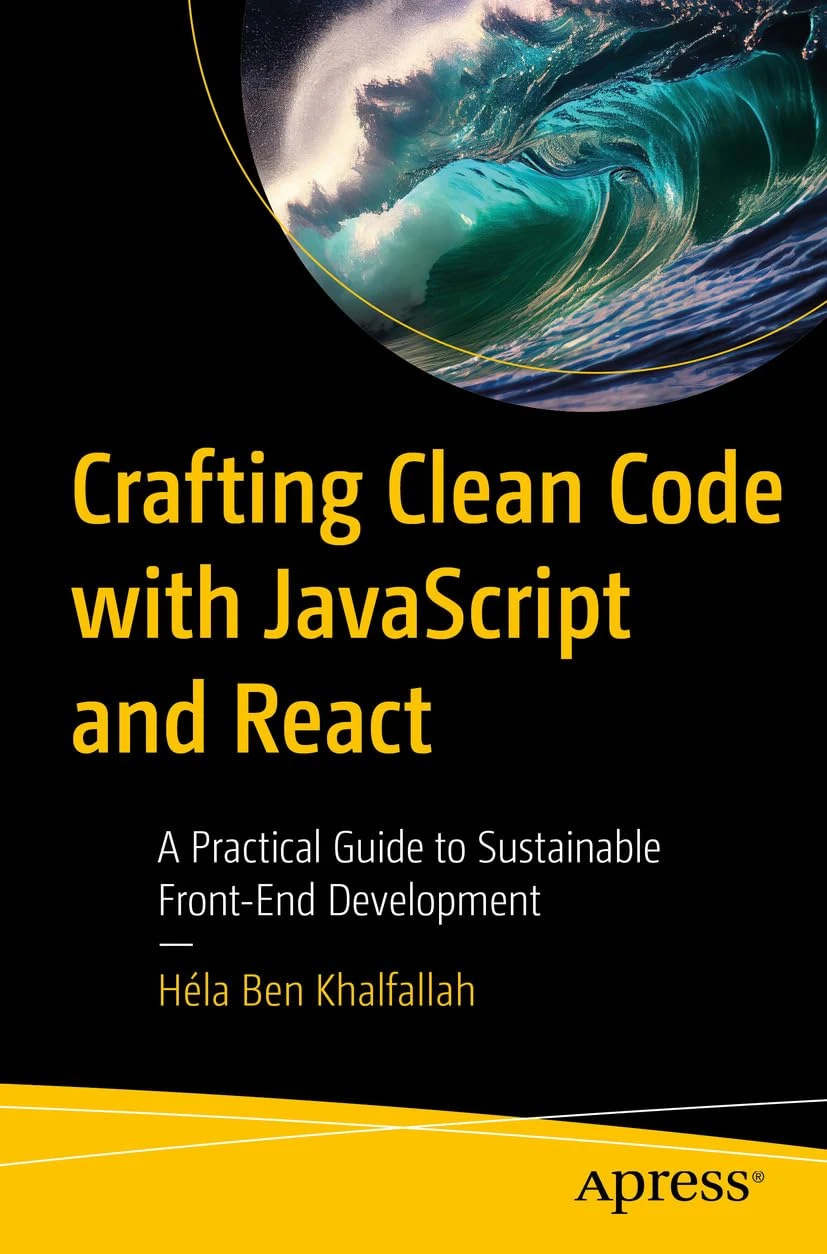
Автор: Khalfallah Héla Ben
Дата выхода: 2024
Издательство: Apress Media, LLC.
Количество страниц: 443
Размер файла: 6,7 МБ
Тип файла: PDF
Добавил: codelibs
Проверить на вирусыTable of Contents....5
About the Author....11
About the Technical Reviewer....12
Introduction: The JavaScript Bubbling Movement....13
Chapter 1: Getting Started: Presenting the Context....16
The Team....17
The Web Application....18
Nonfunctional and Technical Requirements....20
Nonfunctional Requirements....20
Technical Requirements....21
Conclusion....22
Chapter 2: Functional Programming: Blueprint for Pure Code....23
JavaScript Against Others....24
Elm: A Deep Dive....27
ReasonML: An Overview....32
Emscripten: An In-Depth Look....34
TypeScript: An In-Depth Look....36
The Decision: JavaScript....38
The Rise of Functional Programming....39
JavaScript Paradigms....39
Foundations of Functional Thinking....40
Code Driven by Composition....40
Side Effects....42
Pure Functions: The Bedrock of Predictable Code....49
Defining Purity....50
Why Pure Functions Matter....50
Pure vs. Impure: A JavaScript Perspective....51
Pure Functions in React....51
Real-World Applications....52
Mathematical Notation....52
Key Takeaways....54
Immutable and Scoped Variables and Parameters....54
What Makes Immutability So Significant?....54
Primitive and Reference Data Types....55
Deep vs. Shallow Copy: Understanding Object Duplication in JavaScript....58
Declarative Approach to Reduce Code Amount....61
Declarative vs. Imperative....61
Generalizing with Higher-Order Functions....62
Abstraction, Modularity, and Function Composition....63
Handling Code Complexity: Split, Compose, and Reuse....64
The Power of Composition....65
Composition in JavaScript....65
Benefits of Composition....66
Higher-Order Functions: The Glue of Composition....66
Currying: Simplifying Functions with Partial Application....67
Benefits of Currying....68
Beyond Unit Conversion....68
Key Takeaways....69
Functional Programming Superpowers....69
Memoization....69
Why Memoization?....70
Requirements for Memoization....70
Memoization in JavaScript....70
Recursion....72
Memoization and Recursion....81
Lazy Evaluation: Optimizing Computation Through Demand-Driven Execution....84
Functors: Composable Transformations in a Safe Context....85
Monads: Elevating Functional Programming....87
Key Takeaways....89
Thinking Functionally with JavaScript....90
Scoped Variables: let and const....90
Key Takeaways....93
Arrow Functions....94
Key Takeaways....98
High-Order Functions: The Basic Unit of Abstraction....98
Creating Our Own Control Abstractions....102
map to Transform Array Data....103
reduce to Group Array Results....109
filter Out Undesirable Elements....110
Chaining: Performing Sequential Operations on Arrays....111
every/some....112
Time and Space Complexity of JavaScript Array Methods....114
Key Takeaways....116
Metaprogramming in JavaScript....117
Proxies....117
Reflection....118
Use Cases for Proxies and Reflection....119
Validation....119
Logging and Profiling....120
Immutability....121
Dynamic Object Composition....122
Security....123
Cautions with Metaprogramming....124
Debugging....124
Performance....124
Security....124
Creating Shallow Copy with Spread....124
Optional Chaining with “OR”: Safe Access with Default Values....132
Maybe: “If (Not Null) Then” As an Expression....137
The Problem with Null Checks....137
The Maybe Solution....138
Benefits....139
Either: "If/Else" As an Expression....139
The Problem with Traditional Error Handling....139
The Either Solution....140
Example: Error Handling in a Division Function....141
Example: Handling HTTP Response....142
Benefits....144
Pattern Matching: switch As an Expression....145
Key Takeaways....146
Thinking Functionally About UI Using ReactJS....147
React Declarative Approach....147
Lazy Evaluation....151
Memoization....152
Lazy Loading....155
Higher-Order Component (HOC)....157
Effects....160
Functional Reactive Programming (FRP) in React....162
Key Takeaways....164
Thinking Functionally About Async Side Effects....165
Asynchrony Jargon....166
Promisification....168
Linear Async Flows....174
Generators....174
Generator: Early Completion....178
Generator: Early Abort....181
An Attempt to Make Asynchronous Generators....183
Asynchronous Generators....192
Key Takeaways....199
Conclusion....200
Chapter 3: SAGE(S)-Driven Design: An Inclusive and Eco-friendly Website....201
SAGE(S)-Driven Design....202
Semantic....203
Reviving the Power of HTML....203
Backbone of an HTML Document....206
Order and Priority of Web Resource Loads....209
Body’s Arrangement....210
HTML Elements Categories....210
Break the Page into Sections....211
Root Layout....212
The Dilemma: Article vs. Section....213
Headings Hierarchy....214
Paragraph....215
Text-Level Semantics....215
How Can a List of Data Be Represented in a Semantic Way?....217
How to Semantically Organize a Form?....217
Semantic Media Elements....219
Layout Validation....220
Key Takeaways....220
Accessible....221
What Does It Mean to Be “Accessible”?....221
Accessibility Guidelines....222
Screen Readers and HTML....223
Temporary Disabilities....224
Accessibility Best Practices....224
WAI-ARIA....225
Accessibility Testing Tools....227
Key Takeaways....228
Green....229
Sustainable UX Design....229
Sustainable UX Design Practices....230
Easy (KISS): Keep It Simple, Stupid....231
KISS UI/UX Design....231
KISS Software Development....232
Key Takeaways....232
Secure....233
Frontend Security Threats....233
URL-Based Attacks....234
DOM-Based Attacks....235
Form-Based Attacks....237
Input Attacks....237
Form Action Hijacking....238
JSON-Based Attacks....239
React Escape Hatches....240
Dependencies Vulnerabilities....242
Defense Plans....242
Prevent URL-Based XSS Attacks....242
Prevent DOM-Based XSS Attacks....243
innerText Instead of innerHTML....243
Prevent Form-Based XSS Attacks....244
Prevent Dependencies Vulnerabilities....244
Key Takeaways....245
Conclusion....246
Chapter 4: HOFA: The Path Toward Clean Architecture....247
Why Does Software Design and Architecture Matter?....248
Foundation and Plan....248
Team Collaboration....248
Consistency and Automation....248
Adaptive Architecture....249
Bugs and Regressions....249
Quality and Future-Proofing....249
“Good” Architecture’s Definition....249
Learnability....251
Performance (Time and Resource Utilization)....252
Configurability....252
Flexibility....252
Testability....253
Maintainability....253
Measuring Architecture Characteristics....253
Mathematical Model for Software Architecture (Sets and Graphs)....253
Sets for Describing Modules....254
Graphs for Visualizing Relationships....254
Sets for Measuring Cohesion....254
Graphs for Measuring Coupling....255
Benefits of This Approach....256
Practical Measurement of Software Architecture's Effectiveness....256
Metrics....256
Efferent Coupling (CE)....258
Afferent Coupling (CA)....258
Instability Index....259
Code Health Meter Tool....260
Frontend-Oriented Architecture Styles....261
Atomic Design....261
Unidirectional Architecture....267
Extending Capabilities with Ports and Adapters (Hexagonal Architecture)....275
Defining Subdomains (Feature-Sliced Design)....280
Reinforcing Boundaries (Onion Architecture)....282
Final Architecture: HOFA Architecture....289
Merge Patterns and Maximize Profits....290
Benefits....295
Trade-Offs....297
Key Takeaways....298
Conclusion....301
Chapter 5: MOME: Befriend User Execution Capabilities....302
Why Does Performance Matter?....302
What Factors Can Impact Both Loading and Interaction Performance?....303
Browser Internal Working....303
Focus on the Rendering Engine....307
Interaction Between Rendering Engine and JavaScript....310
The Order of Processing Scripts and Stylesheets....312
JavaScript Engines Working Pipeline....316
Standard Working Pipeline for JavaScript Engine....316
V8 (Chrome) Pipeline....318
SpiderMonkey (Firefox) Pipeline....321
Executing an Asynchronous Task (Case of V8)....323
Memory Management (Case of V8)....326
Lessons Learned....327
“MOME” Performance Methodology....330
Measure....330
Performance Metrics....330
A Metric for Each Phase....330
First Contentful Paint....332
Largest Contentful Paint (LCP)....333
First Input Delay (FID)....334
Cumulative Layout Shift (CLS)....335
Interaction to Next Paint (INP)....336
Core Web Vitals....338
Time to Interactive (TTI)....339
Total Blocking Time (TBT)....341
Performance Measurement Tools....343
Code Coverage (Find Unused JavaScript and CSS)....343
Performance Monitor (Analyze Runtime Performance)....345
Network Monitor (Inspect Network Activity)....347
Memory Inspection (Find Memory Issues)....349
Lighthouse (All in One)....351
WebPageTest (Beyond the Local)....353
HTTP Archive (Keep an Eye on the World)....355
Optimize....356
Lazy-First....356
Small Is Better....360
Modern Is More Efficient....362
Adaptive Serving....363
Other Tips....365
Monitor....366
Performance Budgets (Catch Issues Before They Ship)....366
Project Health Tool....369
Educate....371
Key Takeaways....371
Conclusion....373
Chapter 6: CRISP: Clean, Reliable, Integrated Software Process....374
Why CRISP?....375
Pre-development....376
Define a Common Development Protocol....376
Naming Convention....376
Import Order....381
Self-documenting Code vs. Comments....381
Define a Shared Checklist....384
React Checklist....384
W3C Compliance Checklist....386
A11Y Checklist....388
Performances Checklist....392
Security Checklist....393
Browser Compatibility....396
First Step Toward Automated Best Practices....397
Code Generator....397
ESLint for Code-Level Analysis....398
Complexity Analysis....398
Adherence to JavaScript Recommendations....399
Modern JavaScript Features....399
Integrating the Airbnb JavaScript Style Guide....400
Code Formatting....400
Code Health Meter....401
Cognitive Complexity: A Subjective Lens on Code Readability....402
Limitations of Cognitive Complexity....402
Why I Don’t Rely on Cognitive Complexity....403
Bundle Analysis....403
Dependency Management....404
During Development....406
The World of Testing....406
Testing Trophy: A Balanced Approach to Modern Software Testing....406
Unit Testing Reusable Components....408
Integration Testing with Cypress....412
End-to-End Testing with Cypress....413
Visual Testing....414
Why Visual Testing Matters?....414
Visual Testing with Puppeteer and Pixelmatch....415
Key Takeaways: Building a Robust Testing Strategy for React....417
Essential DevTools for React Development: Mastering Our Toolkit....419
React Developer Tools: Our Window into the React World....419
Browser Developer Tools: Our Web Development Arsenal....420
Proactive Use of DevTools....421
Documentation: Empowering Collaboration and Understanding....422
Types of Documentation: Meeting Diverse Needs....422
Best Practices for Documentation Excellence....423
Reaping the Rewards: Why Documentation Matters....424
Overcoming Challenges....424
Post-development....425
Collaborative Coding: Powering React Development with Teamwork....425
Key Collaborative Practices....425
Pull Requests (PRs) and Release Flow: Bridging Collaboration and Delivery....426
Collaborative Coding in the React Ecosystem....427
Continuous Integration (CI): Our Safety Net for Code Quality....428
Automated Code Verification....429
Automated Bundle Check and Security Scanning....430
GitLab CI/CD Example....432
The Power of Continuous Integration and Automated Verification....433
Project Health Tool (phTool)....433
Monitoring and Logging: Keeping Your React Apps Healthy....436
Application Monitoring: The Pulse of Your App....436
Error Logging: Your Application’s Black Box....437
Best Practices for Monitoring and Logging....438
Key Takeaways....439
Conclusion....440
Book Summary....441
Understand the guiding principles of “clean code” and how it applies to modern front-end development, accessibility (a11y), semantics, performance, and the Green Web. Highlighting key topics ranging from the foundations of JavaScript and HTML to popular frameworks like React, this book provides best practices to ensure code and applications are easier, more efficient and cost effective to run.
Using a web-based application as an example, you’ll begin by cleaning and improving its code base by dividing the JavaScript into smaller, reusable and composable functions without side effects. Then, you’ll improve the HTML code base by applying "Disability Driven Design" patterns, focusing on semantics before moving on to improving the architecture with a functional style (immutable, modular and composable).
Because the web today needs to be green with reduced loading time and energy consumption, you’ll apply some tips and tricks to improve code performance and see how to best monitor it in a continuous and scalable way.
What You’ll Learn
- See how the JavaScript engine works and memory management.
- Explore in greater detail key focus areas of accessibility and green computing
- Make applications easier and more cost-effective to run
- Look closely at clean and sustainable development using JavaScript and React
Who This Book Is For
Programmers, developers, engineers and product managers who are looking at cost-efficient ways to make their applications run more smoothly and efficiently.


