-
1C
-
Agda
-
Agile/Scrum
-
Alef
-
APL
-
Assembler
-
AWK
-
Basic
-
Beta Programming Language
-
Big Data/DataScience
-
C
-
C#
-
C++
-
Cobol
-
Crystal
-
CSS
-
D
-
Dart
-
DataBase (SQL)
-
Delphi
-
F#
-
Flutter
-
Fortran
-
GameDev
-
Git
-
Go (Golang)
-
GPT/AI/ИИ
-
Hacking and Security
-
Haskell
-
HTML
-
Java
-
JavaScript (JS)
-
Julia
-
Kotlin
-
Machine Learning (ML)
-
Natural language processing (NLP)
-
.NET (.NET Core)
-
Pascal
-
PHP
-
Python
-
R
-
Ruby
-
Rust
-
Scratch
-
Swift
-
UML
-
UX/UI
-
Visual Basic
-
Wolfram
-
XML
-
АСУ
-
Проектирование/System Design
-
Сети/Network
-
Статьи
-
Схемотехника/электронные схемы
-
1C
-
Agda
-
Agile/Scrum
-
Alef
-
APL
-
Assembler
-
AWK
-
Basic
-
Beta Programming Language
-
Big Data/DataScience
-
C
-
C#
-
C++
-
Cobol
-
Crystal
-
CSS
-
D
-
Dart
-
DataBase (SQL)
-
Delphi
-
F#
-
Flutter
-
Fortran
-
GameDev
-
Git
-
Go (Golang)
-
GPT/AI/ИИ
-
Hacking and Security
-
Haskell
-
HTML
-
Java
-
JavaScript (JS)
-
Julia
-
Kotlin
-
Machine Learning (ML)
-
Natural language processing (NLP)
-
.NET (.NET Core)
-
Pascal
-
PHP
-
Python
-
R
-
Ruby
-
Rust
-
Scratch
-
Swift
-
UML
-
UX/UI
-
Visual Basic
-
Wolfram
-
XML
-
АСУ
-
Проектирование/System Design
-
Сети/Network
-
Статьи
-
Схемотехника/электронные схемы
Меню
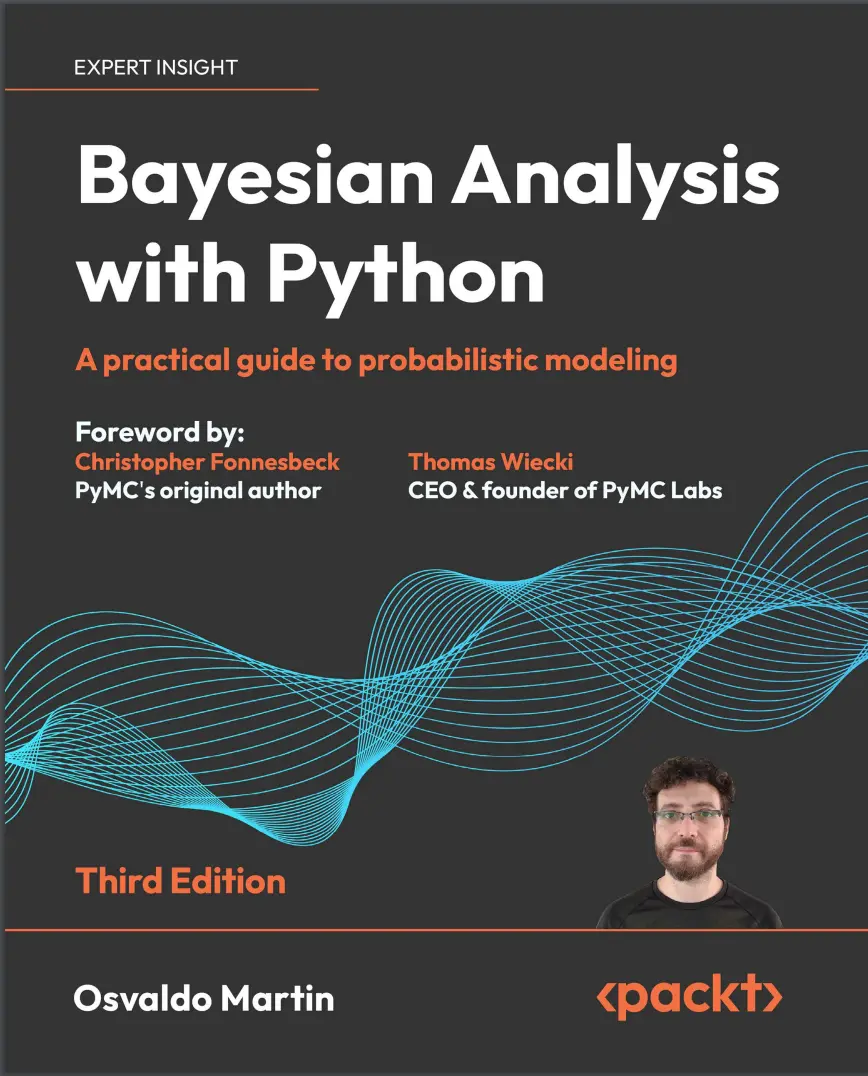
Bayesian Analysis with Python: A practical guide to probabilistic modeling. 3 Ed
Автор: Osvaldo Martin
Дата выхода: 2024
Издательство: Packt Publishing Limited
Количество страниц: 395
Размер файла: 3,6 МБ
Тип файла: PDF
Добавил: codelibs
Проверить на вирусы Дополнительные материалыCover....1
Copyright....3
Foreword....5
Contributors....8
Table of Contents....12
Preface....20
Who this book is for....21
What this book covers....21
What's new in this edition?....23
Installation instructions....25
Conventions used....27
Chapter 1: Thinking Probabilistically....30
Statistics, models, and this book's approach....31
Working with data....32
Bayesian modeling....33
A probability primer for Bayesian practitioners....34
Sample space and events....34
Random variables....38
Discrete random variables and their distributions....40
Continuous random variables and their distributions....45
Cumulative distribution function....47
Conditional probability....49
Expected values....51
Bayes' theorem....52
Interpreting probabilities....55
Probabilities, uncertainty, and logic....57
Single-parameter inference....58
The coin-flipping problem....58
Choosing the likelihood....59
Choosing the prior....60
Getting the posterior....62
The influence of the prior....66
How to choose priors....67
Communicating a Bayesian analysis....70
Model notation and visualization....70
Summarizing the posterior....71
Summary....73
Exercises....74
Chapter 2: Programming Probabilistically....78
Probabilistic programming....79
Flipping coins the PyMC way....80
Summarizing the posterior....83
Posterior-based decisions....86
Savage-Dickey density ratio....87
Region Of Practical Equivalence....88
Loss functions....90
Gaussians all the way down....93
Gaussian inferences....93
Posterior predictive checks....97
Robust inferences....99
Degrees of normality....100
A robust version of the Normal model....101
InferenceData....105
Groups comparison....107
The tips dataset....109
Cohen's d....112
Probability of superiority....113
Posterior analysis of mean differences....114
Summary....116
Exercises....117
Chapter 3: Hierarchical Models....120
Sharing information, sharing priors....121
Hierarchical shifts....122
Water quality....126
Shrinkage....129
Hierarchies all the way up....132
Summary....136
Exercises....137
Chapter 4: Modeling with Lines....140
Simple linear regression....141
Linear bikes....143
Interpreting the posterior mean....145
Interpreting the posterior predictions....148
Generalizing the linear model....149
Counting bikes....150
Robust regression....152
Logistic regression....155
The logistic model....155
Classification with logistic regression....158
Interpreting the coefficients of logistic regression....160
Variable variance....162
Hierarchical linear regression....165
Centered vs. noncentered hierarchical models....168
Multiple linear regression....170
Summary....173
Exercises....174
Chapter 5: Comparing Models....176
Posterior predictive checks....177
The balance between simplicity and accuracy....183
Many parameters (may) lead to overfitting....183
Too few parameters lead to underfitting....185
Measures of predictive accuracy....186
Information criteria....187
Akaike Information Criterion....188
Widely applicable information criteria....189
Other information criteria....189
Cross-validation....190
Approximating cross-validation....191
Calculating predictive accuracy with ArviZ....193
Model averaging....196
Bayes factors....197
Some observations....199
Calculation of Bayes factors....200
Analytically....200
Sequential Monte Carlo....203
Savage–Dickey ratio....204
Bayes factors and inference....207
Regularizing priors....208
Summary....210
Exercises....211
Chapter 6: Modeling with Bambi....214
One syntax to rule them all....215
The bikes model, Bambi's version....219
Polynomial regression....222
Splines....224
Distributional models....227
Categorical predictors....229
Categorical penguins....229
Relation to hierarchical models....232
Interactions....233
Interpreting models with Bambi....236
Variable selection....238
Projection predictive inference....240
Projection predictive with Kulprit....241
Summary....246
Exercises....247
Chapter 7: Mixture Models....250
Understanding mixture models....251
Finite mixture models....253
The Categorical distribution....255
The Dirichlet distribution....255
Chemical mixture....256
The non-identifiability of mixture models....258
How to choose K....260
Zero-Inflated and hurdle models....263
Zero-Inflated Poisson regression....264
Hurdle models....266
Mixture models and clustering....269
Non-finite mixture model....270
Dirichlet process....270
Continuous mixtures....276
Some common distributions are mixtures....276
Summary....277
Exercises....279
Chapter 8: Gaussian Processes....282
Linear models and non-linear data....283
Modeling functions....284
Multivariate Gaussians and functions....286
Covariance functions and kernels....287
Gaussian processes....290
Gaussian process regression....291
Gaussian process regression with PyMC....291
Setting priors for the length scale....295
Gaussian process classification....296
GPs for space flu....299
Cox processes....300
Coal mining disasters....301
Red wood....303
Regression with spatial autocorrelation....306
Hilbert space GPs....311
HSGP with Bambi....314
Summary....315
Exercises....316
Chapter 9: Bayesian Additive Regression Trees....318
Decision trees....319
BART models....321
Bartian penguins....322
Partial dependence plots....324
Individual conditional plots....325
Variable selection with BART....326
Distributional BART models....329
Constant and linear response....331
Choosing the number of trees....333
Summary....334
Exercises....334
Chapter 10: Inference Engines....336
Inference engines....337
The grid method....338
Quadratic method....341
Markovian methods....343
Monte Carlo....343
Markov chain....345
Metropolis-Hastings....346
Hamiltonian Monte Carlo....351
Sequential Monte Carlo....353
Diagnosing the samples....356
Convergence....357
Trace plot....357
Rank plot....359
, (R hat)....360
Effective Sample Size (ESS)....362
Monte Carlo standard error....364
Divergences....365
Keep calm and keep trying....367
Summary....368
Exercises....369
Chapter 11: Where to Go Next....372
Other Books You May Enjoy....383
Index....388
The third edition of Bayesian Analysis with Python serves as an introduction to the main concepts of applied Bayesian modeling using PyMC, a state-of-the-art probabilistic programming library, and other libraries that support and facilitate modeling like ArviZ, for exploratory analysis of Bayesian models; Bambi, for flexible and easy hierarchical linear modeling; PreliZ, for prior elicitation; PyMC-BART, for flexible non-parametric regression; and Kulprit, for variable selection.
In this updated edition, a brief and conceptual introduction to probability theory enhances your learning journey by introducing new topics like Bayesian additive regression trees (BART), featuring updated examples. Refined explanations, informed by feedback and experience from previous editions, underscore the book's emphasis on Bayesian statistics. You will explore various models, including hierarchical models, generalized linear models for regression and classification, mixture models, Gaussian processes, and BART, using synthetic and real datasets.
By the end of this book, you will possess a functional understanding of probabilistic modeling, enabling you to design and implement Bayesian models for your data science challenges. You'll be well-prepared to delve into more advanced material or specialized statistical modeling if the need arises.
What you will learn
- Build probabilistic models using PyMC and Bambi
- Analyze and interpret probabilistic models with ArviZ
- Acquire the skills to sanity-check models and modify them if necessary
- Build better models with prior and posterior predictive checks
- Learn the advantages and caveats of hierarchical models
- Compare models and choose between alternative ones
- Interpret results and apply your knowledge to real-world problems
- Explore common models from a unified probabilistic perspective
- Apply the Bayesian framework's flexibility for probabilistic thinking
Who this book is for
If you are a student, data scientist, researcher, or developer looking to get started with Bayesian data analysis and probabilistic programming, this book is for you. The book is introductory, so no previous statistical knowledge is required, although some experience in using Python and scientific libraries like NumPy is expected.


