-
1C
-
Agda
-
Agile/Scrum
-
Alef
-
APL
-
Assembler
-
AWK
-
Basic
-
Beta Programming Language
-
Big Data/DataScience
-
C
-
C#
-
C++
-
Cobol
-
Crystal
-
CSS
-
D
-
Dart
-
DataBase (SQL)
-
Delphi
-
F#
-
Flutter
-
Fortran
-
GameDev
-
Git
-
Go (Golang)
-
GPT/AI/ИИ
-
Hacking and Security
-
Haskell
-
HTML
-
Java
-
JavaScript (JS)
-
Julia
-
Kotlin
-
Machine Learning (ML)
-
Natural language processing (NLP)
-
.NET (.NET Core)
-
Pascal
-
PHP
-
Python
-
R
-
Ruby
-
Rust
-
Scratch
-
Swift
-
UML
-
UX/UI
-
Visual Basic
-
Wolfram
-
XML
-
АСУ
-
Проектирование/System Design
-
Сети/Network
-
Статьи
-
Схемотехника/электронные схемы
-
1C
-
Agda
-
Agile/Scrum
-
Alef
-
APL
-
Assembler
-
AWK
-
Basic
-
Beta Programming Language
-
Big Data/DataScience
-
C
-
C#
-
C++
-
Cobol
-
Crystal
-
CSS
-
D
-
Dart
-
DataBase (SQL)
-
Delphi
-
F#
-
Flutter
-
Fortran
-
GameDev
-
Git
-
Go (Golang)
-
GPT/AI/ИИ
-
Hacking and Security
-
Haskell
-
HTML
-
Java
-
JavaScript (JS)
-
Julia
-
Kotlin
-
Machine Learning (ML)
-
Natural language processing (NLP)
-
.NET (.NET Core)
-
Pascal
-
PHP
-
Python
-
R
-
Ruby
-
Rust
-
Scratch
-
Swift
-
UML
-
UX/UI
-
Visual Basic
-
Wolfram
-
XML
-
АСУ
-
Проектирование/System Design
-
Сети/Network
-
Статьи
-
Схемотехника/электронные схемы
Меню
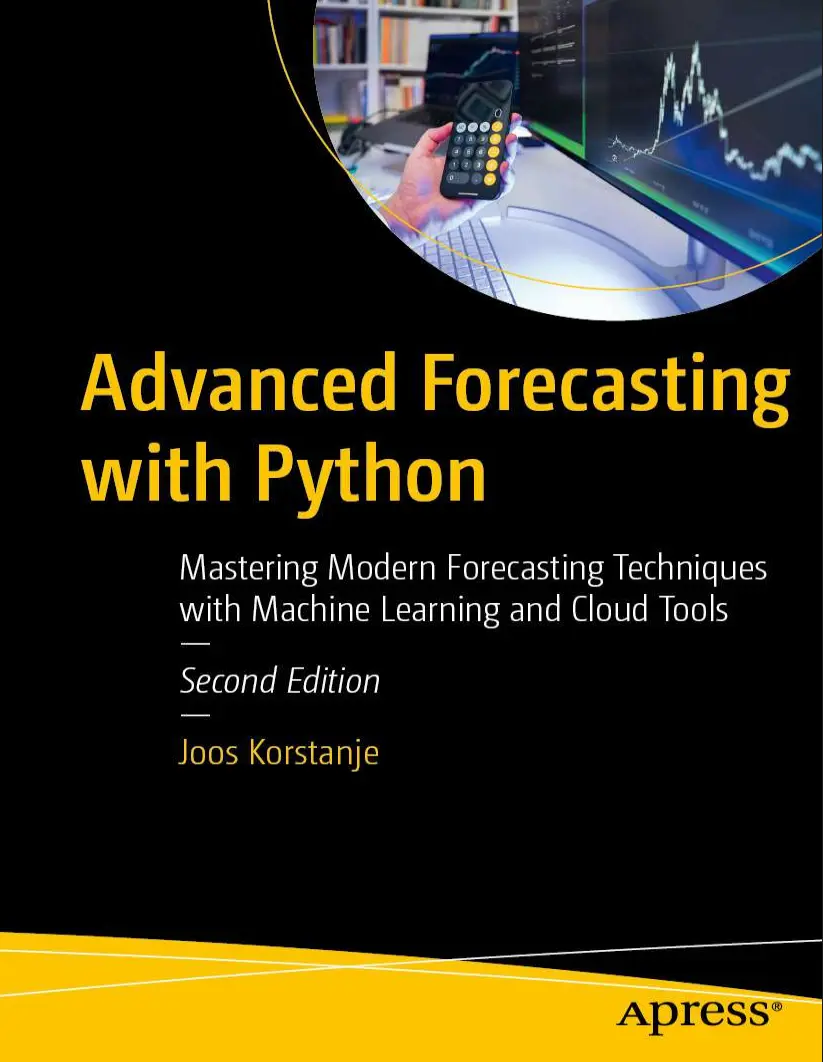
Advanced Forecasting with Python: Mastering Modern Forecasting Techniques with Machine Learning and Cloud Tools. 2 Ed
Автор: Korstanje Joos
Дата выхода: 2025
Издательство: Apress Media, LLC.
Количество страниц: 460
Размер файла: 5,8 МБ
Тип файла: PDF
Добавил: codelibs
Проверить на вирусы Дополнительные материалыAdvanced Forecasting with Python....2
Introduction....5
Table of Contents....7
About the Author....19
About the Technical Reviewer....20
Part I: Machine Learning for Forecasting....21
1. Models for Forecasting....22
Reading Guide for This Book....23
Machine Learning Landscape....23
Univariate Time Series Models....23
A Quick Example of the Time Series Approach....24
Supervised Machine Learning Models....29
A Quick Example of the Supervised Machine Learning Approach....29
Correlation Coefficient....36
Other Distinctions in Machine Learning Models....37
Supervised vs. Unsupervised Models....37
Classification vs. Regression Models....38
Univariate vs. Multivariate Models....38
Key Takeaways....39
2. Model Evaluation for Forecasting....40
Evaluation with an Example Forecast....40
Error Metrics....43
Error Metric 1: MSE....43
Error Metric 2: RMSE....44
Error Metric 3: R2....44
Error Metric 4: MAE....45
Error Metric 5: MAPE....46
Model Evaluation Strategies....46
Overfit and the Out of Sample Error....47
Strategy 1: Train-Test Split....47
Strategy 2: Train-Validation-Test Split....49
Strategy 3: Cross-Validation for Forecasting....51
K-Fold Cross-Validation....51
Time Series Cross-Validation....53
Rolling Time Series Cross-Validation....55
Backtesting....57
Which Strategy to Use for Safe Forecasts?....58
Final Considerations on Model Evaluation....58
Key Takeaways....59
3. Model Management and Benchmarking Using MLflow....61
Introduction to MLflow....61
Local vs. Hosted MLflow....62
Setting Up MLflow Locally....62
Experiment Tracking Using MLflow....63
MLflow Data....64
Artifacts....65
Metrics....65
Params....66
Tags....66
Inspecting the Model Logs Through Python....66
The MLflow UI....67
MLflow Throughout This Book....68
Key Takeaways....69
Part II: Univariate Time Series Models....70
4. The AR Model....71
Autocorrelation: The Past Influences the Present....72
Compute Autocorrelation in Earthquake Counts....72
Positive and Negative Autocorrelation....77
Stationarity and the ADF Test....78
Differencing a Time Series....79
Lags in Autocorrelation....81
Partial Autocorrelation....84
How Many Lags to Include?....86
AR Model Definition....86
Estimating the AR Using Yule–Walker Equations....87
The Yule–Walker Method....87
Train, Test, Evaluation, and Tuning....92
Saving the Final Model Using MLflow....97
Key Takeaways....99
5. The MA Model....100
The Model Definition....101
Fitting the MA Model....102
Stationarity....103
Choosing Between an AR and an MA Model....103
Application of the MA Model....105
Multistep Forecasting with Model Retraining....113
Grid Search to Find the Best MA Order....116
Saving This Model in MLflow....118
Key Takeaways....119
6. The ARMA Model....121
The Idea Behind the ARMA Model....121
The Mathematical Definition of the ARMA Model....122
An Example: Predicting Births Using ARMA....122
Fitting an ARMA(1,1) Model....128
More Model Evaluation KPIs....129
Automated Hyperparameter Tuning....133
Grid Search: Tuning for Predictive Performance....134
Saving This Model in MLflow....138
Key Takeaways....140
7. The ARIMA Model....141
ARIMA Model Definition....141
Model Definition....142
ARIMA on the CO2 Example....142
Key Takeaways....149
8. The SARIMA Model....151
Univariate Time Series Model Breakdown....151
The SARIMA Model Definition....152
Example: SARIMA on Walmart Sales....153
Key Takeaways....158
Part III: Multivariate Time Series Models....159
9. The SARIMAX Model....160
Time Series Building Blocks....160
Model Definition....161
Supervised Models vs. SARIMAX....161
Example of SARIMAX on the Walmart Dataset....162
Key Takeaways....166
10. The VAR Model....168
The Model Definition....168
Order: Only One Hyperparameter....169
Stationarity....169
Estimation of the VAR Coefficients....169
One Multivariate Model vs. Multiple Univariate Models....170
An Example: VAR for Forecasting Walmart Sales....170
Key Takeaways....174
11. The VARMAX Model....175
Model Definition....176
Multiple Time Series with Exogenous Variables....176
Key Takeaways....179
Part IV: Supervised Models....180
12. The Linear Regression....181
Linear Regression....182
Model Definition....182
Example: Linear Model to Forecast CO2 Levels....184
Key Takeaways....190
13. The Decision Tree Model....192
Mathematics....193
Splitting....193
Pruning and Reducing Complexity....194
Example....194
Key Takeaways....202
14. The kNN Model....203
Intuitive Explanation....203
Mathematical Definition of Nearest Neighbors....204
Combining k Neighbors into One Forecast....205
Deciding on the Number of Neighbors k....206
Predicting Traffic Using kNN....207
Grid Search on kNN....210
Random Search: An Alternative to Grid Search....211
Key Takeaways....212
15. The Random Forest....213
Intuitive Idea Behind Random Forests....213
Random Forest Concept 1: Ensemble Learning....214
Bagging Concept 1: Bootstrap....214
Bagging Concept 2: Aggregation....215
Random Forest Concept 2: Variable Subsets....216
Predicting Births Using a Random Forest....216
Grid Search on the Two Main Hyperparameters of the Random Forest....218
Random Search CV Using Distributions....220
Distribution for max_features....220
Distribution for n_estimators....222
Fitting the RandomizedSearchCV....223
Interpretation of Random Forests: Feature Importance....224
Key Takeaways....227
16. Gradient Boosting with XGBoost, LightGBM, and CatBoost....228
Boosting: A Different Way of Ensemble Learning....228
Gradient Boosting....229
The Difference Between XGBoost and LightGBM....230
Adding CatBoost to the Mix....232
Forecasting Traffic Volume with XGBoost....232
Forecasting Traffic Volume with LightGBM....234
Forecasting Traffic Volume with CatBoost....234
Inspecting the Differences in Predictions....235
Hyperparameter Tuning Using Bayesian Optimization....236
The Theory of Bayesian Optimization....236
Bayesian Optimization Using scikit-optimize....237
Conclusion....243
Key Takeaways....243
17. Bayesian Models with pyBATS....245
Intuitive Idea Behind Bayesian Models....245
Bayesian vs. Frequentist Statistics....246
pyBATS As an Implementation of Bayesian Forecasting....247
Forecasting Sales Using pyBATS....248
Sales Forecast: Exploratory Data Analysis....248
Sales Forecast: Univariate Poisson DGLM....253
Sales Forecast: Normal DGLM with X Variable....256
Key Takeaways....258
Part V: Neural Networks....260
18. Neural Networks....261
Fully Connected Neural Networks....262
Activation Functions....262
The Weights: Backpropagation....263
Optimizers....264
Learning Rate of the Optimizer....264
Hyperparameters at Play in Developing a NN....264
Introducing the Example Data....265
Specific Data Prep Needs for NN....267
Scaling and Standardization....267
Principal Component Analysis (PCA)....267
The Neural Network Using Keras....270
Conclusion....276
Key Takeaways....277
19. RNNs Using SimpleRNN and GRU....278
What Are RNNs: Architecture....278
Inside the SimpleRNN Unit....279
The Example....280
Predicting a Sequence Rather Than a Value....280
Univariate Model Rather Than Multivariable....280
Preparing the Data....281
A Simple SimpleRNN....283
SimpleRNN with Hidden Layers....285
Simple GRU....287
GRU with Hidden Layers....290
Key Takeaways....292
20. LSTM RNNs....293
What Is LSTM....293
The LSTM Cell....293
Example....294
LSTM with 1 Layer of 8....296
LSTM with 3 Layers of 64....299
Conclusion....301
Key Takeaways....301
Part VI: Black Box and Cloud-Based Models....303
21. The N-BEATS Model with Darts....304
Intuition and Mathematics of N-BEATS....304
Interpretability....304
Stacking....305
Automatic Feature Engineering and Decomposition....305
The Darts Package and Its Implementation of N-BEATS....305
Forecasting Sales Using N-BEATS in Darts....306
Sales Forecast: Preparing the Data....306
Sales Forecast: Create Default N-BEATS Model....310
Sales Forecast: Create Multivariate N-BEATS Model....312
Sales Forecast: Tuning the Multivariate N-BEATS Model....315
Benchmark Results....319
Key Takeaways....319
22. The Transformer Model with Darts....321
Intuition and Mathematics of Transformers....321
Attention Is All You Need....322
Transformers Move Away from Recurrent Units....322
Positional Encoding....322
Self-Attention....323
The Darts Package and Its Implementation of Transformers....323
Forecasting Sales Using Transformer in Darts....323
Sales Forecast: Preparing the Data....324
Sales Forecast: Create a Default N-BEATS Model....326
Sales Forecast: Create the Multivariate Transformer Model....329
Sales Forecast: Tuning the Multivariate Transformer Model....330
Benchmark Results....336
Key Takeaways....337
23. The NeuralProphet Model....339
The NeuralProphet Model....340
Predicting Heat Waves with NeuralProphet....340
Wikipedia Pageview Tool....340
Preparing the Data in Python....341
Time Series Decomposition Using NeuralProphet....342
Advanced Decomposition Setting....345
Train-Test Split....348
Default Model....349
Tuned Model....352
MLflow....356
Key Takeaways....358
24. The DeepAR Model and AWS SageMaker AI....360
About DeepAR....360
Forecasting Heat Wave Page Views Using gluonts DeepAR Locally....360
Tuning the DeepAR Model Using Ray HyperOptSearch....362
What Is Ray HyperOptSearch?....362
DeepAR vs. AWS SageMaker AI....364
Forecasting Heat Wave Page Views Using DeepAR Inside an AWS SageMaker AI Training Job....365
Step 1: Prepare the Data File....365
Step 2: Upload the Data to S3....365
Step 3: SageMaker AI....365
Key Takeaways....371
25. Uber’s Orbit Model....372
About Orbit....372
Forecasting Heat Wave Page Views Using Orbit’s Local-Global Trend Model....372
Tuning Orbit’s GLT....376
Forecasting Heat Wave Page Views Using Orbit’s Damped Local Trend Model....379
Tuning Orbit’s DLT....382
Key Takeaways....385
26. AutoML with Microsoft Azure....387
Cloud Computing....387
From Cloud-Based Maths to AutoML....388
Microsoft Azure Cloud....388
Forecasting Heat Wave Page Views with Microsoft Azure Cloud AutoML....389
Step 1: Create an Azure Machine Learning Studio....389
Step 2: Create an Automated ML Run....390
Optional: Download MLflow Artifact of the Model....401
Key Takeaways....402
27. AutoML with Vertex AI on Google Cloud Platform....403
GCP and BigQuery....403
Vertex AI....404
Forecasting Heat Wave Page Views with Google Cloud Platform’s Vertex AI AutoML....404
Step 1: Data Preparation for GCP....404
Step 2: Create a Bucket....406
Step 3: Uploading the Data....408
Optional Next Steps....420
Key Takeaways....422
28. Nixtla Suite and TimeGPT....423
The NixtlaVerse....423
Simple Use Case with the NixtlaVerse....424
The GPT in TimeGPT....429
Nixtla’s TimeGPT API....430
Key Takeaways....431
29. Model Selection....432
Model Selection Based on Metrics....432
Model Structure and Inputs....433
One-Step Forecasts vs. Multistep Forecasts....434
Model Complexity vs. Gain....434
Model Complexity vs. Interpretability....435
Model Stability and Variation....436
Open Source vs. Cloud Services Black Box....436
Conclusion....437
Key Takeaways....437
Index....439
Advanced Forecasting with Python, Second Edition, is a comprehensive and practical guide to mastering modern forecasting techniques using Python. Designed for data scientists, analysts, and machine learning practitioners, this updated edition bridges the gap between classical forecasting models and cutting-edge, AI-powered techniques that are reshaping the field.
The book begins with foundational models like AR, MA, ARIMA, and SARIMA, offering intuitive and mathematical explanations alongside hands-on Python implementations. It then expands into multivariate models (VAR, VARMAX), supervised machine learning (Random Forests, XGBoost, LightGBM, CatBoost), and deep learning architectures such as LSTMs, NBEATS, and Transformers. Each chapter not only teaches the theory and code but also tracks model performance using MLflow, enabling efficient benchmarking and experimentation management. The second edition stands out for its extensive new content. Readers will now explore Orbit by Uber, AutoGluon by AWS, Prophet by Meta, Microsoft Azure AutoML, Google GCP AutoML, and TimeGPT by Nixtla, equipping them with the latest tools from top cloud providers. These additions make sure that readers stay current in an ever-evolving landscape. Moreover, the new chapters highlight practical deployment strategies and trade-offs between performance, explainability, and scalability.
Whether you are just beginning your forecasting journey or seeking to enhance your expertise with state-of-the-art tools and cloud-based solutions, this book offers a rich, hands-on learning experience. With step-by-step Python examples, detailed model insights, and modern forecasting workflows, it is an indispensable resource for staying ahead in the realm of predictive analytics.
You Will:
- Build robust forecasting solutions using Python
- Gain both intuitive and mathematical insights into traditional and cutting-edge forecasting models
- Master model evaluation through cross-validation, backtesting, and MLflow-based tracking
- Leverage cloud-based platforms and Model-as-a-Service tools for scalable forecasting deployments
Who this book is for:
This book is ideal for data scientists, analysts, and ML practitioners working on real-world forecasting problems. It suits both intermediate learners and experienced professionals looking to master state-of-the-art forecasting techniques.


