-
1C
-
Agda
-
Agile/Scrum
-
Alef
-
APL
-
Assembler
-
AWK
-
Basic
-
Beta Programming Language
-
Big Data/DataScience
-
C
-
C#
-
C++
-
Cobol
-
Crystal
-
CSS
-
D
-
Dart
-
DataBase (SQL)
-
Delphi
-
F#
-
Flutter
-
Fortran
-
GameDev
-
Git
-
Go (Golang)
-
GPT/AI/ИИ
-
Hacking and Security
-
Haskell
-
HTML
-
Java
-
JavaScript (JS)
-
Julia
-
Kotlin
-
Machine Learning (ML)
-
Natural language processing (NLP)
-
.NET (.NET Core)
-
Pascal
-
PHP
-
Python
-
R
-
Ruby
-
Rust
-
Scratch
-
Swift
-
UML
-
UX/UI
-
Visual Basic
-
Wolfram
-
XML
-
АСУ
-
Проектирование/System Design
-
Сети/Network
-
Статьи
-
Схемотехника/электронные схемы
-
1C
-
Agda
-
Agile/Scrum
-
Alef
-
APL
-
Assembler
-
AWK
-
Basic
-
Beta Programming Language
-
Big Data/DataScience
-
C
-
C#
-
C++
-
Cobol
-
Crystal
-
CSS
-
D
-
Dart
-
DataBase (SQL)
-
Delphi
-
F#
-
Flutter
-
Fortran
-
GameDev
-
Git
-
Go (Golang)
-
GPT/AI/ИИ
-
Hacking and Security
-
Haskell
-
HTML
-
Java
-
JavaScript (JS)
-
Julia
-
Kotlin
-
Machine Learning (ML)
-
Natural language processing (NLP)
-
.NET (.NET Core)
-
Pascal
-
PHP
-
Python
-
R
-
Ruby
-
Rust
-
Scratch
-
Swift
-
UML
-
UX/UI
-
Visual Basic
-
Wolfram
-
XML
-
АСУ
-
Проектирование/System Design
-
Сети/Network
-
Статьи
-
Схемотехника/электронные схемы
Меню
Tools and Skills for .NET 8: Get the career you want with good practices and patterns to design, debug, and test your solutions
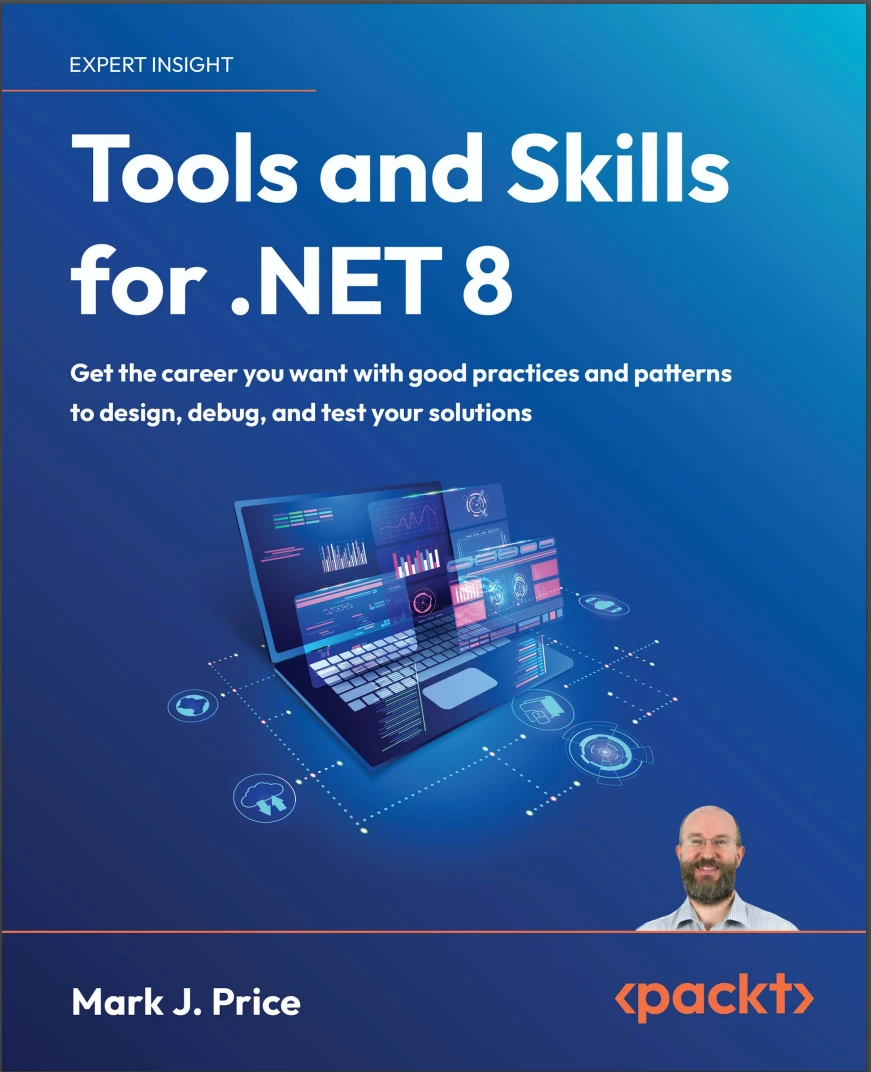
Автор: Price Mark J.
Дата выхода: 2024
Издательство: Packt Publishing Limited
Количество страниц: 779
Размер файла: 7,2 МБ
Тип файла: PDF
Добавил: Федоров_АИ
Проверить на вирусы Дополнительные материалыCover....1
Copyright....3
Contributors....4
Table of Contents....8
Preface....32
Chapter 1: Introducing Tools and Skills for .NET....38
Introducing this book and its contents....39
Companion books to complete your learning journey....39
Audiences for this book....40
Tools....41
Skills....42
Testing....42
Design and career development....43
Setting up your development environment....43
Choosing the appropriate tool and application type for learning....43
Using Visual Studio for general development....44
Using Code for cross-platform development....44
Using GitHub Codespaces for development in the cloud....44
Using Rider for cross-platform development....45
What I used....45
Deploying cross-platform....46
Downloading and installing Visual Studio....46
Visual Studio keyboard shortcuts....47
Visual Studio Enterprise edition tools....47
Downloading and installing Code....48
Installing other extensions....49
Managing Code extensions at the command prompt....50
Understanding Code versions....50
Code keyboard shortcuts....51
Downloading and installing Rider....51
Other JetBrains tools....52
Chrome AI tools....53
Making good use of the GitHub repository for this book....53
Raising issues with the book....53
Giving me feedback....53
Downloading solution code from the GitHub repository....54
Where to go for help....54
Reading documentation on Microsoft Learn....54
Getting help for the dotnet tool....54
LLMs like ChatGPT....55
Getting better help from LLMs using prompt engineering....57
AI usage by developers....58
Getting help on Discord and other chat forums....58
Setting up a database and projects for this book....60
Using a sample relational database....60
Setting up SQL Server and the Northwind database....61
Creating the Northwind database for a local SQL Server....61
Creating the Northwind database for SQL Edge in Docker....62
Creating a class library for entity models using SQL Server....63
Creating a class library for the data context using SQL Server....66
Creating a test project to check the integration of the class libraries....69
Running tests....70
Using .NET 9 with this book....71
Practicing and exploring....73
Exercise 1.1 – Online-only material....73
Exercise 1.2 – Practice exercises....73
Exercise 1.3 – Test your knowledge....73
Exercise 1.4 – Explore topics....74
Summary....74
Chapter 2: Making the Most of the Tools in Your Code Editor....76
Introducing common tools and features....76
Refactoring features....77
Code snippets....77
Editor configuration....78
AI companions....80
Tools in Visual Studio 2022....80
Refactoring features....80
Add method parameter checks....83
Method parameter refactoring....84
Convert foreach to for and vice versa....85
Simplify LINQ statements....86
Align code elements....86
Refactor to primary constructors....87
Code snippets....87
Code snippets schema....89
Creating and importing code snippets....91
Distributing code snippets....94
Editor configuration....94
AI companions: GitHub Copilot....96
Making the most of GitHub Copilot....97
Navigating Visual Studio....98
Copying and pasting a statement....98
Switching between file tabs and tool windows....98
Features to improve the editing experience....99
Line numbers and word wrap....99
Keyboard shortcuts....100
Formatting code....101
Task list....101
Extension Manager....102
Tools in Visual Studio Code....103
Refactoring features....103
Code snippets....103
Decompiling .NET assemblies....105
Creating a console app to decompile....105
Decompiling using the ILSpy extension for Visual Studio....108
Viewing source links with Visual Studio....111
No, you cannot technically prevent decompilation....113
Lowering C# code....114
Custom project and item templates....119
Creating a project for a template....120
Testing the project template....126
Practicing and exploring....127
Exercise 2.1 – Online-only material....127
Exercise 2.2 – Practice exercises....127
Exercise 2.3 – Test your knowledge....128
Exercise 2.4 – Explore topics....128
Summary....128
Chapter 3: Source Code Management Using Git....130
Introducing source code management....130
Features of source code management....131
Types of SCM system....131
Common SCM systems....132
Introducing Git....132
Features of Git....133
Why is Git hard to learn?....134
Roles in a team for Git....134
Downloading the latest Git....134
Git integration with Visual Studio....135
Configuring your Git identity....135
Configuring SSH signature enforcement....136
Configuring your default branch....138
Getting help for Git....138
Working with Git....138
Starting with a Git repository....139
Creating and adding files to a Git repository in theory....140
Tracking changes in Git....141
Creating a Git repository in practice....141
Creating a new project....142
Committing files....147
Undoing a commit....149
Cleaning a commit....150
Stashing....150
Ignoring files....152
Reviewing Git repositories....155
Viewing differences in files....155
Viewing your commit history....157
Filtering log output....161
Managing remote repositories....162
Branching and merging....165
Walking through a branching and merging example....165
Deleting and listing branches....171
Summary of common Git commands....171
Practicing and exploring....172
Exercise 3.1 – Online-only material....172
Exercise 3.2 – Practice exercises....173
Exercise 3.3 – Test your knowledge....173
Exercise 3.4 – Explore topics....174
Summary....174
Chapter 4: Debugging and Memory Troubleshooting....176
Debugging strategies....176
Introducing debugging strategies....177
Understanding the problem....178
How to start debugging....180
When to give up debugging....180
Interactive debugging with Visual Studio....180
Creating code with objects to view....180
Setting a breakpoint and starting debugging....183
Navigating with the debugging toolbar....186
Debugging windows....187
Controlling what appears in debug panes....187
Debugging test projects....190
Asking GitHub Copilot Chat for debugging help....191
Understanding stack and heap memory....193
How reference and value types are stored in memory....193
Understanding unsafe code....196
Understanding pointers....196
Other uses of pointers....198
Understanding boxing....199
Understanding garbage collection....200
Controlling the GC....201
Managing resources with IDisposable....202
Tools and skills for memory troubleshooting....203
Common memory tools and skills....203
Visual Studio tools....204
Using Visual Studio Memory Usage....205
Practicing and exploring....208
Exercise 4.1 – Online-only material....208
Exercise 4.2 – Practice exercises....209
Exercise 4.3 – Test your knowledge....209
Exercise 4.4 – Explore topics....209
Summary....209
Chapter 5: Logging, Tracing, and Metrics for Observability....212
Logging and tracing in .NET....213
Understanding ILogger in .NET....214
How to log using ILogger....215
Building a web service for logging....218
Testing the basic functionality of the web service....223
Monitoring with metrics in .NET....224
Concepts for metrics and alerts....224
Metrics....224
Alerts....224
Scenarios for metrics and alerts....225
Implementing metrics....225
Adding metrics to an ASP.NET Core project....226
Viewing metrics....230
Introducing OpenTelemetry....231
Supported instrumentation packages....232
Instrumenting an ASP.NET Core project....233
Viewing the telemetry....235
Practicing and exploring....239
Exercise 5.1 – Online-only material....239
Exercise 5.2 – Practice exercises....239
Exercise 5.3 – Test your knowledge....239
Exercise 5.4 – Explore topics....240
Summary....240
Chapter 6: Documenting Your Code, APIs, and Services....242
Introducing documentation....242
Benefits of documentation....243
When not to document....244
Documenting your source code....245
When should you document your source code?....245
Good practices for commenting your source code....246
Documenting public APIs in class libraries....247
XML comment documentation....248
How to document code using XML comments....249
Generating documentation using DocFX....255
Creating a DocFX project....259
Adding custom documentation content....264
Markdown markup language....264
Headings....265
Formatting text....265
Creating lists....266
Links and images....266
Code blocks and syntax highlighting....266
Tables....267
Documenting services....268
Considerations for documenting services....268
Tools for documenting services....268
Understanding the OpenAPI Specification (OAS)....269
Documenting a Minimal APIs service using OpenAPI....270
Documenting visually with Mermaid diagrams....275
Rendering Mermaid diagrams....276
Flowcharts using Mermaid....277
Class diagrams using Mermaid....279
Converting Mermaid to SVG....280
Practicing and exploring....281
Exercise 6.1 – Online-only material....282
Exercise 6.2 – Practice exercises....283
Exercise 6.3 – Test your knowledge....283
Exercise 6.4 – Explore topics....283
Summary....284
Chapter 7: Observing and Modifying Code Execution Dynamically....286
Working with reflection and attributes....287
Metadata in .NET assemblies....287
Versioning of assemblies....288
Reading assembly metadata....289
Creating custom attributes....291
Understanding compiler-generated types and members....294
Making a type or member obsolete....295
Dynamically loading assemblies and executing methods....296
A warning about reflection and native AOT....302
Reflection improvements in .NET 9....303
Doing more with reflection....303
Working with expression trees....303
Understanding components of expression trees....305
Executing the simplest expression tree....306
Creating source generators....307
Implementing the simplest source generator....307
Practicing and exploring....312
Exercise 7.1 – Online-only material....312
Exercise 7.2 – Practice exercises....312
Exercise 7.3 – Test your knowledge....312
Exercise 7.4 – Explore topics....313
Summary....313
Chapter 8: Protecting Data and Apps Using Cryptography....314
Understanding the vocabulary of protection....315
Techniques to protect your data....315
Keys and key sizes....316
IVs and block sizes....317
Salts....317
Generating keys and IVs....318
Encrypting and decrypting data....318
Encrypting symmetrically with AES....319
Hashing data....326
Hashing with the commonly used SHA-256....326
Signing data....331
Signing with SHA-256 and RSA....332
Generating random numbers for cryptography....334
Authenticating and authorizing users....336
Authentication and authorization mechanisms....336
Identifying a user....337
User membership....338
Implementing authentication and authorization....339
Protecting application functionality....342
Real-world authentication and authorization....344
What’s coming in .NET 9....344
CryptographicOperations.HashData() method....344
KMAC algorithm....344
Practicing and exploring....345
Exercise 8.1 – Online-only material....345
Exercise 8.2 – Practice exercises....345
Exercise 8.3 – Test your knowledge....346
Exercise 8.4 – Explore topics....346
Summary....346
Chapter 9: Building an LLM-Based Chat Service....348
Introducing LLMs....349
How LLMs work....349
Obtaining access to an LLM....351
Using Semantic Kernel with an OpenAI model....354
Understanding Semantic Kernel....354
Understanding functions....361
Adding functions....362
Adding session memory and enabling multiple functions....368
Streaming results....370
Adding logging and resilience....371
Running local LLMs....373
Hugging Face....373
Ollama....375
Ollama models....375
Ollama CLI....377
OllamaSharp .NET package....378
LM Studio....381
Practicing and exploring....382
Exercise 9.1 – Online-only material....382
Exercise 9.2 – Practice exercises....383
Exercise 9.3 – Test your knowledge....383
Exercise 9.4 – Explore topics....384
Summary....384
Chapter 10: Dependency Injection, Containers, and Service Lifetime....386
Introducing dependency injection....386
Why use DI?....387
The mechanisms of DI in .NET....388
Examples in modern .NET....389
Constructor injection example....390
Property injection examples....391
Method injection example....392
Registering dependency service lifetimes....392
Registering multiple implementations....393
When are exceptions thrown?....394
Best practices for DI....395
Implementing .NET Generic Host....395
Key features of the .NET Generic Host....395
Building a .NET Generic Host....395
Understanding host services and events....401
Service registration methods....405
Dependency graphs and service resolution....406
Disposing services....407
DI with ASP.NET Core....407
Registering services for features using extension methods....407
When you cannot use constructor injection....408
Using scoped services in middleware....409
Resolving services at startup....410
DI and views....410
DI, action methods, and Minimal APIs....410
Practicing and exploring....411
Exercise 10.1 – Online-only material....411
Exercise 10.2 – Practice exercises....411
Exercise 10.3 – Test your knowledge....411
Exercise 10.4 – Explore topics....412
Summary....412
Chapter 11: Unit Testing and Mocking....414
Introducing all types of testing....415
Unit testing....415
Integration, end-to-end, and security testing....415
Performance, load, and stress testing....416
Functional and usability testing....416
Testing terminology....417
Attributes of all good tests....417
Test outcomes....418
Test doubles, mocks, and stubs....419
Adopting a testing mindset....419
Pros and cons of test-driven development....419
Core principles of TDD....420
Pros of TDD....420
Cons of TDD....420
Good practices for TDD....421
Unit testing....421
How isolated should unit tests be?....421
Naming unit tests....422
Unit testing using xUnit....422
Common xUnit attributes....424
Creating a SUT....425
Writing simple unit tests....426
Test methods with parameters....429
Testing theory methods using InlineData....429
Testing theory methods using ClassData....430
Testing theory methods using strongly typed ClassData....431
Testing theory methods using MethodData....432
Positive and negative test results....433
Red flags in unit tests....433
Seeing output during test execution....434
Set up and tear down....435
Controlling test fixtures....437
Mocking in tests....442
Libraries for mocking....443
Using NSubstitute to create test doubles....444
Mocking with NSubstitute example....445
Making fluent assertions in unit testing....448
Making assertions about strings....448
Making assertions about collections and arrays....449
Making assertions about dates and times....450
Generating fake data with Bogus....451
Faking data test project....453
Writing a method with fake data....455
Practicing and exploring....457
Exercise 11.1 – Online-only material....457
Exercise 11.2 – Practice exercises....457
Exercise 11.3 – Test your knowledge....458
Exercise 11.4 – Explore topics....459
Summary....459
Chapter 12: Integration and Security Testing....460
Basics of integration testing....461
Which external systems to test....462
Sharing fixtures in integration tests....462
Walkthrough of an example integration test....463
Integration testing with data stores....464
Developer instances of the database and migrations....465
Data lifecycle....467
Testing services using dev tunnels....469
Installing the dev tunnel CLI....470
Exploring a dev tunnel with the CLI and an echo service....470
Exploring a dev tunnel with an ASP.NET Core project....472
Introducing security testing....476
Open Web Application Security Project....477
OWASP Top 10....478
A1:2021 – Broken Access Control....478
A2:2021 – Cryptographic Failures....479
A3:2021 – Injection....479
A4:2021 – Insecure Design....479
A5:2021 – Security Misconfiguration....480
A6:2021 – Vulnerable and Outdated Components....480
A7:2021 – Identification and Authentication Failures....480
A8:2021 – Software and Data Integrity Failures....480
A9:2021 – Security Logging and Monitoring Failures....480
A10:2021 – Server-Side Request Forgery (SSRF)....481
OWASP Top 10 summary....481
Threat modeling....481
Microsoft Threat Modeling Tool....481
Security Development Lifecycle (SDL)....482
OWASP resources....482
Azure Security and Compliance Blueprints....482
.NET security best practices....482
Practicing and exploring....483
Exercise 12.1 – Online-only sections....483
Exercise 12.2 – Practice exercises....483
Exercise 12.3 – Test your knowledge....483
Exercise 12.4 – Explore topics....483
Summary....484
Chapter 13: Benchmarking Performance, Load, and Stress Testing....486
Benchmarking performance....486
Importance of a baseline....487
Big O notation....488
Statistical metrics....489
BenchmarkDotNet for benchmarking performance....490
Avoiding benchmarking mistakes....497
Isolating benchmarking code from setup or teardown....497
Trust the tool....499
Compare like to like....500
Beware of environmental variations....500
Identifying poor blog posts about performance....500
Load and stress testing....501
Apache JMeter....503
Bombardier – a fast cross-platform HTTP benchmarking tool....504
Using Bombardier....504
Downloading Bombardier....505
Comparing an AOT and a non-AOT web service....506
Testing the two web services with Bombardier....510
Interpreting Bombardier results....513
NBomber – a load testing framework....514
NBomber scenarios....514
Load simulations....515
NBomber types....515
NBomber project example....516
Practicing and exploring....519
Exercise 13.1 – online-only material....520
Benchmarking mistakes....520
Exercise 13.2 – practice exercises....520
Exercise 13.3 – test your knowledge....520
Exercise 13.4 – explore topics....521
Summary....521
Chapter 14: Functional and End-to-End Testing of Websites and Services....522
Understanding functional and end-to-end testing....522
Example 1: Testing a Web API service....523
Example 2: Testing an ASP.NET Core website....523
Example 3: Testing a SignalR real-time application....524
Testing web user interfaces using Playwright....524
Benefits for .NET developers....525
Alternatives to Playwright....526
Common Playwright testing types....527
Common Playwright testing methods....527
Common Playwright locator methods....528
Common Playwright locator automation methods....529
Testing common scenarios with eShopOnWeb....529
Page navigation and title verification....534
Interacting with a web user interface....537
Selecting dropdown items and clicking elements....537
Form submission, authentication, and validation....539
Responsive design testing....540
Emulating screen sizes....540
Emulating devices....540
Emulating locale, time zone, and geolocation....540
Emulating dark mode and color schemes....541
Emulating the user agent, disabling JavaScript, and going offline....541
Single-Page Applications (SPAs) and dynamic content....542
Generating tests with the Playwright Inspector....542
Testing web services using xUnit....546
Creating a web service ready for testing....547
Creating the test project....548
Practicing and exploring....550
Exercise 14.1 – Online-only material....550
Exercise 14.2 – Practice exercises....550
Exercise 14.3 – Test your knowledge....550
Exercise 14.4 – Explore topics....551
Summary....551
Chapter 15: Containerization Using Docker....552
Introducing containerization....552
How containers work and their benefits....554
Docker, Kubernetes, and .NET Aspire....555
Kubernetes....556
.NET Aspire....556
Container registries....557
Docker concepts....558
Docker tools and technologies....559
Docker command-line interface (CLI) commands....560
Building images using Dockerfiles....562
Configuring ports and running a container....564
Interactive mode....566
Setting environment variables....566
Common Docker container images....567
.NET container images....568
CVEs and Chiseled Ubuntu....568
Managing containers with Docker....569
Installing Docker and using prebuilt images....569
Docker image hierarchy and layers....573
Containerizing your own .NET projects....576
Containerizing a console app project....576
Publishing to a Docker container....579
Containerizing an ASP.NET Core project....583
Working with test containers....586
How Testcontainers for .NET works....586
Usage example....587
Practicing and exploring....588
Exercise 15.1 – Online-only material....588
Exercise 15.2 – Practice exercises....588
Exercise 15.3 – Test your knowledge....589
Exercise 15.4 – Explore topics....589
Summary....589
Chapter 16: Cloud-Native Development Using .NET Aspire....592
Introducing Aspire....593
What does the Aspire team say?....594
Code editor and CLI support for Aspire....594
Starting an Aspire solution....595
Aspire project types....595
Aspire resource types....596
Aspire application model and orchestration....597
Aspire project templates....599
Exploring the Aspire starter template....600
Creating the Aspire starter application....600
Exploring the Aspire starter solution....603
Deeper into Aspire....606
Developer dashboard for monitoring....606
AppHost project for orchestrating resources....607
ServiceDefaults project for centralized configuration....610
Participating functional projects....611
Configuring Redis....613
Aspire components....614
Logging, tracing, and metrics for observability....616
Docker versus Podman for containers....616
Waiting for containers to be ready....617
What about Dapr, Orleans, and Project Tye?....617
Dapr....617
Orleans....618
Project Tye....618
Choosing between Dapr, Orleans, and Aspire....619
Aspire for new and existing solutions....619
Creating a new Aspire solution....619
Aspire and PostgreSQL....624
Using data volumes and configuring a stable password....626
Adding Aspire to an existing solution....626
Switching to Aspire components....627
Reviewing the eShop reference application....628
Deployment with Aspire....634
Practicing and exploring....635
Exercise 16.1 – Online-only material....635
Exercise 16.2 – Practice exercises....636
Exercise 16.3 – Test your knowledge....636
Exercise 16.4 – Explore topics....636
Summary....637
Chapter 17: Design Patterns and Principles....638
SOLID principles....639
Single Responsibility Principle (SRP)....639
SRP example....639
SRP violating example....640
SRP adhering refactoring....640
SRP common mistakes....641
SRP takeaways....641
Open/Closed Principle (OCP)....642
OCP example....642
OCP violating example....642
OCP common mistakes....643
OCP takeaways....644
Liskov Substitution Principle (LSP)....644
LSP example....644
LSP violating example....645
LSP adhering refactoring....646
LSP common mistakes....647
LSP in .NET....647
LSP takeaways....648
Interface Segregation Principle (ISP)....648
ISP example....648
ISP violating example....649
ISP adhering refactoring....650
ISP common mistakes....650
ISP in .NET....651
ISP takeaways....651
Dependency Inversion Principle (DIP)....652
DIP example....652
DIP violating example....653
DIP common mistakes....653
DIP takeaways....654
Design patterns....655
Creational patterns....658
Builder pattern....659
Structural design patterns....661
Adapter a.k.a. the Wrapper pattern....662
Behavioral design patterns....664
Template Method pattern....664
Design principles....667
DRY....667
KISS....667
YAGNI....668
Law of Demeter....668
LoD example....668
LoD takeaways....670
Composition over Inheritance....670
Composition over Inheritance example....670
Composition over Inheritance violating example....671
Composition over Inheritance takeaways....672
Principle of Least Astonishment....672
PoLA example....672
PoLA takeaways....674
Algorithms and data structures....674
Sorting algorithms....675
Searching algorithms....675
Data structure algorithms....675
Hashing algorithms....675
Recursive algorithms....675
Where to learn more about algorithms and data structures....676
Practicing and exploring....676
Exercise 17.1 – Online-only material....676
Exercise 17.2 – Practice exercises....676
Exercise 17.3 – Test your knowledge....677
Exercise 17.4 – Explore topics....677
Summary....677
Chapter 18: Software and Solution Architecture Foundations....680
Introducing software and solution architecture....681
Software architecture....681
Solution architecture....682
Software architecture concepts....682
Domain-Driven Design (DDD)....683
Software Development Lifecycle (SDLC) methodologies....684
Software architecture styles....685
Command Query Responsibility Segregation (CQRS)....688
Solution architecture concepts....689
Conclusion....690
Uncle Bob’s Clean Architecture....691
Clean architecture concepts....691
Defining entities....692
Defining use cases and business rules....693
Implementing interfaces....693
Implementing presenters....693
Implementing controllers....693
Good practices in .NET Clean Architecture....694
Diagramming design using Mermaid....694
Mermaid for software and solution architecture....694
Mermaid diagram types....695
Mermaid flowcharts....696
Flowchart syntax....696
Example flowchart – a user login process....697
Example flowchart – a software development process....698
Sequence diagram syntax....700
Example sequence diagram – a user registration process....700
Example sequence diagram – website querying a database....702
Practicing and exploring....703
Exercise 18.1 – Online-only material....703
Exercise 18.2 – Practice exercises....703
Exercise 18.3 – Test your knowledge....704
Exercise 18.4 – Explore topics....704
Summary....705
Chapter 19: Your Career, Teamwork, and Interviews....706
Working on a development team....706
Being a software engineer....707
Career path....708
Roles on a development team that you will collaborate with....708
Project manager....709
Business analyst....709
Quality assurance analyst or tester....709
User experience designer....709
Database administrator....710
DevOps engineer....710
Front-end (FE) developer....711
Technical lead or architect....711
Onboarding process....711
How to ask for training and development....712
Identify specific training needs....712
Align training with business goals....713
Prepare a cost-benefit analysis....713
Propose a flexible plan....713
Request a meeting and present your case....714
Pair programming....714
Could an LLM replace a human paired programmer?....715
Applying for a job....716
Before you apply....716
Refine your skills and knowledge....716
Obtain certifications....716
Search for job openings....717
Craft your job application, resume, and online profiles....717
Your resume or curriculum vitae....718
Ask an LLM to improve your resume....718
Interview preparation....719
Do not use an LLM during an interview....720
Interviewing at the big companies....721
Applying for more experienced positions....722
Applying for tester positions....724
Selection of questions....726
Behavioral questions....727
STAR method....729
Using the STAR method effectively....730
Tips during interviews....730
How to handle difficult coding questions....733
How to handle unprepared interviewers....734
What to never do....735
Sample interview questions....736
1. .NET CLI tools....737
Good answer....737
Commonly given poor answer....738
2. Git fundamentals....739
Good answer....739
Commonly given poor answer....740
3. Entity Framework Core....740
Good answer....740
Commonly given poor answer....742
4. Interfaces and abstract classes....742
5. Properties and indexers....742
6. Generics....742
7. Delegates and events....743
8. Language Integrated Query (LINQ)....743
9. Asynchronous programming with async and await....743
10. Memory management and garbage collection....743
11. Differences between modern .NET and .NET Framework....743
12. Cross-platform capabilities....743
13. .NET Standard....743
14. Dependency injection in .NET....743
15. Middleware in ASP.NET Core....743
16. Configuration and Options pattern....744
17. Hosting and Kestrel server....744
18. Data types....744
19. Globalization and localization....744
20. Control structures....744
21. Exception handling....744
22. Git branching strategies....744
23. Code reviews and pair programming....744
24. Agile and Scrum methodologies....744
25. Documentation standards....745
26. Problem-solving skills....745
27. Project management tools....745
28. Estimation techniques....745
29. Team collaboration....745
30. Leadership and mentorship....745
31. MVC pattern....745
32. Razor syntax....745
33. Web API development....745
34. RESTful services best practices....746
35. SignalR for real-time web functionality....746
36. State management....746
37. Authentication and authorization....746
38. Blazor WebAssembly....746
39. Benefits of microservices....746
40. Challenges in microservices architecture....746
41. Docker containers and .NET....746
42. Microservices communication patterns....746
43. Resilience and transient fault handling....747
44. Distributed tracing....747
45. Health checks and monitoring....747
46. AutoMapper vs. extension method vs. implicit operator....747
47. ADO.NET fundamentals....747
48. Entity Framework Core performance tuning....747
49. Unit testing frameworks like xUnit....747
50. Mocking frameworks like NSubstitute....747
51. Integration testing strategies....747
52. Performance testing....748
53. Security testing....748
54. Automated UI testing....748
55. SOLID principles....748
56. Singleton pattern....748
57. Factory pattern....748
58. Memory leak identification....748
59. Development methodologies....748
60. Big O....748
When you’re failing, you’re learning....748
Practicing and exploring....749
Exercise 19.1 – Online-only material....749
Exercise 19.2 – Practice exercises....749
Exercise 19.3 – Test your knowledge....749
Exercise 19.4 – Explore topics....750
Summary....750
Chapter 20: Epilogue....752
Next steps on your .NET learning journey....752
Companion books to continue your learning journey....752
Ninth edition of C# 12 and .NET 8 coming soon for .NET 9....753
Planned .NET 10 trilogy....754
Packt books to take your learning further....754
Good luck!....755
Packt Page....756
Index....758
Elevate your career by mastering key .NET tools and skills, including debugging, source code management, testing, cloud-native development, intelligent apps and more.
Key Features
- Coverage of key .NET tools and skills including refactoring, source code management, debugging, memory troubleshooting, and more.
- Practical guidance on using code editors effectively, implementing best practices, and protecting data.
- Explore cutting-edge techniques like building intelligent apps, cloud native development with .NET Aspire, and Docker containerization.
Unlock the full potential of .NET development with Tools and Skills for .NET 8. Dive into source code management using Git and learn how to navigate projects while ensuring version control. Discover advanced debugging techniques and troubleshooting strategies to identify and resolve issues, and gain practical insights on documenting your code, APIs, and services, fostering project clarity and maintainability. Delve into the world of cryptography, ensuring confidentiality and integrity throughout your development lifecycle. Elevate your skills as you explore cutting-edge topics such as building intelligent apps using custom LLM-based chat services, mastering dependency injection, optimizing performance through testing, and Docker ontainerization. Harness the power of cloud-native development with .NET Aspire, unlocking the benefits of modern cloud platforms. With guidance on software architecture best practices, this book empowers you to build robust, scalable and maintainable applications. Advance your career with invaluable insights on job readiness and interview preparation, positioning yourself as a top-tier candidate in today's competitive job market. Whether you're a seasoned .NET professional or an aspiring developer looking to enhance your skills, this book is your ultimate companion on the journey to .NET mastery.
What you will learn
- Make the most of code editor tools for efficient development.
- Learn advanced debugging techniques and troubleshooting strategies.
- Understand how to protect data and applications using cryptography.
- Build a custom LLM-based chat service.
- Discover how to master dependency injection.
- Optimize performance through benchmarking and testing.
- Delve into cloud-native development using .NET Aspire.
- Advance your career with advice on job readiness and interviews.
Who this book is for
.NET professionals seeking to enhance their expertise, as well as aspiring developers aiming to advance their careers in the field. This book caters to individuals eager to master essential .NET tools, refine their development practices, explore advanced techniques and cutting-edge tools, and prepare themselves for job opportunities and interviews in the competitive landscape of .NET development


