-
1C
-
Agda
-
Agile/Scrum
-
Alef
-
APL
-
Assembler
-
AWK
-
Basic
-
Beta Programming Language
-
Big Data/DataScience
-
C
-
C#
-
C++
-
Cobol
-
Crystal
-
CSS
-
D
-
Dart
-
DataBase (SQL)
-
Delphi
-
F#
-
Flutter
-
Fortran
-
GameDev
-
Git
-
Go (Golang)
-
GPT/AI/ИИ
-
Hacking and Security
-
Haskell
-
HTML
-
Java
-
JavaScript (JS)
-
Julia
-
Kotlin
-
Machine Learning (ML)
-
Natural language processing (NLP)
-
.NET (.NET Core)
-
Pascal
-
PHP
-
Python
-
R
-
Ruby
-
Rust
-
Scratch
-
Swift
-
UML
-
UX/UI
-
Visual Basic
-
Wolfram
-
XML
-
АСУ
-
Проектирование/System Design
-
Сети/Network
-
Статьи
-
Схемотехника/электронные схемы
-
1C
-
Agda
-
Agile/Scrum
-
Alef
-
APL
-
Assembler
-
AWK
-
Basic
-
Beta Programming Language
-
Big Data/DataScience
-
C
-
C#
-
C++
-
Cobol
-
Crystal
-
CSS
-
D
-
Dart
-
DataBase (SQL)
-
Delphi
-
F#
-
Flutter
-
Fortran
-
GameDev
-
Git
-
Go (Golang)
-
GPT/AI/ИИ
-
Hacking and Security
-
Haskell
-
HTML
-
Java
-
JavaScript (JS)
-
Julia
-
Kotlin
-
Machine Learning (ML)
-
Natural language processing (NLP)
-
.NET (.NET Core)
-
Pascal
-
PHP
-
Python
-
R
-
Ruby
-
Rust
-
Scratch
-
Swift
-
UML
-
UX/UI
-
Visual Basic
-
Wolfram
-
XML
-
АСУ
-
Проектирование/System Design
-
Сети/Network
-
Статьи
-
Схемотехника/электронные схемы
Меню
SQL Query Design Patterns and Best Practices: A practical guide to writing readable and maintainable SQL queries using its design patterns
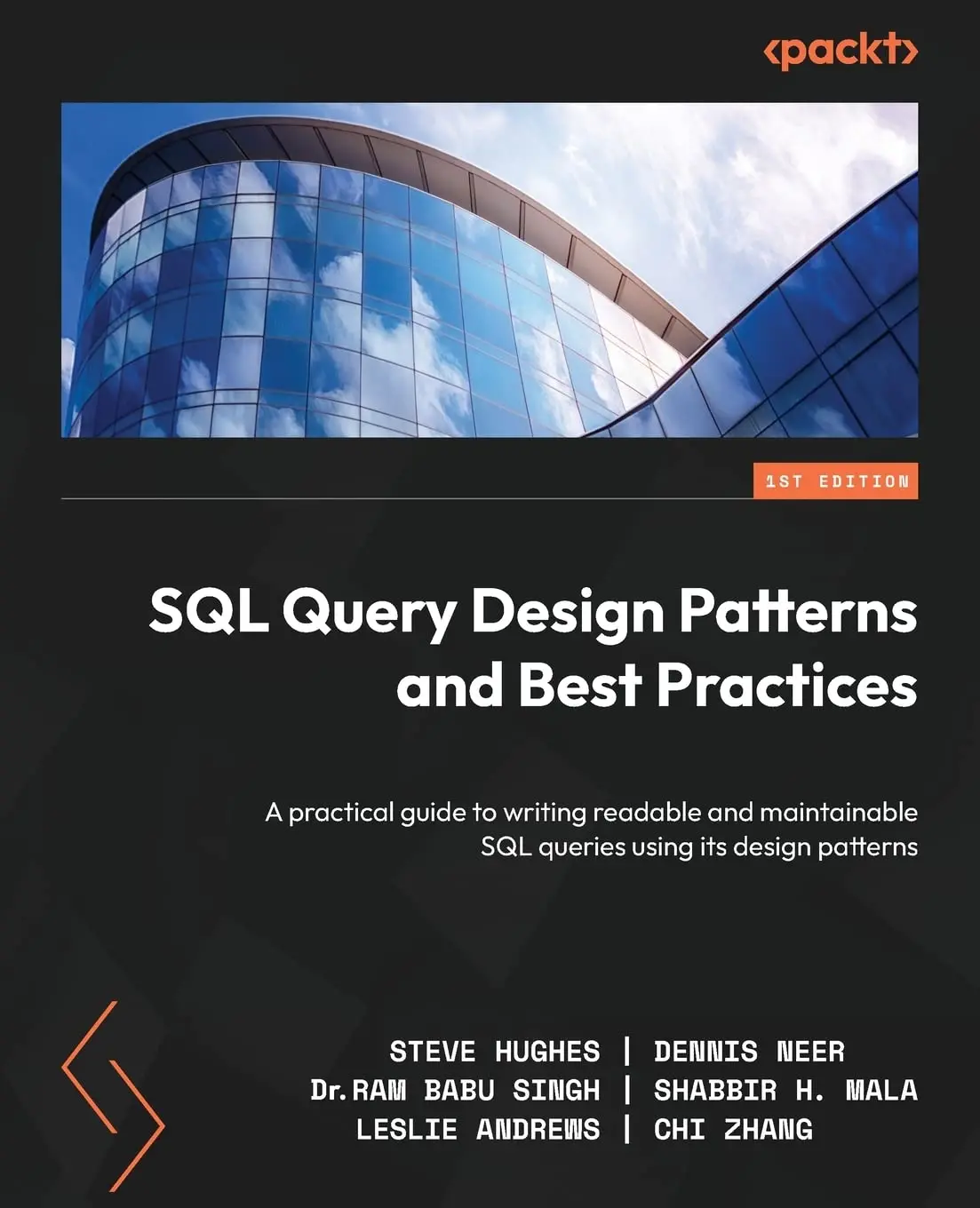
Автор: Andrews Leslie , Hughes Steve , Mala Shabbir H. , Neer Dennis , Singh Ram Babu , Zhang Chi
Дата выхода: 2024
Издательство: Packt Publishing Limited
Количество страниц: 325
Размер файла: 5,5 МБ
Тип файла: PDF
Добавил: codelibs
Проверить на вирусы Дополнительные материалыCover Page....2
Table of Contents....3
Preface....5
Part 1: Refining Your Queries to Get the Results You Need....15
Chapter 1: Reducing Rows and Columns in Your Result Sets....16
Technical requirements....16
Identifying data to remove from the dataset....17
Understanding the value of creating views versus removing data....23
Exploring the impact of row and column reductions on aggregations....26
Summary....31
Chapter 2: Efficiently Aggregating Data....32
Technical requirements....32
Identifying data to be aggregated....33
Determining when data should be aggregated....35
Improving performance when aggregating data....44
Summary....47
Chapter 3: Formatting Your Results for Easier Consumption....49
Technical requirements....50
Formatting dates and numbers with functions....57
Alias columns with meaningful names....64
Summary....65
Chapter 4: Manipulating Data Results Using Conditional SQL....67
Technical requirements....67
Using the CASE statement....68
Using the COALESCE() expression....80
Using ISNULL() function....84
Summary....87
Part 2: Solving Complex Business and Data Problems in Your Queries....89
Chapter 5: Using Common Table Expressions....90
Technical requirements....90
Creating CTEs....91
Creating a recursive CTE....97
Summary....102
Chapter 6: Analyze Your Data Using Window Functions....103
Technical requirements....103
Understanding window functions....104
Scenarios and business problems....115
Chapter 7: Reshaping Data with Advanced Techniques....128
Technical requirements....128
Working with the PIVOT operator....129
Working with the UNPIVOT operator....136
Understanding hierarchical data....139
Summary....143
Chapter 8: Impact of SQL Server Security on Query Results....145
Technical requirements....145
Why is data missing from my result set?....146
Understanding SQL Server security....148
Validating security settings....149
Summary....153
Part 3: Optimizing Your Queries to Improve Performance....154
Chapter 9: Understanding Query Plans....155
Technical requirements....155
Understanding query optimization techniques....156
Understanding the Query Optimizer....156
Understanding and exploring the Query Execution Plan....157
Summary....180
Chapter 10: Understanding the Impact of Indexes on Query Design....182
Technical requirements....182
Understanding index and index types....183
Using CREATE to create an index....183
Exploring the types of indexes....190
The impact of indexes on query design....197
Understanding index maintenance....201
Summary....205
Further reading....205
Part 4: Working with Your Data on the Modern Data Platform....206
Chapter 11: Handling JSON Data in SQL Server....207
Technical requirements....207
Introducing JSON functionality built into SQL Server....208
JSON path in SQL Server....212
Formatting results as JSON in SQL Server....213
Working with JSON data in SQL queries....224
Building tabular results from JSON data in SQL Server....231
Summary....234
Chapter 12: Integrating File Data and Data Lake Content with SQL....235
Technical requirements....235
Understanding the OPENROWSET (BULK..) function....236
Required security and storage permissions....244
Understanding external tables....247
Summary....253
Chapter 13: Organizing and Sharing Your Queries with Jupyter Notebooks....255
Technical requirements....255
Creating Jupyter notebooks in Azure Data Studio....256
Adding queries in your Jupyter notebooks....264
Documenting your code with markdown in your notebooks....275
Managing and sharing your queries with Jupyter notebooks....280
Summary....284
Index....285
Why subscribe?....301
Other Books You May Enjoy....303
Packt is searching for authors like you....307
Share Your Thoughts....307
Download a free PDF copy of this book....308
Appendix: Preparing Your Environment....310
SQL has been the de facto standard when interacting with databases for decades and shows no signs of going away. Through the years, report developers or data wranglers have had to learn SQL on the fly to meet the business needs, so if you are someone who needs to write queries, SQL Query Design and Pattern Best Practices is for you.
This book will guide you through making efficient SQL queries by reducing set sizes for effective results. You'll learn how to format your results to make them easier to consume at their destination. From there, the book will take you through solving complex business problems using more advanced techniques, such as common table expressions and window functions, and advance to uncovering issues resulting from security in the underlying dataset. Armed with this knowledge, you'll have a foundation for building queries and be ready to shift focus to using tools, such as query plans and indexes, to optimize those queries. The book will go over the modern data estate, which includes data lakes and JSON data, and wrap up with a brief on how to use Jupyter notebooks in your SQL journey.
By the end of this SQL book, you'll be able to make efficient SQL queries that will improve your report writing and the overall SQL experience.
What You Will Learn:
- Build efficient queries by reducing the data being returned
- Manipulate your data and format it for easier consumption
- Form common table expressions and window functions to solve complex business issues
- Understand the impact of SQL security on your results
- Understand and use query plans to optimize your queries
- Understand the impact of indexes on your query performance and design
- Work with data lake data and JSON in SQL queries
- Organize your queries using Jupyter notebooks
Who this book is for:
This book is for SQL developers, data analysts, report writers, data scientists, and other data gatherers looking to expand their skills for complex querying as well as for building more efficient and performant queries.
For those new to SQL, this book can help you accelerate your learning and keep you from making common mistakes.


