-
1C
-
Agda
-
Agile/Scrum
-
Alef
-
APL
-
Assembler
-
AWK
-
Basic
-
Beta Programming Language
-
Big Data/DataScience
-
C
-
C#
-
C++
-
Cobol
-
Crystal
-
CSS
-
D
-
Dart
-
DataBase (SQL)
-
Delphi
-
F#
-
Flutter
-
Fortran
-
GameDev
-
Git
-
Go (Golang)
-
GPT/AI/ИИ
-
Hacking and Security
-
Haskell
-
HTML
-
Java
-
JavaScript (JS)
-
Julia
-
Kotlin
-
Machine Learning (ML)
-
Natural language processing (NLP)
-
.NET (.NET Core)
-
Pascal
-
PHP
-
Python
-
R
-
Ruby
-
Rust
-
Scratch
-
Swift
-
UML
-
UX/UI
-
Visual Basic
-
Wolfram
-
XML
-
АСУ
-
Проектирование/System Design
-
Сети/Network
-
Статьи
-
Схемотехника/электронные схемы
-
1C
-
Agda
-
Agile/Scrum
-
Alef
-
APL
-
Assembler
-
AWK
-
Basic
-
Beta Programming Language
-
Big Data/DataScience
-
C
-
C#
-
C++
-
Cobol
-
Crystal
-
CSS
-
D
-
Dart
-
DataBase (SQL)
-
Delphi
-
F#
-
Flutter
-
Fortran
-
GameDev
-
Git
-
Go (Golang)
-
GPT/AI/ИИ
-
Hacking and Security
-
Haskell
-
HTML
-
Java
-
JavaScript (JS)
-
Julia
-
Kotlin
-
Machine Learning (ML)
-
Natural language processing (NLP)
-
.NET (.NET Core)
-
Pascal
-
PHP
-
Python
-
R
-
Ruby
-
Rust
-
Scratch
-
Swift
-
UML
-
UX/UI
-
Visual Basic
-
Wolfram
-
XML
-
АСУ
-
Проектирование/System Design
-
Сети/Network
-
Статьи
-
Схемотехника/электронные схемы
Меню
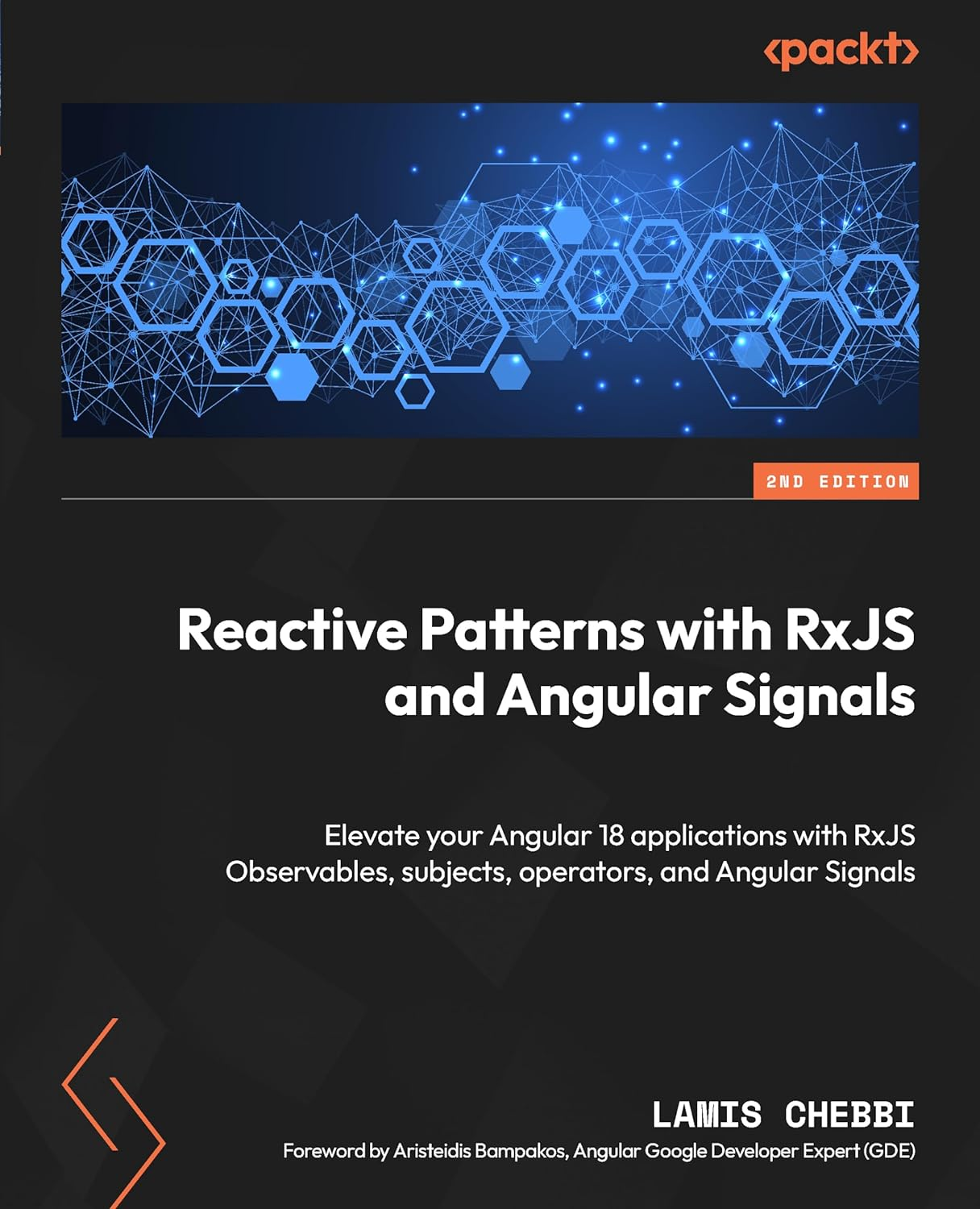
Reactive Patterns with RxJS and Angular Signals: Elevate your Angular 18 applications with RxJS Observables, subjects, operators, and Angular Signals. 2 Ed
Автор: Chebbi Lamis
Дата выхода: 2024
Издательство: Packt Publishing Limited
Количество страниц: 255
Размер файла: 2,9 МБ
Тип файла: PDF
Добавил: codelibs
Проверить на вирусы Дополнительные материалыCover....1
Title Page....2
Copyright and Credits....3
Dedication....4
Foreword....5
Contributors....6
Table of Contents....8
Preface....14
Part 1: An Introduction to the Reactive World....20
Chapter 1: Diving into the Reactive Paradigm....22
Technical requirements....23
Exploring the pillars of reactive programming....23
Data streams....23
Observer patterns....24
Learning about the marble diagram (our secret weapon)....25
Highlighting the use of RxJS in Angular....28
The HttpClient module....28
The Router module....29
Reactive forms....32
The Event emitter....32
Summary....33
Chapter 2: Walking through Our Application....34
Technical requirements....34
Breaking down our app’s interfaces....35
View one – the landing page....35
View two – the New Recipe interface....36
View three – the My Recipes interface....37
View four – the My Favourites interface....38
View five – the Modify Recipe interface....38
View six – the Recipe Details interface....39
Reviewing our app’s architecture....39
Reviewing our app’s components....40
Summary....41
Part 2: A Trip into Reactive Patterns....42
Chapter 3: Fetching Data as Streams....44
Technical requirements....45
Defining the data fetch requirement....46
Exploring the classic pattern for fetching data....47
Defining the structure of your data....47
Creating the fetching data service....47
Creating Angular standalone components....49
Injecting and subscribing to the service in your component....52
Displaying the data in the template....53
Managing unsubscriptions....54
Exploring the reactive pattern for fetching data....57
Retrieving data as streams....57
Defining the stream in your component....58
Using the async pipe in your template....59
Highlighting the advantages of the reactive pattern....60
Using the declarative approach....60
Using the change detection strategy of OnPush....61
Diving into the built-in control flow in Angular 17....63
Structural directives....64
Built-in control flows....65
Including built-in control flows in our recipe app....69
Benefits of built-in control flow....70
Summary....71
Chapter 4: Handling Errors Reactively....72
Technical requirements....72
Understanding the anatomy of an Observable contract....73
Exploring error handling patterns and strategies....74
The replace strategy....76
The rethrow strategy....78
The retrying strategy....79
Choosing the right error handling strategy....85
Handling errors in our recipe app....87
Summary....89
Chapter 5: Combining Streams....90
Technical requirements....90
Defining the filtering requirement....91
Exploring the imperative pattern for filtering data....92
Exploring the declarative pattern for filtering data....95
The combineLatest operator....97
Updating the filter value....100
Highlighting common pitfalls and best practices....103
Unnecessary subscriptions....103
Missing or incomplete values....104
Performance overhead....104
Confusing error handling....104
Summary....104
chapter 6: Transforming Streams....106
Technical requirements....106
Defining the autosave requirement....107
Exploring the imperative pattern for the autosave feature....108
Exploring the reactive pattern for the autosave feature....111
Higher-order Observables....111
Higher-order mapping operators....112
Summary....128
Chapter 7: Sharing Data between Angular Components....130
Technical requirements....130
Defining the sharing data requirement....131
Exploring the reactive pattern to share data....131
Step 1 – Creating a shared service....132
Step 2 – Updating the last selected recipe....133
Step 3 – Consuming the last selected recipe....136
Wrapping up the data-sharing reactive pattern....137
Leveraging Deferrable Views in Angular 17....138
Summary....139
Part 3: The Power of Angular Signals....140
Chapter 8: Mastering Reactivity with Angular Signals....142
Technical requirements....142
Understanding the motivation behind Signals....143
The traditional Zone.js approach....143
The new Signals approach....143
Unveiling the Signal API....144
Defining Signals....144
Creating Signals using the constructor function....145
Reading Signals....146
Modifying a writable Signal....147
Computed Signals....148
Signal effects....149
Unlocking the power of RxJS and Angular Signals....149
Understanding the behavior of toSignal()....151
Understanding the behavior of toObservable()....153
Integrating Signals into our recipe app....155
Fetching data as streams using Signals....155
Combining streams using Signals....158
Sharing data using Signals....160
Transforming streams using Signals....161
Exploring reactive data binding with Signals....163
Signal inputs....163
Model inputs....165
Signal queries....166
Summary....167
Part 4: Multicasting Adventures....168
Chapter 9: Demystifying Multicasting....170
Technical requirements....170
Explaining multicasting versus unicasting....170
Unicasting and cold Observables....171
Multicasting and hot Observables....172
Transforming cold Observables into hot Observables....174
Exploring RxJS subjects....175
A plain subject....176
replaySubject....177
BehaviorSubject....178
Highlighting the advantages of multicasting....181
Summary....182
Chapter 10: Boosting Performance with Reactive Caching....184
Technical requirements....184
Defining the caching requirement....185
Exploring the reactive pattern to cache streams....186
The shareReplay operator....186
Using shareReplay in RecipesApp....187
Customizing the shareReplay operator....189
Replacing the shareReplay operator with the share operator....191
Highlighting the use of caching for side effects....193
Summary....194
Chapter 11: Performing Bulk Operations....196
Technical requirements....196
Defining the bulk operation requirements....197
Learning the reactive pattern for bulk operations....198
The forkJoin operator....199
The bulk operation reactive pattern....200
Benefits of the forkJoin operator....203
Learning the reactive pattern for tracking the bulk operation’s progress....204
Summary....206
Chapter 12: Processing Real-Time Updates....208
Technical requirements....208
Defining the requirements of real time....209
Learning the reactive pattern for consuming real-time messages....210
Creating and using WebSocketSubject....210
WebSocketSubject in action....214
Learning the reactive pattern for handling reconnection....220
Summary....223
Part 5: Final Touches....224
Chapter 13: Testing RxJS Observables....226
Technical requirements....226
Learning about the subscribe and assert pattern....227
Testing single-value output methods....227
Testing multiple-value output methods....230
Testing timed-value output methods....231
Learning about the marble testing pattern....232
Understanding the syntax....232
Introducing TestScheduler....233
Implementing marble tests....235
Testing timed-value output methods....237
Highlighting testing streams using HttpClientTestingModule....239
Summary....241
Index....244
Other Books You May Enjoy....251
RxJS is a powerful reactive extension for JavaScript, specializing in asynchronous and event-driven programming. This book serves as a comprehensive, step-by-step guide to learning RxJS and reactivity, helping you navigate reactive patterns, efficient data management, and the streamlined implementation of common features with minimal code.
This second edition aligns with the latest version of Angular, introducing new reactive patterns based on Angular Signals, which play a pivotal role in enabling fine-grained reactivity within Angular and enhancing change detection and user interface rendering. Throughout the book, you'll construct a complete application that incorporates the latest Angular features, such as standalone components, new built-in control flow, deferrable views, and more. You'll focus on cultivating skills to handle data reactively, thus improving the application's overall quality, user experience, and developer productivity. As you progress, the book covers best practices for testing asynchronous streams and optimizing app performance.
By the end of this RxJS and Angular book, you'll not only be able to develop Angular applications by implementing reactive patterns, but also grasp all the best practices, ensuring a well-rounded understanding of RxJS within the Angular framework.
What you will learn
- Get to grips with RxJS core concepts such as Observables, subjects, and operators
- Use the marble diagram in reactive patterns
- Delve into stream manipulation, including transforming and combining them
- Understand memory leak problems using RxJS and best practices to avoid them
- Build reactive patterns using Angular Signals and RxJS
- Explore different testing strategies for RxJS apps
- Discover multicasting in RxJS and how it can resolve complex problems
- Build a complete Angular app reactively using the latest features of RxJS and Angular
Who this book is for
If you're a developer working with Angular and RxJS, this book is for you. Designed for anyone at a beginner level in both Angular and RxJS, this book will help you gain experience and harness the potential of RxJS or benefit you if you're looking to leverage the reactive paradigm within your Angular applications. This book assumes some familiarity with Angular, basic RxJS, and TypeScript, as well as foundational knowledge of functional programming.


