-
1C
-
Agda
-
Agile/Scrum
-
Alef
-
APL
-
Assembler
-
AWK
-
Basic
-
Beta Programming Language
-
Big Data/DataScience
-
C
-
C#
-
C++
-
Cobol
-
Crystal
-
CSS
-
D
-
Dart
-
DataBase (SQL)
-
Delphi
-
F#
-
Flutter
-
Fortran
-
GameDev
-
Git
-
Go (Golang)
-
GPT/AI/ИИ
-
Hacking and Security
-
Haskell
-
HTML
-
Java
-
JavaScript (JS)
-
Julia
-
Kotlin
-
Machine Learning (ML)
-
Natural language processing (NLP)
-
.NET (.NET Core)
-
Pascal
-
PHP
-
Python
-
R
-
Ruby
-
Rust
-
Scratch
-
Swift
-
UML
-
UX/UI
-
Visual Basic
-
Wolfram
-
XML
-
АСУ
-
Проектирование/System Design
-
Сети/Network
-
Статьи
-
Схемотехника/электронные схемы
-
1C
-
Agda
-
Agile/Scrum
-
Alef
-
APL
-
Assembler
-
AWK
-
Basic
-
Beta Programming Language
-
Big Data/DataScience
-
C
-
C#
-
C++
-
Cobol
-
Crystal
-
CSS
-
D
-
Dart
-
DataBase (SQL)
-
Delphi
-
F#
-
Flutter
-
Fortran
-
GameDev
-
Git
-
Go (Golang)
-
GPT/AI/ИИ
-
Hacking and Security
-
Haskell
-
HTML
-
Java
-
JavaScript (JS)
-
Julia
-
Kotlin
-
Machine Learning (ML)
-
Natural language processing (NLP)
-
.NET (.NET Core)
-
Pascal
-
PHP
-
Python
-
R
-
Ruby
-
Rust
-
Scratch
-
Swift
-
UML
-
UX/UI
-
Visual Basic
-
Wolfram
-
XML
-
АСУ
-
Проектирование/System Design
-
Сети/Network
-
Статьи
-
Схемотехника/электронные схемы
Меню
Practical C++ STL Programming: Real-World Applications with C++20 and C++23
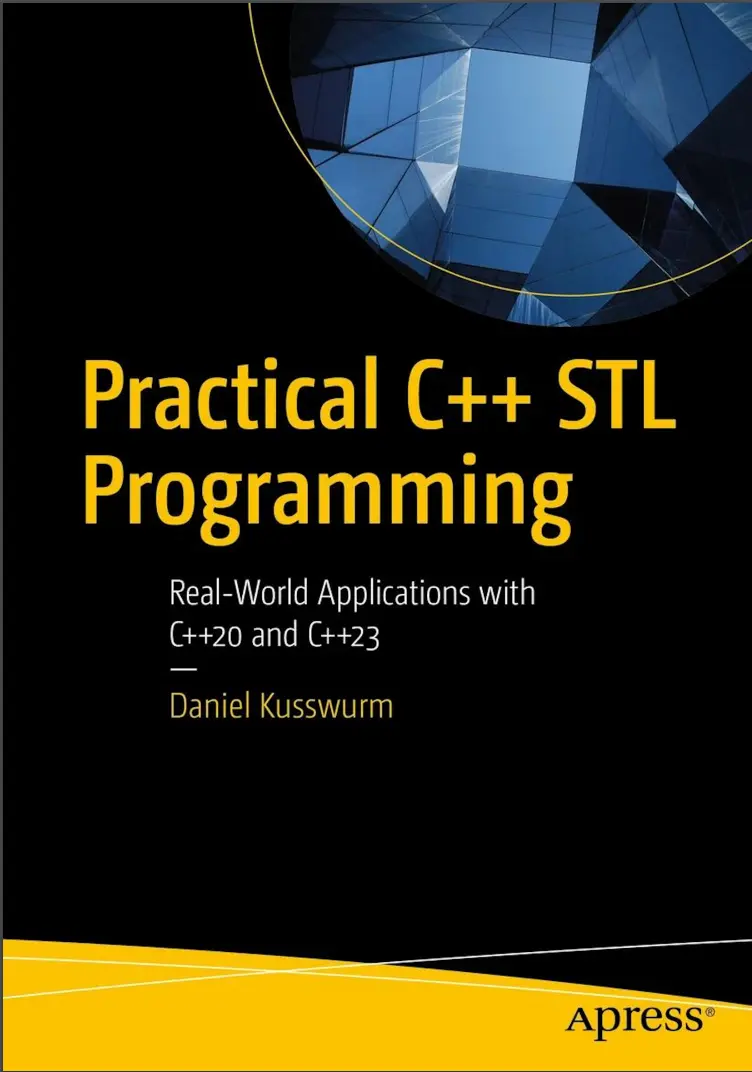
Автор: Kusswurm Daniel
Дата выхода: 2024
Издательство: Apress Media, LLC.
Количество страниц: 898
Размер файла: 2,6 МБ
Тип файла: PDF
Добавил: codelibs
Проверить на вирусыTable of Contents....4
About the Author....11
About the Technical Reviewer....12
Acknowledgments....13
Introduction....14
Prologue....18
Chapter 1: C++ Review....24
Templates....24
Source Code Overview....34
Containers and Iterators....35
Strings....40
User-Defined Classes....46
User-Defined Template Classes....57
Lambda Expressions....64
Three-Way Comparison Operator....71
Exceptions....81
Summary....84
Chapter 2: Formatted I/O....86
Formatted Output Using std::printf()....86
Formatted Output Using Streams....91
Formatted Output Using std::format()....103
Formatted Output Using std::print()....116
Formatted File I/O Using Streams....120
Summary....126
Chapter 3: Sequence Containers – Part 1....127
Overview of Sequence Containers....127
Using std::array....128
Using std::vector....138
More Algorithms Using std::array and std::vector....150
Summary....156
Chapter 4: Sequence Containers – Part 2....158
Using std::deque....158
Using std::list....169
Using std::forward_list....179
Understanding Iterators....186
Summary....192
Chapter 5: General Utilities Library....194
Heterogeneous Containers....194
Using std::pair....195
Using std::tuple....201
Utility Classes....211
Using std::variant....211
Using std::optional....221
Using std::any....240
Using std::expected....244
Summary....252
Chapter 6: Smart Pointers....253
Smart Pointer Primer....253
Using std::unique_ptr....255
Using std::shared_ptr....268
Using std::weak_ptr....274
Summary....278
Chapter 7: Associative Containers....279
Using std::set....279
Using std::multiset....291
Using std::map....296
Using std::multimap....312
Summary....320
Chapter 8: Unordered Associative Containers....321
Unordered Associative Container Primer....321
Hash Functions and Concepts....322
Using std::unordered_set....323
Using std::unordered_multiset....346
Using std::unordered_map....353
Using std::unordered_multimap....365
Summary....372
Chapter 9: Container Adaptors....374
Container Adaptor Primer....374
Using std::stack....376
Using std::queue....389
Using std::priority_queue....394
Flat Container Adaptors....406
Summary....407
Chapter 10: Algorithms – Part 1....409
Algorithm Primer....409
Counting Algorithms....411
Minimum and Maximum Algorithms....426
Copy Algorithms....432
Move Algorithms....438
Reversal Algorithms....443
Replacement Algorithms....446
Removal Algorithms....454
Fill Algorithms....461
Summary....465
Chapter 11: Algorithms – Part 2....467
For_Each Algorithms....467
Transformation Algorithms....472
Generation Algorithms....477
Find Algorithms....482
Contains Algorithms....501
More Find Algorithms....509
Search Algorithms....512
Accumulate and Fold Algorithms....521
Summary....529
Chapter 12: Algorithms – Part 3....531
Sorting Algorithms....531
Binary Search Algorithms....541
Partition Algorithms....549
Heap Algorithms....553
Summary....560
Chapter 13: Algorithms – Part 4....562
Merge Algorithms....562
Shuffle and Sample Algorithms....570
Rotate and Shift Algorithms....574
Set Algorithms....581
Permutation Algorithms....585
Summary....589
Chapter 14: Ranges – Part 1....591
Range Views and Adaptors Primer....591
Range Views and Adaptors....593
Range Adaptors and Pipelines....600
Range Projections....606
More Range Adaptors....614
Range Views and Adaptors Minutiae....620
Summary....625
Chapter 15: Ranges – Part 2....626
Tuple Views....626
More Tuple Views....631
Join, Split, and Cartesian Product Views....641
Slide, Stride, and Chunk Views....648
Range Factories....657
Summary....662
Chapter 16: Time Library....664
Ratios....664
Durations....671
Clocks and Timepoints....680
More Clocks and Timepoints....690
Software Benchmarking....695
Summary....702
Chapter 17: File Systems....703
File System Path Classes....703
File System Directory Iterator Classes....713
File System Helper Functions....723
File System Copy Functions....732
Summary....739
Chapter 18: Numerical Processing – Part 1....741
Mathematical Constants....741
Complex Numbers....748
Random Number Generation....757
Using Generators and Distributions....761
Dice Games....769
Vector of Random Numbers....778
Summary....781
Chapter 19: Numerical Processing – Part 2....783
Class std::valarray....783
Arithmetic Functions....784
Statistical Calculations....791
Class std::slice....799
Basic Operations....799
Covariance Matrix....808
Inner Products and Reductions....813
Summary....822
Chapter 20: Concurrency – Part 1....824
Concurrency Primer....824
Execution Policies....826
Mutexes....834
Threads....838
Atomic Operations....846
Multithreaded Algorithms....854
Summary....864
Chapter 21: Concurrency – Part 2....865
Semaphores....865
Latches....873
Condition Variables....878
Futures....885
Summary....898
Learn how to use the classes, algorithms, and other programming constructs of C++ STL. This comprehensive and practical guide covers a broad range of STL programming topics and highlights numerous programming constructs from the C++20 and C++23 standards.
Mastering use of STL can be daunting for both new and experienced C++ programmers. It doesn’t help that the ISO C++ specification documents are meticulous and verbose. This book is organized to help you quickly understand C++ STL programming, focusing on the real-world aspects of its usage. Rather than spend time providing extensive explanations of the inner workings of STL, author Daniel Kusswurm judiciously explores these intricacies only when they advance the reader’s understanding of a particular topic.
This book is accompanied by over 100 source code examples, designed to accelerate learning by emphasizing practical use cases. It coincides with the C++20 and C++23 standards and works with any OS platform that supports these standards including Windows (Visual C++), Linux (GNU C++) and macOS (clang). After reading Practical C++ STL Programming, you’ll be able to exploit the computational capabilities of STL to implement a wide variety of software algorithms and solve unique programming challenges.
What You Will Learn
- Explore STL capabilities, including how to generate formatted output, utilize sequence containers, apply utility classes, exploit smart pointers, manipulate associative containers, and exercise container adaptors.
- Apply algorithms and iterators to perform a wide variety of container operations including sorts, searches, insertions, removals, and erasures.
- Utilize ranges and range iterators, adaptors, views, compositions, projections, and factories.
- Perform file and directory operations using STL’s file system classes.
- Execute chronological calculations and formatting using the time classes.
- Employ STL’s random number generation and distribution classes.
- Implement numerical processing algorithms using STL’s std::valarray and std:complex classes.
- Accelerate program performance using STL’s concurrency classes and algorithm execution policies.
Who This Book Is For
Software developers and programmers who understand the basic syntax and semantics of C++ and want/need to learn how to use STL’s classes and algorithms, or programmers who have experience using STL as specified by the C++11/14/17 standards and are interested in learning how to use the new STL classes and algorithms of C++20/23. Computer science/engineering students or hobbyists who want to learn about or better understand the capabilities of STL.


