-
1C
-
Agda
-
Agile/Scrum
-
Alef
-
APL
-
Assembler
-
AWK
-
Basic
-
Beta Programming Language
-
Big Data/DataScience
-
C
-
C#
-
C++
-
Cobol
-
Crystal
-
CSS
-
D
-
Dart
-
DataBase (SQL)
-
Delphi
-
F#
-
Flutter
-
Fortran
-
GameDev
-
Git
-
Go (Golang)
-
GPT/AI/ИИ
-
Hacking and Security
-
Haskell
-
HTML
-
Java
-
JavaScript (JS)
-
Julia
-
Kotlin
-
Machine Learning (ML)
-
Natural language processing (NLP)
-
.NET (.NET Core)
-
Pascal
-
PHP
-
Python
-
R
-
Ruby
-
Rust
-
Scratch
-
Swift
-
UML
-
UX/UI
-
Visual Basic
-
Wolfram
-
XML
-
АСУ
-
Проектирование/System Design
-
Сети/Network
-
Статьи
-
Схемотехника/электронные схемы
-
1C
-
Agda
-
Agile/Scrum
-
Alef
-
APL
-
Assembler
-
AWK
-
Basic
-
Beta Programming Language
-
Big Data/DataScience
-
C
-
C#
-
C++
-
Cobol
-
Crystal
-
CSS
-
D
-
Dart
-
DataBase (SQL)
-
Delphi
-
F#
-
Flutter
-
Fortran
-
GameDev
-
Git
-
Go (Golang)
-
GPT/AI/ИИ
-
Hacking and Security
-
Haskell
-
HTML
-
Java
-
JavaScript (JS)
-
Julia
-
Kotlin
-
Machine Learning (ML)
-
Natural language processing (NLP)
-
.NET (.NET Core)
-
Pascal
-
PHP
-
Python
-
R
-
Ruby
-
Rust
-
Scratch
-
Swift
-
UML
-
UX/UI
-
Visual Basic
-
Wolfram
-
XML
-
АСУ
-
Проектирование/System Design
-
Сети/Network
-
Статьи
-
Схемотехника/электронные схемы
Меню
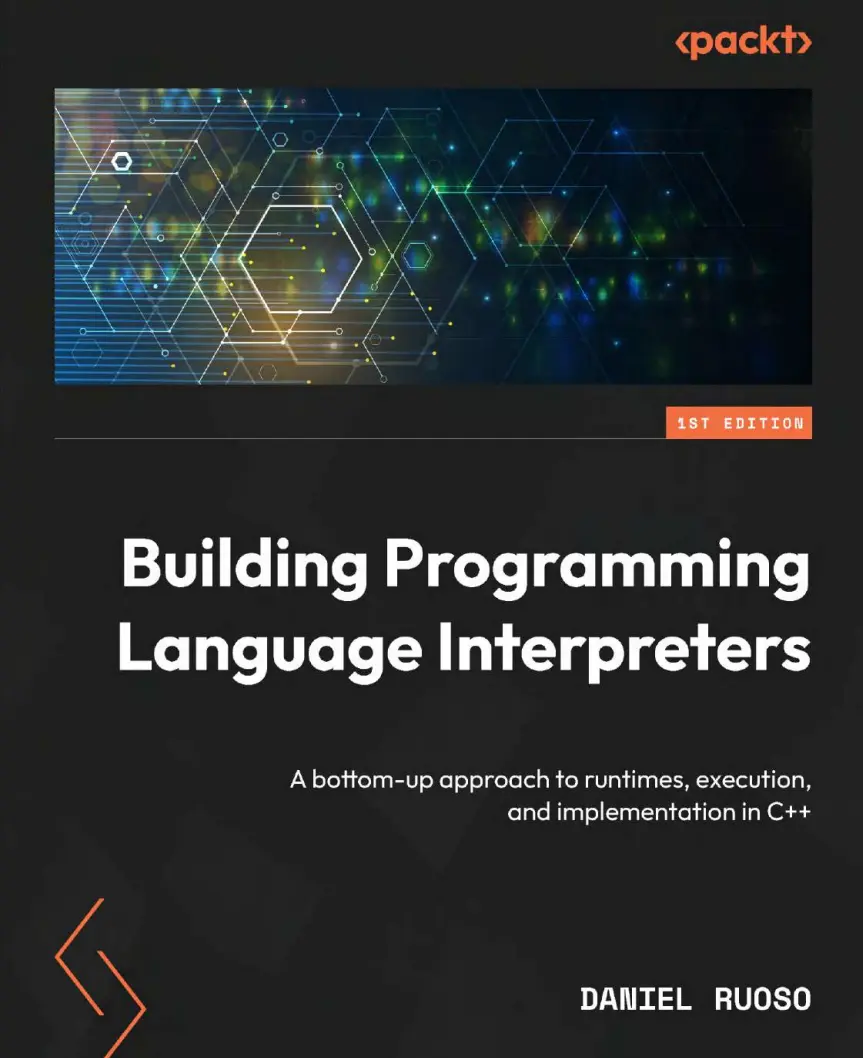
Building Programming Language Interpreters: A bottom-up approach to runtimes, execution, and implementation in C++
Автор: Ruoso Daniel
Дата выхода: 2026
Издательство: Packt Publishing Limited
Количество страниц: 372
Размер файла: 1,7 МБ
Тип файла: PDF
Добавил: codelibs
Проверить на вирусыCover....1
Title Page....2
Copyright and Credits....3
Dedication....4
Contributors....5
Table of Contents....8
Preface....16
Free Benefits with Your Book....23
Part 1: Modeling the Programming Language Runtime Environment....26
Chapter 1: Defining the Scope....28
Technical requirements....29
Why do we keep creating new languages?....29
Domain-specific languages....31
Compilers and interpreters....31
The exercise we will complete in this book....32
How will the interpreter be integrated?....34
Summary....38
Chapter 2: The Blurred Lines Between Native Code, Virtual Machines, and Interpreters....40
Modern ISAs are virtual machines of sorts....41
Native programming languages also have a virtual machine model....45
Interpreters as virtual machines....46
Abstraction of complexity versus execution overhead....47
How JIT compilers change the performance calculation....50
Deciding which model our language will use....51
Summary....52
Chapter 3: Instructions, Concurrency, Inputs, and Outputs....54
Instructions as building blocks....55
Operator stack versus registers....56
Interpreter stack versus language stack....58
Interruptions to the control flow....61
Continuations across native and interpreted code....62
Concurrency model....64
Deciding on the execution model....67
Summary....68
Chapter 4: Native Types, User Types, and Extension Points....70
Different types of type systems....70
Static typing versus dynamic typing....71
Strong typing versus weak typing....74
Language types versus user-defined types....75
Nominal typing versus structural typing....76
Duck typing....78
Approaches to modeling the type system....80
The native types for your language....80
How the users will declare their own types....83
Interaction with native extensions....83
Summary....85
Chapter 5: Putting It All Together: Making Trade-Off Decisions....88
Designing the execution model....88
Interacting with inputs and outputs....89
Identifying continuations that are ready to execute....90
Performing interpreted operations....91
Making native callbacks....92
Concurrency in an embedded language....93
Memory management....95
Memory access patterns....95
Managing mutability....96
Data ownership....98
Life cycle management....99
Finalizing my design....99
Summary....100
Part 2: Modeling the Programming Language Syntax....102
Chapter 6: Review of Programming Language Paradigms....104
Imperative programming....105
Functional programming....106
Declarative programming....109
Logic programming....111
Choosing a paradigm for our language....114
Summary....115
Chapter 7: Values, Containers, and the Language Meta-Model....118
Variables and values....118
Values and containers....120
Mutability....122
Copies, references, and shared values....123
The language meta-model....124
Summary....126
Chapter 8: Lexical Scopes....128
The lexical pad....128
Function lexical scopes....129
Block lexical scopes....130
Closure lexical scopes....131
Global lexical scopes....132
Summary....133
Chapter 9: Putting It All Together and Creating a Coherent Vision....136
The shape of a declarative language....136
Specifying the empty program....137
Hello World!....138
Hello who?....140
Immutability, containers, and values....141
Value types....143
Container types....144
Variables and references....145
The final language design....146
Summary....151
Part 3: Implementing the Interpreter Runtime....152
Chapter 10: Initialization and Entry Point....154
The scaffolding....154
The global interpreter state....155
The interpreted program and the interpreter....155
The operation tree and the mutable interpreter state....156
Executing the operations in the tree....160
Making it friendly to be embedded....165
Refactoring for multiple types of operations....169
Designing the interface for IO....173
Summary....176
Chapter 11: Execution Frames, the Stack, and Continuations....178
Code as a value....179
Invoking a callable value....182
Making a function....186
Calling a function....195
The end-to-end example....198
Summary....200
Chapter 12: Running and Testing Language Operators....202
Identifying and implementing operators....208
IO operators....209
List operators....215
Testing the operators....221
Finalizing the integration....225
Summary....239
Part 4: Interpreting Source Code....242
Chapter 13: Lexing: Turning Text into a Stream of Tokens....244
Identifying token types and their data structures....245
Specifying the rules of the lexer....248
Evaluating different lexer libraries....249
Getting a stream of tokens....250
Testing the tokenizer....253
Summary....254
Chapter 14: Parsing: Turning a Stream of Tokens into a Parse Tree....256
Types of parse nodes and their data structures....257
Specifying the grammar for the parser....259
Evaluating different parser libraries....261
Building a grammar engine in C....263
Getting the parse tree....272
Summary....276
Chapter 15: Analyzing: Turning a Parse Tree into an Abstract Syntax Tree....278
Difference between a parse tree and an abstract syntax tree....279
Modeling the node types and their data structures....279
Transforming one tree into another....286
Summary....298
Chapter 16: Generating: Turning an Abstract Syntax Tree into Instructions....300
Matching AST nodes to interpreter operations....301
Introducing the TransitionLookAhead operation....301
Introducing StateMachineOperation....306
Generating the code for StateMachineOperation....314
Generating the entire program....321
Integrating into the interpreter....328
Executing code in our programming language for the first time....330
Summary....332
Chapter 17: Proving That It Works....334
Revisiting our goals....334
Domain-specific language (DSL) for specifying network protocols....335
Synchronous request–response protocols....335
Transfer of control at multiple points....335
Transferring values to the native language....336
Using captured values within the protocol....336
Checking our acceptance criteria....337
Initialize the interpreter once....337
Make the interpreter drive the interaction with the network....337
Transfer control at specific points....338
Working through an example....338
Understanding SMTP....339
Expressing SMTP in the DSL....340
Implementing an SMTP server....347
Implementing callbacks....351
Was it worth it?....355
Summary....356
Chapter 18: Unlock Your Exclusive Benefits....358
Other Books You May Enjoy....364
Index....368
Explore why you might build a new programming language, which aspects influence runtime and language design choices, and how to implement a working first-version interpreter for that language in C++.
Free with your book: DRM-free PDF version + access to Packt's next-gen Reader*
Key Features
- Design a domain-specific language to solve focused problems and reduce complexity and bugs
- Follow a bottom-up approach, from runtime design to interpreter implementation
- Build an interpreter from scratch as a functional, minimum viable product
Book Description
Designing a custom programming language can be the most effective way to solve certain types of problems—especially when precision, safety, or domain-specific expressiveness matters. This book guides you through the full process of designing and implementing your own programming language and interpreter, from language design to execution, using modern C++.
You’ll start by exploring when and why building a domain-specific language is worth it, and how to design one to fit a specific problem domain. Along the way, you’ll examine real-world interpreter architectures and see how their design decisions affect language behavior, capabilities, and runtime trade-offs.
The book then walks through the entire process of interpreter implementation: defining syntax, building a lexer and parser, designing an abstract syntax tree, generating executable instructions, and implementing a runtime. All examples are in modern C++, with a focus on clean architecture and real-world usability.
By the end, you’ll have a fully working interpreter for a domain-specific language designed to handle network protocols—plus the knowledge and tools to design your own programming language from scratch.
*Email sign-up and proof of purchase required
What you will learn
- Design a domain-specific language and interpreter from scratch
- Write an interpreter that can be embedded into existing environments
- Understand how runtime shapes language execution and interpreter design
- Reason about language design and runtime trade-offs
- Define and implement the execution model of an interpreted language
- Implement a lexer, parser, analyzer, and instruction emitter in C++
Who this book is for
This book is tailored for intermediate to advanced software developers, particularly those interested in language design and implementation. It's ideal for programmers seeking to expand their skill set and tackle complex problems efficiently. Professionals working in roles such as software engineers, language designers, or system architects will benefit from the practical insights and hands-on experience provided in the book. Good understanding of C++ programming and basic understanding of language design concepts are recommended to fully grasp the content.


