-
1C
-
Agda
-
Agile/Scrum
-
Alef
-
APL
-
Assembler
-
AWK
-
Basic
-
Beta Programming Language
-
Big Data/DataScience
-
C
-
C#
-
C++
-
Cobol
-
Crystal
-
CSS
-
D
-
Dart
-
DataBase (SQL)
-
Delphi
-
F#
-
Flutter
-
Fortran
-
GameDev
-
Git
-
Go (Golang)
-
GPT/AI/ИИ
-
Hacking and Security
-
Haskell
-
HTML
-
Java
-
JavaScript (JS)
-
Julia
-
Kotlin
-
Machine Learning (ML)
-
Natural language processing (NLP)
-
.NET (.NET Core)
-
Pascal
-
PHP
-
Python
-
R
-
Ruby
-
Rust
-
Scratch
-
Swift
-
UML
-
UX/UI
-
Visual Basic
-
Wolfram
-
XML
-
АСУ
-
Проектирование/System Design
-
Сети/Network
-
Статьи
-
Схемотехника/электронные схемы
-
1C
-
Agda
-
Agile/Scrum
-
Alef
-
APL
-
Assembler
-
AWK
-
Basic
-
Beta Programming Language
-
Big Data/DataScience
-
C
-
C#
-
C++
-
Cobol
-
Crystal
-
CSS
-
D
-
Dart
-
DataBase (SQL)
-
Delphi
-
F#
-
Flutter
-
Fortran
-
GameDev
-
Git
-
Go (Golang)
-
GPT/AI/ИИ
-
Hacking and Security
-
Haskell
-
HTML
-
Java
-
JavaScript (JS)
-
Julia
-
Kotlin
-
Machine Learning (ML)
-
Natural language processing (NLP)
-
.NET (.NET Core)
-
Pascal
-
PHP
-
Python
-
R
-
Ruby
-
Rust
-
Scratch
-
Swift
-
UML
-
UX/UI
-
Visual Basic
-
Wolfram
-
XML
-
АСУ
-
Проектирование/System Design
-
Сети/Network
-
Статьи
-
Схемотехника/электронные схемы
Меню
Expert Python Programming: Master Python by learning the best coding practices and advanced programming concepts. 4 Ed
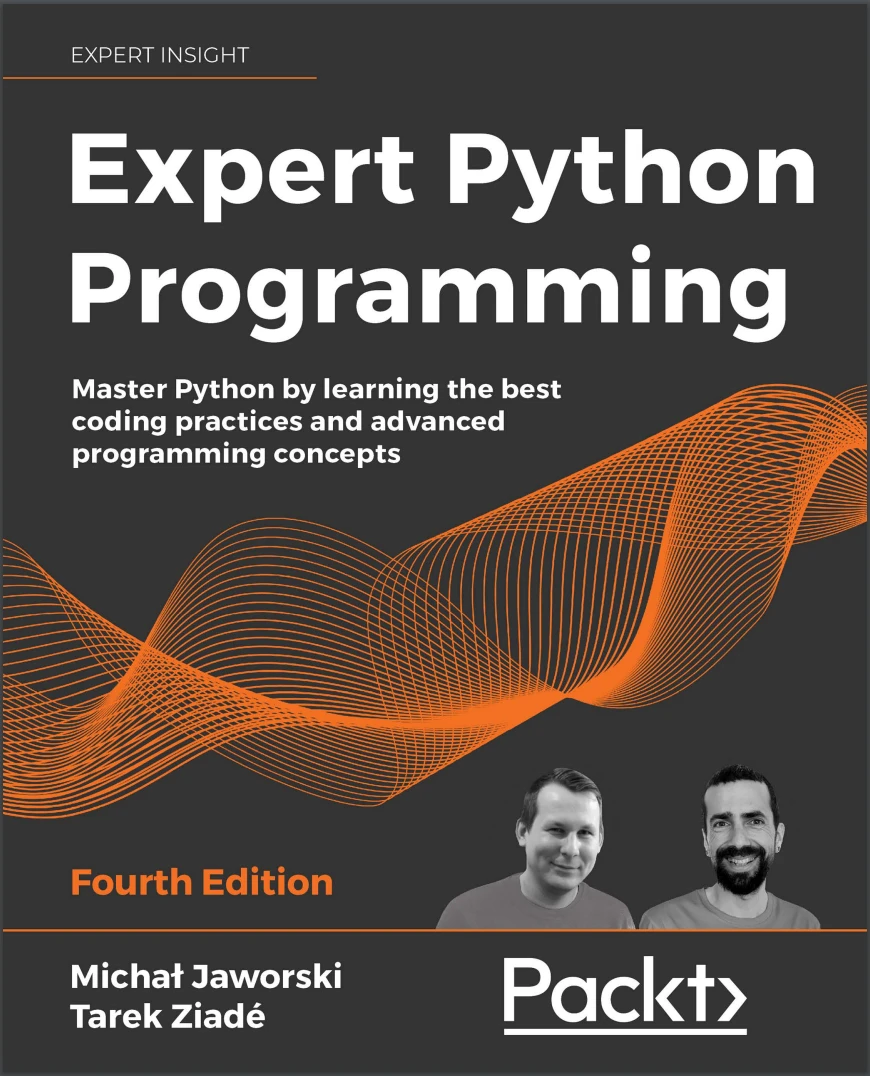
Автор: Jaworski Michał , Ziadé Tarek
Дата выхода: 2021
Издательство: Packt Publishing Limited
Количество страниц: 631
Размер файла: 2,8 МБ
Тип файла: PDF
Добавил: codelibs
Проверить на вирусы Дополнительные материалыCover....1
Copyright....3
Contributors....4
Table of Contents....6
Preface....14
Chapter 1: Current Status of Python....20
Where are we now and where are we going?....21
What to do with Python 2....22
Keeping up to date....24
PEP documents....25
Active communities....27
Other resources....30
Summary....31
Chapter 2: Modern Python Development Environments....34
Technical requirements....35
Python's packaging ecosystem....36
Installing Python packages using pip....36
Isolating the runtime environment....38
Application-level isolation versus system-level isolation....42
Application-level environment isolation....43
Poetry as a dependency management system....46
System-level environment isolation....51
Containerization versus virtualization....53
Virtual environments using Docker....55
Writing your first Dockerfile....56
Running containers....60
Setting up complex environments....62
Useful Docker and Docker Compose recipes for Python....65
Virtual development environments using Vagrant....75
Popular productivity tools....78
Custom Python shells....78
Using IPython....80
Incorporating shells in your own scripts and programs....84
Interactive debuggers....85
Other productivity tools....87
Summary....89
Chapter 3: New Things in Python....90
Technical requirements....91
Recent language additions....91
Dictionary merge and update operators....92
Alternative – Dictionary unpacking....95
Alternative – ChainMap from the collections module....95
Assignment expressions....98
Type-hinting generics....102
Positional-only parameters....103
zoneinfo module....106
graphlib module....107
Not that new, but still shiny....112
breakpoint() function....112
Development mode....113
Module-level __getattr__() and __dir__() functions....116
Formatting strings with f-strings....117
Underscores in numeric literals....119
secrets module....119
What may come in the future?....120
Union types with the | operator....121
Structural pattern matching....122
Summary....127
Chapter 4: Python in Comparison with Other Languages....128
Technical requirements....129
Class model and object-oriented programming ....129
Accessing super-classes....131
Multiple inheritance and Method Resolution Order....133
Class instance initialization....139
Attribute access patterns....143
Descriptors....144
Real-life example – lazily evaluated attributes....147
Properties....151
Dynamic polymorphism....157
Operator overloading....159
Dunder methods (language protocols)....160
Comparison to C++....164
Function and method overloading....166
Single-dispatch functions....168
Data classes....170
Functional programming....174
Lambda functions....176
The map(), filter(), and reduce() functions....178
Partial objects and partial functions....181
Generators....182
Generator expressions....184
Decorators....185
Enumerations....187
Summary....190
Chapter 5: Interfaces, Patterns, and Modularity....192
Technical requirements....193
Interfaces....194
A bit of history: zope.interface....196
Using function annotations and abstract base classes....205
Using collections.abc....210
Interfaces through type annotations....211
Inversion of control and dependency injection....214
Inversion of control in applications....216
Using dependency injection frameworks....225
Summary....231
Chapter 6: Concurrency....232
Technical requirements....233
What is concurrency?....233
Multithreading....235
What is multithreading?....236
How Python deals with threads....240
When should we use multithreading?....242
Application responsiveness....242
Multiuser applications....243
Work delegation and background processing....244
An example of a multithreaded application....245
Using one thread per item....248
Using a thread pool....250
Using two-way queues....255
Dealing with errors in threads....257
Throttling....260
Multiprocessing....264
The built-in multiprocessing module....266
Using process pools....270
Using multiprocessing.dummy as the multithreading interface....273
Asynchronous programming....274
Cooperative multitasking and asynchronous I/O....275
Python async and await keywords....276
A practical example of asynchronous programming....281
Integrating non-asynchronous code with async using futures....284
Executors and futures....286
Using executors in an event loop....287
Summary....288
Chapter 7: Event-Driven Programming....290
Technical requirements....291
What exactly is event-driven programming?....291
Event-driven != asynchronous....292
Event-driven programming in GUIs....293
Event-driven communication....296
Various styles of event-driven programming....298
Callback-based style....299
Subject-based style....300
Topic-based style....305
Event-driven architectures....307
Event and message queues....309
Summary....312
Chapter 8: Elements of Metaprogramming....314
Technical requirements....315
What is metaprogramming?....315
Using decorators to modify function behavior before use ....316
One step deeper: class decorators....318
Intercepting the class instance creation process....323
Metaclasses....326
The general syntax....328
Metaclass usage....331
Metaclass pitfalls....334
Using the __init__subclass__() method as an alternative to metaclasses....336
Code generation....338
exec, eval, and compile....338
The abstract syntax tree ....340
Import hooks....342
Notable examples of code generation in Python....342
Falcon's compiled router....343
Hy....344
Summary....345
Chapter 9: Bridging Python with C and C++....346
Technical requirements....348
C and C++ as the core of Python extensibility....348
Compiling and loading Python C extensions....349
The need to use extensions....351
Improving performance in critical code sections....352
Integrating existing code written in different languages....353
Integrating third-party dynamic libraries....354
Creating efficient custom datatypes....354
Writing extensions....355
Pure C extensions....356
A closer look at the Python/C API....360
Calling and binding conventions....364
Exception handling....368
Releasing GIL....370
Reference counting....372
Writing extensions with Cython....375
Cython as a source-to-source compiler....375
Cython as a language....379
Downsides of using extensions....381
Additional complexity....382
Harder debugging....383
Interfacing with dynamic libraries without extensions....384
The ctypes module....384
Loading libraries....384
Calling C functions using ctypes....386
Passing Python functions as C callbacks....388
CFFI....391
Summary....393
Chapter 10: Testing and Quality Automation....396
Technical requirements....397
The principles of test-driven development....398
Writing tests with pytest....400
Test parameterization....408
pytest's fixtures....411
Using fakes....421
Mocks and the unittest.mock module....424
Quality automation....429
Test coverage....430
Style fixers and code linters....434
Static type analysis....438
Mutation testing....439
Useful testing utilities....446
Faking realistic data values....446
Faking time values....448
Summary....449
Chapter 11: Packaging and Distributing Python Code....452
Technical requirements....453
Packaging and distributing libraries....453
The anatomy of a Python package....454
setup.py....457
setup.cfg....459
MANIFEST.in....459
Essential package metadata....461
Trove classifiers....462
Types of package distributions....464
sdist distributions....464
bdist and wheel distributions....466
Registering and publishing packages....469
Package versioning and dependency management....472
The SemVer standard for semantic versioning....474
CalVer for calendar versioning....475
Installing your own packages....476
Installing packages directly from sources....476
Installing packages in editable mode....477
Namespace packages....478
Package scripts and entry points....480
Packaging applications and services for the web....484
The Twelve-Factor App manifesto....485
Leveraging Docker....486
Handling environment variables....489
The role of environment variables in application frameworks....494
Creating standalone executables....499
When standalone executables are useful....500
Popular tools....500
PyInstaller....501
cx_Freeze....505
py2exe and py2app....507
Security of Python code in executable packages....509
Summary....510
Chapter 12: Observing Application Behavior and Performance....512
Technical requirements....513
Capturing errors and logs....513
Python logging essentials....514
Logging system components....516
Logging configuration....524
Good logging practices....528
Distributed logging....530
Capturing errors for later review....533
Instrumenting code with custom metrics....537
Using Prometheus....539
Distributed application tracing....549
Distributed tracing with Jaeger....553
Summary....559
Chapter 13: Code Optimization....560
Technical requirements....561
Common culprits for bad performance....561
Code complexity....562
Cyclomatic complexity....563
The big O notation....564
Excessive resource allocation and leaks....567
Excessive I/O and blocking operations....568
Code profiling....568
Profiling CPU usage....570
Macro-profiling....570
Micro-profiling....576
Profiling memory usage....579
Using the objgraph module....581
C code memory leaks....589
Reducing complexity by choosing appropriate data structures....590
Searching in a list....590
Using sets....592
Using the collections module....593
deque....593
defaultdict....595
namedtuple....597
Leveraging architectural trade-offs....599
Using heuristics and approximation algorithms....599
Using task queues and delayed processing....600
Using probabilistic data structures....604
Caching....605
Deterministic caching....606
Non-deterministic caching....609
Summary....614
Why subscribe?....616
Packt Page....616
Other Books You May Enjoy....618
Index....620
Attain a deep understanding of building, maintaining, packaging, and shipping robust Python applications
Key Features:
- Discover the new features of Python, such as dictionary merge, the zoneinfo module, and structural pattern matching
- Create manageable code to run in various environments with different sets of dependencies
- Implement effective Python data structures and algorithms to write, test, and optimize code
Book Description:
Python is used in a wide range of domains owing to its simple yet powerful nature. Although writing Python code is easy, making it readable, reusable, and easy to maintain can be challenging. Complete with best practices, useful tools, and standards implemented by professional Python developers, this fourth edition will help you in not only overcoming such challenges but also learning Python's latest features and advanced concepts. The book begins with a warm-up, where you will catch-up with the latest Python improvements, syntax elements, and interesting tools to boost your development efficiency. Further, the initial few chapters should allow experienced programmers coming from different languages to safely land in the Python ecosystem. As you progress, you will explore common software design patterns and various programming methodologies, such as event-driven programming, concurrency, and metaprogramming. You will also go through complex code examples and try to solve meaningful problems by bridging Python with C and C++, writing extensions that benefit from the strengths of multiple languages. Finally, you will understand the complete lifetime of any application after it goes live. By the end of the book, you should be proficient in writing efficient and maintainable Python code.
What You Will Learn:
- Explore modern ways of setting up repeatable and consistent Python development environments
- Effectively package Python code for community and production use
- Learn modern syntax elements of Python programming, such as f-strings, enums, and lambda functions
- Demystify metaprogramming in Python with metaclasses
- Write concurrent code in Python
- Extend and integrate Python with code written in different languages
Who this book is for:
The Python programming book is intended for expert programmers who want to learn Python's advanced-level concepts and latest features.
Anyone who has basic Python skills should be able to follow the content of the book, although it might require some additional effort from less experienced programmers. It should also be a good introduction to Python 3.9 for those who are still a bit behind and continue to use other older versions.


