-
1C
-
Agda
-
Agile/Scrum
-
Alef
-
APL
-
Assembler
-
AWK
-
Basic
-
Beta Programming Language
-
Big Data/DataScience
-
C
-
C#
-
C++
-
Cobol
-
Crystal
-
CSS
-
D
-
Dart
-
DataBase (SQL)
-
Delphi
-
F#
-
Flutter
-
Fortran
-
GameDev
-
Git
-
Go (Golang)
-
GPT/AI/ИИ
-
Hacking and Security
-
Haskell
-
HTML
-
Java
-
JavaScript (JS)
-
Julia
-
Kotlin
-
Machine Learning (ML)
-
Natural language processing (NLP)
-
.NET (.NET Core)
-
Pascal
-
PHP
-
Python
-
R
-
Ruby
-
Rust
-
Scratch
-
Swift
-
UML
-
UX/UI
-
Visual Basic
-
Wolfram
-
XML
-
АСУ
-
Проектирование/System Design
-
Сети/Network
-
Статьи
-
Схемотехника/электронные схемы
-
1C
-
Agda
-
Agile/Scrum
-
Alef
-
APL
-
Assembler
-
AWK
-
Basic
-
Beta Programming Language
-
Big Data/DataScience
-
C
-
C#
-
C++
-
Cobol
-
Crystal
-
CSS
-
D
-
Dart
-
DataBase (SQL)
-
Delphi
-
F#
-
Flutter
-
Fortran
-
GameDev
-
Git
-
Go (Golang)
-
GPT/AI/ИИ
-
Hacking and Security
-
Haskell
-
HTML
-
Java
-
JavaScript (JS)
-
Julia
-
Kotlin
-
Machine Learning (ML)
-
Natural language processing (NLP)
-
.NET (.NET Core)
-
Pascal
-
PHP
-
Python
-
R
-
Ruby
-
Rust
-
Scratch
-
Swift
-
UML
-
UX/UI
-
Visual Basic
-
Wolfram
-
XML
-
АСУ
-
Проектирование/System Design
-
Сети/Network
-
Статьи
-
Схемотехника/электронные схемы
Меню
Essential Data Analytics, Data Science, and AI: A Practical Guide for a Data-Driven World
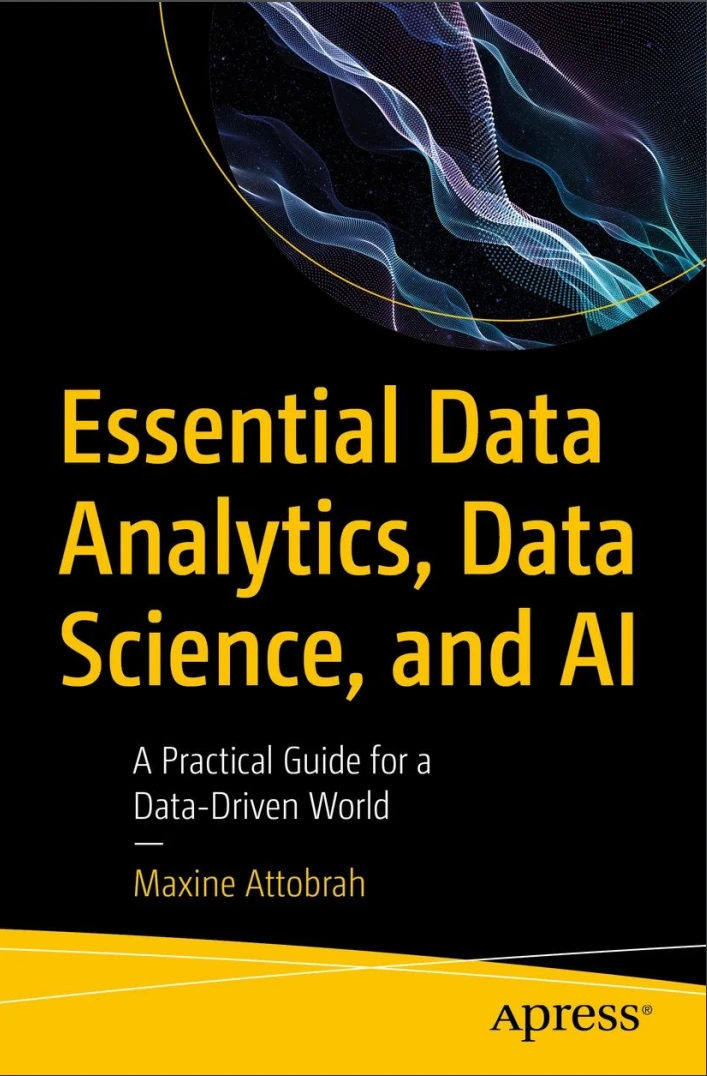
Автор: Attobrah Maxine
Дата выхода: 2024
Издательство: Apress Media, LLC.
Количество страниц: 209
Размер файла: 3,7 МБ
Тип файла: PDF
Добавил: codelibs
Проверить на вирусы Дополнительные материалыContents....5
About the Author....13
About the Technical Reviewers....14
Foreword....17
Chapter 1: Introduction....19
Data Analytics....19
Data Science....20
Artificial Intelligence....20
The Dream Team....21
What to Expect?....21
Chapter 2: Obtaining Data....24
Understanding the Different Types of Data....24
Structured Data....24
Unstructured Data....25
Quantitative Data....26
Qualitative Data....26
Time Series Data....27
Cross-Sectional Data....27
Spatial Data....28
Ways to Obtain Data....28
Web Scraping: Extracting Data from the Web....28
API: Application Programming Interface....28
Questionnaires and Surveys....29
Popular Sites and Datasets....29
Kaggle....29
Hugging Face....31
Quandl....34
Synthetic Data....35
Telemetry....38
Case Studies and Real-World Examples....38
Obtaining Real-World Data....38
Retail Sales Forecasting....38
Financial Fraud Detection....39
Supply Chain Optimization....39
Obtaining Synthetic Data....39
Preserving Privacy in Healthcare....39
Image Recognition....40
Ethics and Liabilities....40
CCPA: California Consumer Privacy Act....40
GDPR: General Data Protection Regulation....41
HIPAA: Health Insurance Portability and Accountability Act....41
Enhancing Transparency and Understanding Using Dataset Cards....41
Why Are Data Cards Important?....42
Conclusion....43
Chapter 3: ETL Pipeline....44
Introduction to ETL....45
Importance of ETL....45
ETL Tools and Techniques....49
Case Studies and Real-World Examples....61
Retail Analytics....61
Healthcare Data Integration....61
Social Media....61
Fraud Detection in Financial Transactions....62
Smart Home Automation....62
Conclusion....63
Chapter 4: Exploratory Data Analysis....64
Introduction to Exploratory Data Analysis....64
Importance of Exploratory Data Analysis....66
Exploratory Data Analysis Tools and Techniques....76
Python....76
R....77
Tableau....77
Power BI....77
Choosing the Right Visualizations for EDA....83
Use Cases of EDA for Business....85
Retail Industry....85
Healthcare....86
Finance....88
Manufacturing....89
Conclusion....90
Chapter 5: Machine Learning Models....91
Introduction to Machine Learning Models....93
Deep Learning Models....98
Key Concepts and Terminology....101
Importance of Machine Learning Models....106
Healthcare....106
Finance....106
Retail....106
Transportation....107
Marketing....107
Machine Learning Models’ Tools and Techniques....108
Programming Languages....108
Frameworks and Libraries....108
TensorFlow....108
PyTorch....108
Keras....108
scikit-Learn....109
Transformers....109
Integrated Development Environments....109
Jupyter Notebook....109
Google Colab....110
Feature Selection and Engineering....114
Pre-trained vs. Fine-Tuned Models....115
Prompt Engineering....115
Conclusion....115
Chapter 6: Evaluating Models....117
Introduction to Evaluating Models....117
Importance of Evaluating Models....118
Tools and Techniques When Evaluating Models’....120
Examples with Code....133
Monitoring Your Model....136
Examples Where Machine Learning Models Can Be Useful....137
Conclusion....137
Chapter 7: When to Use Machine Learning Models....139
Introduction to When to Use Machine Learning Models....139
Importance of Understanding When to Use Machine Learning Models....140
Assessing the Necessity and Value of Machine Learning Models....141
Identifying the Right Problems....141
Navigating Open-Ended Challenges....142
Adapting to Change in Dynamic Environments....143
Solving Tough Problems....143
Critical Conditions for Successful Machine Learning Models....144
Critical Conditions for Successful AI Products....144
Enhancing Your Model by Leveraging the Data from Interactions with It....145
Cost Considerations for AI Products....146
When to Consider Alternatives....146
Tools and Techniques of When to Use Machine Learning Models’....147
Techniques and Tools....148
Examples Where Machine Learning Models Can Be Useful....155
Finance: Fraud Detection....155
Retail: Personalized Recommendations....155
Conclusion....155
Chapter 8: Where Machine Learning Models Live....156
Introduction to Where Machine Learning Models Live....156
Key Considerations to Think About When Deciding Where Your Machine Learning Models Should Live....157
Deciding Where the Machine Learning Should Live....162
Built-In Machine Learning Model....162
Cloud-Based Machine Learning Model....163
Stored Machine Learning Results....163
Mixing Different Approaches....164
Tools and Techniques....164
Cloud Services....164
On-Premise Options....165
Edge Devices....165
Hybrid Systems....166
Examples of Machine Learning Deployment Strategies for Industry Needs....166
Retail: Cloud-Based Recommendation Systems....166
Healthcare: Edge AI for Real-Time Diagnostics....167
Manufacturing: Hybrid Systems for Predictive Maintenance....167
Conclusion....168
Chapter 9: Telemetry....169
Introduction to Telemetry....169
Importance of Telemetry....170
Telemetry Tools and Techniques....171
Data Collection Tools....171
Data Transmission Tools....171
Data Analysis Tools....172
Model Decay, a.k.a. Model Drift....172
Types of Drift....173
Ways to Detect Drift....174
Examples of How Telemetry Can Be Used in the World....175
E-commerce Recommendation Systems....175
Autonomous Vehicles....177
Healthcare Monitoring System....178
Conclusion....179
Chapter 10: Adversaries and Abuse....180
Introduction to Adversaries and Abuse....180
Importance of Understanding Adversaries and Abuse in Machine Learning....182
Impact on Security and Privacy....182
Economic and Operational Implications....183
Trust in Machine Learning Systems....184
Ways Adversarial Attacks Can Be Used....184
Data Poisoning in Autonomous Vehicles....184
Model Inversion in Healthcare....184
Evasion Attacks Using Adversarial Images....184
Mitigating Risk....187
Ethical Considerations....188
Conclusion....193
Chapter 11: Working with Models....194
Introduction....194
The Historical Context of Technological Advancement....194
The Benefits of AI: Transformative Potential Across Industries....195
Healthcare: Improved Diagnostics and Personalized Medicine....195
Education: Personalized Learning....196
Manufacturing: Automation and Predictive Maintenance....196
Everyday Life: Personal Assistants and Smart Home Devices....196
AI Enhancing Human Capabilities....197
Successful AI Integration....197
Healthcare....197
Finance....198
Consumer Goods....198
Addressing Common Fears and Misconceptions....198
AI As a Threat to Privacy: Balancing Innovation with Ethical Considerations....198
The Myth of AI As an Uncontrollable Force....199
Responsible AI....199
Understanding Bias....199
Mitigating Bias – Human in the Loop Approach....204
Ways Humans Can Be in the Loop but Not Limited To....205
Benefits of Humans in the Loop....205
Challenges of Humans in the Loop....206
Mitigating Bias – Why Diversity Matters....206
Building Trust and Transparency – Ethical AI: Ensuring Fairness, Accountability, and Transparency....206
The Role of Education and Public Engagement....207
The Future AI: Opportunities and Challenges....208
Conclusion....209
In today’s world, understanding data analytics, data science, and artificial intelligence is not just an advantage but a necessity. This book is your thorough guide to learning these innovative fields, designed to make the learning practical and engaging.
The book starts by introducing data analytics, data science, and artificial intelligence. It illustrates real-world applications, and, it addresses the ethical considerations tied to AI. It also explores ways to gain data for practice and real-world scenarios, including the concept of synthetic data. Next, it uncovers Extract, Transform, Load (ETL) processes and explains how to implement them using Python. Further, it covers artificial intelligence and the pivotal role played by machine learning models. It explains feature engineering, the distinction between algorithms and models, and how to harness their power to make predictions. Moving forward, it discusses how to assess machine learning models after their creation, with insights into various evaluation techniques. It emphasizes the crucial aspects of model deployment, including the pros and cons of on-device versus cloud-based solutions. It concludes with real-world examples and encourages embracing AI while dispelling fears, and fostering an appreciation for the transformative potential of these technologies.
Whether you’re a beginner or an experienced professional, this book offers valuable insights that will expand your horizons in the world of data and AI.
What you will learn:
- What are Synthetic data and Telemetry data
- How to analyze data using programming languages like Python and Tableau.
- What is feature engineering
- What are the practical Implications of Artificial Intelligence
Who this book is for:
Data analysts, scientists, and engineers seeking to enhance their skills, explore advanced concepts, and stay up-to-date with ethics. Business leaders and decision-makers across industries are interested in understanding the transformative potential and ethical implications of data analytics and AI in their organizations.


