-
1C
-
Agda
-
Agile/Scrum
-
Alef
-
APL
-
Assembler
-
AWK
-
Basic
-
Beta Programming Language
-
Big Data/DataScience
-
C
-
C#
-
C++
-
Cobol
-
Crystal
-
CSS
-
D
-
Dart
-
DataBase (SQL)
-
Delphi
-
F#
-
Flutter
-
Fortran
-
GameDev
-
Git
-
Go (Golang)
-
GPT/AI/ИИ
-
Hacking and Security
-
Haskell
-
HTML
-
Java
-
JavaScript (JS)
-
Julia
-
Kotlin
-
Machine Learning (ML)
-
Natural language processing (NLP)
-
.NET (.NET Core)
-
Pascal
-
PHP
-
Python
-
R
-
Ruby
-
Rust
-
Scratch
-
Swift
-
UML
-
UX/UI
-
Visual Basic
-
Wolfram
-
XML
-
АСУ
-
Проектирование/System Design
-
Сети/Network
-
Статьи
-
Схемотехника/электронные схемы
-
1C
-
Agda
-
Agile/Scrum
-
Alef
-
APL
-
Assembler
-
AWK
-
Basic
-
Beta Programming Language
-
Big Data/DataScience
-
C
-
C#
-
C++
-
Cobol
-
Crystal
-
CSS
-
D
-
Dart
-
DataBase (SQL)
-
Delphi
-
F#
-
Flutter
-
Fortran
-
GameDev
-
Git
-
Go (Golang)
-
GPT/AI/ИИ
-
Hacking and Security
-
Haskell
-
HTML
-
Java
-
JavaScript (JS)
-
Julia
-
Kotlin
-
Machine Learning (ML)
-
Natural language processing (NLP)
-
.NET (.NET Core)
-
Pascal
-
PHP
-
Python
-
R
-
Ruby
-
Rust
-
Scratch
-
Swift
-
UML
-
UX/UI
-
Visual Basic
-
Wolfram
-
XML
-
АСУ
-
Проектирование/System Design
-
Сети/Network
-
Статьи
-
Схемотехника/электронные схемы
Меню
Generative AI for Game Development: Crafting Narrative Worlds with Machines
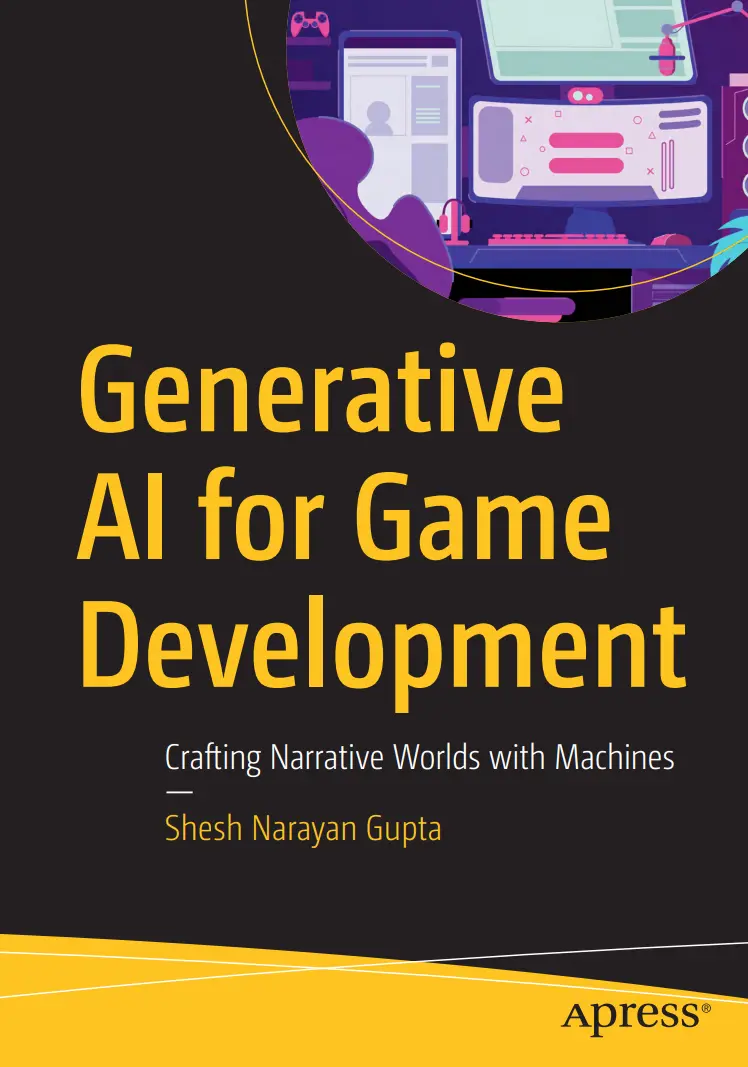
Автор: Gupta Shesh Narayan
Дата выхода: 2026
Издательство: Apress Media, LLC.
Количество страниц: 513
Размер файла: 3,7 МБ
Тип файла: PDF
Добавил: codelibs
Проверить на вирусыTable of Contents....5
About the Author....16
Acknowledgments....17
Introduction....18
Chapter 1: What Is Generative AI?....19
Definition of Generative AI....19
How Does Generative AI Work?....20
Core Machine Learning Techniques in Generative AI....20
Neural Networks: The Building Blocks of AI Creativity....21
Transformer Models: Powering Advanced Text and Image Generation....22
Generative Adversarial Networks (GANs): AIs Creativity Engine....23
Variational Autoencoders (VAEs): Learning Creativity from Data....25
Retrieval-Augmented Generation (RAG): Guiding AI with Game-Specific Knowledge....26
How These Models Work Together in Game Development....27
Applications of Generative AI in Gaming....28
Evolution: From Simple Text Generation to Multimodal AI....29
Early Stages: Rule-Based and Statistical AI....29
Rise of Deep Learning and Transformer Models....29
The Age of Multimodal AI....30
Key Tools for Generative AI in Game Development....30
GPT (Generative Pre-trained Transformer)....31
DALLE and Stable Diffusion....31
Unity ML-Agents, Unity Sentis, and Unreal Engine AI....32
AI Dungeon and Twine....32
Real-World Applications in Gaming....33
AI-Generated Game Narratives....33
Procedural World Generation....34
AI-Enhanced NPC Behavior....34
Conclusion....34
Chapter 2: Why Generative AI Matters in Game Development....36
The Rise of Adaptive and Dynamic Gameplay....36
AI-Driven Game Mechanics....36
Example: Left 4 Deads AI Director....37
AI-Driven Personalization and Player Engagement....37
How AI Personalizes Gaming Experiences....37
Example: AI-Powered NPCs in Roleplaying Games (RPGs)....38
Generative AI in Procedural Content and Narrative Design....38
How AI Enhances Procedural Content Generation....38
Example: OasisAI-Generated Universes....39
Why AI Tools Are Essential: A Comparison of Traditional vs. AI-Driven Game Development....39
Game World Creation: Traditional vs. AI-Driven....39
Traditional Method (Handcrafted Environments)....40
AI-Powered Method (Procedural Generation and AI-Enhanced Level Design)....40
Example: Oasis vs. Handcrafted Open Worlds....40
Storytelling and Dialogue: Traditional vs. AI-Generated....41
Traditional Method (Scripted Storylines and Predefined NPC Dialogues)....41
AI-Powered Method (Adaptive, Player-Driven Narratives)....41
Example: AI Dungeon vs. Traditional RPGs....42
NPC Behavior: Traditional vs. AI-Enhanced....42
Traditional Method (Pre-scripted AI and Fixed Behavior Trees)....43
AI-Powered Method (Machine Learning for Smarter NPCs)....43
Example: Alien: Isolation vs. Older Stealth Games....43
Game Asset Creation: Traditional vs. AI-Assisted....43
Traditional Method (Handcrafted Game Assets and Textures)....44
AI-Powered Method (DALLE and Stable Diffusion for Instant Asset Generation)....44
Example: Cyberpunk 2077 (Handcrafted) vs. AI-Assisted Art Generation....45
Why AI Is a Game-Changer....46
The Future of Generative AI in Game Development: Whats Next?....47
Conclusion....47
Chapter 3: Purpose and Audience of the Book....48
Who This Book Is For....48
Target Audience....49
Key Takeaways: What You Will Gain....49
What You Will Learn....49
How This Book Is Structured....50
Part 1: Foundations of AI Storytelling....50
Part 2: Designing Interactive Narratives....50
Part 3: Implementing AI-Driven Storytelling....50
Part 4: Advanced Techniques Across Industries....51
Part 5: Challenges, Best Practices, and Future Trends....51
Part 6: Practical Projects and Templates....51
Why This Book Matters Now....51
Conclusion....51
Part I: Foundations of AI Storytelling....52
Chapter 4: What Is Storytelling?....53
The Role of Storytelling in Games....53
Why Narrative Matters in Games....54
Contextualizing Gameplay....54
Driving Emotional Engagement....54
Immersion and Worldbuilding....54
Nonlinear Exploration and Replay Ability....54
Core Elements of a Story....55
Plot: The Sequence of Meaningful Events....55
Classical Structure....56
i. The Heros Journey (The Quest)....56
ii. Rags to Riches....57
iii. Overcoming the Monster....57
iv. The Tragedy....57
v. The Voyage and Return....57
vi. The Rebirth....58
vii. The Mystery....58
viii. The Transformation (Internal Journey)....58
Characters: The Emotional Anchor of the Narrative....59
Key Traits of Effective Characters....59
i. The Protagonist (Player Character)....60
Types of Protagonists....60
Narrative Role....60
ii. The Antagonist....60
Types of Antagonists....60
Narrative Role....61
iii. Companion Characters (Allies and Sidekicks)....61
Examples....61
Narrative Role....61
iv. Non-playable Characters (NPCs)....62
Types of NPCs....62
Narrative Role....62
v. The Mentor or Guide....62
Examples....62
Narrative Role....63
vi. The Trickster or Wildcard....63
Examples....63
Narrative Role....63
vii. The Player-Created Character (Avatar)....63
Examples....64
Narrative Role....64
Setting: The World Where the Story Unfolds....64
In Games, Setting Is Multifaceted....64
i. Fantasy Worlds....65
Key Characteristics....65
Example....65
Narrative Function....65
ii. Science Fiction and Futuristic Settings....65
Key Characteristics....66
Example....66
Narrative Function....66
iii. Post-Apocalyptic Worlds....66
Key Characteristics....66
Example....67
Narrative Function....67
vi. Historical Settings....67
Key Characteristics....67
Example....67
Narrative Function....67
v. Urban and Modern-Day Settings....68
Key Characteristics....68
Example....68
Narrative Function....68
vi. Horror and Psychological Settings....68
Key Characteristics....68
Example....69
Narrative Function....69
vii. Mythical or Surreal Settings....69
Key Characteristics....69
Example....69
Narrative Function....69
viii. Hybrid and Multiverse Settings....70
Key Characteristics....70
Example....70
Narrative Function....70
Conflict: The Engine of the Story....70
i. Character vs. Self (Internal Conflict)....71
Example....71
Narrative Function....71
ii. Character vs. Character....71
Example....71
Narrative Function....71
iii. Character vs. Society....72
Example....72
Narrative Function....72
iv. Character vs. Nature....72
Example....72
Narrative Function....72
v. Character vs. Technology....73
Example....73
Narrative Function....73
vi. Character vs. Supernatural....73
Example....73
Narrative Function....73
vii. Character vs. Time....73
Example....74
Narrative Function....74
viii. Character vs. The Unknown (Existential or Metaphysical Conflict)....74
Example....74
Narrative Function....74
Resolution: The Payoff or Aftermath....75
i. Closed or Definitive Resolution....75
Example....75
Narrative Function....75
ii. Open-Ended Resolution....75
Example....75
Narrative Function....76
iii. Branching or Multiple Endings....76
Example....76
Narrative Function....76
iv. Circular or Looping Resolution....76
Example....76
Narrative Function....77
v. Tragic or Bittersweet Resolution....77
Example....77
Narrative Function....77
vi. Player-Defined or Emergent Resolution....77
Example....77
Narrative Function....78
vii. False or Deceptive Resolution....78
Example....78
Narrative Function....78
The Evolution of Storytelling: From Oral Tales to AI Narratives....79
Early Storytelling....79
Film and Television....79
Interactive Storytelling....80
AI-Enhanced Storytelling: A New Frontier....80
How AI Is Changing Storytelling....80
Conclusion....81
Chapter 5: Understanding Narrative Structures....82
Linear Narrative: Structure with Purpose....82
Example....83
What Its Good For....83
Key Benefits....83
Challenges....84
Potential Downsides....84
Nonlinear Narrative: Freedom and Discovery....84
Example....84
What Its Good For....85
Key Benefits....85
Challenges....85
Potential Downsides....85
Decision Trees and Consequence Mapping....85
Example....86
What Its Good For....86
Key Benefits....86
Challenges....87
Potential Downsides....87
Modular and Episodic Structures....87
Episodic Games....87
Modular Game Design....87
What Its Good For....88
Key Benefits....88
Challenges....88
Potential Downsides....88
Nested and Layered Narratives....88
Example....89
What Its Good For....89
Key Benefits....89
Challenges....89
Potential Downsides....89
Emergent Narratives....90
Example....90
What Its Good For....90
Key Benefits....90
Challenges....91
Potential Downsides....91
Blended Structures in Modern Game Design....91
Example....91
What Its Good For....91
Key Benefits....92
Challenges....92
Potential Downsides....92
Comparing Narrative Structures in Games....92
Real-World Examples: AI Dungeon and Bandersnatch....94
AI Dungeon: Narrative Without a Script....94
Narrative Structure: Emergent and Dynamic....94
What Its Good For....94
Benefits....95
Challenges....95
Why It Matters....95
Bandersnatch: Branching Narratives in Cinematic Form....95
Narrative Structure: Deeply Branching Decision Tree....95
What Its Good For....96
Benefits....96
Challenges....96
Why It Matters....96
How Generative AI Uses Narrative Structures....97
Conclusion....98
Chapter 6: Types of Interactive Narratives....99
Interactive Narratives....100
Branching Narratives....100
How It Works....100
Best For....100
Benefits....101
Challenges....101
Example: The Walking Dead (Telltale Games)....101
Open-Ended Narratives....101
How It Works....102
Best For....102
Benefits....102
Challenges....102
Example: The Elder Scrolls V: Skyrim....102
Procedural or Generated Narratives....103
How It Works....103
Best For....103
Benefits....103
Challenges....104
Example: AI Dungeon....104
Dialogue-Driven Narratives....104
How It Works....104
Best For....105
Benefits....105
Challenges....105
Example: Mass Effect Series....105
Environmental and Embedded Narratives....106
How It Works....106
Best For....106
Benefits....106
Challenges....106
Example: Gone Home....106
Hybrid Narratives....107
How It Works....107
Best For....107
Benefits....107
Challenges....108
Example: Red Dead Redemption 2....108
Comparison of Interactive Narrative Types....108
How Developers Use Generative AI Within These Narrative Structures....112
Conclusion....113
Chapter 7: AI Tools and Technologies for Storytelling....115
Lightweight Tools vs. Advanced AI Systems....115
Lightweight Tools....116
Key Features....116
Common Examples....116
Advanced AI Systems....116
Key Features....117
Common Examples....117
Lightweight Tools vs. Advanced AI Systems: A Comparison....118
Twine: Visual Storytelling for Everyone....119
GPT (Generative Pre-trained Transformer): Dynamic Text Generation....119
DALLE and Stable Diffusion: Visual Storytelling with AI Art....120
VADER (Valence Aware Dictionary for Sentiment Reasoning): Emotional Tone Analysis....121
Flask: A Lightweight Framework for Custom Narrative Tools....121
Combining Tools: A Layered Approach....123
Conclusion....123
Chapter 8: Ethical and Practical Considerations....130
What Does Ethical Mean in AI-Powered Game Storytelling?....130
Ethical Means Inclusive....131
Ethical Means Emotionally Aware....131
Ethical Means Transparent....131
Ethical Means Accountable....131
Ethical Means Story-First....132
Why Ethics in AI Storytelling Matters....132
Where Things Can Go Wrong and How to Make Them Right....133
Bias in AI-Generated Content....133
Authorship and Ownership....134
Narrative Coherence and Continuity....135
AI Hallucinations....136
Player Trust and Emotional Safety....138
Data Privacy and Player Input....138
Overreliance on Automation....139
Developer Checklist: Ethical AI Storytelling....140
Bias and Representation....140
Authorship and Transparency....141
Narrative Coherence....141
Player Safety and Emotional Sensitivity....142
Data Privacy....142
Creative Oversight....142
Intentional Design....143
Conclusion....143
Part II: Designing Interactive Narratives....144
Chapter 9: Creating Branching Story Frameworks....145
Understanding the Components of a Branching Narrative Framework....145
Decision Points....146
Narrative Branches....146
Convergence Points....147
Endings....148
Flags and Variables (Supporting Mechanisms)....149
Feedback and Consequence....150
Putting It All Together: A Mini Scenario....150
Premise....150
Types of Branching Structures....151
Simple Branching (Basic Trees)....151
Foldback Structure (Branch-and-Rejoin)....152
Hub-and-Spoke Model....152
Branching with Variable Endings....153
Designing Meaningful Decision Points....153
Managing Narrative Complexity....154
Tools for Building Branching Narratives....154
Twine....155
Articy:Draft....155
Ink by Inkle....156
ChatMapper....156
Conclusion....156
Chapter 10: Designing Emotionally Engaging Narratives with AI....161
Foundations of Emotional Storytelling....161
Techniques for Building Emotional Connection....162
Character Motivations....162
Contrast and Pacing....163
Reflection Opportunities....163
Mechanics Reinforcing Emotion....164
Craft Conflict and Resolution....164
Types of Emotional Conflict....164
Traditional Emotional Storytelling with AI....165
Sentiment-Aware Storytelling with AI....166
Best Practices for Emotional AI Design....166
Conclusion....175
Chapter 11: Emotionally Adaptive Storytelling....176
What Is Emotionally Adaptive Storytelling?....176
From Scene-Level Emotion to System-Level Design....178
Modeling Emotion Over Time....179
Real-World Game Examples....182
Expanding the Chapter 10 Flask Prototype into a Narrative Engine....185
Best Practices and Narrative Balance....203
Ethical Design Considerations....204
Conclusion....205
Chapter 12: Dynamic Character Creation....206
Why Dynamic Characters Matter....207
Building Blocks of Dynamic Characters....208
Using AI to Expand Character Depth....209
Integrating Personality and Emotional State....210
Hands-On Project: Build an AI-Powered Character Generator....213
Project Structure....214
Flask Setup (app.py)....214
home.html....216
character.html....217
Ethical Considerations and Narrative Integrity....221
Conclusion....222
Part III: Implementing AI-Driven Storytelling....223
Chapter 13: Integrating AI Models into Game Development....224
Roles of AI Models in Games....224
Architectural Considerations....226
Implementing AI Model Connections....229
Testing and Refinement....237
Maintaining Narrative Coherence at Scale....238
Conclusion....239
Chapter 14: Procedural Worldbuilding with AI....240
Principles of Procedural Worldbuilding....240
AI-Generated Narrative Layers....242
System Design and Data Management....246
Scaling and Narrative Integrity....262
Conclusion....264
Chapter 15: Advanced Applications in C and Unity....265
Conclusion....303
Part IV: Advanced Techniques Across Industries....304
Chapter 16: AI in Educational Storytelling....305
Why Storytelling Works in Education....305
Real-World Examples....307
Design Considerations....309
Conclusion....324
Chapter 17: Corporate and Marketing Applications....326
Storytelling for Brand Engagement....327
Personalized Customer Interactions and Training....330
Adaptive Storytelling for Skills Development....332
AI-Driven Personalization in Marketing Storytelling....336
Tools and Techniques for AI-Generated Brand Stories....338
Ethical Considerations in Marketing AI Stories....340
Industry Standards and the Future of AI-Driven Brand Storytelling....342
Conclusion....343
Chapter 18: Therapeutic and Emotional AI Narratives....344
Principles of Therapeutic Storytelling with AI....345
Real-World Examples: Woebot, Replika, and Beyond....347
Designing for Emotional Integrity....351
Practical Guardrails and Design Practices....354
Cultural Sensitivity and Localization in Therapeutic AI....357
Future Directions in Emotionally Intelligent AI....358
How Therapeutic AI Techniques Integrate into Game Development Workflows....359
Conclusion....360
Part V: Challenges, Best Practices, and Future Trends....361
Chapter 19: Common Challenges in AI Storytelling....362
Narrative Coherence and Story Drift....362
Bias and Cultural Blind Spots....365
Coherence and Narrative Integrity....369
Player Agency and Narrative Weight....372
Real-Time Narrative Systems....374
Scalability and Maintenance....376
Conclusion....378
Chapter 20: Best Practices for AI Storytelling....379
Balancing AI Automation with Human Creativity....379
Practical Example: Tiered Narrative Workflow....382
Designing for Inclusive and Ethical Narratives....383
Practical Example: Using Moderation Sensitivity Filters....386
Using Templates and Narrative Scaffolding....386
Practical Example: Reusable Story Scaffold....387
Prompt Engineering for Narrative Control....388
Practical Example: Tone-Controlled NPC Prompt....389
Evaluating and Testing AI-Generated Narratives....390
Practical Example: Narrative QA Pipeline....394
Feedback Loops and Iterative Refinement....394
Practical Example: In-Game Feedback System....396
Conclusion....397
Chapter 21: The Future of Generative AI in Storytelling....398
The Rise of Narrative Ecosystems....399
Synthetic Memory and Persistent Worlds....399
Industry Use Cases and Prototypes....409
Open Problems and Research Frontiers....410
Designing the Future Together....411
Conclusion....412
Chapter 22: Interviews with Industry Professionals....413
Why These Interviews Matter....413
The Academic Perspective: Professor Nik Brown....414
The Data Scientist: Storytelling in a Regulated World....415
The BI Engineer: Shivangi Saxena....415
The Reliability Engineer: Shubhi Saxena....416
Threads and Contrasts....417
Takeaways: Turning Perspectives into Practice....419
Applying These Lessons to AI Game Development....423
Conclusion....424
Part VI: Practical Projects and Templates....425
Chapter 23: Step-by-Step Projects....426
Conclusion....446
Chapter 24: Templates and Frameworks....447
Python and JSON Templates for Story Logic....447
Template 1: JSON-Based Narrative Schema....448
Template 2: Python Story Engine (Modular and Extendable)....450
Twine Templates for Branching Narratives....459
Unity Starter Projects....465
Project Setup....466
Steps to Build....467
Step 1: Load the Narrative JSON....467
Step 2: Create the Dialogue UI....468
Step 3: Build the Branching Logic....470
Step 4: AI-Generated Responses....475
Step 5: Audio and Visual Feedback (Optional)....478
Step 6: Build and Test....478
Conclusion....481
Chapter 25: Project Variations....482
Educational Adaptations....482
Marketing Adaptations....486
Customizing Workflows for Specific Goals....488
Final Considerations for Workflow Customization....491
Conclusion and Future Directions....491
Index....493
In the era of Generative AI, creating immersive and adaptive experiences in game development has become more innovative and practical than ever before. This book looks to deepen your expertise in using tools such as GPT, DALL-E, and VADER to design dynamic narratives, procedurally generated content, and create AI-powered gameplay.
Divided into six parts, you will start from building foundational concepts to implementing advanced projects. Early chapters establish a shared understanding of narrative structures, interactive storytelling types, and tools like Twine, Flask and Python. It then progresses to designing branching story frameworks, crafting emotionally adaptive narratives, and creating AI-driven characters with dynamic dialogue and behavioral depth. Further chapters focus on procedural generation for world building, showing how to leverage AI for dynamic environments, levels, and storytelling events. A dedicated section dives into C# and Unity, providing hands-on projects such as integrating AI for real-time narrative adaptation, dynamic NPC behavior, and procedural world generation in Unity. These patterns are also revisited in non-game contexts to highlight their broader applicability.
This book equips you with knowledge to master Generative AI tools and techniques for creating sophisticated, interactive games. Whether you're looking to enhance your current workflows or explore new creative frontiers, this book guides you to building engaging, adaptive, and innovative experiences that blend AI technology with human creativity.
What You Will Learn
- Master designing dynamic narratives and characters with Generative AI
- Learn to integrate AI into game development with C# and Unity
- Find out how to leverage AI for procedural world building and interactive experiences
Who Is This Book For
This book is designed for intermediate-level developers, writers, and game designers who already have foundational knowledge in storytelling, programming, and/or game design and are looking to expand their skills with Generative AI technologies.


