-
1C
-
Agda
-
Agile/Scrum
-
Alef
-
APL
-
Assembler
-
AWK
-
Basic
-
Beta Programming Language
-
Big Data/DataScience
-
C
-
C#
-
C++
-
Cobol
-
Crystal
-
CSS
-
D
-
Dart
-
DataBase (SQL)
-
Delphi
-
F#
-
Flutter
-
Fortran
-
GameDev
-
Git
-
Go (Golang)
-
GPT/AI/ИИ
-
Hacking and Security
-
Haskell
-
HTML
-
Java
-
JavaScript (JS)
-
Julia
-
Kotlin
-
Machine Learning (ML)
-
Natural language processing (NLP)
-
.NET (.NET Core)
-
Pascal
-
PHP
-
Python
-
R
-
Ruby
-
Rust
-
Scratch
-
Swift
-
UML
-
UX/UI
-
Visual Basic
-
Wolfram
-
XML
-
АСУ
-
Проектирование/System Design
-
Сети/Network
-
Статьи
-
Схемотехника/электронные схемы
-
1C
-
Agda
-
Agile/Scrum
-
Alef
-
APL
-
Assembler
-
AWK
-
Basic
-
Beta Programming Language
-
Big Data/DataScience
-
C
-
C#
-
C++
-
Cobol
-
Crystal
-
CSS
-
D
-
Dart
-
DataBase (SQL)
-
Delphi
-
F#
-
Flutter
-
Fortran
-
GameDev
-
Git
-
Go (Golang)
-
GPT/AI/ИИ
-
Hacking and Security
-
Haskell
-
HTML
-
Java
-
JavaScript (JS)
-
Julia
-
Kotlin
-
Machine Learning (ML)
-
Natural language processing (NLP)
-
.NET (.NET Core)
-
Pascal
-
PHP
-
Python
-
R
-
Ruby
-
Rust
-
Scratch
-
Swift
-
UML
-
UX/UI
-
Visual Basic
-
Wolfram
-
XML
-
АСУ
-
Проектирование/System Design
-
Сети/Network
-
Статьи
-
Схемотехника/электронные схемы
Меню
Domain-Specific Languages in R: Advanced Statistical Programming
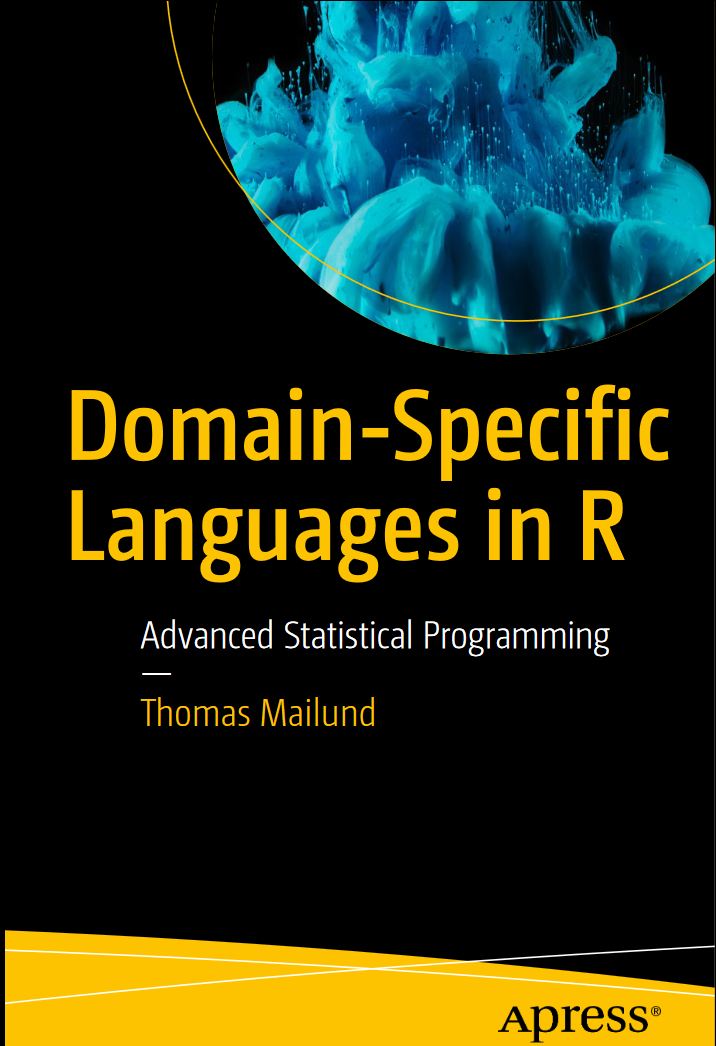
Автор: Mailund Thomas
Дата выхода: 2018
Издательство: Apress Media, LLC.
Количество страниц: 257
Размер файла: 1,5 МБ
Тип файла: PDF
Добавил: codelibs
Проверить на вирусы Дополнительные материалыTable of Contents....4
About the Author....7
About the Technical Reviewer....8
Chapter 1: Introduction....9
Who This Book Is For....9
Domain-Specific Languages....10
Chapter 2: Matrix Expressions....17
Parsing Expressions....18
Meta-Programming Parsing....22
Expression Manipulation....26
Optimizing Multiplication....28
Expression Rewriting....31
Expression Evaluation....35
Chapter 3: Components of a Programming Language....38
Text, Tokens, Grammars, and Semantics....39
Specifying a Grammar....43
Designing Semantics....53
Chapter 4: Functions, Classes, and Operators....61
The S3 Object-Oriented Programming System....62
Objects and Classes....62
Generic Functions....64
Operator Overloading....69
Group Generics....74
Precedence and Evaluation Order....76
Code Blocks....79
Chapter 5: Parsing and Manipulating Expressions....82
Quoting and Evaluating....83
Exploring Expressions....89
Manipulating Expressions....99
Chapter 6: Lambda Expressions....106
Anonymous functions....106
Experiments with Alternatives to the Syntax....109
Don’t Do This at Home....112
Chapter 7: Environments and Expressions....113
Scopes and Environments....113
Default Parameters, Lazy Evaluation, and Promises....118
Quotes and Non-standard Evaluation....128
Chapter 8: Tidy Evaluation....139
Quosures....140
Quasi-quoting....151
Chapter 9: List Comprehension....162
Chapter 10: Continuous-Time Markov Chains....170
Constructing the Markov Chain....173
Constructing a Rate Matrix....177
Traces....180
Computing Likelihoods....183
Chapter 11: Pattern Matching....186
Constructors....188
Pattern Matching....199
Lists....206
Search Trees....210
Chapter 12: Dynamic Programming....217
Parsing Expressions....223
Evaluating Expressions....231
Fixing the Evaluation Environment....244
Chapter 13: Conclusion....248
References....250
Index....251
Gain an accelerated introduction to domain-specific languages in R, including coverage of regular expressions. This compact, in-depth book shows you how DSLs are programming languages specialized for a particular purpose, as opposed to general purpose programming languages. Along the way, you’ll learn to specify tasks you want to do in a precise way and achieve programming goals within a domain-specific context.
Domain-Specific Languages in R includes examples of DSLs including large data sets or matrix multiplication; pattern matching DSLs for application in computer vision; and DSLs for continuous time Markov chains and their applications in data science. After reading and using this book, you’ll understand how to write DSLs in R and have skills you can extrapolate to other programming languages.
What You'll Learn
- Program with domain-specific languages using R
- Discover the components of DSLs
- Carry out large matrix expressions and multiplications
- Implement metaprogramming with DSLs
- Parse and manipulate expressions
Who This Book Is For
Those with prior programming experience. R knowledge is helpful but not required.


