-
1C
-
Agda
-
Agile/Scrum
-
Alef
-
APL
-
Assembler
-
AWK
-
Basic
-
Beta Programming Language
-
Big Data/DataScience
-
C
-
C#
-
C++
-
Cobol
-
Crystal
-
CSS
-
D
-
Dart
-
DataBase (SQL)
-
Delphi
-
F#
-
Flutter
-
Fortran
-
GameDev
-
Git
-
Go (Golang)
-
GPT/AI/ИИ
-
Hacking and Security
-
Haskell
-
HTML
-
Java
-
JavaScript (JS)
-
Julia
-
Kotlin
-
Machine Learning (ML)
-
Natural language processing (NLP)
-
.NET (.NET Core)
-
Pascal
-
PHP
-
Python
-
R
-
Ruby
-
Rust
-
Scratch
-
Swift
-
UML
-
UX/UI
-
Visual Basic
-
Wolfram
-
XML
-
АСУ
-
Проектирование/System Design
-
Сети/Network
-
Статьи
-
Схемотехника/электронные схемы
-
1C
-
Agda
-
Agile/Scrum
-
Alef
-
APL
-
Assembler
-
AWK
-
Basic
-
Beta Programming Language
-
Big Data/DataScience
-
C
-
C#
-
C++
-
Cobol
-
Crystal
-
CSS
-
D
-
Dart
-
DataBase (SQL)
-
Delphi
-
F#
-
Flutter
-
Fortran
-
GameDev
-
Git
-
Go (Golang)
-
GPT/AI/ИИ
-
Hacking and Security
-
Haskell
-
HTML
-
Java
-
JavaScript (JS)
-
Julia
-
Kotlin
-
Machine Learning (ML)
-
Natural language processing (NLP)
-
.NET (.NET Core)
-
Pascal
-
PHP
-
Python
-
R
-
Ruby
-
Rust
-
Scratch
-
Swift
-
UML
-
UX/UI
-
Visual Basic
-
Wolfram
-
XML
-
АСУ
-
Проектирование/System Design
-
Сети/Network
-
Статьи
-
Схемотехника/электронные схемы
Меню
Data Structures and Algorithms with the C++ STL: A guide for modern C++ practitioners
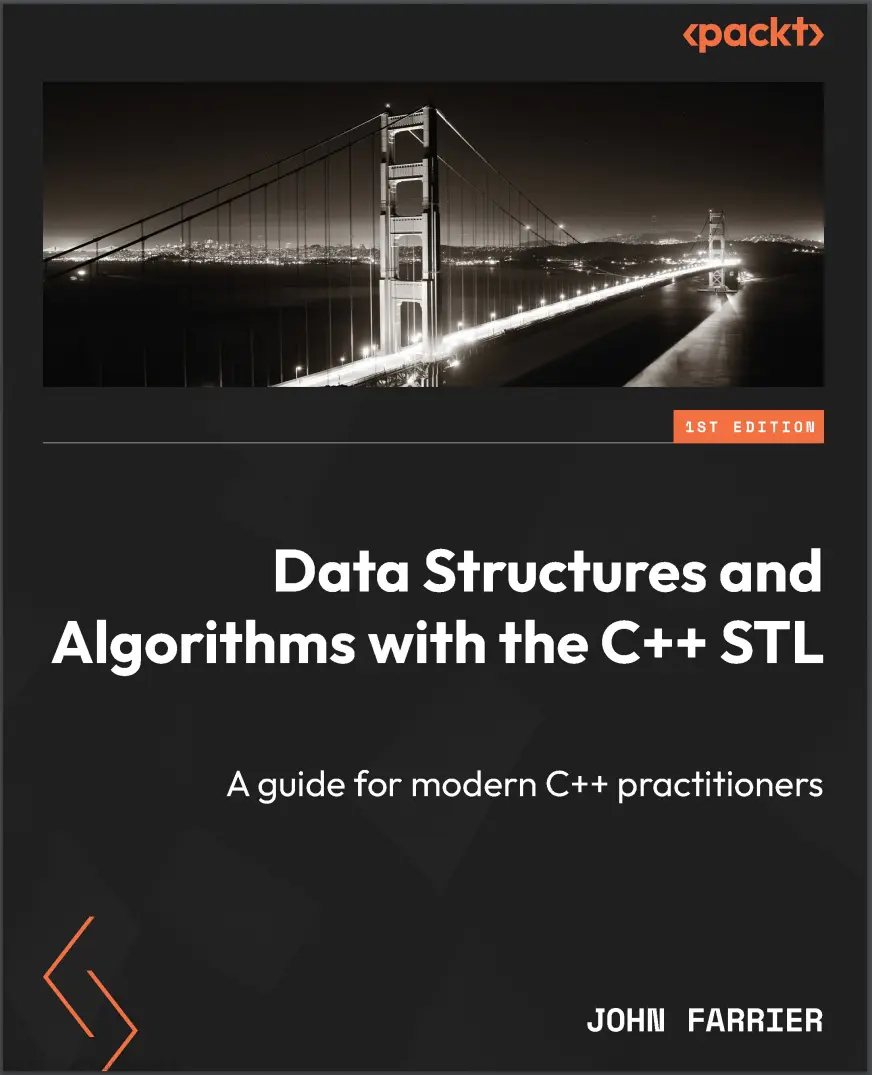
Автор: Farrier John
Дата выхода: 2024
Издательство: Packt Publishing Limited
Количество страниц: 458
Размер файла: 3,0 МБ
Тип файла: PDF
Добавил: codelibs
Проверить на вирусы Дополнительные материалыTitle page....2
Copyright and credits....3
Dedication....4
Contributors....5
Table of Contents....8
Preface....24
Part 1: Mastering std::vector....30
Chapter 1: The Basics of std::vector....32
Technical requirements....32
The significance of std::vector....32
A basic comparison of C-style arrays and std::vector....33
Comparison of C-style arrays and std::vector for memory management....36
Declaring and initializing std::vector....38
Declaring a vector....38
Initializing a vector....39
Accessing elements....42
Random access....42
Accessing the first and last elements....44
Vector size....44
Adding and removing elements....46
Adding elements....46
Removing elements....48
Capacity....50
Prefer using empty() when possible....51
Clearing all elements....51
Summary....53
Chapter 2: Mastering Iterators with std::vector....56
Technical requirements....56
Types of iterators in the STL....56
Input iterators....57
Output iterators....57
Forward iterators....58
Reverse iterators....59
Bidirectional iterators....59
Random access iterators....60
Basic iteration techniques with std::vector....62
Iterating over std::vector....62
Basic iteration using iterators....62
Using constant iterators....63
Benefits of iteration....63
Using std::begin and std::end....64
Understanding iterator requirements....66
Range-based for loops....67
Overview of range-based for loops....67
When to use range-based for loops....68
Modifying elements during iteration....68
Creating a custom iterator....69
The appeal of custom iterators....69
Core requirements....69
Iterator categories and their specialties....70
A custom iterator example....72
Custom iterator challenges and use cases....74
Illustrative use cases of custom iterators....74
Summary....78
Chapter 3: Mastering Memory and Allocators with std::vector....80
Technical requirements....80
Understanding capacity versus size....80
Revisiting the basics....81
What exactly is capacity?....81
Why this distinction matters....81
Looking under the hood....82
Resizing and reserving memory....84
The power of resize()....84
Enter reserve()....86
Optimizing with shrink_to_fit()....87
Real-world relevance....89
Custom allocator basics....89
The role and responsibility of an allocator....89
Under the hood – the allocator interface....90
Trade-offs and the need for custom allocators....92
Choosing std::allocator over new, delete, and managed pointers....93
Creating a custom allocator....94
Custom allocators – the heart of memory flexibility....94
Understanding the motivation behind custom allocators....95
Memory pools – a popular custom allocator strategy....95
Unlocking the potential of custom allocators....95
Allocators and container performance....96
Why allocators matter in performance....96
The performance characteristics of std::allocator....96
When to consider alternative allocators....97
Profiling – the key to making informed decisions....97
Summary....97
Chapter 4: Mastering Algorithms with std::vector....100
Technical requirements....100
Sorting a vector....100
Getting started with std::sort....101
The engine under the hood – introsort....101
Efficiency unparalleled – O(n log n)....101
Sorting in descending order....101
Sorting custom data types....102
Pitfalls and precautions....103
Searching elements....106
Linear search with std::find....106
Binary search techniques....106
Using std::lower_bound and std::upper_bound....107
Binary search versus linear search – efficiency and versatility....108
Manipulating vectors....109
Transforming with std::copy....110
Reversing elements with std::reverse....110
Rotating vectors with std::rotate....110
Filling a vector with std::fill....111
Putting manipulation to use....111
Considerations in manipulation....113
Custom comparators and predicates....114
Understanding comparators....114
The power of predicates....114
Crafting effective comparators and predicates....115
User-defined structs and classes....115
Understanding container invariants and iterator invalidation....116
Understanding iterator invalidation....116
Strategies to counteract invalidation....118
Dealing with invalidation in multi-threaded scenarios....120
Summary....122
Chapter 5: Making a Case for std::vector....124
Performance considerations....124
Comparison with other containers....125
The memory advantage....125
The takeaway....125
Practical use cases....126
A resizable dynamic array at heart....126
Data processing and analytics....126
Graphics and game development....126
Beyond just containers....126
Versatility and efficiency....127
A testament to versatility....127
Efficiency isn’t just about speed....127
A safe default, but not the only option....127
Summary....128
Part 2: Understanding STL Data Structures....130
Chapter 6: Advanced Sequence Container Usage....132
Technical requirements....133
std::array....133
Purpose and suitability....133
Ideal use cases....133
Performance....134
Memory management....135
Thread safety....135
Extensions and variants....135
Sorting and searching complexity....135
Interface and member functions....135
Comparisons....135
Interactions with algorithms....135
Exceptions....135
Customization....136
Example....136
Best practices....138
std::vector....138
Purpose and suitability....139
Ideal use cases....139
Performance....140
Memory management....140
Thread safety....140
Extensions and variants....140
Sorting and searching complexity....141
Special interface and member functions....141
Comparisons....141
Interactions with algorithms....141
Exceptions....141
Customization....141
Example....141
Best practices....145
std::deque....146
Purpose and suitability....146
Ideal use cases....146
Performance....147
Memory management....147
Thread safety....147
Extensions and variants....148
Sorting and searching complexity....148
Interface and member functions....148
Comparisons....148
Interactions with algorithms....148
Exceptions....148
Customization....148
Example....149
Best practices....151
std::list....151
Purpose and suitability....152
Ideal use cases....152
Performance....153
Memory management....153
Thread safety....153
Extensions and variants....154
Sorting and searching complexity....154
Interface and member functions....154
Comparisons....154
Interactions with algorithms....154
Exceptions....154
Customization....154
Example....155
Best practices....156
std::forward_list....157
Purpose and suitability....157
Ideal use cases....158
Performance....158
Memory management....159
Thread safety....159
Extensions and variants....159
Sorting and searching complexity....159
Special interface and member functions....159
Comparisons....159
Interactions with algorithms....160
Exceptions....160
Customization....160
Example....160
Best practices....162
std::string....163
Purpose and suitability....163
Ideal use cases....164
Performance....164
Memory management....164
Thread safety....164
Extensions and variants....164
Sorting and searching complexity....164
Special interface and member functions....165
Comparisons....165
Interactions with algorithms....165
Exceptions....165
Customization....165
Example....165
Best practices....167
Chapter 7: Advanced Ordered Associative Container Usage....170
Technical requirements....170
std::set....171
Purpose and suitability....171
Ideal use cases....171
Performance....172
Memory management....172
Thread safety....172
Extensions and variants....172
Sorting and searching complexity....172
Special interface and member functions....173
Comparisons....173
Interactions with algorithms....173
Exceptions....173
Customization....173
Example....173
Best practices....175
std::map....176
Purpose and suitability....176
Ideal use cases....177
Performance....177
Memory management....178
Thread safety....178
Extensions and variants....178
Sorting and searching complexity....178
Special interface and member functions....178
Comparisons....178
Interactions with algorithms....179
Exceptions....179
Customization....179
Example....179
Best practices....181
std::multiset....182
Purpose and suitability....182
Ideal use cases....182
Performance....183
Memory management....183
Thread safety....184
Extensions and variants....184
Sorting and searching complexity....184
Special interface and member functions....184
Comparisons....184
Interactions with algorithms....184
Exceptions....184
Customization....185
Example....185
Best practices....187
std::multimap....187
Purpose and suitability....187
Ideal use cases....188
Performance....189
Memory management....189
Thread safety....189
Extensions and variants....189
Sorting and searching complexity....189
Special interface and member functions....189
Comparisons....190
Interactions with algorithms....190
Exceptions....190
Customization....190
Example....190
Best practices....192
Chapter 8: Advanced Unordered Associative Container Usage....194
Technical requirements....194
std::unordered_set....195
Purpose and suitability....195
Ideal use cases....195
Performance....196
Memory management....196
Thread safety....196
Extensions and variants....196
Sorting and searching complexity....196
Special interface and member functions....196
Comparisons....197
Interactions with algorithms....197
Exceptions....197
Customization....197
Example....197
Best practices....199
std::unordered_map....200
Purpose and suitability....200
Ideal use cases....201
Performance....202
Memory management....202
Thread safety....202
Extensions and variants....202
Sorting and searching complexity....202
Special interface and member functions....202
Comparisons....203
Interactions with algorithms....203
Exceptions....203
Customization....203
Example....203
Best practices....205
std::unordered_multiset....206
Purpose and suitability....206
Ideal use cases....206
Performance....207
Memory management....207
Thread safety....207
Extensions and variants....208
Sorting and searching complexity....208
Special interface and member functions....208
Comparisons....208
Interactions with algorithms....208
Exceptions....208
Customization....208
Example....209
Best practices....211
std::unordered_multimap....212
Purpose and suitability....212
Ideal use cases....212
Performance....213
Memory management....213
Thread safety....214
Extensions and variants....214
Sorting and searching complexity....214
Special interface and member functions....214
Comparisons....214
Interactions with algorithms....214
Exceptions....214
Customization....215
Example....215
Best practices....217
Chapter 9: Advanced Container Adaptor Usage....220
Technical requirements....220
std::stack....220
Purpose and suitability....221
Ideal use cases....221
Performance....221
Memory management....222
Thread safety....222
Extensions and variants....222
Sorting and searching complexity....222
Special interface and member functions....222
Comparisons....222
Interactions with algorithms....222
Exceptions....222
Customization....223
Example....223
Best practices....225
std::queue....226
Purpose and suitability....226
Ideal use cases....226
Performance....227
Memory management....227
Thread safety....227
Extensions and variants....227
Sorting and searching complexity....227
Special interface and member functions....227
Comparisons....227
Interactions with algorithms....228
Exceptions....228
Customization....228
Example....228
Best practices....230
std::priority_queue....231
Purpose and suitability....231
Ideal use cases....231
Performance....231
Memory management....232
Thread safety....232
Extensions and variants....232
Sorting and searching complexity....232
Special interface and member functions....232
Comparisons....232
Interactions with algorithms....233
Exceptions....233
Customization....233
Example....233
Best practices....235
std::flat_set....236
Purpose and suitability....237
Ideal use cases....237
Performance....237
Memory management....238
Thread safety....238
Extensions and variants....238
Sorting and searching complexity....238
Special interface and member functions....238
Comparisons....238
Interactions with algorithms....238
Exceptions....239
Customization....239
Best practices....239
std::flat_map....240
Purpose and suitability....240
Ideal use cases....241
Performance....241
Memory management....241
Thread safety....241
Extensions and variants....241
Sorting and searching complexity....242
Interface and member functions....242
Comparisons....242
Interactions with algorithms....242
Exceptions....242
Customization....242
Best practices....242
std::flat_multiset....243
Purpose and suitability....243
Ideal use cases....244
Performance....244
Memory management....244
Thread safety....245
Extensions and variants....245
Sorting and searching complexity....245
Special interface and member functions....245
Comparisons....245
Interactions with algorithms....245
Exceptions....245
Customization....246
Best practices....246
std::flat_multimap....247
Purpose and suitability....247
Ideal use cases....247
Performance....248
Memory management....248
Thread safety....248
Extensions and variants....248
Sorting and searching complexity....248
Interface and member functions....248
Comparisons....249
Interactions with algorithms....249
Exceptions....249
Customization....249
Best practices....249
Chapter 10: Advanced Container View Usage....252
Technical requirements....252
std::span....252
Purpose and suitability....253
Ideal use cases....253
Performance....253
Memory management....253
Thread safety....254
Extensions and variants....254
Sorting and searching complexity....254
Interface and member functions....254
Comparisons....254
Interactions with algorithms....254
Exceptions....254
Customization....254
Example....255
Best practices....257
std::mdspan....257
Purpose and suitability....258
Ideal use cases....258
Performance....258
Memory management....258
Thread safety....259
Extensions and variants....259
Sorting and searching complexity....259
Special interface and member functions....259
Comparisons....259
Interactions with algorithms....259
Exceptions....259
Customization....259
Best practices....260
Part 3: Mastering STL Algorithms....262
Chapter 11: Fundamental Algorithms and Searching....264
Technical requirements....264
Sorting....264
Checking conditions....266
Counting and finding....269
Searching and comparison....275
Best practices....279
Summary....281
Chapter 12: Manipulation and Transformation....282
Technical requirements....282
Copying and moving in STL containers....282
Copying semantics in the STL....283
Moving semantics in the STL....283
Copying versus moving – a deliberate choice....283
Exploring return value optimization....285
Filling and generating in STL containers....286
Populating with static assignment....286
Dynamic generation with the STL....286
Ensuring relevance and efficiency....287
Removing and replacing in STL containers....287
The essence of removal....288
Replacement....288
A balancing act....289
Swapping and reversing in STL containers....290
Swapping – the art of interchanging....290
Reversing – a glimpse from the end....290
Deduplication – singling out the unique....290
Sampling – a slice of the whole....290
Best practices....291
Summary....292
Chapter 13: Numeric and Range -Based Operations....294
Technical requirements....294
Basic numeric operations....294
Generating sequences with std::iota....295
Summing elements with std::accumulate....296
Adjacent elements and their interactions with std::adjacent_difference....297
Inner products with std::inner_product....299
Advanced numeric operations....300
Operations on sorted ranges....302
Best practices....305
Summary....306
Chapter 14: Permutations, Partitions, and Heaps....308
Technical requirements....308
Partitioning....308
std::partition and its power....309
Checking partitions with std::is_partitioned....309
The utility of std::partition_point....309
Partitioning beyond basic sequences....309
Permutations....310
Generating permutations with std::next_permutation....311
Predecessor permutations with std::prev_permutation....311
Shuffling elements randomly with std::shuffle....311
Rotating sequences with std::rotate....312
Heap operations....313
Constructing heaps with std::make_heap....314
Adding and removing elements – std::push_heap and std::pop_heap....314
Heap-based sorting – the power of std::sort_heap....314
Checking heap validity with std::is_heap....315
The significance of heaps in today’s computing....315
Best practices....316
Summary....317
Chapter 15: STL with Ranges....318
Technical requirements....318
Introduction to ranges....318
Understanding the essence of ranges....319
Why the shift to ranges?....319
A glimpse into range operations....319
Looking ahead – the power of modern STL....320
Ranges for sorting algorithms....320
Traditional STL sorting – a recap....321
Range-based sorting – the basics....321
Embracing composability in sorting....321
Advantages beyond syntax – why ranges shine in sorting....322
The revolution of ranges in sorting....323
Ranges for searching algorithms....323
Finding elegance – range-based searching....324
Chaining and filtering – the beauty of composability....324
Understanding views in searches....325
The extended toolkit – more than just find....325
Best practices....326
Embracing the power of chaining....326
Guarding against range pitfalls – lifetime awareness....326
Performance considerations – laziness and evaluation....327
Readability over brevity – striking the balance....327
Adhering to range idioms – keep it standard....327
Summary....328
Part 4: Creating STL-Compatible Types and Algorithms....330
Chapter 16: Creating STL-Types Containers....332
Technical requirements....332
The advantages of STL-compatible types....332
One language, one approach....333
Reusability – the gift that keeps giving....333
Efficiency in the familiar....333
Paving the way forward....334
Interacting with STL algorithms....334
The centrality of iterators....334
Adapting to algorithmic expectations....335
Error handling and feedback mechanisms....335
Algorithmic efficiency and your type....337
Laying a solid foundation....337
Essential requirements for compatibility....337
The cornerstones of compatibility....338
The vitality of iterators....338
Embracing value semantics....338
Operational guarantees....338
Size and capacity queries....338
Element access and manipulation....339
Consistency in exception safety....339
Looking forward to enhanced integration....341
Crafting iterators for custom types....341
Choosing the right iterator type....341
Crafting the basic components....342
Addressing iterator categories with type traits....342
End iterators – signifying the finish line....342
Considerations for const iterators....342
Performance optimizations and advanced techniques....344
Embracing the iterative spirit....344
Effective operator overloading....345
Operator overloading in C++....345
Considerations in overloading....345
Implementing arithmetic operators for custom types....345
Overloading relational operators for clear comparisons....346
Simplifying tasks with assignment and compound assignment....348
Stream operators for efficient I/O....348
Operator precedence and associativity in overloading....348
The role of operator overloading in C++....348
Creating custom hash functions....348
Interoperability with STL containers....348
Custom type semantics....349
The characteristics of a good hash function....349
Example for the creation of a custom hash function....350
Summary....352
Chapter 17: Creating STL -Compatible Algorithms....354
Technical requirements....354
Template functions....354
A primer on function templates....355
Variadic templates – multiplicity in templates....355
SFINAE – fine-tuning template substitution....355
Harnessing SFINAE with std::enable_if....355
Overloading....358
Crafting multiple algorithm versions for STL containers....358
Function resolution – navigating the intricacies....358
Overloading with care – clarity and consistency....359
Creating generic algorithms....359
Toward a type-independent approach....360
Embracing iterators – the bridge to generics....360
Predicates – customizing algorithm behavior....360
The magic of functors – enhancing flexibility....361
Customizing existing algorithms....361
Looking at the decorator pattern in action....362
Harnessing the power of lambda functions....364
Mixing patterns with lambdas for ultimate customization....364
Summary....367
Chapter 18: Type Traits and Policies....368
Technical requirements....368
Understanding and using type traits....368
Enhancing code adaptability with type traits....369
Empowering metaprogramming with type traits....369
Toward more informed and adaptable code....369
Utilizing type traits with the STL....370
Working with data types....370
Working with algorithms....371
Understanding and using policies in C++....374
Benefits with respect to the STL....374
Building modular components using policies....376
Potential challenges....376
The role of policies in modern C++....376
Using policies with the STL....377
Memory allocation policies....377
Sorting policies for versatile algorithms....377
Fine-tuning data structures with policies....378
Summary....379
Part 5: STL Data Structures and Algorithms: Under the Hood....382
Chapter 19: Exception Safety....384
Technical requirements....384
Basic exception safety....384
The pivotal role of program invariants in the STL....385
Resource integrity – the guardian of robust software....386
Harnessing the STL for basic exception safety....386
Strong exception safety....387
Navigating STL containers with strong guarantees....387
Crafting custom STL containers with strong guarantees....387
Infusing exception safety into custom STL algorithms....391
Exception safety is the path to robust applications....391
The effect of noexcept on STL operations....392
An introduction to noexcept....392
Application to STL data types....392
Application to STL algorithms....392
Summary....393
Chapter 20: Thread Safety and Concurrency with the STL....394
Technical requirements....395
Concurrency versus thread safety....395
Thread safety – a pillar for stable concurrency....395
The interplay of concurrency and thread safety....395
Challenges and rewards....396
Concurrency without thread safety – a recipe for chaos....396
Understanding thread safety....396
Thread safety in STL containers – laying the groundwork....396
Grasping the thread-safe nature of STL algorithms....397
Race conditions – the ghosts in the machine....397
Safeguarding concurrency – the way forward....398
Race conditions....399
Steering clear of a silent peril – race conditions in the STL....399
The anatomy of a race condition in the STL....399
More than meets the eye....399
Anticipating race conditions....400
Safeguarding your code – a proactive stance....400
Mutexes and locks....400
From manual to automatic – lock guards and unique locks....401
Avoiding the stalemate – deadlock prevention....401
Incorporating mutexes with STL containers....401
STL containers and thread safety....402
When safety needs reinforcements – concurrent modifications....402
Container iterators – the fragile bridge....402
Containers with a built-in shield – concurrent containers....402
Specific container concerns....403
Behaviors of std::vector in multi-threading....403
Characteristics of std::list in concurrency....403
Considerations with associative containers....404
Concurrency aspects of unordered containers....404
Insights into container adaptors....404
Concurrency support within the STL....404
Introduction to threads....405
The advent of asynchronous tasks....405
Atomic operations....405
Potential concurrent challenges....406
Using the STL’s concurrency features....406
Using std::thread, std::async, std::future, and thread -local storage....409
Initiating threads using std::thread....409
Managing asynchronous operations with std::async and std::future....409
Preserving data consistency using thread-local storage....410
Integrating tools for proficient concurrency....410
Concurrent data structures in the STL....412
The STL’s concurrency-optimized containers....412
Striving for maximum efficiency in concurrent environments....413
Best practices in action....413
Summary....416
Chapter 21: STL Interaction with Concepts and Coroutines....418
Technical requirements....418
Concepts....419
A brief introduction to concepts....419
Refined constraints in STL algorithms....419
Effectively constraining templates....419
Enhanced data structures with explicit requirements....422
Custom concepts and STL interactions....422
Potential challenges and caveats....423
Coroutines....424
Understanding coroutines – a refresher....424
STL algorithms and coroutine integration....425
Coroutines and STL data structures....425
Potential synergies with ranges and views....425
Looking ahead: A ahead – a paradigm shift....428
Summary....429
Chapter 22: Parallel Algorithms with the STL....430
Technical requirements....430
Introduction to execution policies....430
The header– enabling parallelism in STL algorithms....431
Implementing parallel execution....431
Reflecting on the transition to parallel STL....431
Incorporating execution policies....432
Integrating policies with standard algorithms....432
Understanding parallel execution policies....433
Selecting the appropriate execution policy....433
The impact of constexpr on algorithms and containers....434
Evolution of constexpr....434
Algorithms and the role of constexpr....434
Containers and constexpr integration....435
Performance considerations....436
Parallelism overhead....436
Determining optimal data size....436
Data access and synchronization challenges....436
False sharing – a subtle performance issue....437
Load balancing....437
The importance of profiling....437
Summary....438
Index....440
Other Books You May Enjoy....455
While the Standard Template Library (STL) offers a rich set of tools for data structures and algorithms, navigating its intricacies can be daunting for intermediate C++ developers without expert guidance. This book offers a thorough exploration of the STL's components, covering fundamental data structures, advanced algorithms, and concurrency features.
Starting with an in-depth analysis of the std:: vector, this book highlights its pivotal role in the STL, progressing toward building your proficiency in utilizing vectors, managing memory, and leveraging iterators. The book then advances to STL's data structures, including sequence containers, associative containers, and unordered containers, simplifying the concepts of container adaptors and views to enhance your knowledge of modern STL programming. Shifting the focus to STL algorithms, you'll get to grips with sorting, searching, and transformations and develop the skills to implement and modify algorithms with best practices. Advanced sections cover extending the STL with custom types and algorithms, as well as concurrency features, exception safety, and parallel algorithms.
By the end of this book, you'll have transformed into a proficient STL practitioner ready to tackle real-world challenges and build efficient and scalable C++ applications.
What you will learn
- Streamline data handling using the std:: vector
- Master advanced usage of STL iterators
- Optimize memory in STL containers
- Implement custom STL allocators
- Apply sorting and searching with STL algorithms
- Craft STL-compatible custom types
- Manage concurrency and ensure thread safety in STL
- Harness the power of parallel algorithms in STL
Who this book is for
This book is for intermediate-level C++ developers looking to enhance their software development skills. Familiarity with basic C++ syntax and object-oriented programming (OOP) as well as some exposure to data structures and algorithms is assumed.
Tailored to software engineers, computer science students, and hobbyist programmers, this book delves into C++ STL for practical application, performance enhancement, and efficient coding practices.


