-
1C
-
Agda
-
Agile/Scrum
-
Alef
-
APL
-
Assembler
-
AWK
-
Basic
-
Beta Programming Language
-
Big Data/DataScience
-
C
-
C#
-
C++
-
Cobol
-
Crystal
-
CSS
-
D
-
Dart
-
DataBase (SQL)
-
Delphi
-
F#
-
Flutter
-
Fortran
-
GameDev
-
Git
-
Go (Golang)
-
GPT/AI/ИИ
-
Hacking and Security
-
Haskell
-
HTML
-
Java
-
JavaScript (JS)
-
Julia
-
Kotlin
-
Machine Learning (ML)
-
Natural language processing (NLP)
-
.NET (.NET Core)
-
Pascal
-
PHP
-
Python
-
R
-
Ruby
-
Rust
-
Scratch
-
Swift
-
UML
-
UX/UI
-
Visual Basic
-
Wolfram
-
XML
-
АСУ
-
Проектирование/System Design
-
Сети/Network
-
Статьи
-
Схемотехника/электронные схемы
-
1C
-
Agda
-
Agile/Scrum
-
Alef
-
APL
-
Assembler
-
AWK
-
Basic
-
Beta Programming Language
-
Big Data/DataScience
-
C
-
C#
-
C++
-
Cobol
-
Crystal
-
CSS
-
D
-
Dart
-
DataBase (SQL)
-
Delphi
-
F#
-
Flutter
-
Fortran
-
GameDev
-
Git
-
Go (Golang)
-
GPT/AI/ИИ
-
Hacking and Security
-
Haskell
-
HTML
-
Java
-
JavaScript (JS)
-
Julia
-
Kotlin
-
Machine Learning (ML)
-
Natural language processing (NLP)
-
.NET (.NET Core)
-
Pascal
-
PHP
-
Python
-
R
-
Ruby
-
Rust
-
Scratch
-
Swift
-
UML
-
UX/UI
-
Visual Basic
-
Wolfram
-
XML
-
АСУ
-
Проектирование/System Design
-
Сети/Network
-
Статьи
-
Схемотехника/электронные схемы
Меню
Causal Inference and Discovery in Python: Unlock the secrets of modern causal machine learning with DoWhy, EconML, PyTorch and more
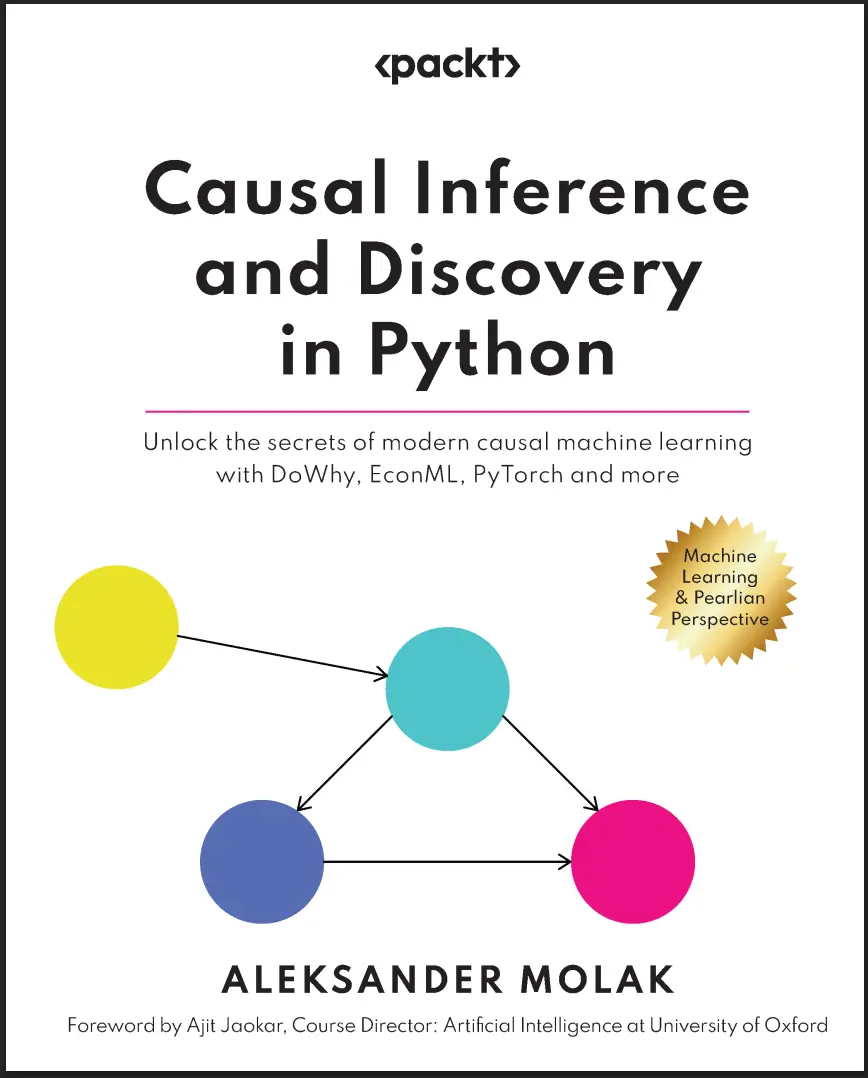
Автор: Molak Aleksander
Дата выхода: 2023
Издательство: Packt Publishing Limited
Количество страниц: 456
Размер файла: 11,0 МБ
Тип файла: PDF
Добавил: codelibs
Проверить на вирусы Дополнительные материалыPreface xix
Part 1: Causality – an Introduction
1
Causality – Hey, We Have Machine Learning, So Why Even Bother?....3
A brief history of causality....4
Why causality? Ask babies!....5
Interacting with the world....5
Confounding – relationships that are not real....6
How not to lose money… and
human lives....9
A marketer’s dilemma....9
Let’s play doctor!....10
Associations in the wild....12
Wrapping it up....12
References....12
2
Judea Pearl and the Ladder of Causation....15
From associations to logic and imagination – the Ladder
of Causation....15
Associations....18
Let’s practice!....20
What are interventions?....23
Changing the world....24
Correlation and causation....26
What are counterfactuals?....28
Let’s get weird (but formal)!....28
The fundamental problem of causal inference....30
Computing counterfactuals....30
Time to code!....32
Extra – is all machine learning causally the same?....33
Causality and reinforcement learning....33
Causality and semi-supervised and unsupervised learning....34
Wrapping it up....34
References....35
3
Regression, Observations, and Interventions....37
Starting simple – observational data
and linear regression....37
Linear regression....37
p-values and statistical significance....41
Geometric interpretation of linear regression....42
Reversing the order....42
Should we always control for all
available covariates?....44
Navigating the maze....45
If you don’t know where you’re going, you
might end up somewhere else....45
Get involved!....48
To control or not to control?....48
Regression and structural models....49
SCMs....49
Linear regression versus SCMs....49
Finding the link....49
Regression and causal effects....51
Wrapping it up....53
References....53
4
Graphical Models....55
Graphs, graphs, graphs....55
Types of graphs....56
Graph representations....58
Graphs in Python....60
What is a graphical model?....63
DAG your pardon? Directed acyclic
graphs in the causal wonderland....64
Definitions of causality....64
DAGs and causality....65
Let’s get formal!....65
Limitations of DAGs....66
Sources of causal graphs in the
real world....66
Causal discovery....67
Expert knowledge....67
Combining causal discovery and expert
knowledge....67
Extra – is there causality
beyond DAGs?....67
Dynamical systems....67
Cyclic SCMs....68
Wrapping it up....68
References....69
5
Forks, Chains, and Immoralities....71
Graphs and distributions and how to
map between them....71
How to talk about independence....72
Choosing the right direction....73
Conditions and assumptions....74
Chains, forks, and colliders or…
immoralities....78
A chain of events....78
Chains....79
Forks....80
Colliders, immoralities, or v-structures....82
Ambiguous cases....84
Forks, chains, colliders,
and regression....85
Generating the chain dataset....87
Generating the fork dataset....88
Generating the collider dataset....89
Fitting the regression models....90
Wrapping it up....93
References....93
Part 2: Causal Inference
6
Nodes, Edges, and Statistical (In)dependence....97
You’re gonna keep ‘em d-separated....98
Practice makes perfect – d-separation....99
Estimand first!....102
We live in a world of estimators....102
So, what is an estimand?....102
The back-door criterion....104
What is the back-door criterion?....105
Back-door and equivalent estimands....105
The front-door criterion....107
Can GPS lead us astray?....108
London cabbies and the magic pebble....109
Opening the front door....110
Three simple steps toward the front door....111
Front-door in practice....112
Are there other criteria out there?
Let’s do-calculus!....118
The three rules of do-calculus....119
Instrumental variables....120
Wrapping it up....122
Answer....122
References....123
7
The Four-Step Process of Causal Inference....125
Introduction to DoWhy
and EconML....126
Python causal ecosystem....126
Why DoWhy?....128
Oui, mon ami, but what is DoWhy?....128
How about EconML?....129
Step 1 – modeling the problem....130
Creating the graph....130
Building a CausalModel object....132
Step 2 – identifying the estimand(s)....133
Step 3 – obtaining estimates....134
Step 4 – where’s my validation set?
Refutation tests....135
How to validate causal models....135
Introduction to refutation tests....137
Full example....139
Step 1 – encode the assumptions....140
Step 2 – getting the estimand....142
Step 3 – estimate!....142
Step 4 – refute them!....144
Wrapping it up....149
References....149
8
Causal Models – Assumptions and Challenges....151
I am the king of the world! But am I?....152
In between....152
Identifiability....153
Lack of causal graphs....153
Not enough data....154
Unverifiable assumptions....156
An elephant in the room – hopeful
or hopeless?....156
Let’s eat the elephant....156
Positivity....157
Exchangeability....161
Exchangeable subjects....161
Exchangeability versus confounding....161
…and more....162
Modularity....162
SUTVA....164
Consistency....164
Call me names – spurious
relationships in the wild....165
Names, names, names....165
Should I ask you or someone who’s not here?....166
DAG them!....166
More selection bias....168
Wrapping it up....169
References....170
9
Causal Inference and Machine Learning – from Matching
to Meta-Learners....173
The basics I – matching....174
Types of matching....174
Treatment effects – ATE versus ATT/ATC....175
Matching estimators....176
Implementing matching....178
The basics II – propensity scores....183
Matching in the wild....183
Reducing the dimensionality with
propensity scores....185
Propensity score matching (PSM)....185
Inverse probability weighting (IPW)....186
Many faces of propensity scores....186
Formalizing IPW....187
Implementing IPW....187
IPW – practical considerations....188
S-Learner – the Lone Ranger....188
The devil’s in the detail....189
Mom, Dad, meet CATE....190
Jokes aside, say hi to the
heterogeneous crowd....190
Waving the assumptions flag....192
You’re the only one – modeling with
S-Learner....192
Small data....198
S-Learner’s vulnerabilities....199
T-Learner – together we can do more....200
Forcing the split on treatment....200
T-Learner in four steps and a formula....201
Implementing T-Learner....202
X-Learner – a step further....204
Squeezing the lemon....204
Reconstructing the X-Learner....205
X-Learner – an alternative formulation....207
Implementing X-Learner....208
Wrapping it up....212
References....213
10
Causal Inference and Machine Learning – Advanced Estimators,
Experiments, Evaluations, and More....215
Doubly robust methods – let’s get
more!....216
Do we need another thing?....216
Doubly robust is not equal to bulletproof…....218
…but it can bring a lot of value....218
The secret doubly robust sauce....218
Doubly robust estimator versus assumptions....220
DR-Learner – crossing the chasm....220
DR-Learners – more options....224
Targeted maximum likelihood estimator....224
If machine learning is cool, how
about double machine learning?....227
Why DML and what’s so double about it?....228
DML with DoWhy and EconML....231
Hyperparameter tuning with DoWhy and
EconML....234
Is DML a golden bullet?....239
Doubly robust versus DML....240
What’s in it for me?....241
Causal Forests and more....242
Causal trees....242
Forests overflow....242
Advantages of Causal Forests....242
Causal Forest with DoWhy and EconML....243
Heterogeneous treatment
effects with experimental data – the
uplift odyssey....245
The data....245
Choosing the framework....251
We don’t know half of the story....251
Kevin’s challenge....252
Opening the toolbox....253
Uplift models and performance....257
Other metrics for continuous outcomes with
multiple treatments....262
Confidence intervals....263
Kevin’s challenge’s winning submission....264
When should we use CATE estimators for
experimental data?....264
Model selection – a simplified guide....265
Extra – counterfactual explanations....267
Bad faith or tech that does not know?....267
Wrapping it up....268
References....269
11
Causal Inference and Machine Learning – Deep Learning,
NLP, and Beyond....273
Going deeper – deep learning for
heterogeneous treatment effects....274
CATE goes deeper....274
SNet....276
Transformers and causal inference....284
The theory of meaning in five paragraphs....285
Making computers understand language....285
From philosophy to Python code....286
LLMs and causality....286
The three scenarios....288
CausalBert....292
Causality and time series – when an
econometrician goes Bayesian....297
Quasi-experiments....297
Twitter acquisition and our
googling patterns....298
The logic of synthetic controls....298
A visual introduction to the logic
of synthetic controls....300
Starting with the data....302
Synthetic controls in code....303
Challenges....308
Wrapping it up....309
References....309
Part 3: Causal Discovery
12
Can I Have a Causal Graph, Please?....315
Sources of causal knowledge....316
You and I, oversaturated....316
The power of a surprise....317
Scientific insights....317
The logic of science....318
Hypotheses are a species....318
One logic, many ways....319
Controlled experiments....319
Randomized controlled trials (RCTs)....320
From experiments to graphs....321
Simulations....321
Personal experience and domain
knowledge....321
Personal experiences....322
Domain knowledge....323
Causal structure learning....323
Wrapping it up....324
References....324
13
Causal Discovery and Machine Learning – from Assumptions to
Applications....327
Causal discovery – assumptions
refresher....328
Gearing up....328
Always trying to be faithful…....328
…but it’s difficult sometimes....328
Minimalism is a virtue....329
The four (and a half) families....329
The four streams....329
Introduction to gCastle....331
Hello, gCastle!....331
Synthetic data in gCastle....331
Fitting your first causal discovery model....336
Visualizing the model....336
Model evaluation metrics....338
Constraint-based causal discovery....341
Constraints and independence....341
Leveraging the independence structure to
recover the graph....342
PC algorithm – hidden challenges....345
PC algorithm for categorical data....346
Score-based causal discovery....347
Tabula rasa – starting fresh....347
GES – scoring....347
GES in gCastle....348
Functional causal discovery....349
The blessings of asymmetry....349
ANM model....350
Assessing independence....353
LiNGAM time....355
Gradient-based causal discovery....360
What exactly is so gradient about you?....360
Shed no tears....362
GOLEMs don’t cry....363
The comparison....363
Encoding expert knowledge....366
What is expert knowledge?....366
Expert knowledge in gCastle....366
Wrapping it up....368
References....368
14
Causal Discovery and Machine Learning – Advanced Deep
Learning and Beyond....371
Advanced causal discovery
with deep learning....372
From generative models to causality....372
Looking back to learn who you are....373
DECI’s internal building blocks....373
DECI in code....375
DECI is end-to-end....387
Causal discovery under hidden
confounding....387
The FCI algorithm....388
Other approaches to confounded data....392
Extra – going beyond observations....393
ENCO....393
ABCI....393
Causal discovery – real-world
applications, challenges, and
open problems....394
Wrapping it up!....395
References....396
15
Epilogue....399
What we’ve learned in this book....399
Five steps to get the best out of your
causal project....400
Starting with a question....400
Obtaining expert knowledge....401
Generating hypothetical graph(s)....401
Check identifiability....402
Falsifying hypotheses....402
Causality and business....403
How causal doers go from vision to
implementation....403
Toward the future of causal ML....405
Where are we now and where
are we heading?....406
Causal benchmarks....406
Causal data fusion....407
Intervening agents....407
Causal structure learning....408
Imitation learning....408
Learning causality....409
Let’s stay in touch....410
Wrapping it up....411
References....411
Index....413
Other Books You May Enjoy....426
Causal methods present unique challenges compared to traditional machine learning and statistics. Learning causality can be challenging, but it offers distinct advantages that elude a purely statistical mindset. Causal Inference and Discovery in Python helps you unlock the potential of causality.
You’ll start with basic motivations behind causal thinking and a comprehensive introduction to Pearlian causal concepts, such as structural causal models, interventions, counterfactuals, and more. Each concept is accompanied by a theoretical explanation and a set of practical exercises with Python code.
Next, you’ll dive into the world of causal effect estimation, consistently progressing towards modern machine learning methods. Step-by-step, you’ll discover Python causal ecosystem and harness the power of cutting-edge algorithms. You’ll further explore the mechanics of how “causes leave traces” and compare the main families of causal discovery algorithms.
The final chapter gives you a broad outlook into the future of causal AI where we examine challenges and opportunities and provide you with a comprehensive list of resources to learn more.
What you will learn
Master the fundamental concepts of causal inference
Decipher the mysteries of structural causal models
Unleash the power of the 4-step causal inference process in Python
Explore advanced uplift modeling techniques
Unlock the secrets of modern causal discovery using Python
Use causal inference for social impact and community benefit
Who this book is for
This book is for machine learning engineers, data scientists, and machine learning researchers looking to extend their data science toolkit and explore causal machine learning. It will also help developers familiar with causality who have worked in another technology and want to switch to Python, and data scientists with a history of working with traditional causality who want to learn causal machine learning. It’s also a must-read for tech-savvy entrepreneurs looking to build a competitive edge for their products and go beyond the limitations of traditional machine learning.


