-
1C
-
Agda
-
Agile/Scrum
-
Alef
-
APL
-
Assembler
-
AWK
-
Basic
-
Beta Programming Language
-
Big Data/DataScience
-
C
-
C#
-
C++
-
Cobol
-
Crystal
-
CSS
-
D
-
Dart
-
DataBase (SQL)
-
Delphi
-
F#
-
Flutter
-
Fortran
-
GameDev
-
Git
-
Go (Golang)
-
GPT/AI/ИИ
-
Hacking and Security
-
Haskell
-
HTML
-
Java
-
JavaScript (JS)
-
Julia
-
Kotlin
-
Machine Learning (ML)
-
Natural language processing (NLP)
-
.NET (.NET Core)
-
Pascal
-
PHP
-
Python
-
R
-
Ruby
-
Rust
-
Scratch
-
Swift
-
UML
-
UX/UI
-
Visual Basic
-
Wolfram
-
XML
-
АСУ
-
Проектирование/System Design
-
Сети/Network
-
Статьи
-
Схемотехника/электронные схемы
-
1C
-
Agda
-
Agile/Scrum
-
Alef
-
APL
-
Assembler
-
AWK
-
Basic
-
Beta Programming Language
-
Big Data/DataScience
-
C
-
C#
-
C++
-
Cobol
-
Crystal
-
CSS
-
D
-
Dart
-
DataBase (SQL)
-
Delphi
-
F#
-
Flutter
-
Fortran
-
GameDev
-
Git
-
Go (Golang)
-
GPT/AI/ИИ
-
Hacking and Security
-
Haskell
-
HTML
-
Java
-
JavaScript (JS)
-
Julia
-
Kotlin
-
Machine Learning (ML)
-
Natural language processing (NLP)
-
.NET (.NET Core)
-
Pascal
-
PHP
-
Python
-
R
-
Ruby
-
Rust
-
Scratch
-
Swift
-
UML
-
UX/UI
-
Visual Basic
-
Wolfram
-
XML
-
АСУ
-
Проектирование/System Design
-
Сети/Network
-
Статьи
-
Схемотехника/электронные схемы
Меню
AI-Assisted Programming: Better Planning, Coding, Testing, and Deployment
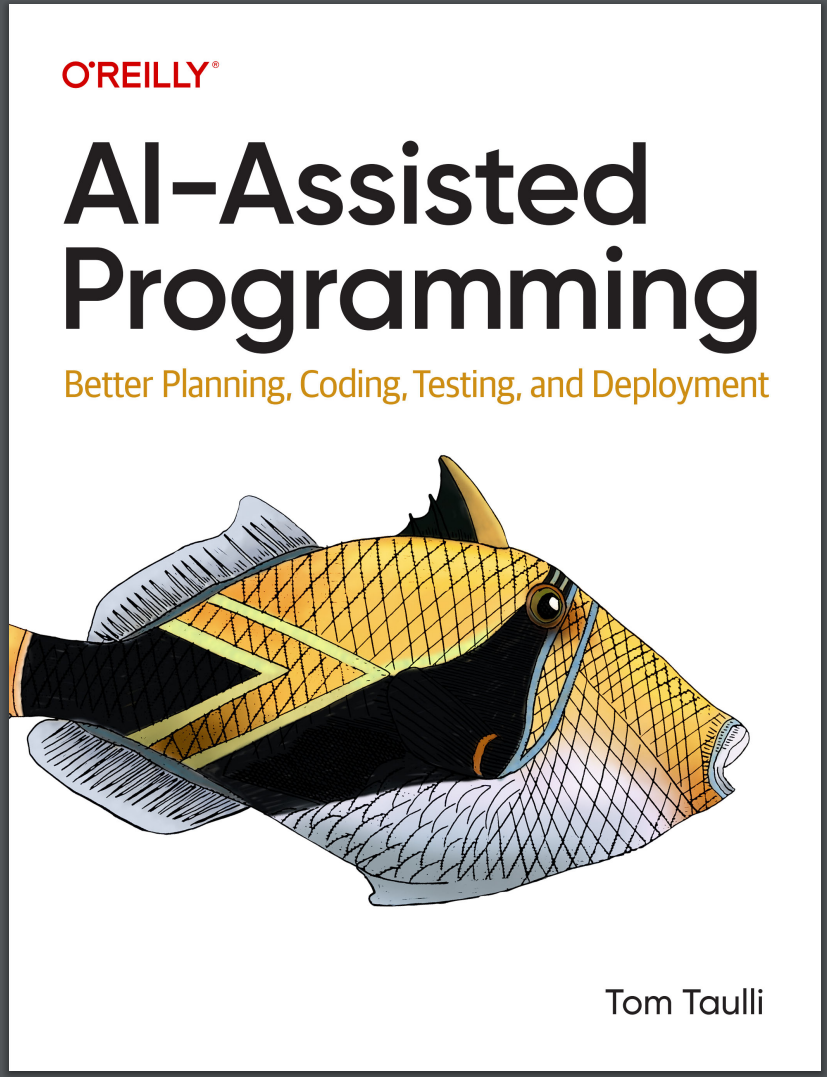
Автор: Taulli Tom
Дата выхода: 2024
Издательство: O’Reilly Media, Inc.
Количество страниц: 225
Размер файла: 2,7 МБ
Тип файла: PDF
Добавил: codelibs
Проверить на вирусыCover....1
Copyright....6
Table of Contents....7
Foreword....13
Preface....15
What’s Covered....16
How This Book Is Different....17
Who Should Read This Book....17
Conventions Used in This Book....17
Using Code Examples....18
O’Reilly Online Learning....18
How to Contact Us....19
Acknowledgments....19
Chapter 1. New World for Developers....21
Evolution and Revolution....22
Generative AI....25
The Benefits....26
Minimizing Search....26
Your Advisor....28
IDE Integration....29
Reflecting Your Codebase....30
Code Integrity....31
AI-Powered Documentation Generator....31
Modernization....32
Drawbacks....35
Hallucinations....35
Intellectual Property....35
Privacy....36
Security....37
Training Data....37
Bias....38
A New Way for Developers....38
Career....39
10x Developer?....39
Skills of the Developer....40
Conclusion....40
Chapter 2. How AI Coding Technology Works....41
Key Features....41
Code Suggestions and Context-Aware Completions Versus Smart Code Completion....42
Compilers Versus AI-Assisted Programming Tools....43
Levels of Capability....44
Generative AI and Large Language Models (LLMs)....46
Evolution....46
The Transformer Model....47
OpenAI Playground....50
Evaluating LLMs....55
Types of LLMs....58
Evaluation of AI-Assisted Programming Tools....60
Conclusion....61
Chapter 3. Prompt Engineering....63
Art and Science....64
Challenges....64
The Prompt....65
Context....66
Instructions....66
Summarization....67
Text Classification....68
Recommendation....68
Translation....69
Input of Content....70
Format....70
Best Practices....71
Be Specific....71
Acronyms and Technical Terms....72
Zero- and Few-Shot Learning....73
Leading Words....74
Chain of Thought (CoT) Prompting....74
Leading Questions....75
Ask for Examples and Analogies....75
Reducing Hallucinations....76
Security and Privacy....77
Autonomous AI Agents....78
Conclusion....80
Chapter 4. GitHub Copilot....81
GitHub Copilot....81
Pricing and Versions....82
Use Case: Programming Hardware....83
Use Case: Shopify....84
Use Case: Accenture....85
Security....85
Getting Started....86
Codespaces and Visual Studio Code....87
Suggestions....89
Comments....92
Chat....92
Inline Chat....97
Open Tabs....99
Command-Line Interface....100
Copilot Partner Program....101
Conclusion....102
Chapter 5. Other AI-Assisted Programming Tools....103
Amazon’s CodeWhisperer....103
Google’s Duet AI for Developers....105
Tabnine....107
Replit....108
CodeGPT....111
Cody....111
CodeWP....113
Warp....114
Bito AI....116
Cursor....117
Code Llama....118
Other Open Source Models....119
StableCode....119
AlphaCode....120
PolyCoder....120
CodeT5....121
Enterprise Software Companies....121
Conclusion....122
Chapter 6. ChatGPT and Other General-Purpose LLMs....123
ChatGPT....123
GPT-4....124
Navigating ChatGPT....125
Mobile App....128
Custom Instructions....129
Browse with Bing....129
Tedious Tasks....133
Regular Expressions....134
Starter Code....135
GitHub README....135
Cross-Browser Compatibility....136
Bash Commands....137
GitHub Actions....137
Plugins....138
The Codecademy Plugin....139
The AskYourDatabase Plugin....140
Recombinant AI Plugin....141
GPTs....141
Gemini....143
Applications....145
Gemini for Coding....146
Claude....148
Conclusion....150
Chapter 7. Ideas, Planning, and Requirements....151
Brainstorming....151
Market Research....153
Market Trends....155
Total Addressable Market....156
Competition....157
Requirements....159
Product Requirements Document....160
Software Requirements Specification....161
Interviews....162
Whiteboarding....163
Tone....164
Approaches to Project Planning....165
Test-Driven Development (TDD)....167
Planning Web Design....169
Conclusion....172
Chapter 8. Coding....173
Reality Check....173
Judgment Calls....175
Learning....176
Comments....177
Modular Programming....178
Starting a Project....179
Autofill....180
Refactoring....182
Ninja Code....182
Extract Method....183
Decomposing Conditionals....184
Renaming....184
Dead Code....185
Functions....186
Object-Oriented Programing....187
Frameworks and Libraries....188
Data....189
Frontend Development....191
CSS....192
Creating Graphics....192
AI Tools....193
APIs....196
Conclusion....197
Chapter 9. Debugging, Testing, and Deployment....199
Debugging....199
Documentation....200
Code Review....202
Unit Tests....203
Pull Requests....206
Deployment....207
User Feedback....209
The Launch....210
Conclusion....211
Chapter 10. Takeaways....213
The Learning Curve Is Steep....213
There Are Major Benefits....214
But There Are Drawbacks....214
Prompt Engineering Is an Art and Science....215
Beyond Programming....215
AI Won’t Take Your Job....216
Conclusion....216
Index....217
About the Author....224
Colophon....224
Get practical advice on how to leverage AI development tools for all stages of code creation, including requirements, planning, design, coding, debugging, testing, and documentation. With this book, beginners and experienced developers alike will learn how to use a wide range of tools, from general-purpose LLMs (ChatGPT, Gemini, and Claude) to code-specific systems (GitHub Copilot, Tabnine, Cursor, and Amazon CodeWhisperer).
You'll also learn about more specialized generative AI tools for tasks such as text-to-image creation.
Author Tom Taulli provides a methodology for modular programming that aligns effectively with the way prompts create AI-generated code. This guide also describes the best ways of using general purpose LLMs to learn a programming language, explain code, or convert code from one language to another.
This book examines:
- The core capabilities of AI-based development tools
- Pros, cons, and use cases of popular systems such as GitHub Copilot and Amazon CodeWhisperer
- Ways to use ChatGPT, Gemini, Claude, and other generic LLMs for coding
- Using AI development tools for the software development lifecycle, including requirements, planning, coding, debugging, and testing
- Prompt engineering for development
- Using AI-assisted programming for tedious tasks like creating regular expressions, starter code, object-oriented programming classes, and GitHub Actions
- How to use AI-based low-code and no-code tools, such as to create professional UIs.


