-
1C
-
Agda
-
Agile/Scrum
-
Alef
-
APL
-
Assembler
-
AWK
-
Basic
-
Beta Programming Language
-
Big Data/DataScience
-
C
-
C#
-
C++
-
Cobol
-
Crystal
-
CSS
-
D
-
Dart
-
DataBase (SQL)
-
Delphi
-
F#
-
Flutter
-
Fortran
-
GameDev
-
Git
-
Go (Golang)
-
GPT/AI/ИИ
-
Hacking and Security
-
Haskell
-
HTML
-
Java
-
JavaScript (JS)
-
Julia
-
Kotlin
-
Machine Learning (ML)
-
Natural language processing (NLP)
-
.NET (.NET Core)
-
Pascal
-
PHP
-
Python
-
R
-
Ruby
-
Rust
-
Scratch
-
Swift
-
UML
-
UX/UI
-
Visual Basic
-
Wolfram
-
XML
-
АСУ
-
Проектирование/System Design
-
Сети/Network
-
Статьи
-
Схемотехника/электронные схемы
-
1C
-
Agda
-
Agile/Scrum
-
Alef
-
APL
-
Assembler
-
AWK
-
Basic
-
Beta Programming Language
-
Big Data/DataScience
-
C
-
C#
-
C++
-
Cobol
-
Crystal
-
CSS
-
D
-
Dart
-
DataBase (SQL)
-
Delphi
-
F#
-
Flutter
-
Fortran
-
GameDev
-
Git
-
Go (Golang)
-
GPT/AI/ИИ
-
Hacking and Security
-
Haskell
-
HTML
-
Java
-
JavaScript (JS)
-
Julia
-
Kotlin
-
Machine Learning (ML)
-
Natural language processing (NLP)
-
.NET (.NET Core)
-
Pascal
-
PHP
-
Python
-
R
-
Ruby
-
Rust
-
Scratch
-
Swift
-
UML
-
UX/UI
-
Visual Basic
-
Wolfram
-
XML
-
АСУ
-
Проектирование/System Design
-
Сети/Network
-
Статьи
-
Схемотехника/электронные схемы
Меню
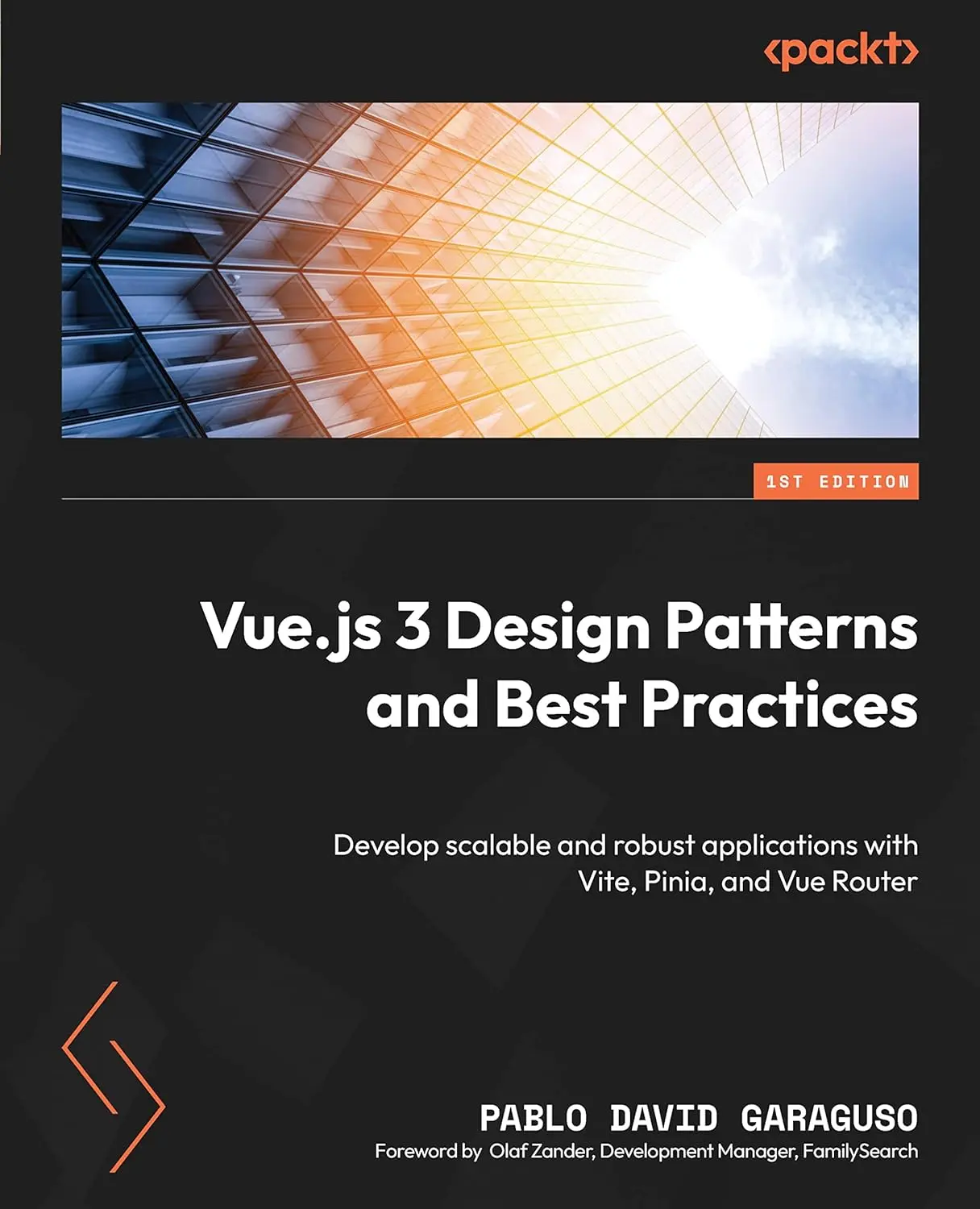
Vue.js 3 Design Patterns and Best Practices: Develop scalable and robust applications with Vite, Pinia, and Vue Router
Автор: Garaguso Pablo David
Дата выхода: 2023
Издательство: Packt Publishing Limited
Количество страниц: 384
Размер файла: 2,7 МБ
Тип файла: PDF
Добавил: codelibs
Проверить на вирусы Дополнительные материалыCover Page....2
Table of Contents....3
Preface....4
Chapter 1: The Vue 3 Framework....13
The progressive framework....14
Using Vue in your web application....17
Understanding single-file components....20
Different strokes – options, composition, and script setup API....22
Exploring built-in directives in Vue 3....26
Built-in components....29
Book code conventions....31
Summary....33
Review questions....34
Chapter 2: Software Design Principles and Patterns....35
What are the principles of software design?....36
A non-exclusive list of design principles....36
What is a software design pattern?....44
A quick reference list of patterns....45
Summary....76
Review questions....76
Chapter 3: Setting Up a Working Project....77
Technical requirements....77
Project setup and tools....79
Folder structure and modifications....82
Integration with CSS frameworks....86
FontAwesome is just awesome....88
Vite configuration options....90
The To-Do app....92
Summary....101
Review questions....102
Chapter 4: User Interface Composition with Components....103
Technical requirements....104
Page composition with components....104
Components in depth....110
Special components....119
A real-world example – a modals plugin....126
Implementing our new To-Do application....133
A small critique of our new To-Do application....136
Summary....136
Review questions....137
Chapter 5: Single-Page Applications....138
Technical requirements....138
What is a SPA?....139
The Vue 3 router....141
Exploring authentication patterns....157
Summary....175
Review questions....175
Chapter 6: Progressive Web Applications....177
Technical requirements....177
PWAs or installable SPAs....178
Upscaling a SPA into a PWA....181
Service workers....189
Vite-PWA plugin....192
Testing your PWA score with Google Lighthouse....193
Summary....195
Review questions....195
Chapter 7: Data Flow Management....197
Technical requirements....197
Components’ basic communication....198
Implementing an event bus with the Singleton and Observer patterns....201
Implementing a basic reactive state....204
Implementing a powerful reactive store with Pinia....207
Browser data stores – session, local, and IndexedDB....213
Experimenting with reactivity and Proxies patterns....216
Summary....219
Review questions....219
Chapter 8: Multithreading with Web Workers....221
Technical requirements....221
An introduction to web workers....222
The business delegate pattern....228
The dispatcher pattern....230
Establishing a communication pipeline with the web worker....230
Accessing IndexedDB with DexieJS in the web worker....236
Consuming a RESTful API with the web worker....241
A simple NodeJS server for testing....245
Summary....247
Review questions....248
Chapter 9: Testing and Source Control....249
Technical requirements....250
What are testing and TDD....250
What to test....251
Our base example application....253
Installation and use of Vitest....254
Installation of Vue Test Utils....260
In-source testing....264
Coverage....265
The Vitest UI....267
What is source control... and why?....268
Source control with Git....269
Continuous Integration and Delivery....279
Summary....280
Review questions....280
Chapter 10: Deploying Your Application....281
Technical requirements....281
What is involved in publishing a web application?....281
Considerations for building our application for deployment....285
Web server options and configurations....287
Transferring your files to the server....291
Protecting your web application with Let’s Encrypt....292
Summary....294
Review questions....295
Chapter 11: Bonus Chapter - UX Patterns....296
Technical requirements....296
UI design versus UX design....297
The principles of UI design....298
Common patterns for data manipulation....306
Common patterns for data visualization....308
Common patterns for interaction and navigation....317
Common patterns for content organization....323
Dark patterns....328
Summary....333
Review questions....333
Final words....335
Where to go from here....336
Finally.......336
Index....337
Why subscribe?....367
Other Books You May Enjoy....368
Packt is searching for authors like you....372
Share Your Thoughts....372
Download a free PDF copy of this book....374
Appendix: Migrating from Vue 2....376
If you’re familiar with the progressive Vue framework for creating responsive user interfaces, you’ll be impressed with its latest iteration, Vue 3, which introduces new concepts and approaches design patterns that are uncommon in other libraries or frameworks. By building on your foundational knowledge of Vue 3 and software engineering principles, this book will enable you to evaluate the trade-offs of different approaches to building robust applications.
This book covers Vue 3 from the basics, including components and directives, and progressively moves on to more advanced topics such as routing, state management, web workers, and offline storage. Starting with a simple page, you’ll gradually build a fully functional multithreaded, offline, and installable progressive web application.
By the time you finish reading this Vue book, not only will you have learned how to build applications, but you’ll also understand how to solve common problems efficiently by applying existing design patterns. With this knowledge, you’ll avoid reinventing the wheel for every project, saving time and creating software that’s adaptable to future changes.
What you will learn
- What is the Vue 3 progressive framework
- What are software principles and design patterns, how and when to implement them, and the trade-offs to consider
- Setup your development environment using the new Vite bundler
- Integrate in your applications state management, routing, multithreading, offline storage, and other resources provided to you by the browser, seldom taken advantage
- Apply and identify design patterns to solve common problems in the architecture of your web application
- Best practices for your code, organization, architecture, and user experience implementation
- Incrementally expand an application with new functionalities without re-writing the whole application each time
Who this book is for
This book is for Vue.js developers who are passionate about framework design principles and seek to apply commonly found design patterns to their web development projects. This book assumes prior knowledge of JavaScript and a basic understanding of Vue.js, making it an ideal resource for developers looking to expand their existing skillset.


