-
1C
-
Agda
-
Agile/Scrum
-
Alef
-
APL
-
Assembler
-
AWK
-
Basic
-
Beta Programming Language
-
Big Data/DataScience
-
C
-
C#
-
C++
-
Cobol
-
Crystal
-
CSS
-
D
-
Dart
-
DataBase (SQL)
-
Delphi
-
F#
-
Flutter
-
Fortran
-
GameDev
-
Git
-
Go (Golang)
-
GPT/AI/ИИ
-
Hacking and Security
-
Haskell
-
HTML
-
Java
-
JavaScript (JS)
-
Julia
-
Kotlin
-
Machine Learning (ML)
-
Natural language processing (NLP)
-
.NET (.NET Core)
-
Pascal
-
PHP
-
Python
-
R
-
Ruby
-
Rust
-
Scratch
-
Swift
-
UML
-
UX/UI
-
Visual Basic
-
Wolfram
-
XML
-
АСУ
-
Проектирование/System Design
-
Сети/Network
-
Статьи
-
Схемотехника/электронные схемы
-
1C
-
Agda
-
Agile/Scrum
-
Alef
-
APL
-
Assembler
-
AWK
-
Basic
-
Beta Programming Language
-
Big Data/DataScience
-
C
-
C#
-
C++
-
Cobol
-
Crystal
-
CSS
-
D
-
Dart
-
DataBase (SQL)
-
Delphi
-
F#
-
Flutter
-
Fortran
-
GameDev
-
Git
-
Go (Golang)
-
GPT/AI/ИИ
-
Hacking and Security
-
Haskell
-
HTML
-
Java
-
JavaScript (JS)
-
Julia
-
Kotlin
-
Machine Learning (ML)
-
Natural language processing (NLP)
-
.NET (.NET Core)
-
Pascal
-
PHP
-
Python
-
R
-
Ruby
-
Rust
-
Scratch
-
Swift
-
UML
-
UX/UI
-
Visual Basic
-
Wolfram
-
XML
-
АСУ
-
Проектирование/System Design
-
Сети/Network
-
Статьи
-
Схемотехника/электронные схемы
Меню
Traditional vs Generative AI Pentesting: A Hands-On Approach to Hacking
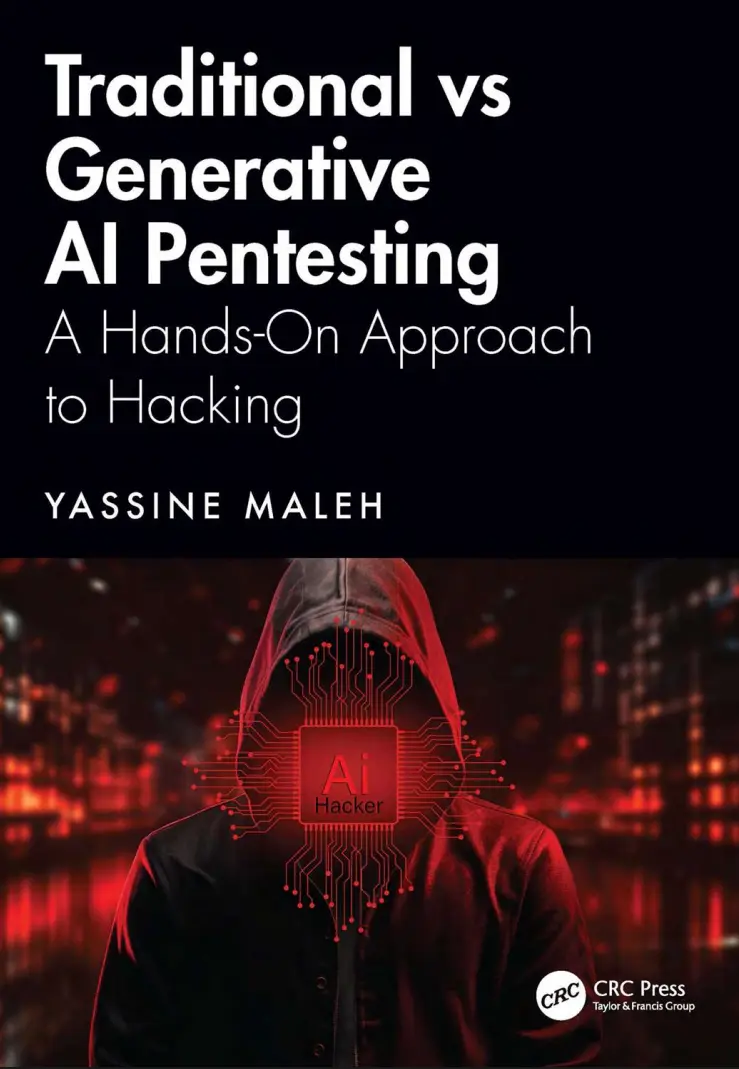
Автор: Maleh Yassine
Дата выхода: 2026
Издательство: CRC Press is an imprint of Taylor & Francis Group, LLC
Количество страниц: 316
Размер файла: 10,6 МБ
Тип файла: PDF
Добавил: codelibs
Проверить на вирусыCover....1
Half Title....2
Title Page....4
Copyright Page....5
Dedication....6
Table of Contents....8
Preface....9
About the author....11
Chapter 1: Foundations of pentesting: Methodologies, frameworks, and AI integration....12
Introduction....12
What is PT?....13
Benefits of conducting a PT....13
Comparison of security audit vulnerability assessment and PT....14
Pentesting vs ethical hacking....15
Pentesting benefits....15
PT strategies....16
Black-box penetration testing....16
White-box penetration testing....17
Gray-box penetration testing....17
Pentesting vs red teaming....17
Common areas of penetration testing....18
PT process....19
Code of good practice....19
Legal framework: Rules of Engagement (RoE)....20
Legal framework: Non-disclosure agreement (NDA)....21
Understanding the restrictions....21
Characteristics of a good PT....23
When should a PT be conducted?....23
Pentester ethics....23
PT methodologies....23
OSSTMM methodology....23
Phase I: Regulatory....24
Phase II: Definitions....24
Phase III: Information phase....24
Phase IV: Interactive control test phase....24
Advantages....24
Limits....24
PTES methodology....25
The stages of the PTES methodology....25
Pre-commitment interactions....25
Information gathering....25
Threat modeling....25
Vulnerability analysis....25
Operation....25
Post-op....26
Reports....26
Benefits....27
Limits....27
NIST methodology SP 800-115....27
The ISSAF (Information Systems Security Assessment Framework)....27
OWASP methodology....28
The OWASP phases....29
Benefits of OWASP....29
Limits of OWASP....29
Cyber kill chain methodology....30
MITRE ATT&CK....31
Adversary profile....33
Contribution of MITRE....33
Tools for pentesting according to MITRE ATT&CK....33
Challenges in penetration testing....37
AI-driven penetration testing....38
Key features of AI-driven penetration testing....39
Benefits of AI-driven penetration testing....39
Tools for AI-driven penetration testing....39
Challenges and ethical considerations....40
Overreliance on AI....40
Ethical and legal concerns....41
Inherent bias in AI models....41
Skill gap in using AI tools....41
Risks associated with generative AI in penetration testing....41
Escalation of cyber threats....41
Advanced persistent threats (APTs)....42
Autonomous and self-propagating attacks....42
Uncontrolled AI development....42
Conclusion....42
References....42
Chapter 2: Building a modern penetration testing lab with generative AI....45
Technical requirements....45
Set up a virtual PT laboratory....45
Your security....45
Understanding virtualization technology....46
Target machines....47
Metasploitable 2....47
Step 1: Download and install VirtualBox on your PC....47
Step 2: Install Kali Linux on VirtualBox....47
Kali Linux basic commands....51
PT tools....52
PT platform....52
Information gathering....52
Vulnerability scanner Nessus and Openvas....54
Web application testing platforms....54
Examples of training platforms....54
Generative AI in penetration testing....55
Conclusion....60
References....60
Chapter 3: GenAI-driven reconnaissance for effective penetration testing....61
Reconnaissance....61
Objectives of reconnaissance and footprinting....61
Types of footprinting....61
Passive footprinting....61
Methods of Passive Footprinting:....61
Active footprinting....62
Methods of active footprinting....62
Importance of reconnaissance....62
Types of information collected during footprinting....62
Organizational information....62
Network information....63
System information....63
Footprinting methodology....63
Key sources for information gathering....63
Methodological approach....64
Footprinting through search engines....64
Information extracted through search engines....64
Applications in footprinting....66
Google....66
Example of using google operators....66
Metasearch engines....69
Footprinting using advanced Google hacking techniques with AI....70
Example of AI-powered Google hacking....70
Advanced Google hacking with shell command....71
VPN footprinting through Google hacking....72
Automating VPN footprinting with AI....72
NetCraft: Website search engine....74
Social media....75
Example: LinkedIn....75
Example: Facebook....78
OSINT automation tools....79
Finding the target’s domain and subdomains....79
Fingerprinting the target using Shodan....82
Recon-ng: An OSINT tool Web....84
TheHarvester....84
Metagoofil (http://www.edge-security.com)....88
SpiderFoot: An OSINT tool recognition....90
OSINT framework....93
Maltego: A framework for collecting information....96
OSINT with DNS querying....98
Perform Whois lookups....98
APNIC Whois lookup (source: https://www.oonic.net)....99
ARIN WhOIS.RIS (source: http://whois.arin.net)....100
Dnsenum (https://github.com)....100
Nslookup (source: https://docs.microsoft.com)....101
What does a non-authoritative answer mean?....101
Lookup DNS records for the domain....103
Reverse domain name search....104
Find a website’s domain name from its IP address....104
Finding a company’s Top-Level Domains (TLDs) and subdomains with AI....104
Example 1: Enumerate subdomains with Sublist3r....104
Reverse DNS Lookup....106
Performing DNS enumeration with DNSRecon....106
DNSdumpster....108
Draw a network diagram using traceroute analysis....109
Traceroute....109
Example of AI-enhanced tracerouting....109
AI-powered OSINT tools....110
Key use cases of AI in OSINT....110
Benefits of AI in OSINT....111
Notable AI-powered OSINT tools....111
Footprinting using AI script....111
Automating domain footprinting with AI....111
Documentation of result....112
Conclusion....112
References....113
Chapter 4: GenAI-enhanced scanning and sniffing....114
Introduction....114
Nmap: Network mapper....115
Installation of Nmap....116
Installing on Linux....116
Installation on Windows....116
Install on macOS....116
Using Nmap....117
Basic syntax....117
Examples of use....117
Scan options....117
Output options....118
Identification options....118
Port options....118
Attack options....118
Examples of advanced use....118
Nmap: TCP Connect Scan sT....118
Nmap: TCP SYN Scan sS (Stealth)....119
Nmap: UDP Scan sU....120
Nmap: The scripts....120
NMAP: Examples....120
NMAP Scanning with AI....121
Example #1....121
Example #2....121
Example #3....121
Example #4....123
Firewall Evasion....123
Example....123
Nmap to fragment....124
Example....124
Script to automate network scanning tasks with AI....125
Hping3....125
Key features....126
Advanced applications....126
Syntax....126
Hping commands....128
Hping Scan with AI....128
Example 2....129
Metasploit....130
Network sniffing....131
How a sniffer works....131
Types of sniffing....132
Sniffing passive....132
Sniffing active....132
Protocols vulnerable to sniffing....133
Get Wireshark....134
Demer's Wireshark....134
Packet color coding....137
Packet filtering in Wireshark....137
Attack and defend with Wireshark....139
How do you catch a network scan attack?....139
How do I detect running local services (accessible to the web)?....139
Creating firewall rules....141
Packet capture....141
HTTP traffic....141
Traffic FTP....145
Traffic HTTPS....146
Conclusion....153
References....153
Chapter 5: Vulnerability assessment: Tools, techniques, and GenAI integration....155
Introduction....155
Background....156
Vulnerability....156
Vulnerability classification....156
Vulnerability research....157
What is vulnerability assessment?....158
Characteristics of a good vulnerability assessment solution....158
Vulnerability assessment systems and databases....159
Types of scanners....159
General-purpose scanners....159
Web application scanners....159
Specific application scanners....159
Scanner types by authentication....160
Unauthenticated scanners....160
Authenticated scanners....160
Agent-based scanners....160
Resources for vulnerability research....160
Vulnerability assessment tools....160
Nessus....160
Installation....161
Scan console....162
Start a scan....162
Run a basic scan....163
Run a web scan....164
Web Scan Results (Figure 5.9)....166
Rapid7 Nexpo....167
Running Vulnerability Scanning....167
OpenVAS....170
Nikto (Source: https://cirt.net)....175
Characteristics....177
OWASP Zap (https://www.zaproxy.org)....177
Automated scanning....177
Alerts....177
Generate a report....180
Scan web servers and applications for vulnerabilities using Nikto....181
Scan wordpress sites with WPscan....183
Wordpress scan through AI....185
Vulnerability assessment using AI....186
Example usage....186
Explanation....187
Explanation....187
Vulnerability scanning using Nmap with AI....187
Command example....188
Vulnerability assessment using Python script and AI....188
Concept and approach....188
Skipfish vulnerability scanning with AI....189
Database vulnerability assessment....189
Vulnerability assessment reports....191
Structure of vulnerability assessment reports....191
Components of a vulnerability assessment report....191
Classification of reports....192
Conclusion....192
References....192
Chapter 6: AI-driven social engineering and penetration testing....194
Introduction....194
Social engineering concepts....195
PT by social engineering: An overview....195
Black box or white box test?....196
Types of social engineering....196
Human-based social engineering....196
Computer-based social engineering....196
Example of social engineering by e-mail....197
Mobile-based social engineering....197
Methods of influence....201
The importance of phishing campaigns....201
Phishing tools....201
Launch a phishing campaign....202
Social engineering using different techniques....202
The social engineering toolkit....202
Using setoolkit for attacks phishing....202
Socialphish phishing....205
Installation....207
Uses....208
Detecting a phishing attack....210
Objectives of the Lab....210
Detecting phishing with Netcraft....210
Detecting phishing with PhishTank....213
Audit organization’s security for phishing attacks....214
Gophish (https://getgophish.com)....218
Creating phishing emails with ChatGPT....226
Handwriting style for identity theft....226
Writing style for identity theft (example)....227
Identity theft using AI: Creation of Deepfake videos....228
Purpose of Deepfakes....229
Technologies and tools used....229
Conclusion....230
References....230
Chapter 7: GenAI-driven exploitation testing techniques....231
Technical requirements....231
Why consider exploiting a target machine during a test?....231
Reverse vs bind shell....232
Staged vs non-staged payloads....234
Exploiting vulnerabilities: Categories of exploits....234
Exploiting vulnerabilities....234
Metasploit....235
Useful Metasploit user interfaces....236
Metasploit modules....236
Meterpreter....237
Basic commands in Meterpreter....237
Process commands....238
File System Commands....238
Networking Commands....238
User Interface Functionalities....238
Feat-db: searchsploit....238
Find modules....240
Feat-DB....240
Rapid7 exploits database....240
0day.today....242
Preparing the Metasploit environment....242
Identifying the target of the attack....242
Identify the target’s vulnerabilities....242
Vsftpd Backdoor v2.3.4....242
Launch attacks using the Metasploit framework....242
Exploit FTP Backdoor through GenAI....247
Exploit with the UnreaIRCD IRC backdoor....247
Metasploit options, shells, and payloads....249
Feat SMB on Windows via EternalBlue....250
Finding a vulnerable target....251
Find a module to use....251
Shells....252
Verify that the target is compromised....253
Lab: Penetration testing with Metasploit....253
Exploit Steps....254
Payload and exploit generation....264
Perform system hacking using ShellGPT....264
Generate a payload....265
Conclusion....266
References....267
Chapter 8: Post-exploitation techniques and AI-driven privilege escalation....268
Introduction....268
Post-exploitation techniques....268
File transfer techniques: Push vs pull....269
File transfer services....269
Alternative methods for file transfer....270
Alternative file transfer methods....270
Looting files....271
File transfer....271
Evasion tactics....271
Pivoting and cracking....272
The primacy of passwords....272
Password guessing vs. password cracking....272
Synchronized passwords....273
Dictionaries for password cracking....273
Improving speed in password cracking....273
Passwords without cracking....274
Attention to information leaks....274
Best practices for handling passwords....274
Post-test analysis and reporting....275
Dumping hashes with Meterpreter....275
Dumping credentials with Mimikatz....275
Why pivot?....276
Pivoting using metasploit’s route command....276
SSH local port forwarding....276
SSH remote port forwarding....276
SSH dynamic port forwarding....277
Port forwarding via a Meterpreter session....277
Meterpreter sessions via MSF route....277
SSH local and dynamic port forwarding....278
Cracking passwords with John the ripper....279
Multithreaded and GPU cracking with Hashcat....279
Elevation of privilege....279
Elevation of privilege: The enumeration....280
User enumeration....280
Elevation of privilege: The enumeration....281
Host name enumeration....283
Enumerating the OS version and architecture....284
Automating enumeration with GENAI tools....285
Exploit kernel vulnerabilities through AI....287
Identify the kernel version....287
Elevation of privilege: sudo....288
Elevation of privilege: SUID/GUID....289
Search and use of SUID files....289
SUID....289
Example of SUID operation....289
Lateral movements....290
Example 1....290
Persistence....291
Backdoor....291
Example 2: Creating a backdoor with msfvenom....292
Example 3: Sticky keys persistence....292
Example 4: Automating the process with a script....292
Privilege escalation to collect the Hashdump using Mimikatz....293
Conclusion....302
References....302
Chapter 9: GenAI for automating and enhancing penetration testing reports....303
Introduction....303
Risk ranking....304
General findings....305
Strategic roadmap....305
Technical report....306
Tools used....306
Information gathering....306
Vulnerability assessment and exploitation....306
Post-op....307
Conclusion....308
Appendices....308
Use Case: Automating PT reports with generative AI and Dradis....308
Pentest findings....308
Evaluation of findings....309
Report-writing through GenIA tools....309
Executive summary....309
Test methodology....310
Detailed findings....310
Recommendations....311
Conclusion....311
Submission of PT report....311
Report retention....312
Closing document....312
Conclusion....312
References....312
Index....314
Traditional vs Generative AI Pentesting: A Hands-On Approach to Hacking explores the evolving landscape of penetration testing, comparing traditional methodologies with the revolutionary impact of Generative AI. This book provides a deep dive into modern hacking techniques, demonstrating how AI-driven tools can enhance reconnaissance, exploitation, and reporting in cybersecurity assessments.
Bridging the gap between manual pentesting and AI automation, this book equips readers with the skills and knowledge to leverage Generative AI for more efficient, adaptive, and intelligent security testing. By blending practical case studies, hands-on exercises, and theoretical insights, it guides cybersecurity professionals, researchers, and students through the next generation of offensive security strategies.
The book offers comprehensive coverage of key topics, including:
- Traditional vs AI-Driven Pentesting: Understanding the evolution of security testing methodologies
- Building an AI-Powered Pentesting Lab: Leveraging Generative AI tools for reconnaissance and exploitation
- GenAI in Social Engineering and Attack Automation: Exploring AI-assisted phishing, deepfake attacks, and deception tactics
- Post-Exploitation and Privilege Escalation with AI: Enhancing persistence and lateral movement techniques
- Automating Penetration Testing Reports: Utilizing AI for streamlined documentation and risk analysis
This book is an essential resource for ethical hackers, cybersecurity professionals, and academics seeking to explore the transformative role of Generative AI in penetration testing. It provides practical guidance, in-depth analysis, and cutting-edge techniques for mastering AI-driven offensive security.


