-
1C
-
Agda
-
Agile/Scrum
-
Alef
-
APL
-
Assembler
-
AWK
-
Basic
-
Beta Programming Language
-
Big Data/DataScience
-
C
-
C#
-
C++
-
Cobol
-
Crystal
-
CSS
-
D
-
Dart
-
DataBase (SQL)
-
Delphi
-
F#
-
Flutter
-
Fortran
-
GameDev
-
Git
-
Go (Golang)
-
GPT/AI/ИИ
-
Hacking and Security
-
Haskell
-
HTML
-
Java
-
JavaScript (JS)
-
Julia
-
Kotlin
-
Machine Learning (ML)
-
Natural language processing (NLP)
-
.NET (.NET Core)
-
Pascal
-
PHP
-
Python
-
R
-
Ruby
-
Rust
-
Scratch
-
Swift
-
UML
-
UX/UI
-
Visual Basic
-
Wolfram
-
XML
-
АСУ
-
Проектирование/System Design
-
Сети/Network
-
Статьи
-
Схемотехника/электронные схемы
-
1C
-
Agda
-
Agile/Scrum
-
Alef
-
APL
-
Assembler
-
AWK
-
Basic
-
Beta Programming Language
-
Big Data/DataScience
-
C
-
C#
-
C++
-
Cobol
-
Crystal
-
CSS
-
D
-
Dart
-
DataBase (SQL)
-
Delphi
-
F#
-
Flutter
-
Fortran
-
GameDev
-
Git
-
Go (Golang)
-
GPT/AI/ИИ
-
Hacking and Security
-
Haskell
-
HTML
-
Java
-
JavaScript (JS)
-
Julia
-
Kotlin
-
Machine Learning (ML)
-
Natural language processing (NLP)
-
.NET (.NET Core)
-
Pascal
-
PHP
-
Python
-
R
-
Ruby
-
Rust
-
Scratch
-
Swift
-
UML
-
UX/UI
-
Visual Basic
-
Wolfram
-
XML
-
АСУ
-
Проектирование/System Design
-
Сети/Network
-
Статьи
-
Схемотехника/электронные схемы
Меню
Think Python: How to Think Like a Computer Scientist. 3 Ed
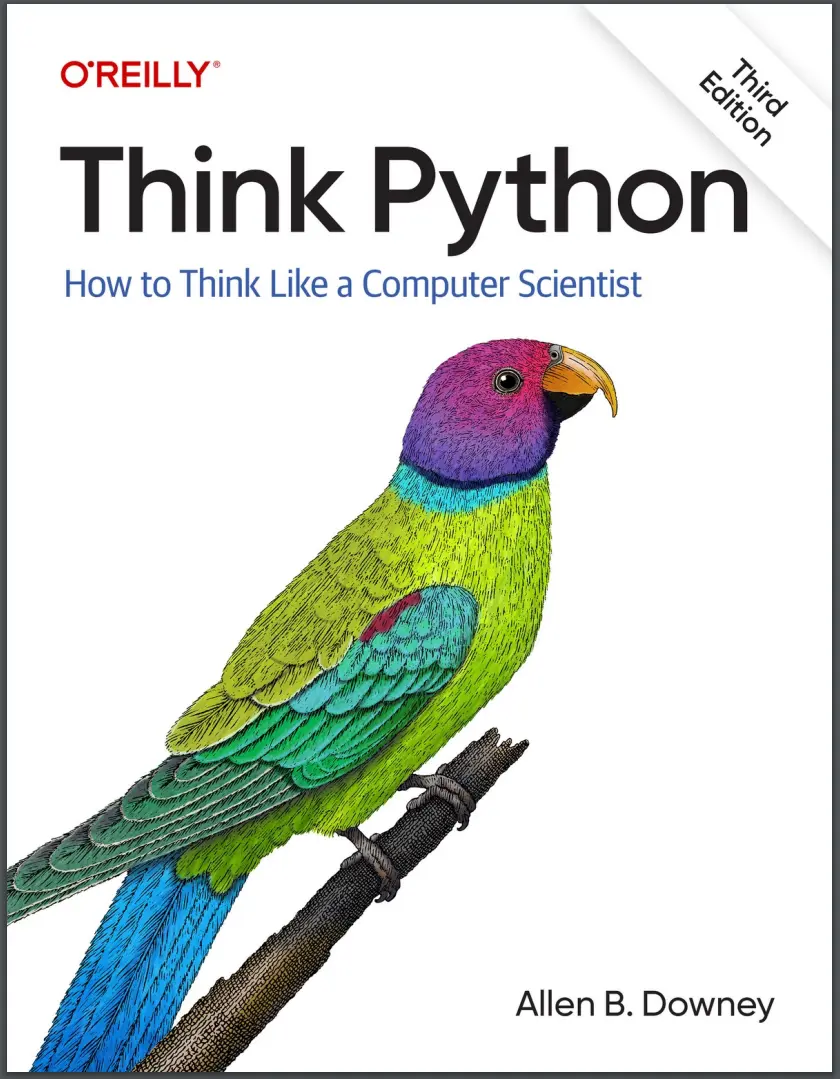
Автор: Downey Allen
Дата выхода: 2024
Издательство: O’Reilly Media, Inc.
Количество страниц: 630
Размер файла: 2,3 МБ
Тип файла: PDF
Добавил: codelibs
Проверить на вирусыPreface....6
Who Is This Book For?....6
Goals of the Book....8
Navigating the Book....8
What’s New in the Third Edition?....10
Getting Started....11
Resources for Teachers....12
Conventions Used in This Book....13
Using Code Examples....14
O’Reilly Online Learning....15
How to Contact Us....15
Acknowledgments....16
1. Programming as a Way of Thinking....18
Arithmetic Operators....18
Expressions....22
Arithmetic Functions....23
Strings....26
Values and Types....29
Formal and Natural Languages....34
Debugging....35
Glossary....36
Exercises....38
2. Variables and Statements....43
Variables....43
State Diagrams....46
Variable Names....46
The import Statement....49
Expressions and Statements....50
The print Function....51
Arguments....53
Comments....57
Debugging....58
Glossary....60
Exercises....62
3. Functions....65
Defining New Functions....65
Parameters....67
Calling Functions....69
Repetition....72
Variables and Parameters Are Local....75
Stack Diagrams....76
Tracebacks....78
Why Functions?....80
Debugging....80
Glossary....81
Exercises....82
4. Functions and Interfaces....87
The jupyturtle Module....87
Making a Square....91
Encapsulation and Generalization....93
Approximating a Circle....98
Refactoring....100
Stack Diagram....104
A Development Plan....104
Docstrings....106
Debugging....107
Glossary....108
Exercises....109
5. Conditionals and Recursion....117
Integer Division and Modulus....117
Boolean Expressions....120
Logical Operators....123
if Statements....125
The else Clause....126
Chained Conditionals....127
Nested Conditionals....128
Recursion....130
Stack Diagrams for Recursive Functions....133
Infinite Recursion....135
Keyboard Input....136
Debugging....139
Glossary....141
Exercises....142
6. Return Values....152
Some Functions Have Return Values....152
And Some Have None....156
Return Values and Conditionals....158
Incremental Development....160
Boolean Functions....166
Recursion with Return Values....168
Leap of Faith....173
Fibonacci....174
Checking Types....175
Debugging....177
Glossary....180
Exercises....181
7. Iteration and Search....184
Loops and Strings....184
Reading the Word List....187
Updating Variables....190
Looping and Counting....192
The in Operator....194
Search....197
Doctest....199
Glossary....202
Exercises....203
8. Strings and Regular Expressions....211
A String Is a Sequence....211
String Slices....215
Strings Are Immutable....217
String Comparison....219
String Methods....220
Writing Files....221
Find and Replace....226
Regular Expressions....228
String Substitution....234
Debugging....237
Glossary....238
Exercises....239
9. Lists....243
A List Is a Sequence....243
Lists Are Mutable....245
List Slices....248
List Operations....250
List Methods....252
Lists and Strings....254
Looping Through a List....256
Sorting Lists....258
Objects and Values....259
Aliasing....261
List Arguments....263
Making a Word List....265
Debugging....268
Glossary....269
Exercises....270
10. Dictionaries....275
A Dictionary Is a Mapping....275
Creating Dictionaries....279
The in Operator....280
A Collection of Counters....285
Looping and Dictionaries....287
Lists and Dictionaries....289
Accumulating a List....290
Memos....293
Debugging....297
Glossary....298
Exercises....299
11. Tuples....305
Tuples Are Like Lists....305
But Tuples Are Immutable....310
Tuple Assignment....312
Tuples as Return Values....316
Argument Packing....318
Zip....321
Comparing and Sorting....326
Inverting a Dictionary....330
Debugging....332
Glossary....335
Exercises....335
12. Text Analysis and Generation....342
Unique Words....342
Punctuation....344
Word Frequencies....350
Optional Parameters....352
Dictionary Subtraction....354
Random Numbers....357
Bigrams....361
Markov Analysis....366
Generating Text....371
Debugging....373
Glossary....375
Exercises....376
Exercise....379
13. Files and Databases....380
Filenames and Paths....380
f-strings....385
YAML....388
Shelve....391
Storing Data Structures....396
Checking for Equivalent Files....400
Walking Directories....404
Debugging....407
Glossary....408
Exercises....410
14. Classes and Functions....414
Programmer-Defined Types....414
Attributes....416
Objects as Return Values....420
Objects Are Mutable....420
Copying....424
Pure Functions....426
Prototype and Patch....427
Design-First Development....432
Debugging....436
Glossary....438
Exercises....439
15. Classes and Methods....443
Defining Methods....443
Another Method....446
Static Methods....448
Comparing Time Objects....451
The __str__ Method....452
The __init__ Method....454
Operator Overloading....456
Debugging....457
Glossary....459
Exercises....460
16. Classes and Objects....463
Creating a Point....463
Creating a Line....467
Equivalence and Identity....472
Creating a Rectangle....474
Changing Rectangles....478
Deep Copy....482
Polymorphism....487
Debugging....489
Glossary....490
Exercises....491
17. Inheritance....493
Representing Cards....493
Card Attributes....497
Printing Cards....498
Comparing Cards....500
Decks....508
Printing the Deck....509
Add, Remove, Shuffle, and Sort....511
Parents and Children....515
Specialization....518
Debugging....521
Glossary....523
Exercises....524
18. Python Extras....534
Sets....534
Counters....540
defaultdict....543
Conditional Expressions....546
List Comprehensions....549
any and all....553
Named Tuples....555
Packing Keyword Arguments....559
Debugging....563
Glossary....567
Exercises....567
19. Final Thoughts....573
Index....577
About the Author....628
Python is an excellent way to get started in programming, and this clear, concise guide walks you through Python a step at a time—beginning with basic programming concepts before moving on to functions, data structures, and object-oriented design. This revised third edition reflects the growing role of large language models (LLMs) in programming and includes exercises on effective LLM prompts, testing code, and debugging skills.
With this popular hands-on guide at your side, you'll get:
- A grounding in the syntax and semantics of the Python language
- A clear definition of each programming concept, with emphasis on clear vocabulary
- How to work with variables, statements, functions, and data structures in a logical progression
- Techniques for reading and writing files and databases
- A solid understanding of objects, methods, and object-oriented programming
- Debugging strategies for syntax, runtime, and semantic errors
- An introduction to recursion, interface design, data structures, and basic algorithms
- How to use LLMs—including effective prompts, testing code, and debugging
- And more


