-
1C
-
Agda
-
Agile/Scrum
-
Alef
-
APL
-
Assembler
-
AWK
-
Basic
-
Beta Programming Language
-
Big Data/DataScience
-
C
-
C#
-
C++
-
Cobol
-
Crystal
-
CSS
-
D
-
Dart
-
DataBase (SQL)
-
Delphi
-
F#
-
Flutter
-
Fortran
-
GameDev
-
Git
-
Go (Golang)
-
GPT/AI/ИИ
-
Hacking and Security
-
Haskell
-
HTML
-
Java
-
JavaScript (JS)
-
Julia
-
Kotlin
-
Machine Learning (ML)
-
Natural language processing (NLP)
-
.NET (.NET Core)
-
Pascal
-
PHP
-
Python
-
R
-
Ruby
-
Rust
-
Scratch
-
Swift
-
UML
-
UX/UI
-
Visual Basic
-
Wolfram
-
XML
-
АСУ
-
Проектирование/System Design
-
Сети/Network
-
Статьи
-
Схемотехника/электронные схемы
-
1C
-
Agda
-
Agile/Scrum
-
Alef
-
APL
-
Assembler
-
AWK
-
Basic
-
Beta Programming Language
-
Big Data/DataScience
-
C
-
C#
-
C++
-
Cobol
-
Crystal
-
CSS
-
D
-
Dart
-
DataBase (SQL)
-
Delphi
-
F#
-
Flutter
-
Fortran
-
GameDev
-
Git
-
Go (Golang)
-
GPT/AI/ИИ
-
Hacking and Security
-
Haskell
-
HTML
-
Java
-
JavaScript (JS)
-
Julia
-
Kotlin
-
Machine Learning (ML)
-
Natural language processing (NLP)
-
.NET (.NET Core)
-
Pascal
-
PHP
-
Python
-
R
-
Ruby
-
Rust
-
Scratch
-
Swift
-
UML
-
UX/UI
-
Visual Basic
-
Wolfram
-
XML
-
АСУ
-
Проектирование/System Design
-
Сети/Network
-
Статьи
-
Схемотехника/электронные схемы
Меню
Practical Graph Structures in SQL Server and Azure SQL: Enabling Deeper Insights Using Highly Connected Data
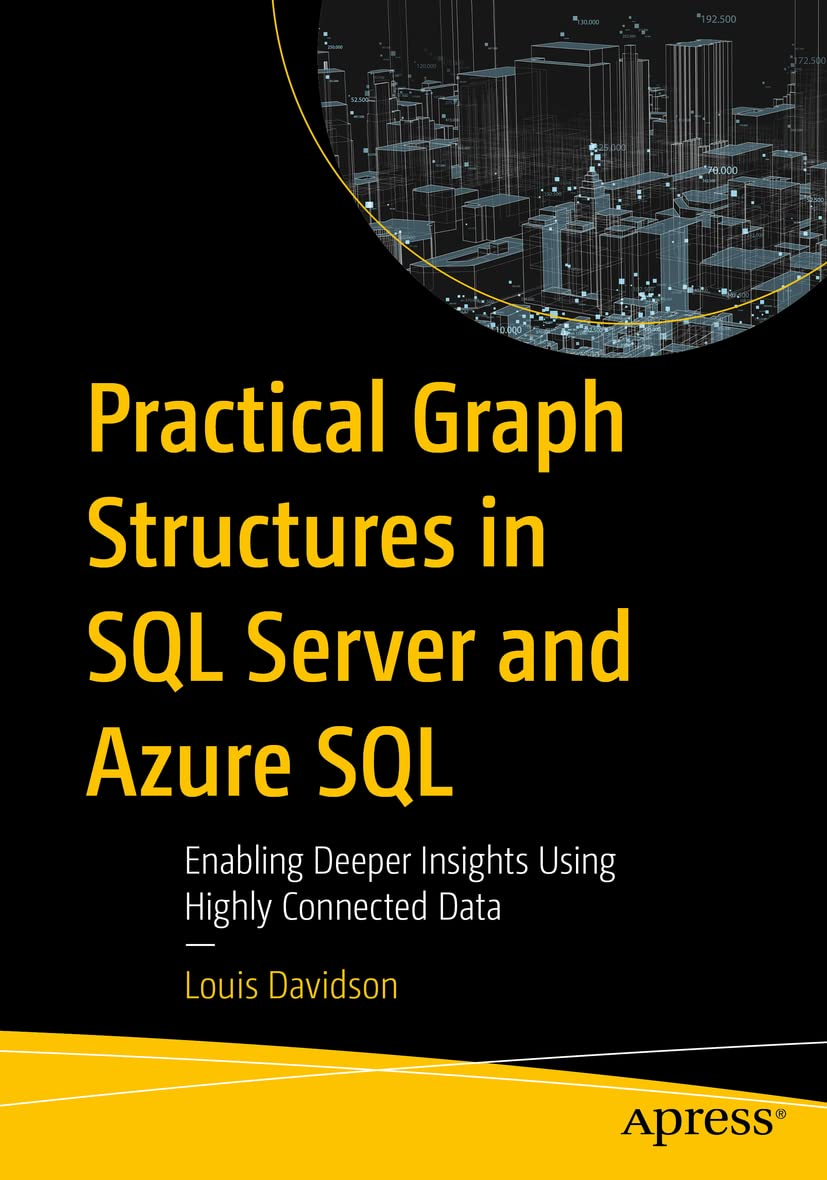
Автор: Davidson Louis
Дата выхода: 2023
Издательство: Apress Media, LLC.
Количество страниц: 244
Размер файла: 3,7 МБ
Тип файла: PDF
Добавил: codelibs
Проверить на вирусыTable of Contents....5
About the Author....8
About the Technical Reviewer....9
Acknowledgments....10
Preface....11
Chapter 1: Introduction to Graphs....14
Graph Fundamentals....16
Definition....17
Graphs In Computing/Directed Graphs....24
Cyclic and Acyclic Graphs....26
Summary....28
Chapter 2: Data Structures and Algorithms....29
Basic Implementation....29
Acyclic Graphs....31
Trees....34
Other Acyclic Graphs....39
Cyclic Graphs....42
Non-Directed Graphs....47
Summary....48
Chapter 3: SQL Graph Table Basics....50
Object Creation....51
Creating Data....54
Querying Data....59
Node-to-Node Querying....59
Filtering Output....62
Multiple MATCH Expressions....64
Traversing Variable Level Paths....70
Displaying the Last Node in the Path....71
Aggregation Along the Path....73
Controlling Depth of Processing....76
Filtering for One Path....78
Finding All Paths Between Nodes....79
Weighted Graph Calculations....82
Checking Conditions on the Matched Item....84
Summary....86
Chapter 4: SQL Graph Tables: Extended Topics....87
Advanced Data Creation Techniques....87
Building an Interface Layer....88
INSERT....88
UPDATE....93
DELETE....94
Loading Data Using Composable JSON Tags....97
Heterogenous Queries....103
Integrity Constraints and Indexes....111
Edge Constraint....111
Uniqueness Constraints (and Indexes)....117
Additional Constraints....121
Metadata Roundup....125
List Graph Objects in the Database....125
Types of Graph Columns....126
Tools for Fetching Graph Information....127
Summary....128
Chapter 5: Tree Data Structures....130
Creating the Data Structures....131
Base Table Structures....131
Demo Sales Structure....134
Essential Tree Maintenance Code....136
Code To Create New Nodes....137
Reparenting Nodes....147
Deleting a Node....150
Tree Output Code....157
Returning Part of the Tree....158
Determining If a Child Node Exists....160
Aggregating Child Activity at Every Level....163
Summary....171
Chapter 6: Tree Structures, Algorithms, and Performance....172
Alternative Tree Implementation....173
Path Technique....175
Code....177
Table Create Script....178
Insert New Rows....178
Return Hierarchy....179
Check For Child....181
Report Sales....182
Helper Table....184
Kimball Helper Table....185
Code....187
Table Create Script....187
Check For Child....190
Hierarchy Display Helper....191
Code....191
Table Create Script....191
Using the Helper Objects....192
Report Sales....192
Performance Comparison....195
Summary....198
Chapter 7: Other Directed Acyclic Graphs....199
The Problem Set....199
The Example....201
Determining If a Part Is Used in a Build....205
Picking Items for a Build....208
Printing Out the Parts List for a Build....209
Summary....214
Chapter 8: A Graph For Testing....216
The Example....216
Creating the Tables....217
Loading the Data....219
The Queries....222
Find Every Node That Is Connected to a Specific Node....222
Seeing If One Node is Connected to Another....224
Returning All Paths Between Two Nodes....225
Finding All People That a User Connects To At Any Level Where They Share an Interest....229
Finding a Specific User Who a User Connects To at Any Level Where They Share a Specific Interest....231
Finding Connections Through Other Nodes....233
Performance Tuning Results....235
Performance Tuning Roundup....238
Test....238
Index the Internal Columns....238
Employ a Maximum Degree of Parallelism of One....239
Consider Breaking Up Some Queries....239
The End (or Is It the Beginning?)....240
Index....241
Use the graph table features in Azure SQL that were introduced in SQL Server 2017 and further refined in SQL Server 2019. This book shows you how to create data structures to capture complex connections between items in your data. These connections will help you analyze and draw insights from connections in your data that go beyond classic relationships.
The graph examples in the book are useful for analyzing social media relationships, complex product-to-customer relationships, and any other type of data analysis in which indirect connections that otherwise might be missed using conventional techniques can be mined for their insight and business value.
Tree structures are covered, with emphasis on a structure commonly used by organizations to aggregate data at different levels of an organization. The book provides code examples of SQL Graph objects as well as an alternate tree implementation technique. Included is sample data (and data generators) for you to test for performance and choose the implementation approach that best suits your needs and that of your application.
If your job involves analyzing or storage of data elements that are connected in a networked topology, then this is the book that will help you bring the power of SQL Server to bear on that data and take advantage of your existing knowledge.
What You Will Learn
- Understand the graph model and the associated terms used in graph analysis
- Store highly connected data in SQL Server and Azure SQL alongside existing relational data
- Make full use of the graph table feature that is refined and enhanced in SQL Server 2019
- Implement high performance tree structures that will make storing and querying tree data possible
- Report on data associated with a tree structure to aggregate results at different levels


