-
1C
-
Agda
-
Agile/Scrum
-
Alef
-
APL
-
Assembler
-
AWK
-
Basic
-
Beta Programming Language
-
Big Data/DataScience
-
C
-
C#
-
C++
-
Cobol
-
Crystal
-
CSS
-
D
-
Dart
-
DataBase (SQL)
-
Delphi
-
F#
-
Flutter
-
Fortran
-
GameDev
-
Git
-
Go (Golang)
-
GPT/AI/ИИ
-
Hacking and Security
-
Haskell
-
HTML
-
Java
-
JavaScript (JS)
-
Julia
-
Kotlin
-
Machine Learning (ML)
-
Natural language processing (NLP)
-
.NET (.NET Core)
-
Pascal
-
PHP
-
Python
-
R
-
Ruby
-
Rust
-
Scratch
-
Swift
-
UML
-
UX/UI
-
Visual Basic
-
Wolfram
-
XML
-
АСУ
-
Проектирование/System Design
-
Сети/Network
-
Статьи
-
Схемотехника/электронные схемы
-
1C
-
Agda
-
Agile/Scrum
-
Alef
-
APL
-
Assembler
-
AWK
-
Basic
-
Beta Programming Language
-
Big Data/DataScience
-
C
-
C#
-
C++
-
Cobol
-
Crystal
-
CSS
-
D
-
Dart
-
DataBase (SQL)
-
Delphi
-
F#
-
Flutter
-
Fortran
-
GameDev
-
Git
-
Go (Golang)
-
GPT/AI/ИИ
-
Hacking and Security
-
Haskell
-
HTML
-
Java
-
JavaScript (JS)
-
Julia
-
Kotlin
-
Machine Learning (ML)
-
Natural language processing (NLP)
-
.NET (.NET Core)
-
Pascal
-
PHP
-
Python
-
R
-
Ruby
-
Rust
-
Scratch
-
Swift
-
UML
-
UX/UI
-
Visual Basic
-
Wolfram
-
XML
-
АСУ
-
Проектирование/System Design
-
Сети/Network
-
Статьи
-
Схемотехника/электронные схемы
Меню
Modernizing .NET Web Applications: Everything You Need to Know About Migrating ASP.NET Web Applications to the Latest Version of .NET
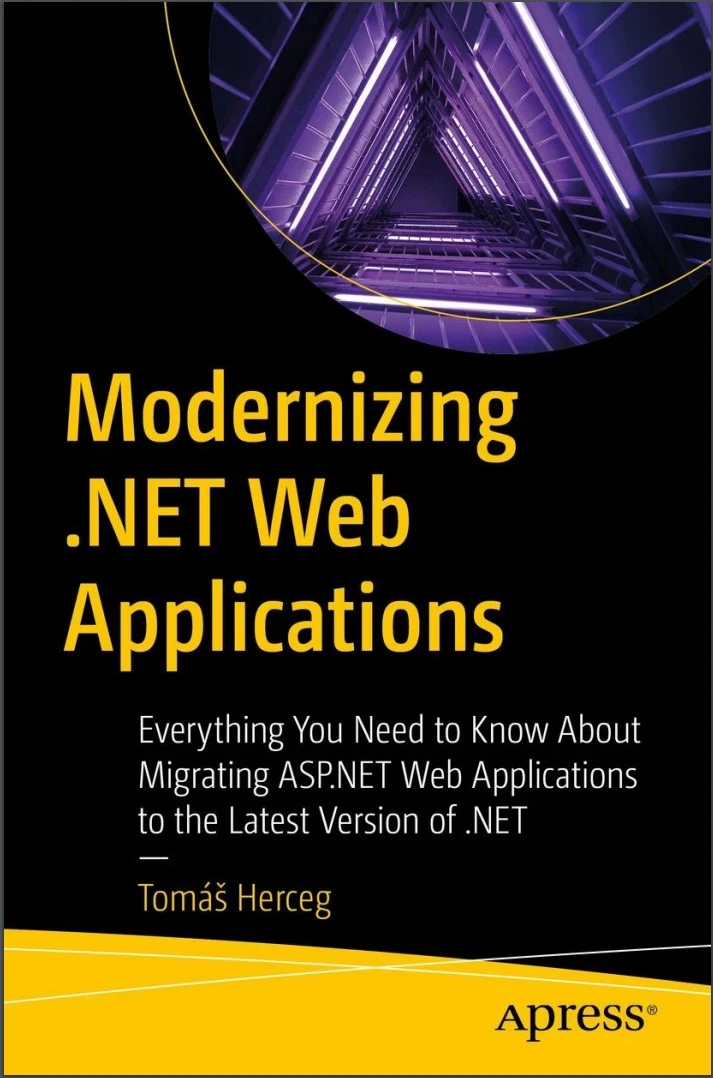
Автор: Herceg Tomáš
Дата выхода: 2024
Издательство: Apress Media, LLC.
Количество страниц: 672
Размер файла: 3,9 МБ
Тип файла: PDF
Добавил: codelibs
Проверить на вирусы Дополнительные материалыTable of Contents....4
About the Author....11
About the Technical Reviewer....12
Acknowledgments....13
Chapter 1: Introduction....15
The New Generation of .NET....16
Bridging the Gap with .NET Standard....17
What Has Changed....19
Ten Thousand Feet View of the Book....22
Get Ready....24
About the Author....25
Application Framework Equivalents in the .NET Core World....28
Frameworks for Web UI....29
ASP.NET Web Forms....29
ASP.NET MVC....31
ASP.NET Web Pages....34
Communication Frameworks....35
ASP.NET XML Web Services....36
Windows Communication Foundation....37
ASP.NET Web API....39
ASP.NET SignalR....40
Data Access Libraries....42
LINQ to SQL....44
Entity Framework....45
Membership and Identity....47
Membership Providers....48
ASP.NET Identity....49
Other Unsupported Technologies and APIs....51
Summary....53
Chapter 2: Justifying the Modernization....56
To Modernize or Not to Modernize....57
Example 1: Application in Maintenance Mode with a Negligible Number of New Requirements....57
Example 2: Complex and Actively Developed Admin Portal....58
Example 3: Ecommerce Solution Transformed into Multiple Applications....60
Takeaways....63
Benefits of the New .NET....64
Technical Arguments....64
Performance Improvements....65
Just-In-Time Compiler....66
Tiered Compilation....67
Inlining....69
Other JIT Improvements....72
Vectorization....73
Garbage Collector....74
New Performance-Related Types....75
Span and Memory....75
Allocation-Free Parsing....80
ValueTask....85
Source Generators....87
New JSON Parser....88
Optimizations in Base Types and Collections....91
Parsing and Formatting....91
Vectorization for Strings....91
Collections....95
Summary....98
Developer Productivity....99
Better Developer Tools....99
Hot Reload....101
Version Control....103
Package References....106
SDK-Style Projects....108
Entity Framework Migrations....111
Support for Linux and Containers....111
Architectural Improvements....114
Configuration....115
Dependency Injection....120
Logging....124
Hosting....127
Other Packages....130
Conclusion....132
Nontechnical Arguments....132
Hiring and Motivation of Developers....133
Higher Operating and Maintenance Costs....135
Security Considerations....138
Summary....142
Chapter 3: Before You Start....143
Choosing the Right Strategy....143
Example: Modernizing a Large E-learning Website....145
Incremental Changes....149
In-Place Modernization....151
Side-by-Side Modernization....158
Full Rewrite....164
Back to the Example....167
Estimating the Effort....169
Divide and Conquer....170
Example: Estimating the Effort....171
Preparing the Environment....176
Cleanup....177
Review Project Dependencies....178
Monitoring and Diagnostics....181
Version Control....183
Git Workflows....184
GitHub Flow....185
Gitflow....186
Trunk-Based Development....187
Conclusion....187
Summary....188
Chapter 4: Migrating APIs and Web Services....190
Before You Start....191
Refactoring on the Way....194
ASP.NET XML Web Services....196
Migrating to SoapCore....198
SOAP Extensions....203
Authentication....204
Migrating to gRPC....207
Windows Communication Foundation....214
Migrating to CoreWCF....216
Authentication....223
Unsupported Features....227
CoreWCF Improvements over WCF....229
ASP.NET Web API....233
Migrating Controllers....234
Explicit HTTP Methods....235
Routing....236
Action Results....238
Parameter Binding....241
Working with Files....242
Configuration....245
Compatibility with Newtonsoft.Json....247
Authentication....248
Host Authentication....249
Custom Authentication Filters....251
JWT and OWIN-Based Authentication....255
Unifying the OpenAPI Metadata....257
Configuring Client Proxy Generation....258
Diff Tools....260
ASP.NET SignalR....264
Migration of SignalR Hubs....265
Authentication and Authorization....268
Persistent Connections....274
Migration of Client Applications....274
Automatic Reconnects....277
Scaling....279
Summary....282
Chapter 5: Migrating Data Access....283
Migrating ADO.NET Primitives....286
SQL Server....286
Connection Encryption by Default....291
SQLite....293
Oracle....294
LINQ to SQL....294
Lazy and Eager Loading....302
Scaffolding Entity Framework Core Model....307
Other Differences....308
Entity Framework....311
Choose Between Entity Framework and Entity Framework Core....312
Migrate ObjectContext to DbContext API....314
Database First Approach with Entity Framework and the New .NET....319
Migrate to Entity Framework Core....320
Scaffolding....321
Porting the Code First Model....326
Lazy Loading....333
Configuration and Connection Strings....333
ASP.NET Identity Tables....335
Testing....336
Differences in Complex Queries....337
Migrations....341
Migrating the Entity Framework Migrations....343
Summary....349
Chapter 6: Migrating Identity Stores....350
ASP.NET Membership Providers....353
Insecure Passwords....356
Migration to ASP.NET Core Identity....358
Migration of Passwords....363
Do Not Keep Passwords in the Original Format....364
Storing the Old Password Hashes Securely....364
Other Password Formats....373
ASP.NET Universal Providers....374
Migration to ASP.NET Core Identity....376
Migrating User Profiles....377
ASP.NET Identity....389
Migration to ASP.NET Core Identity....391
Authentication in ASP.NET Core....399
Using ASP.NET Core Identity....403
Summary....407
Chapter 7: In-Place Migration of Web UI Applications....408
Trivial Applications....410
In-Place and Side-by-Side Migration....411
Modernization Using DotVVM....413
A Brief History....415
Model-View-ViewModel on the Web....420
Communication with the Server....424
Before You Start....429
Prerequisites....430
Coexistence of DotVVM and Web Forms....431
Migrating the Master Page....436
Migrating the Pages....439
Migrating Components....440
Handlers....445
The Final Step....447
Practical Example....449
Running the Project....451
Adding DotVVM....454
Master Page and the First Page....454
Migrating the Other Pages....467
Switching to the New .NET....472
Authentication and Authorization....474
Other Changes....477
Wrapping Up....479
Summary....480
Chapter 8: Side-by-Side Migration of UI Applications....481
Initial Setup....482
Create the New ASP.NET Core Application....484
Forwarded Headers....494
Server Configuration....497
Sharing Code Between the Applications....498
Migrating the First Page....506
Choosing the UI Framework....507
Adding Blazor Server....508
Migrating Layout Page....511
Migrating First Page....516
Sharing the Session....519
Remote Session....523
Remote Session in Blazor Server....527
Sharing the Authentication State....533
Remote Authentication....534
External Identity Providers....536
Cache Invalidation....539
Distributed Caching....540
Custom Solution Based on SignalR....541
Other Considerations....548
Filesystem Access....548
Concurrency and Locking....552
Migrating Remaining Pages....555
Migrating the Handler....561
Moving Static Files....563
Completing the Migration....564
Remove the Session....564
Switch the Authentication....566
Caching....571
Removing the Old Application....573
Summary....575
Chapter 9: Migration of ASP.NET MVC and Web Pages....576
Available Frameworks....576
Choosing the Technology....581
ASPX View Engine....584
Preparing the Migration....586
Migrating ASP.NET Web Pages....590
Routing....592
Migrating the Layout Page....594
The First Page....598
Migration of Remaining Pages....600
Route Parameters....601
Validation....602
Forms and Binding....604
Authorization....606
Unsupported Features....607
Migrating ASP.NET MVC....608
Upgrading Controllers....608
Fixing the Upgrade Issues....613
Migration of Remaining Pages....618
Final Step....619
Summary....622
Chapter 10: A Word on Architecture....624
Clean and Readable Code....626
Layering....632
Code Consistency and Conventions....652
Testing....655
Unit Tests....656
Integration Tests....658
Integration Tests with Database....663
User Interface Tests....667
Summary....670
Conclusion....671
In 2016, Microsoft introduced the new generation of .NET called .NET Core. It brought many fundamental improvements to the platform, but there were also many breaking changes and missing APIs, especially when it comes to creating web applications. Upgrading any website running on .NET Framework to the new .NET Core proved to be a complex process, which can take months or even years.
This book describes two approaches you can take to incrementally modernize legacy .NET web applications. It explains the changes that happened in ASP.NET MVC, ASP.NET Web API, Entity Framework, ASP.NET Identity, SignalR, and other libraries. It also shows a migration path for applications written in ASP.NET Web Forms: a technology which isn’t supported in the new .NET at all.
In addition, the book describes the new frameworks available in the ASP.NET Core platform (Blazor, Razor Pages, ASP.NET Core MVC, SignalR Core, and so on) and helps you decide which technology will be the best fit.
The book also covers several “soft” areas: how to explain the benefits or necessity for the modernization to your company management, how to deal with refactoring and improving the overall code quality during the entire process, and how to adjust the architecture of the application to be ready for another technology upgrade in the future.
The topic of modernization is highly relevant. There are still plenty of legacy .NET applications that are being actively developed and maintained. Many of them were developed for 10+ years, they involve plethora of company-specific know-how, and it is not economically feasible to rewrite them from scratch.
What You Will Learn
- Discover the changes you need to make in a legacy ASP.NET application to migrate it to .NET 8 and beyond
- Estimate the required effort and prepare the entire process
- Use the In-place or Side-by-side approach to modernize your application incrementally
- Migrate from ASP.NET Web Services or WCF to REST or gRPC
- Migrate from ASP.NET SignalR to SignalR Core or from Entity Framework to EF Core
- Migrate from Forms Authentication to ASP.NET Identity
- Migrate ASP.NET Web Forms to Blazor Server or DotVVM
- Migrate ASP.NET MVC and Web Pages to ASP.NET Core MVC and Razor Pages
- Refactor and clean up your codebase to make it more maintainable
Who This Book Is For
.NET developers who work with ASP.NET web applications running on the .NET framework, and tech leads and software architects who make technical decisions about legacy .NET projects used in their organization


