-
1C
-
Agda
-
Agile/Scrum
-
Alef
-
APL
-
Assembler
-
AWK
-
Basic
-
Beta Programming Language
-
Big Data/DataScience
-
C
-
C#
-
C++
-
Cobol
-
Crystal
-
CSS
-
D
-
Dart
-
DataBase (SQL)
-
Delphi
-
F#
-
Flutter
-
Fortran
-
GameDev
-
Git
-
Go (Golang)
-
GPT/AI/ИИ
-
Hacking and Security
-
Haskell
-
HTML
-
Java
-
JavaScript (JS)
-
Julia
-
Kotlin
-
Machine Learning (ML)
-
Natural language processing (NLP)
-
.NET (.NET Core)
-
Pascal
-
PHP
-
Python
-
R
-
Ruby
-
Rust
-
Scratch
-
Swift
-
UML
-
UX/UI
-
Visual Basic
-
Wolfram
-
XML
-
АСУ
-
Проектирование/System Design
-
Сети/Network
-
Статьи
-
Схемотехника/электронные схемы
-
1C
-
Agda
-
Agile/Scrum
-
Alef
-
APL
-
Assembler
-
AWK
-
Basic
-
Beta Programming Language
-
Big Data/DataScience
-
C
-
C#
-
C++
-
Cobol
-
Crystal
-
CSS
-
D
-
Dart
-
DataBase (SQL)
-
Delphi
-
F#
-
Flutter
-
Fortran
-
GameDev
-
Git
-
Go (Golang)
-
GPT/AI/ИИ
-
Hacking and Security
-
Haskell
-
HTML
-
Java
-
JavaScript (JS)
-
Julia
-
Kotlin
-
Machine Learning (ML)
-
Natural language processing (NLP)
-
.NET (.NET Core)
-
Pascal
-
PHP
-
Python
-
R
-
Ruby
-
Rust
-
Scratch
-
Swift
-
UML
-
UX/UI
-
Visual Basic
-
Wolfram
-
XML
-
АСУ
-
Проектирование/System Design
-
Сети/Network
-
Статьи
-
Схемотехника/электронные схемы
Меню
Modern Oracle Database Programming: Level Up Your Skill Set to Oracle's Latest and Most Powerful Features in SQL, PL/SQL, and JSON
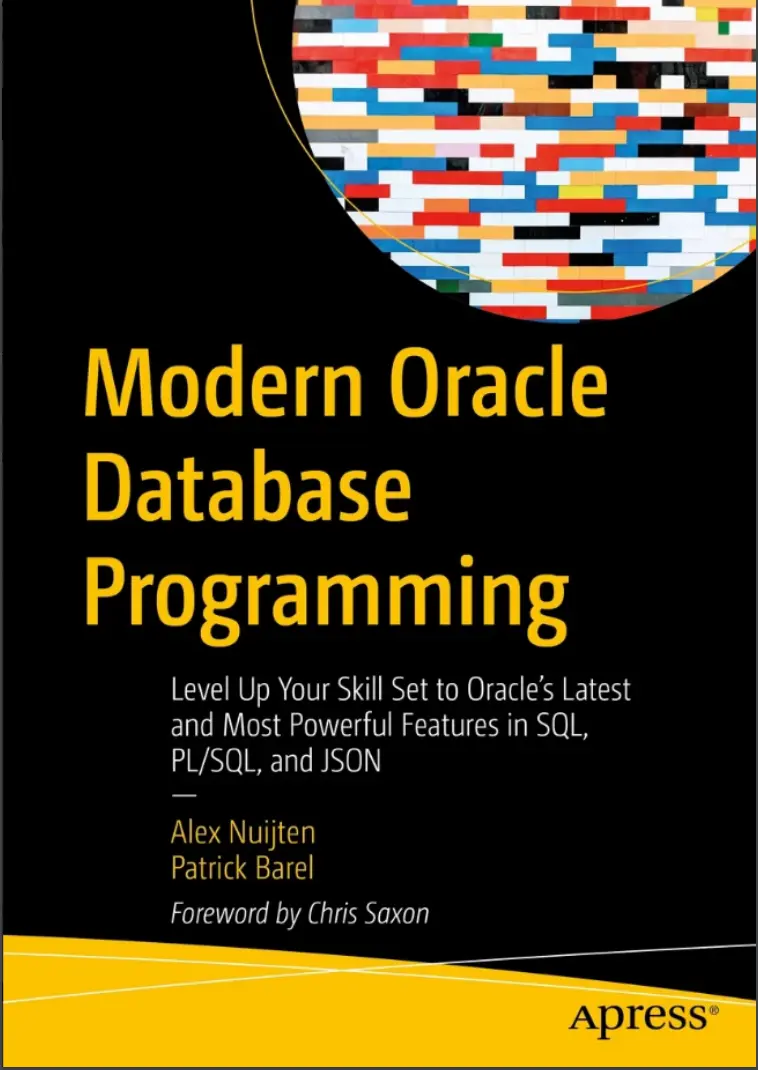
Автор: Barel Patrick , Nuijten Alex
Дата выхода: 2023
Издательство: Apress Media, LLC.
Количество страниц: 551
Размер файла: 1,9 МБ
Тип файла: PDF
Добавил: codelibs
Проверить на вирусы Дополнительные материалыPart I: Advanced Basics....2
Chapter 1: Underutilized Functionality and Enhancements....3
Merge....3
Collections....4
Bulk Collect....6
Limit....8
forall....10
Range....11
indices of....12
values of....15
Bulk Exceptions....19
Compound Triggers....19
Journaling....21
Mutating Table....25
DML Error Logging....28
Log Errors....28
Save Exceptions....32
Summary....34
Chapter 2: Analytic Functions and (un)Pivoting....35
Analytic Functions....35
Building Blocks....36
Running Totals....37
Accessing Values from Other Rows....42
The Fastest Lap and the Slowest Lap....45
Ranking: Top-N....47
Deduplication....48
Reusable Windowing Clause....51
Pivot and Unpivot....53
Pivot....53
Unpivot....57
Summary....61
Chapter 3: Joins....62
Why Choose ANSI Joins?....62
Natural Joins....63
Inner Joins....65
Outer Joins....67
Almost Outer Joins....68
Full Outer Joins....70
Cross Joins....71
Partitioned Outer Joins....72
Lateral Joins....74
Summary....79
Chapter 4: Finding Patterns....80
Looking for Contracts....80
Classifying the Records....82
Logical Groups....87
Faster at the End....89
Winning?....93
Undefined Classification....96
Longest Winning Streak....98
Pit Stops and Hazards....100
Summary....105
Chapter 5: Pagination and Set Operators....106
Top-N and Pagination....106
Row-Limiting Clause....109
Pagination....113
Under the Hood....116
Set Operators....117
Union....119
Minus and Except....121
Intersect....124
Summary....126
Chapter 6: Conditional Compilation....127
Directives....127
Selection Directive....127
Inquiry Directive....128
The DBMS_DB_VERSION Package....128
Predefined CCFLAGS....133
Error Directive....133
DEPRECATE Pragma Directive....134
Using Directives....136
Use Cases....137
Checking for the Presence of New Features....137
Showing Output of Debug and Test Code....139
Checking for the Correct Database Environment....146
Showing What’s Compiled....149
Summary....150
Chapter 7: Iterations and Qualified Expressions....151
Iterations....151
Iteration Controls....151
Multiple Iteration Controls....152
Stepped Iteration Controls....153
The while Loop in Iteration Controls....155
when in Iteration Controls....157
Cursor in Iteration Controls....159
Mutable Iterator....165
Augmenting the Iterator....167
The for loop in an Array....168
The Indices of an Array....169
The Values of an Array....171
The pairs of Array....173
PL/SQL Qualified Expressions....176
Records....176
Collections....180
Summary....184
Chapter 8: Polymorphic Table Functions and SQL Macros....185
Polymorphic Table Functions....186
Function....186
Package....187
describe....187
open....188
fetch_rows....188
close....188
Usage....188
Use Cases....189
Split....189
Calling the Polymorphic Function....196
Sum Intervals....197
Aggregating Intervals....205
SQL Macros....206
Table-Type SQL Macros....207
Scalar-Type SQL Macro....208
Use Cases....208
Parametrized View....208
Column Splitter (Table)....210
Splitting Columns with a SQL Macro....212
Parametrized View....213
Mimic Other Databases (Scalar)....216
Date Functions....216
String Functions....220
expand_sql_text....221
Summary....223
Chapter 9: Subquery Factoring, the WITH Clause, Explained....224
Monaco Podium....224
Functions in the WITH clause....229
Recursive Subquery Factoring....234
Simulate Built-in Recursive Functions....239
Level Pseudocolumn....240
sys_connect_by_path, connect_by_root, connect_by_isleaf....241
Sorting the Results....244
Cycle Detection....247
Summary....250
Chapter 10: Calling PL/SQL from SQL....251
UDF Pragma....251
Deterministic....252
Result Cache....255
Hierarchical Profiler....257
DBMS_HPROF....260
create_tables....260
start_profiling....261
stop_profiling....262
analyze....263
Report....268
Summary....274
Chapter 11: Storing JSON in the Database....276
Stage Data Before Processing....276
Which Data Type to Choose?....277
JSON Constraint....278
Under the Hood....283
Major Differences Between TREAT and JSON Constructor....287
Determining the Structure....290
Indexing JSON Documents....295
Searching for a Specific Key....296
Ad Hoc Searching with the JSON Search Index....299
Multivalue Indexes....301
Summary....302
Chapter 12: Path Expressions in JSON....303
Sample Data....303
JSON Data Types....305
Path Expressions and Filters....305
Using Filter Conditions....308
Passing Variables....312
Empty String and NULL....313
Item Methods....315
Handling Errors in JSON Path Expressions....319
Dot Notation....322
Summary....326
Chapter 13: SQL/JSON and Conditions....327
SQL/JSON Functions....327
JSON_VALUE....327
JSON_QUERY....333
JSON_TABLE....337
JSON_SERIALIZE....346
SQL Conditions....348
Summary....353
Chapter 14: Generate, Compare, and Manipulate JSON....354
Generating JSON Documents....354
Comparing JSON Documents....362
Changing a JSON Document....364
JSON and PL/SQL....369
Constructing and Manipulating JSON with PL/SQL....378
Summary....382
Chapter 15: Useful APEX Packages....383
APEX Availability....383
Calling Web Services....384
Getting Data from JSON....389
Basic Spatial Functionality....392
Utilities for Text Manipulations....394
Formatting a Message....396
Please Initial Here....397
Parsing Data....398
Business Case....398
Let’s Parse!....399
Working with ZIP Files....403
Unzipping Files....404
Zipping Files....405
Summary....406
Chapter 16: Processing Data in the Background....407
Resource Intensive....407
Queuing....407
The Use Case....408
Setup....409
Queue Table and Queue....410
Enqueue and Dequeue....412
Wrapper Procedures....414
PL/SQL Callback Notification....416
Seeing It in Action....421
Exception Queue....423
Advanced Queuing and JSON....426
Summary....428
Chapter 17: Introspecting PL/SQL....429
DBMS_SESSION....429
current_is_role_enabled....429
set_role....430
set_nls....430
set_context....431
clear_context....434
clear_all_context....435
set_identifier....435
clear_identifier....436
sleep....436
DBMS_APPLICATION_INFO....437
set_module....437
set_action....437
read_module....438
DBMS_UTILITY....439
compile_schema....439
format_call_stack....440
format_error_stack....442
comma_to_table....443
expand_sql_text....447
UTL_CALL_STACK....451
subprogram....454
concatenate_subprogram....455
owner....457
unit_line....457
Summary....458
Chapter 18: See What You Need to See....459
Temporal Validity....459
Setup....459
as of Queries....463
Versions Between Queries....465
DBMS_FLASHBACK_ARCHIVE....467
Virtual Private Database....469
The Policy Function....470
Context....471
Policy....472
add_policy....472
enable_policy....480
drop_policy....480
alter_policy....480
Complex Policies....481
Redaction....483
add_policy....484
alter_policy....489
enable_policy....491
disable_policy....491
drop_policy....492
Summary....492
Chapter 19: Upgrade Your Application with Zero Downtime....493
Downtime....493
Definitions....494
Concept....495
The Challenges of Zero-Downtime Upgrades....496
Solution....497
Dependencies....498
Preparation....499
Privileges....500
Several Levels of Complexity....501
Only Changing PL/SQL Objects....502
Table Changes: Don’t Sync Between Editions....507
Table Changes with Data Sync....511
Retiring Older Editions....517
Change Default Edition....518
Summary....518
Chapter 20: Choosing the Right Table Type....519
Heap Table....519
Index....520
B-tree....522
Bitmap Index....522
Index-Organized Table (IOT)....522
Clusters....524
Temporary Table....529
Global Temporary Table....529
Private Temporary Table....535
Restrictions on Temporary Tables....540
External Table....541
Immutable Table....547
Blockchain Table....550
Summary....551
0.PNG....1
Level up your skill set to the latest that Oracle Database can offer. This book introduces features that are not well known that can transform your development efforts. You’ll discover built-in functionality that can save you massive amounts of time that otherwise would be spent reinventing the wheel. You’ll find that what used to take a lot of programming some years ago can be done with less code in a more reliable way today. Anyone using Oracle Database without the knowledge in this book is leaving valuable functionality–that their company has paid for–on the table, and this book opens the door to that functionality so that you can deliver reliable and performant solutions faster and more easily than ever.Part I looks at features in SQL and PL/SQL that are underused and not well known. You’ll learn about new join types, pattern matching across rows, Top N pagination (useful in reporting!), qualified expressions, and enhancements to iterators that reduce code complexity and make your logic easier to understand.Part II covers how and when to invoke PL/SQL from SQL while maintaining performance. You'll learn about SQL macro functions for creating reusable SQL fragments, polymorphic table functions with return types determined by incoming argument types, and constructing and parsing JSON documents for data interchange with other systems.Part III introduces a vast array of built-in functionality that Oracle provides that is just waiting to be used. Edition-based redefinition enables zero-downtime application and schema upgrades. Data redaction enables easier compliance with privacy laws and similar regulations by protecting sensitive data from those who have no need to see it. Virtual private databases provide the appearance of giving each user their own database, again helping to secure sensitive data. These features are just a taste of what the book provides. Soon you’ll be improving your skillsand wondering why you ever worked so hard to solve problems that Oracle Database already solves for you.
What You Will Learn
- Write more powerful code by incorporating underused features in SQL and PL/SQL
- Optimize your integration between SQL and PL/SQL for best performance
- Take advantage of enhanced set operators, lateral joins, row-based pattern matching, and other advanced features in SQL
- Make your code easier to understand through your use of newer PL/SQL features, such as qualified expressions and iterator enhancements
- Integrate with web services and external data sources directly from the database
- Create and parse JSON documents for easy data exchange and flexible schema design
Who This Book Is For
Any developer who is writing SQL or PL/SQL, PL/SQL experts who want to level up their knowledgeand skills to the latest features that Oracle Database provides, and developers who don’t want to write their own solutions only to find out later that they’ve wasted their time by building something that Oracle Database provides out of the box


