-
1C
-
Agda
-
Agile/Scrum
-
Alef
-
APL
-
Assembler
-
AWK
-
Basic
-
Beta Programming Language
-
Big Data/DataScience
-
C
-
C#
-
C++
-
Cobol
-
Crystal
-
CSS
-
D
-
Dart
-
DataBase (SQL)
-
Delphi
-
F#
-
Flutter
-
Fortran
-
GameDev
-
Git
-
Go (Golang)
-
GPT/AI/ИИ
-
Hacking and Security
-
Haskell
-
HTML
-
Java
-
JavaScript (JS)
-
Julia
-
Kotlin
-
Machine Learning (ML)
-
Natural language processing (NLP)
-
.NET (.NET Core)
-
Pascal
-
PHP
-
Python
-
R
-
Ruby
-
Rust
-
Scratch
-
Swift
-
UML
-
UX/UI
-
Visual Basic
-
Wolfram
-
XML
-
АСУ
-
Проектирование/System Design
-
Сети/Network
-
Статьи
-
Схемотехника/электронные схемы
-
1C
-
Agda
-
Agile/Scrum
-
Alef
-
APL
-
Assembler
-
AWK
-
Basic
-
Beta Programming Language
-
Big Data/DataScience
-
C
-
C#
-
C++
-
Cobol
-
Crystal
-
CSS
-
D
-
Dart
-
DataBase (SQL)
-
Delphi
-
F#
-
Flutter
-
Fortran
-
GameDev
-
Git
-
Go (Golang)
-
GPT/AI/ИИ
-
Hacking and Security
-
Haskell
-
HTML
-
Java
-
JavaScript (JS)
-
Julia
-
Kotlin
-
Machine Learning (ML)
-
Natural language processing (NLP)
-
.NET (.NET Core)
-
Pascal
-
PHP
-
Python
-
R
-
Ruby
-
Rust
-
Scratch
-
Swift
-
UML
-
UX/UI
-
Visual Basic
-
Wolfram
-
XML
-
АСУ
-
Проектирование/System Design
-
Сети/Network
-
Статьи
-
Схемотехника/электронные схемы
Меню
Modern Angular. Also covers signals, standalone, SSR, zoneless, and more
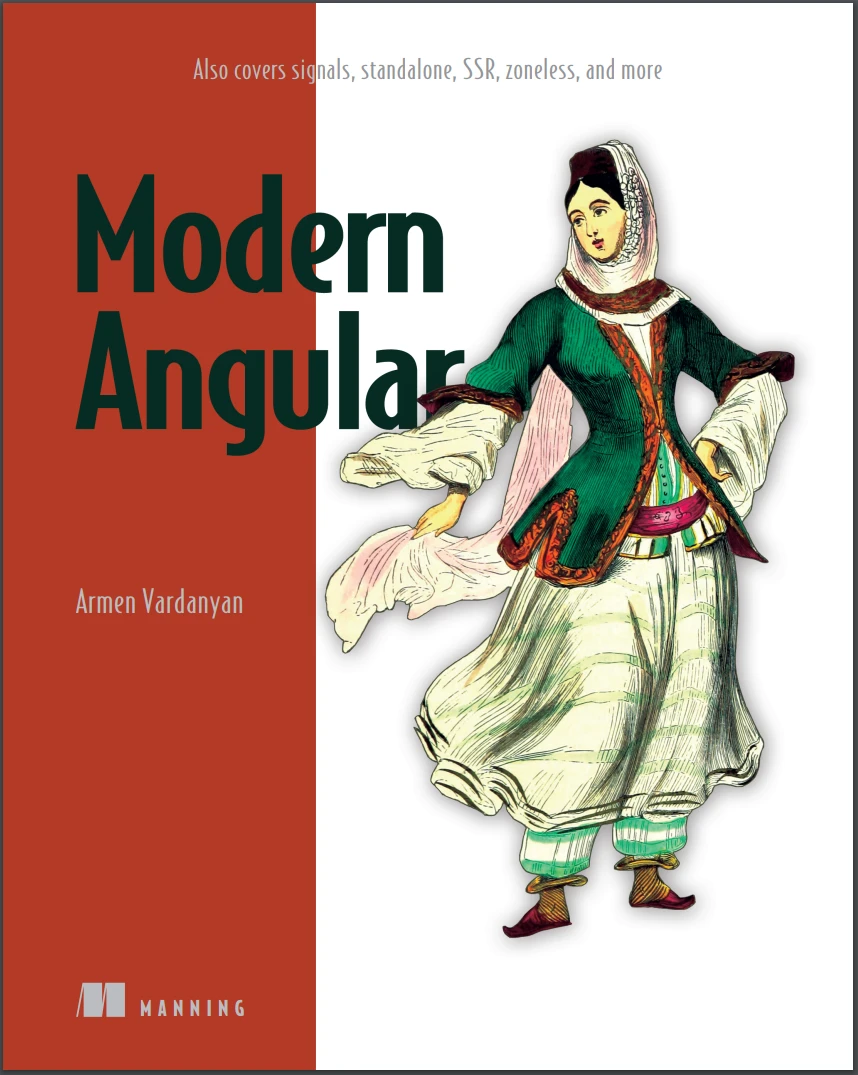
Автор: Vardanyan Armen
Дата выхода: 2025
Издательство: Manning Publications Co.
Количество страниц: 306
Размер файла: 2,6 МБ
Тип файла: PDF
Добавил: codelibs
Проверить на вирусы Дополнительные материалыModern Angular....1
contents....6
preface....12
acknowledgments....14
about this book....16
Who should read this book....16
How this book is organized: A road map....16
About the code....17
liveBook discussion forum....18
about the author....19
about the cover illustration....20
1 Welcome to modern Angular....21
1.1 What to expect....22
1.1.1 Who will benefit from reading this book?....22
1.1.2 What do we need to know before getting started?....22
1.1.3 How is the book structured?....23
1.2 How Angular was....23
1.2.1 Angular’s core features....24
1.2.2 What is an Angular application?....25
1.3 Let’s start a modern Angular app....27
1.3.1 Using the Angular CLI....27
1.3.2 Creating a new project....28
1.3.3 What changed?....29
1.4 What’s new in Angular?....31
1.4.1 How does Angular evolve?....31
1.4.2 How does Angular recognize problems?....32
1.4.3 Current goals....33
1.4.4 New features....34
1.4.5 What about the future?....36
1.4.6 The learning process....38
Summary....38
2 A standalone future....39
2.1 Why abandon NgModules?....40
2.1.1 Hard to learn, hard to explain....40
2.1.2 Indirectness and boilerplate....42
2.1.3 Other concerns with NgModules....44
2.2 Previous solutions....44
2.2.1 Hierarchic shared modules....45
2.2.2 Enter SCAMs....45
2.3 Developing apps without NgModules....47
2.3.1 Creating our first standalone component....47
2.3.2 Routing standalone components and providing dependencies....51
2.4 Lazy-loading components....54
2.4.1 Lazy-loading with NgModules....54
2.4.2 Lazy-loading a single standalone component....55
2.4.3 Lazy-loading several standalone components....56
2.4.4 Providing dependencies only to certain routes....58
2.4.5 Lazy-loading a component into another component....59
2.5 Migrations and common pitfalls....62
2.5.1 Migrating by hand....62
2.5.2 Using SCAMs....63
2.5.3 Migrating with a schematic command....63
2.5.4 Handling circular dependencies....65
2.6 Exercises for the reader....66
Summary....66
3 Revitalized dependency injection....67
3.1 How does dependency injection work?....68
3.1.1 Why do we need DI?....68
3.1.2 Let’s build a primitive DI mechanism....69
3.1.3 Dependency injection the Angular way....70
3.1.4 Injection contexts....74
3.2 The inject function....75
3.2.1 Another way of injecting dependencies....75
3.2.2 Injecting dependencies outside classes....76
3.2.3 Why we should always use inject....78
3.2.4 What about the drawbacks?....81
3.3 Functional guards, resolvers, and interceptors....82
3.3.1 Building an AuthGuard....82
3.3.2 Building an EmployeeResolver....84
3.3.3 Adding tokens to HTTP requests....86
3.3.4 Migrating to functional guards/resolvers/interceptors....87
3.4 DI deep dive....88
3.4.1 DI lookup and how to modify it....89
3.4.2 Truncating text with DI....90
3.5 Exercises for the reader....92
Summary....92
4 New capabilities of Angular building blocks....94
4.1 Powerful inputs....95
4.1.1 Required inputs....95
4.1.2 Transforming input values....98
4.1.3 Binding routing parameters to input properties....101
4.1.4 Inputs for dynamic components....103
4.2 Host directives....108
4.2.1 Extending existing directives....108
4.2.2 Using multiple directives and adding inputs....109
4.2.3 Things to know when using host directives....110
4.3 Type-safe reactive forms....112
4.3.1 Downsides of using untyped forms....112
4.3.2 Introducing type-safe forms....113
4.3.3 Common pitfalls when working with type-safe forms....114
4.3.4 Migrating to type-safe forms....115
4.3.5 Form events....115
4.4 NgOptimizedImage....116
4.4.1 Adding lazy loading and remembering to set width/height....117
4.4.2 Prioritizing image loading....118
4.4.3 Srcsets and image loaders....118
4.5 Other improvements....120
4.5.1 Self-closing component tags....120
4.5.2 Fetch-based HttpClient....120
4.5.3 Support for default export components in routing....121
4.5.4 Improved error messages....121
4.6 Exercises for the reader....122
Summary....122
5 RxJS in modern Angular....123
5.1 What is reactive programming?....124
5.2 Why we (still) need RxJS....125
5.3 Unsubscribing from observables....126
5.3.1 Why unsubscribe?....127
5.3.2 Problems with unsubscribing....127
5.3.3 Introducing DestroyRef....128
5.3.4 The takeUntilDestroyed operator....131
5.4 Writing our own custom RxJS operators....135
5.4.1 What is an RxJS operator?....135
5.4.2 How do operators work?....137
5.4.3 Building custom operators....139
5.5 Exercises for the reader....144
Summary....144
6 Signals: A new approach to reactive programming....145
6.1 Why go beyond RxJS?....146
6.1.1 What are the problems with RxJS?....146
6.1.2 What must the solution look like?....149
6.2 What is a signal?....150
6.2.1 Creating signals....151
6.2.2 Updating signals....152
6.2.3 Creating signals vs. observables....154
6.3 Building Angular components with signals....154
6.3.1 Creating TimeOffComponent....155
6.3.2 Handling signals in Angular components....157
6.4 Computed signals....158
6.4.1 Creating computed signals....158
6.4.2 Simplifying complex logic in Angular components using computed signals....160
6.5 Effects....163
6.5.1 Creating effects....163
6.5.2 Important things to know about effects....164
6.5.3 When to use effects....166
6.6 RxJS and signals interoperability....167
6.6.1 Converting observables to signals....167
6.6.2 Converting signals to observables....169
6.7 Exercises for the reader....171
Summary....171
7 Signals: A deep dive....172
7.1 Advanced options when dealing with signals....172
7.1.1 Signal equality....173
7.1.2 Untracking dependencies....174
7.1.3 Manual cleanup....176
7.1.4 Readonly signals and synchronizing with RxJS....178
7.2 Signals under the hood....179
7.2.1 The nature of signals....179
7.2.2 How changes to signals propagate....180
7.3 State management with signals....183
7.3.1 State management: The task....183
7.3.2 State management: The implementation....184
7.3.3 State management: The problems....187
7.3.4 Advanced interoperability with RxJS....190
7.4 Migrating to signals....193
7.4.1 Migrating RxJS-heavy Angular applications....193
7.4.2 Migrating more traditional Angular applications....194
7.5 The future of signals....195
7.5.1 Signal-based components....195
7.5.2 Signal inputs and outputs....195
7.5.3 Everything else....196
7.6 Exercises for the reader....196
Summary....196
8 Unit testing in modern Angular....198
8.1 Unit testing: The what and the why....199
8.1.1 Prerequisites....199
8.1.2 What is a unit test?....199
8.1.3 Why do we want unit tests?....200
8.2 Configuring a testing environment....201
8.2.1 Choosing a test runner....201
8.2.2 Setting up the test runner....202
8.2.3 Installing third-party tools....205
8.3 Running Angular unit tests....206
8.3.1 What do unit tests look like?....206
8.3.2 Providing mock dependencies....208
8.3.3 Testing components....210
8.3.4 Testing services....214
8.3.5 Testing signals....217
8.4 Powers of AI with Angular unit tests....224
8.4.1 Unit testing Angular applications with ChatGPT....224
8.4.2 Unit testing Angular applications with GitHub Copilot....228
8.5 The future of unit testing in Angular....229
8.6 Exercises for the reader....230
Summary....230
9 Modern Angular everywhere....231
9.1 What is server-side rendering?....232
9.1.1 SSR: The what....232
9.1.2 SSR: The why....234
9.1.3 SSR: The how....236
9.2 Building Angular apps with SSR from scratch....238
9.2.1 How is an SSR Angular application different from a SPA?....238
9.2.2 Running an SSR Angular application....241
9.2.3 Building components in an SSR Angular application....243
9.3 Improving Angular SSR....248
9.3.1 HTTP caching....248
9.3.2 Client-side hydration....251
9.3.3 Prerendering....253
9.4 Building an Angular application....255
9.4.1 What does building an Angular application mean?....255
9.4.2 ESBuild and Vite....256
9.4.3 Configuring environments for Angular applications....256
9.4.4 Preparing to deploy Angular applications....258
9.5 Exercises for the reader....260
Summary....260
10 What’s next in modern Angular?....261
10.1 New template syntax....261
10.1.1 Goodbye ngIf!....262
10.1.2 Hello @for!....266
10.1.3 @switch....269
10.1.4 Migrating to the new template syntax....271
10.2 Deferrable views....272
10.2.1 Deferring a simple component....272
10.2.2 Deferring depending on a condition or trigger....274
10.2.3 Customizing deferred loading....277
10.3 Zoneless Angular applications....279
10.3.1 How change detection works in Angular....279
10.3.2 Why change detection in Angular needs to improve....282
10.3.3 ChangeDetectionStrategy.OnPush....283
10.3.4 Introducing granular change detection....285
10.3.5 Zoneless scheduler for change detection....293
10.4 In other news....295
Summary....296
index....297
Symbols....297
A....297
B....298
C....298
D....298
E....299
F....299
G....299
H....299
I....300
K....300
L....300
M....300
N....300
O....301
P....301
R....301
S....302
T....303
U....303
V....304
W....304
X....304
Z....304
The powerful Angular framework is ever-evolving, with each new iteration bringing amazing new modern features. Modern Angular gets you rapidly up to speed with Angular’s latest innovations.
Inside Modern Angular you’ll learn how to:
- Create modern Angular apps with the newest framework capabilities
- Setting up and structuring your Angular projects
- Implement advanced testing strategies for Angular
- Benefit from new improvements in debugging, image loading, and component inputs
- Apply state management with reactive programming
- Explore signals and server-side rendering
- Migrate legacy Angular projects to modern practices
- Refactor old Angular patterns using new techniques
- Use modern performance optimization approaches to improve User Experience
Discover new ways of working with components, dependency injection, RxJS, Signals, and more—all through building a complete enterprise-grade HR management system! You’ll soon be improving your daily development with Angular’s quality-of-life features, upgrading your app’s performance with server-side rendering, and getting ready for what’s coming Angular’s future. Plus, detailed migration guides demonstrate ways to update existing apps to modern patterns, and make it easy to modernize your legacy code.
About the technology
Modern web applications have to handle serious challenges, such as complex state management, reactive programming, and SEO. With a host of new features, ecosystem tools, and programming practices, the Angular web framework tackles modern web development head on. If you haven’t tried modern Angular, you’re in for a treat!
About the book
Modern Angular updates your web development skills to take advantage of new Angular features like signals, server-side rendering, and zoneless change detection. Each chapter explores an exciting capability by adding it hands-on to a full-featured app for managing HR systems. Along the way, you’ll explore dependency injection, RxJS, and standalone components, and pick up techniques for upgrading legacy apps.
What's inside
- Advanced testing strategies
- RxJS and custom operators
- Performance and search engine optimization
- Migrate legacy Angular projects
About the reader
For experienced Angular developers. Covers Angular versions 12 and later.


