-
1C
-
Agda
-
Agile/Scrum
-
Alef
-
APL
-
Assembler
-
AWK
-
Basic
-
Beta Programming Language
-
Big Data/DataScience
-
C
-
C#
-
C++
-
Cobol
-
Crystal
-
CSS
-
D
-
Dart
-
DataBase (SQL)
-
Delphi
-
F#
-
Flutter
-
Fortran
-
GameDev
-
Git
-
Go (Golang)
-
GPT/AI/ИИ
-
Hacking and Security
-
Haskell
-
HTML
-
Java
-
JavaScript (JS)
-
Julia
-
Kotlin
-
Machine Learning (ML)
-
Natural language processing (NLP)
-
.NET (.NET Core)
-
Pascal
-
PHP
-
Python
-
R
-
Ruby
-
Rust
-
Scratch
-
Swift
-
UML
-
UX/UI
-
Visual Basic
-
Wolfram
-
XML
-
АСУ
-
Проектирование/System Design
-
Сети/Network
-
Статьи
-
Схемотехника/электронные схемы
-
1C
-
Agda
-
Agile/Scrum
-
Alef
-
APL
-
Assembler
-
AWK
-
Basic
-
Beta Programming Language
-
Big Data/DataScience
-
C
-
C#
-
C++
-
Cobol
-
Crystal
-
CSS
-
D
-
Dart
-
DataBase (SQL)
-
Delphi
-
F#
-
Flutter
-
Fortran
-
GameDev
-
Git
-
Go (Golang)
-
GPT/AI/ИИ
-
Hacking and Security
-
Haskell
-
HTML
-
Java
-
JavaScript (JS)
-
Julia
-
Kotlin
-
Machine Learning (ML)
-
Natural language processing (NLP)
-
.NET (.NET Core)
-
Pascal
-
PHP
-
Python
-
R
-
Ruby
-
Rust
-
Scratch
-
Swift
-
UML
-
UX/UI
-
Visual Basic
-
Wolfram
-
XML
-
АСУ
-
Проектирование/System Design
-
Сети/Network
-
Статьи
-
Схемотехника/электронные схемы
Меню
Learning LangChain: Building AI and LLM Applications with LangChain and LangGraph
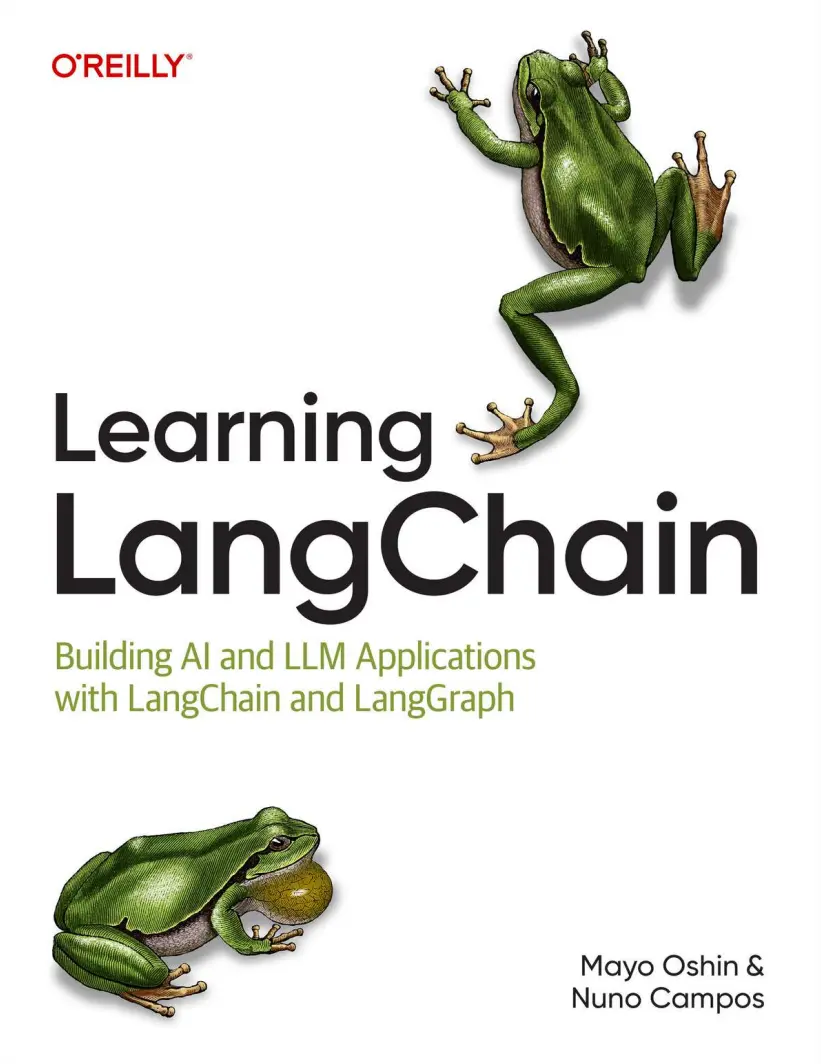
Автор: Campos Nuno , Oshin Mayo
Дата выхода: 2025
Издательство: O’Reilly Media, Inc.
Количество страниц: 598
Размер файла: 3,1 МБ
Тип файла: PDF
Добавил: codelibs
Проверить на вирусыPreface
Brief Primer on LLMs
Instruction-Tuned LLMs
Dialogue-Tuned LLMs
Fine-Tuned LLMs
Brief Primer on Prompting
Zero-Shot Prompting
Chain-of-Thought
Retrieval-Augmented Generation
Tool Calling
Few-Shot Prompting
LangChain and Why It’s Important
What to Expect from This Book
Conventions Used in This Book
Using Code Examples
O’Reilly Online Learning
How to Contact Us
Acknowledgments
1. LLM Fundamentals with LangChain
Getting Set Up with LangChain
Using LLMs in LangChain
Making LLM Prompts Reusable
Getting Specific Formats out of LLMs
JSON Output
Other Machine-Readable Formats with Output Parsers
Assembling the Many Pieces of an LLM Application
Using the Runnable Interface
Imperative Composition
Declarative Composition
Summary
2. RAG Part I: Indexing Your Data
The Goal: Picking Relevant Context for LLMs
Embeddings: Converting Text to Numbers
Embeddings Before LLMs
LLM-Based Embeddings
Semantic Embeddings Explained
Converting Your Documents into Text
Splitting Your Text into Chunks
Generating Text Embeddings
Storing Embeddings in a Vector Store
Getting Set Up with PGVector
Working with Vector Stores
Tracking Changes to Your Documents
Indexing Optimization
MultiVectorRetriever
RAPTOR: Recursive Abstractive Processing for Tree-Organized Retrieval
ColBERT: Optimizing Embeddings
Summary
3. RAG Part II: Chatting with Your Data
Introducing Retrieval-Augmented Generation
Retrieving Relevant Documents
Generating LLM Predictions Using Relevant Documents
Query Transformation
Rewrite-Retrieve-Read
Multi-Query Retrieval
RAG-Fusion
Hypothetical Document Embeddings
Query Routing
Logical Routing
Semantic Routing
Query Construction
Text-to-Metadata Filter
Text-to-SQL
Summary
4. Using LangGraph to Add Memory to Your Chatbot
Building a Chatbot Memory System
Introducing LangGraph
Creating a StateGraph
Adding Memory to StateGraph
Modifying Chat History
Trimming Messages
Filtering Messages
Merging Consecutive Messages
Summary
5. Cognitive Architectures with LangGraph
Architecture #1: LLM Call
Architecture #2: Chain
Architecture #3: Router
Summary
6. Agent Architecture
The Plan-Do Loop
Building a LangGraph Agent
Always Calling a Tool First
Dealing with Many Tools
Summary
7. Agents II
Reflection
Subgraphs in LangGraph
Calling a Subgraph Directly
Calling a Subgraph with a Function
Multi-Agent Architectures
Supervisor Architecture
Summary
8. Patterns to Make the Most of LLMs
Structured Output
Intermediate Output
Streaming LLM Output Token-by-Token
Human-in-the-Loop Modalities
Multitasking LLMs
Summary
9. Deployment: Launching Your AI Application into Production
Prerequisites
Install Dependencies
Large Language Model
Vector Store
Backend API
Create a LangSmith Account
Understanding the LangGraph Platform API
Data Models
Features
Deploying Your AI Application on LangGraph Platform
Create a LangGraph API Config
Test Your LangGraph App Locally
Deploy from the LangSmith UI
Launch LangGraph Studio
Security
Summary
10. Testing: Evaluation, Monitoring, and Continuous Improvement
Testing Techniques Across the LLM App Development Cycle
The Design Stage: Self-Corrective RAG
The Preproduction Stage
Creating Datasets
Defining Your Evaluation Criteria
Regression Testing
Evaluating an Agent’s End-to-End Performance
Production
Tracing
Collect Feedback in Production
Classification and Tagging
Monitoring and Fixing Errors
Summary
11. Building with LLMs
Interactive Chatbots
Collaborative Editing with LLMs
Ambient Computing
Summary
Index
About the Authors
If you're looking to build production-ready AI applications that can reason and retrieve external data for context-awareness, you'll need to master--;a popular development framework and platform for building, running, and managing agentic applications. LangChain is used by several leading companies, including Zapier, Replit, Databricks, and many more. This guide is an indispensable resource for developers who understand Python or JavaScript but are beginners eager to harness the power of AI.
Authors Mayo Oshin and Nuno Campos demystify the use of LangChain through practical insights and in-depth tutorials. Starting with basic concepts, this book shows you step-by-step how to build a production-ready AI agent that uses your data.
- Harness the power of retrieval-augmented generation (RAG) to enhance the accuracy of LLMs using external up-to-date data
- Develop and deploy AI applications that interact intelligently and contextually with users
- Make use of the powerful agent architecture with LangGraph
- Integrate and manage third-party APIs and tools to extend the functionality of your AI applications
- Monitor, test, and evaluate your AI applications to improve performance
- Understand the foundations of LLM app development and how they can be used with LangChain


