-
1C
-
Agda
-
Agile/Scrum
-
Alef
-
APL
-
Assembler
-
AWK
-
Basic
-
Beta Programming Language
-
Big Data/DataScience
-
C
-
C#
-
C++
-
Cobol
-
Crystal
-
CSS
-
D
-
Dart
-
DataBase (SQL)
-
Delphi
-
F#
-
Flutter
-
Fortran
-
GameDev
-
Git
-
Go (Golang)
-
GPT/AI/ИИ
-
Hacking and Security
-
Haskell
-
HTML
-
Java
-
JavaScript (JS)
-
Julia
-
Kotlin
-
Machine Learning (ML)
-
Natural language processing (NLP)
-
.NET (.NET Core)
-
Pascal
-
PHP
-
Python
-
R
-
Ruby
-
Rust
-
Scratch
-
Swift
-
UML
-
UX/UI
-
Visual Basic
-
Wolfram
-
XML
-
АСУ
-
Проектирование/System Design
-
Сети/Network
-
Статьи
-
Схемотехника/электронные схемы
-
1C
-
Agda
-
Agile/Scrum
-
Alef
-
APL
-
Assembler
-
AWK
-
Basic
-
Beta Programming Language
-
Big Data/DataScience
-
C
-
C#
-
C++
-
Cobol
-
Crystal
-
CSS
-
D
-
Dart
-
DataBase (SQL)
-
Delphi
-
F#
-
Flutter
-
Fortran
-
GameDev
-
Git
-
Go (Golang)
-
GPT/AI/ИИ
-
Hacking and Security
-
Haskell
-
HTML
-
Java
-
JavaScript (JS)
-
Julia
-
Kotlin
-
Machine Learning (ML)
-
Natural language processing (NLP)
-
.NET (.NET Core)
-
Pascal
-
PHP
-
Python
-
R
-
Ruby
-
Rust
-
Scratch
-
Swift
-
UML
-
UX/UI
-
Visual Basic
-
Wolfram
-
XML
-
АСУ
-
Проектирование/System Design
-
Сети/Network
-
Статьи
-
Схемотехника/электронные схемы
Меню
Learn LLVM 17: A beginner's guide to learning LLVM compiler tools and core libraries with C++. 2 Ed
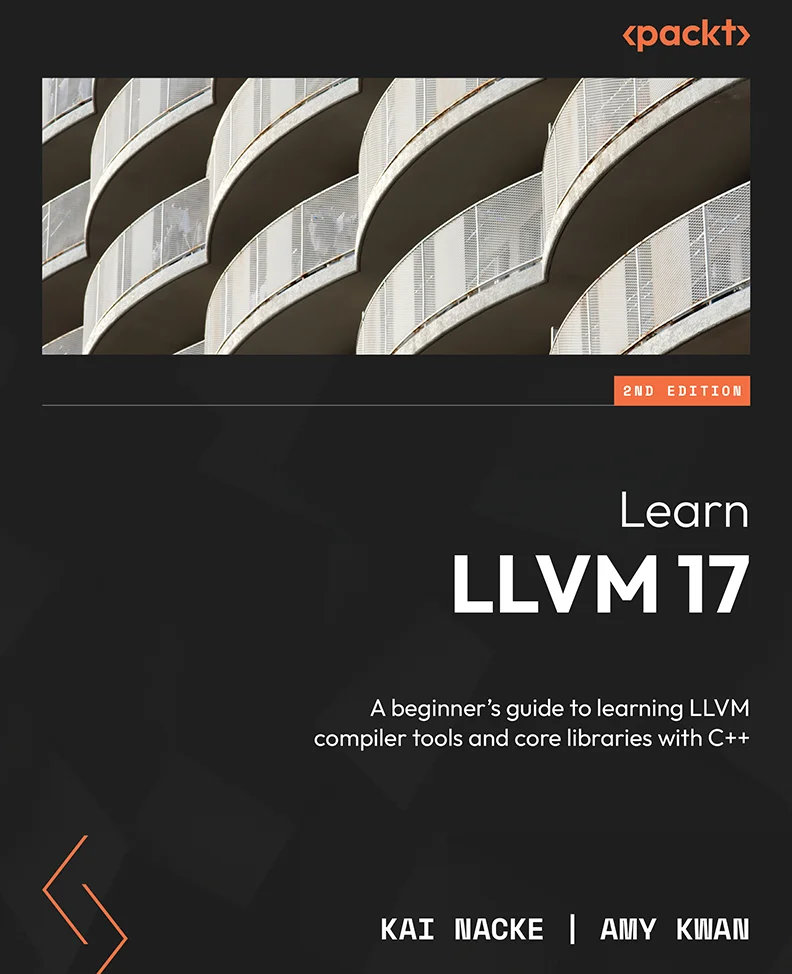
Автор: Kwan Amy , Nacke Kai
Дата выхода: 2021
Издательство: Packt Publishing Limited
Количество страниц: 747
Размер файла: 2,2 МБ
Тип файла: PDF
Добавил: codelibs
Проверить на вирусыLearn LLVM 17....2
Contributors....10
About the authors....10
About the reviewers....11
Preface....31
What’s new in this edition....32
Who this book is for....33
What this book covers....34
To get the most out of this book....37
Download the example code files....39
Conventions used....39
Get in touch....40
Share Your Thoughts....41
Download a free PDF copy of this book....41
Part 1: The Basics of Compiler Construction with LLVM....44
Chapter 1: Installing LLVM....45
Compiling LLVM versus installing binaries....45
Getting the prerequisites ready....45
Ubuntu....47
Fedora and RedHat....47
FreeBSD....47
OS X....47
Windows....48
Cloning the repository and building from source....49
Configuring Git....49
Cloning the repository....50
Creating a build directory....51
Generating the build system files....51
Compiling and installing LLVM....52
Customizing the build process....53
Variables defined by CMake....54
Using LLVM-defined build configuration variables....56
Summary....60
Chapter 2: The Structure of a Compiler....61
Building blocks of a compiler....62
An arithmetic expression language....64
Formalism for specifying the syntax of a programming language....64
How does grammar help the compiler writer?....66
Lexical analysis....67
A hand-written lexer....67
Syntactical analysis....75
A hand-written parser....75
The abstract syntax tree....85
Semantic analysis....90
Generating code with the LLVM backend....93
Textual representation of LLVM IR....94
Generating the IR from the AST....96
The missing pieces – the driver and the runtime library....103
Summary....109
Part 2: From Source to Machine Code Generation....111
Chapter 3: Turning the Source File into an Abstract Syntax Tree....112
Defining a real programming language....113
Creating the project layout....119
Managing the input files for the compiler....120
Handling messages for the user....121
Structuring the lexer....126
Constructing a recursive descent parser....135
Performing semantic analysis....146
Handling the scope of names....148
Using an LLVM-style RTTI for the AST....152
Creating the semantic analyzer....154
Summary....165
Chapter 4: Basics of IR Code Generation....167
Generating IR from the AST....168
Understanding the IR code....168
Learning about the load-and-store approach....177
Mapping the control flow to basic blocks....179
Using AST numbering to generate IR code in SSA form....184
Defining the data structure to hold values....185
Reading and writing values local to a basic block....186
Searching the predecessor blocks for a value....187
Optimizing the generated phi instructions....191
Sealing a block....194
Creating the IR code for expressions....194
Emitting the IR code for a function....197
Controlling visibility with linkage and name mangling....197
Converting a type from an AST description into LLVM types....200
Creating the LLVM IR function....201
Emitting the function body....205
Setting up the module and the driver....206
Wrapping all in the code generator....207
Initializing the target machine class....209
Emitting assembler text and object code....212
Summary....218
Chapter 5: IR Generation for High-Level Language Constructs....220
Technical requirements....221
Working with arrays, structs, and pointers....221
Getting the application binary interface right....229
Creating IR code for classes and virtual functions....234
Implementing single inheritance....234
Extending single inheritance with interfaces....242
Adding support for multiple inheritance....245
Summary....250
Chapter 6: Advanced IR Generation....252
Throwing and catching exceptions....253
Raising an exception....263
Catching an exception....268
Integrating the exception handling code into the application....273
Generating metadata for type-based alias analysis....276
Understanding the need for additional metadata....276
Creating TBAA metadata in LLVM....280
Adding TBAA metadata to tinylang....282
Adding debug metadata....290
Understanding the general structure of debug metadata....290
Tracking variables and their values....299
Adding line numbers....306
Adding debug support to tinylang....308
Summary....319
Chapter 7: Optimizing IR....321
Technical requirements....322
The LLVM pass manager....322
Implementing a new pass....325
Developing the ppprofiler pass as a plugin....326
Adding the pass to the LLVM source tree....334
Using the ppprofiler pass with LLVM tools....340
Adding an optimization pipeline to your compiler....354
Creating an optimization pipeline....354
Extending the pass pipeline....364
Summary....370
Part 3: Taking LLVM to the Next Level....371
Chapter 8: The TableGen Language....372
Technical requirements....373
Understanding the TableGen language....373
Experimenting with the TableGen language....375
Defining records and classes....376
Creating multiple records at once with multiclasses....381
Simulating function calls....385
Generating C++ code from a TableGen file....390
Defining data in the TableGen language....392
Implementing a TableGen backend....396
Drawbacks of TableGen....413
Summary....414
Chapter 9: JIT Compilation....415
Technical requirements....416
LLVM’s overall JIT implementation and use cases....416
Using JIT compilation for direct execution....419
Exploring the lli tool....420
Implementing our own JIT compiler with LLJIT....423
Integrating the LLJIT engine into the calculator....426
Code generation changes to support JIT compilation via LLJIT....433
Building an LLJIT-based calculator....439
Building a JIT compiler class from scratch....444
Creating a JIT compiler class....446
Using our new JIT compiler class....460
Summary....466
Chapter 10: Debugging Using LLVM Tools....467
Technical requirements....468
Instrumenting an application with sanitizers....469
Detecting memory access problems with the address sanitizer....469
Finding uninitialized memory accesses with the memory sanitizer....473
Pointing out data races with the thread sanitizer....475
Finding bugs with libFuzzer....479
Limitations and alternatives....485
Performance profiling with XRay....486
Checking the source with the clang static analyzer....495
Adding a new checker to the clang static analyzer....500
Creating your own clang-based tool....518
Summary....531
Part 4: Roll Your Own Backend....533
Chapter 11: The Target Description....534
Setting the stage for a new backend....535
Adding the new architecture to the Triple class....536
Extending the ELF file format definition in LLVM....538
Creating the target description....542
Adding the register definition....543
Defining the instruction formats and the instruction information....548
Creating the top-level file for the target description....555
Adding the M88k backend to LLVM....557
Implementing the assembler parser....564
Creating the disassembler....587
Summary....591
Chapter 12: Instruction Selection....593
Defining the rules of the calling convention....594
Implementing the rules of the calling convention....596
Instruction selection via the selection DAG....598
Implementing DAG lowering – handling legal types and setting operations....601
Implementing DAG lowering – lowering formal arguments....605
Implementing DAG lowering – lowering return values....609
Implementing DAG-to-DAG transformations within instruction selection....613
Adding register and instruction information....615
Putting an empty frame lowering in place....621
Emitting machine instructions....623
Creating the target machine and the sub-target....628
Implementing M88kSubtarget....629
Implementing M88kTargetMachine – defining the definitions....632
Implementing M88kTargetMachine – adding the implementation....634
Global instruction selection....641
Lowering arguments and return values....643
Legalizing the generic machine instructions....648
Selecting a register bank for operands....650
Translating generic machine instructions....654
Running an example....655
How to further evolve the backend....656
Summary....657
Chapter 13: Beyond Instruction Selection....659
Adding a new machine function pass to LLVM....659
Implementing the top-level interface for the M88k target....661
Adding the TargetMachine implementation for machine function passes....662
Developing the specifics of the machine function pass....664
Building newly implemented machine function passes....676
A glimpse of running a machine function pass with llc....677
Integrating a new target into the clang frontend....679
Implementing the driver integration within clang....679
Implementing ABI support for M88k within clang....691
Implementing the toolchain support for M88k within clang....695
Building the M88k target with clang integration....702
Targeting a different CPU architecture....704
Summary....711
Index....713
Why subscribe?....740
Other Books You May Enjoy....741
Packt is searching for authors like you....745
Share Your Thoughts....745
Download a free PDF copy of this book....746
LLVM was built to bridge the gap between the theoretical knowledge found in compiler textbooks and the practical demands of compiler development. With a modular codebase and advanced tools, LLVM empowers developers to build compilers with ease. This book serves as a practical introduction to LLVM, guiding you progressively through complex scenarios and ensuring that you navigate the challenges of building and working with compilers like a pro.
The book starts by showing you how to configure, build, and install LLVM libraries, tools, and external projects. You’ll then be introduced to LLVM's design, unraveling its applications in each compiler stage: frontend, optimizer, and backend. Using a real programming language subset, you'll build a frontend, generate LLVM IR, optimize it through the pipeline, and generate machine code. Advanced chapters extend your expertise, covering topics such as extending LLVM with a new pass, using LLVM tools for debugging, and enhancing the quality of your code. You'll also focus on just-in-time compilation issues and the current state of JIT-compilation support with LLVM. Finally, you’ll develop a new backend for LLVM, gaining insights into target description and how instruction selection works.
By the end of this book, you'll have hands-on experience with the LLVM compiler development framework through real-world examples and source code snippets.
What you will learn
- Configure, compile, and install the LLVM framework
- Understand how the LLVM source is organized
- Discover what you need to do to use LLVM in your own projects
- Explore how a compiler is structured, and implement a tiny compiler
- Generate LLVM IR for common source language constructs
- Set up an optimization pipeline and tailor it for your own needs
- Extend LLVM with transformation passes and clang tooling
- Add new machine instructions and a complete backend
Who this book is for
This book is for compiler developers, enthusiasts, and engineers new to LLVM. C++ software engineers looking to use compiler-based tools for code analysis and improvement, as well as casual users of LLVM libraries who want to gain more knowledge of LLVM essentials will also find this book useful. Intermediate-level experience with C++ programming is necessary to understand the concepts covered in this book.


