-
1C
-
Agda
-
Agile/Scrum
-
Alef
-
APL
-
Assembler
-
AWK
-
Basic
-
Beta Programming Language
-
Big Data/DataScience
-
C
-
C#
-
C++
-
Cobol
-
Crystal
-
CSS
-
D
-
Dart
-
DataBase (SQL)
-
Delphi
-
F#
-
Flutter
-
Fortran
-
GameDev
-
Git
-
Go (Golang)
-
GPT/AI/ИИ
-
Hacking and Security
-
Haskell
-
HTML
-
Java
-
JavaScript (JS)
-
Julia
-
Kotlin
-
Machine Learning (ML)
-
Natural language processing (NLP)
-
.NET (.NET Core)
-
Pascal
-
PHP
-
Python
-
R
-
Ruby
-
Rust
-
Scratch
-
Swift
-
UML
-
UX/UI
-
Visual Basic
-
Wolfram
-
XML
-
АСУ
-
Проектирование/System Design
-
Сети/Network
-
Статьи
-
Схемотехника/электронные схемы
-
1C
-
Agda
-
Agile/Scrum
-
Alef
-
APL
-
Assembler
-
AWK
-
Basic
-
Beta Programming Language
-
Big Data/DataScience
-
C
-
C#
-
C++
-
Cobol
-
Crystal
-
CSS
-
D
-
Dart
-
DataBase (SQL)
-
Delphi
-
F#
-
Flutter
-
Fortran
-
GameDev
-
Git
-
Go (Golang)
-
GPT/AI/ИИ
-
Hacking and Security
-
Haskell
-
HTML
-
Java
-
JavaScript (JS)
-
Julia
-
Kotlin
-
Machine Learning (ML)
-
Natural language processing (NLP)
-
.NET (.NET Core)
-
Pascal
-
PHP
-
Python
-
R
-
Ruby
-
Rust
-
Scratch
-
Swift
-
UML
-
UX/UI
-
Visual Basic
-
Wolfram
-
XML
-
АСУ
-
Проектирование/System Design
-
Сети/Network
-
Статьи
-
Схемотехника/электронные схемы
Меню
Julia Cookbook: Over 40 recipes to get you up and running with programming using Julia
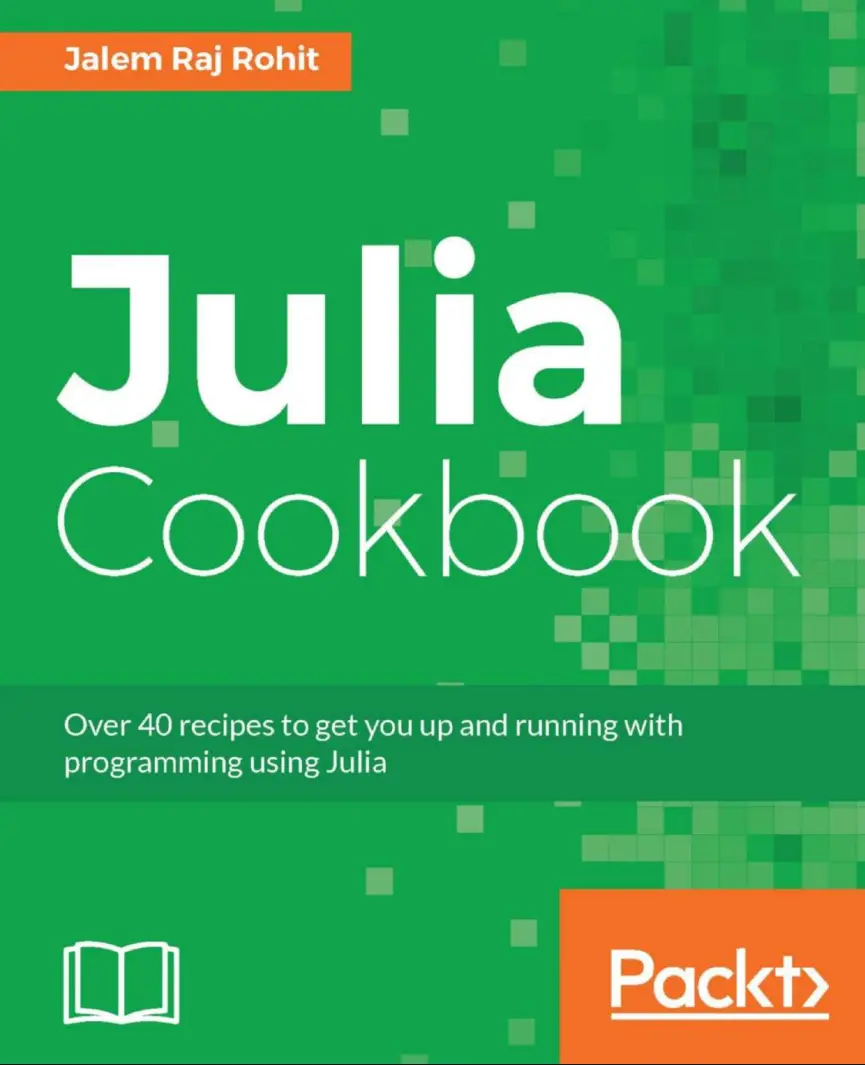
Автор: Rohit Jalem Raj
Дата выхода: 2016
Издательство: Packt Publishing Limited
Количество страниц: 167
Размер файла: 2,7 МБ
Тип файла: PDF
Добавил: codelibs
Проверить на вирусыCover....1
Copyright....3
Credits....4
About the Author....5
About the Reviewer....6
www.PacktPub.com....7
Table of Contents....8
Preface....13
Chapter 1: Extracting and Handling Data....18
Introduction....18
Why should we use Julia for data science?....18
Handling data with CSV files....20
Getting ready....21
How to do it…....21
Handling data with TSV files....22
Getting ready....22
How to do it…....22
Working with databases in Julia....23
Getting ready....23
How to do it…....24
MySQL....24
PostgreSQL....26
There's more…....28
MySQL....28
PostgreSQL....28
SQLite....28
Interacting with the Web....28
Getting ready....29
How to do it…....29
GET request....30
There's more…....31
Chapter 2: Metaprogramming....32
Introduction....32
Representation of a Julia program....33
Getting ready....33
How to do it…....33
How it works…....37
There's more....38
Symbols and expressions....38
Symbols....38
Getting ready....39
How to do it…....39
How it works…....40
There's more....41
Quoting....41
How to do it…....41
How it works…....42
Interpolation....43
How to do it…....43
How it works…....44
There's more....45
The Eval function....45
Getting ready....45
How to do it…....45
How it works…....47
Macros....48
Getting ready....48
How to do it…....48
How it works…....50
Metaprogramming with DataFrames....51
Getting ready....51
How to do it…....51
How it works…....55
Chapter 3: Statistics with Julia....56
Introduction....56
Basic statistics concepts....56
Getting ready....56
How to do it…....56
How it works…....59
Descriptive statistics....60
Getting ready....60
How to do it…....61
How it works…....67
Deviation metrics....68
Getting ready....68
How to do it…....68
How it works…....72
Sampling....72
Getting ready....72
How to do it…....72
How it works…....77
Correlation analysis....79
Getting ready....79
How to do it…....79
How it works…....83
Chapter 4: Building Data Science Models....85
Introduction....85
Dimensionality reduction....85
Getting ready....86
How to do it…....86
How it works…....89
Linear discriminant analysis....90
Getting ready....90
How to do it…....90
How it works…....94
Data preprocessing....95
Getting ready....96
How to do it…....96
How it works…....100
Linear regression....101
Getting ready....101
How to do it…....101
How it works…....103
Classification....104
Getting ready....104
How to do it…....104
How it works…....106
Performance evaluation and model selection....106
Getting ready....107
How to do it…....107
How it works…....109
Cross validation....110
Getting ready....110
How to do it…....111
How it works…....112
Distances....113
Getting ready....113
How to do it…....113
How it works…....116
Distributions....117
Getting ready....117
How to do it…....117
How it works…....120
Time series analysis....121
Getting ready....121
How to do it…....121
How it works…....126
Chapter 5: Working with Visualizations....127
Introduction....127
Plotting basic arrays....128
Getting ready....128
How to do it…....129
How it works…....131
Plotting dataframes....132
Getting ready....132
How to do it…....132
How it works…....135
Plotting functions....135
Getting ready....135
How to do it…....136
How it works…....139
Exploratory data analytics through plots....140
Getting ready....140
How to do it…....141
How it works…....143
Line plots....144
Getting ready....144
How to do it…....144
How it works…....145
Scatter plots....146
Getting ready....146
How to do it…....146
How it works…....148
Histograms....149
Getting ready....149
How to do it…....149
How it works…....151
Aesthetic customizations....151
Getting ready....152
How to do it…....152
How it works…....154
Chapter 6: Parallel Computing....155
Introduction....155
Basic concepts of parallel computing....155
Getting ready....156
How to do it…....156
How it works…....158
Data movement....158
Getting ready....158
How to do it…....158
How it works…....160
Parallel maps and loop operations....161
Getting ready....161
How to do it…....161
How it works…....162
Channels....162
Getting ready....163
How to do it…....163
Index....164
About This Book
- Follow a practical approach to learn Julia programming the easy way
- Get an extensive coverage of Julia's packages for statistical analysis
- This recipe-based approach will help you get familiar with the key concepts in Julia
Who This Book Is For
This book is for data scientists and data analysts who are familiar with the basics of the Julia language. Prior experience of working with high-level languages such as MATLAB, Python, R, or Ruby is expected.
What You Will Learn
- Extract and handle your data with Julia
- Uncover the concepts of metaprogramming in Julia
- Conduct statistical analysis with StatsBase.jl and Distributions.jl
- Build your data science models
- Find out how to visualize your data with Gadfly
- Explore big data concepts in Julia
In Detail
Want to handle everything that Julia can throw at you and get the most of it every day? This practical guide to programming with Julia for performing numerical computation will make you more productive and able work with data more efficiently. The book starts with the main features of Julia to help you quickly refresh your knowledge of functions, modules, and arrays. We'll also show you how to utilize the Julia language to identify, retrieve, and transform data sets so you can perform data analysis and data manipulation.
Later on, you'll see how to optimize data science programs with parallel computing and memory allocation. You'll get familiar with the concepts of package development and networking to solve numerical problems using the Julia platform.
This book includes recipes on identifying and classifying data science problems, data modelling, data analysis, data manipulation, meta-programming, multidimensional arrays, and parallel computing. By the end of the book, you will acquire the skills to work more effectively with your data.
Style and approach
This book has a recipe-based approach to help you grasp the concepts of Julia programming.


