-
1C
-
Agda
-
Agile/Scrum
-
Alef
-
APL
-
Assembler
-
AWK
-
Basic
-
Beta Programming Language
-
Big Data/DataScience
-
C
-
C#
-
C++
-
Cobol
-
Crystal
-
CSS
-
D
-
Dart
-
DataBase (SQL)
-
Delphi
-
F#
-
Flutter
-
Fortran
-
GameDev
-
Git
-
Go (Golang)
-
GPT/AI/ИИ
-
Hacking and Security
-
Haskell
-
HTML
-
Java
-
JavaScript (JS)
-
Julia
-
Kotlin
-
Machine Learning (ML)
-
Natural language processing (NLP)
-
.NET (.NET Core)
-
Pascal
-
PHP
-
Python
-
R
-
Ruby
-
Rust
-
Scratch
-
Swift
-
UML
-
UX/UI
-
Visual Basic
-
Wolfram
-
XML
-
АСУ
-
Проектирование/System Design
-
Сети/Network
-
Статьи
-
Схемотехника/электронные схемы
-
1C
-
Agda
-
Agile/Scrum
-
Alef
-
APL
-
Assembler
-
AWK
-
Basic
-
Beta Programming Language
-
Big Data/DataScience
-
C
-
C#
-
C++
-
Cobol
-
Crystal
-
CSS
-
D
-
Dart
-
DataBase (SQL)
-
Delphi
-
F#
-
Flutter
-
Fortran
-
GameDev
-
Git
-
Go (Golang)
-
GPT/AI/ИИ
-
Hacking and Security
-
Haskell
-
HTML
-
Java
-
JavaScript (JS)
-
Julia
-
Kotlin
-
Machine Learning (ML)
-
Natural language processing (NLP)
-
.NET (.NET Core)
-
Pascal
-
PHP
-
Python
-
R
-
Ruby
-
Rust
-
Scratch
-
Swift
-
UML
-
UX/UI
-
Visual Basic
-
Wolfram
-
XML
-
АСУ
-
Проектирование/System Design
-
Сети/Network
-
Статьи
-
Схемотехника/электронные схемы
Меню
Julia as a Second Language: General purpose programming with a taste of data science
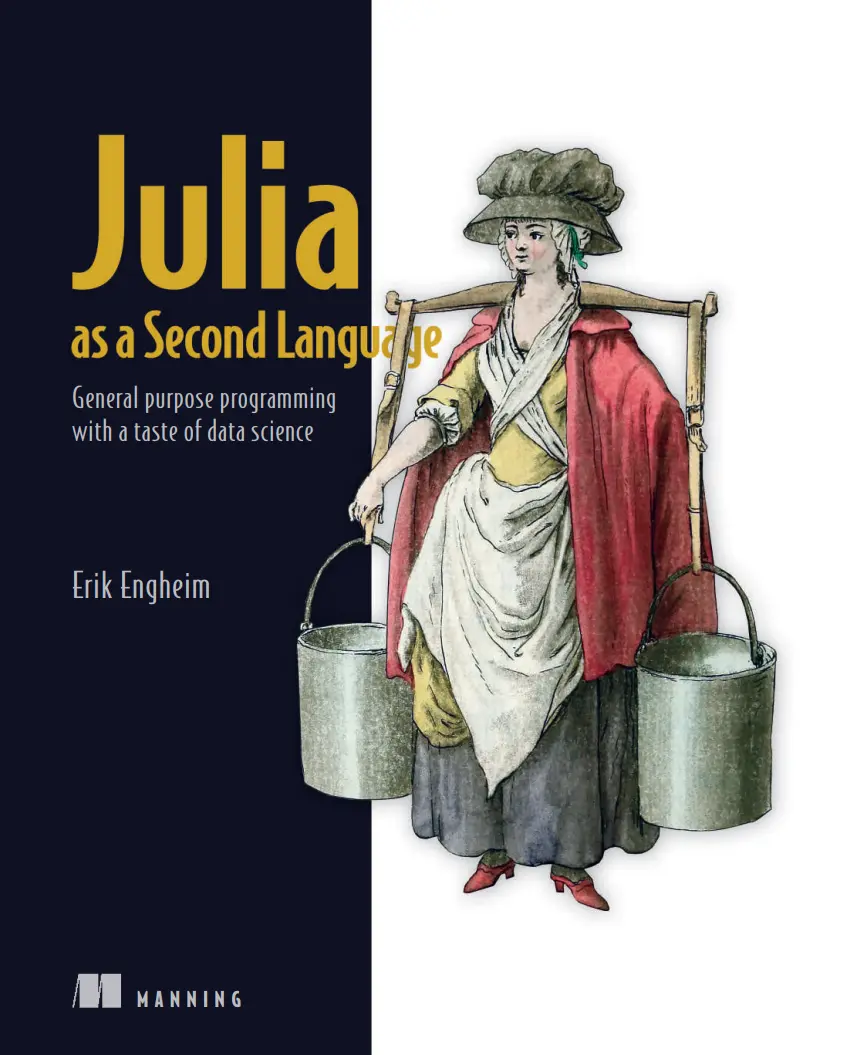
Автор: Engheim Erik
Дата выхода: 2023
Издательство: Manning Publications Co.
Количество страниц: 402
Размер файла: 3,9 МБ
Тип файла: PDF
Добавил: codelibs
Проверить на вирусы Дополнительные материалыChapter....8
Chapter....9
Chapter....10
Julia as a Second Language introduces Julia to readers with a beginning-level knowledge of another language like Python or JavaScript. You’ll learn by coding engaging hands-on projects that encourage you to apply what you’re learning immediately. Don’t be put off by Julia’s reputation as a scientific programming language—there’s no data science or numerical computing knowledge required. You can get started with what you learned in high school math classes.
About the Technology
Originally designed for high-performance data science, Julia has become an awesome general purpose programming language. It offers developer-friendly features like garbage collection, dynamic typing, and a flexible approach to concurrency and distributed computing. It is the perfect mix of simplicity, flexibility and performance.
About the Book
Julia as a Second Language introduces Julia by building on your existing programming knowledge. You’ll see Julia in action as you create a series of interesting projects that guide you from Julia’s basic syntax through its advanced features. Master types and data structures as you model a rocket launch. Use dictionaries to interpret Roman numerals. Use Julia’s unique multiple dispatch feature to send knights and archers into a simulated battle. Along the way, you’ll even compare the object-oriented and functional programming styles–Julia supports both!
What’s Inside
Data types like numbers, strings, arrays, and dictionaries
Immediate feedback with Julia’s read-evaluate-print-loop (REPL)
Simplify code interactions with multiple dispatch
Share code using modules and packages
About the Reader
For readers comfortable with another programming language like Python, JavaScript, or C#.


