-
1C
-
Agda
-
Agile/Scrum
-
Alef
-
APL
-
Assembler
-
AWK
-
Basic
-
Beta Programming Language
-
Big Data/DataScience
-
C
-
C#
-
C++
-
Cobol
-
Crystal
-
CSS
-
D
-
Dart
-
DataBase (SQL)
-
Delphi
-
F#
-
Flutter
-
Fortran
-
GameDev
-
Git
-
Go (Golang)
-
GPT/AI/ИИ
-
Hacking and Security
-
Haskell
-
HTML
-
Java
-
JavaScript (JS)
-
Julia
-
Kotlin
-
Machine Learning (ML)
-
Natural language processing (NLP)
-
.NET (.NET Core)
-
Pascal
-
PHP
-
Python
-
R
-
Ruby
-
Rust
-
Scratch
-
Swift
-
UML
-
UX/UI
-
Visual Basic
-
Wolfram
-
XML
-
АСУ
-
Проектирование/System Design
-
Сети/Network
-
Статьи
-
Схемотехника/электронные схемы
-
1C
-
Agda
-
Agile/Scrum
-
Alef
-
APL
-
Assembler
-
AWK
-
Basic
-
Beta Programming Language
-
Big Data/DataScience
-
C
-
C#
-
C++
-
Cobol
-
Crystal
-
CSS
-
D
-
Dart
-
DataBase (SQL)
-
Delphi
-
F#
-
Flutter
-
Fortran
-
GameDev
-
Git
-
Go (Golang)
-
GPT/AI/ИИ
-
Hacking and Security
-
Haskell
-
HTML
-
Java
-
JavaScript (JS)
-
Julia
-
Kotlin
-
Machine Learning (ML)
-
Natural language processing (NLP)
-
.NET (.NET Core)
-
Pascal
-
PHP
-
Python
-
R
-
Ruby
-
Rust
-
Scratch
-
Swift
-
UML
-
UX/UI
-
Visual Basic
-
Wolfram
-
XML
-
АСУ
-
Проектирование/System Design
-
Сети/Network
-
Статьи
-
Схемотехника/электронные схемы
Меню
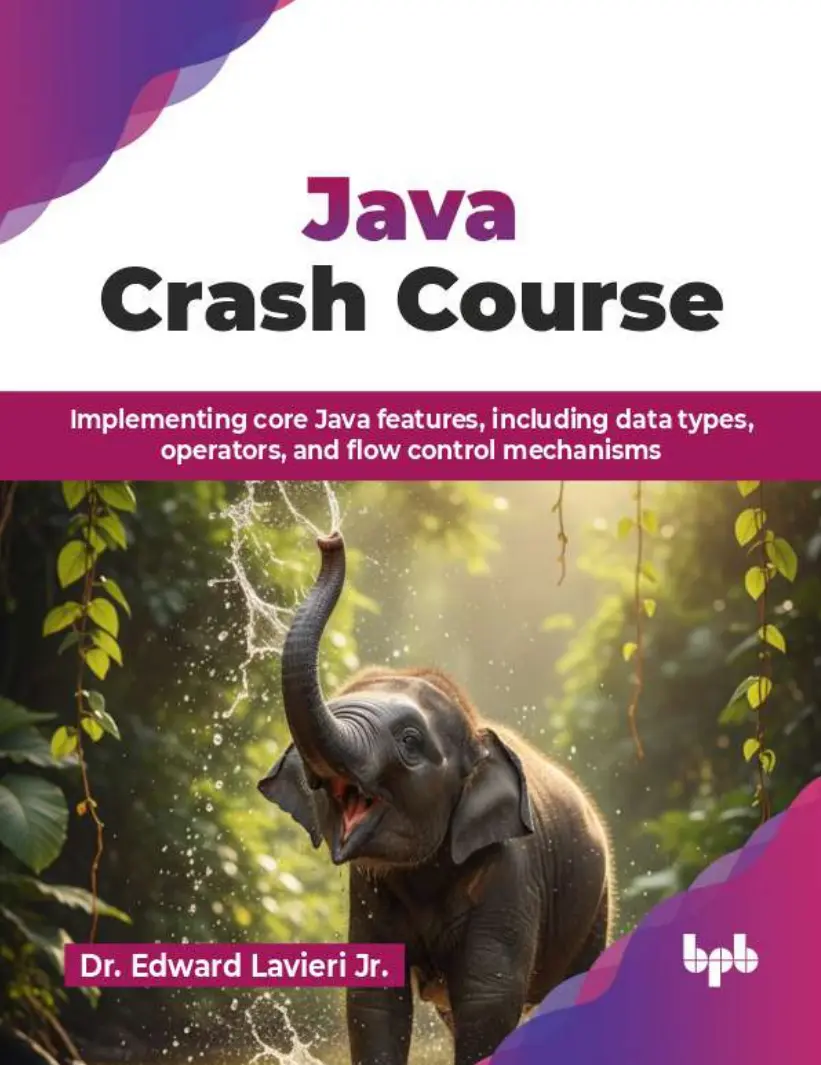
Java Crash Course: Implementing core Java features, including data types, operators, and flow control mechanisms
Автор: Lavieri Edward Jr.
Дата выхода: 2026
Издательство: BPB Publications
Количество страниц: 615
Размер файла: 2,7 МБ
Тип файла: PDF
Добавил: codelibs
Проверить на вирусыCover....2
Title Page....3
Copyright Page....4
Dedication Page....5
About the Author....6
About the Reviewers....7
Acknowledgement....8
Preface....9
Table of Contents....16
1. Introduction to Java Programming....37
Introduction....37
Structure....37
Objectives....38
Overview of Java....38
Key features....38
Java architecture....40
Java platforms....40
History and evolution of Java....41
Rapid adoption....41
Oracle years....41
Ready for the future....42
Importance of Java....42
Javas relevance to modern software development....43
New paradigms....43
Security....44
Setting up the development environment....44
Downloading and installing the JDK....44
Setting up environment variables....46
Verify your installation....47
Choosing and configuring an IDE....47
Downloading and installing VS Code....48
Installing the Java extension pack....49
Writing and running your first Java program....51
Writing a Java program....51
Running a Java program....52
Conclusion....52
Points to remember....53
Case studies....53
Multiple choice questions....55
Answers....56
Questions....56
Challenges....57
Self-assessment....59
Answers....59
2. Core Java Concepts....61
Introduction....61
Structure....61
Objectives....62
Data types and variables....62
Variables....62
Variable naming conventions....63
Constants....63
Data types....64
Primitive data types....64
Reference data types....65
Declaring variables....65
Variable scope....65
Local variables....65
Instance variables....66
Class variables....66
Typecasting and conversion....67
Implicit casting....67
Explicit casting....68
Converting between integers and strings....68
Arithmetic operators....69
Assignment operators....70
Bitwise operators....71
Logical operators....72
Relational operators....73
Ternary operator....76
Unary operators....76
Control structures....78
Conditional statements....78
If....78
If-else....79
Else-if....79
Switch....79
Looping....80
For....80
While....81
Do-while....81
Branching....82
Break....82
Continue....82
Return....83
Methods....83
More on parameters....84
Scope....85
Detailed example....85
Best practices....90
Conclusion....91
Points to remember....91
Case studies....93
Multiple choice questions....97
Answers....98
Questions....98
Challenges....99
Self-assessment....101
Answers....102
3. Object-oriented Programming Basics....104
Introduction....104
Structure....104
Objectives....105
Introduction to OOP principles....105
Encapsulation....106
Inheritance....106
Polymorphism....107
Abstraction....108
Defining and using classes and objects....108
Defining a class....109
Creating an object....110
Initializing an object....111
Manipulating attributes....112
Constructors and overloading....114
Constructor overloading use case....115
Calling constructors....118
Benefits....119
Inheritance and the super keyword....120
Implementing inheritance....120
Full inheritance demonstration....123
Benefits....124
Polymorphism and method overriding....125
Method overriding....125
Dynamic method dispatch....126
Full implementation....127
Benefits....129
Access modifiers and encapsulation....129
Private....130
Protected....132
Full implementation....133
Conclusion....134
Points to remember....135
Case studies....136
Multiple choice questions....139
Answers....140
Questions....140
Challenges....141
Self-assessment....144
Answers....144
4. Advanced OOP Concepts....147
Introduction....147
Structure....148
Objectives....148
Introduction to interfaces....148
Syntax and implementation....149
Multiple inheritance....151
Polymorphism....153
Default and static methods....153
Working with abstract classes....155
Abstract class implementation....156
Wrapping up abstract classes....157
Multiple inheritance in Java via interfaces....158
Advantages and use cases....159
Practical application....159
Functional interfaces and default methods....161
Default methods....162
Lambdas and method references....163
Lambdas....163
Method references....165
Use cases....166
Object lifecycle....167
Object creation....167
Object use....168
Object destruction....169
Best practices....169
Minimize object creation....170
Manage object references....170
Explicitly close resources....170
Example....171
Conclusion....172
Points to remember....173
Case studies....174
Multiple choice questions....176
Answers....177
Questions....178
Challenges....179
Self-assessment....181
Answers....182
5. Handling Errors and Exceptions....185
Introduction....185
Structure....186
Objectives....186
Understanding Java exception hierarchy....186
Throwable class....187
Errors vs. exceptions....188
Throwable methods....190
Best practices....190
Checked vs. unchecked exceptions....191
Checked exceptions....191
Unchecked exceptions....193
Try-catch-finally blocks....194
Structure of try-catch-finally block....194
Try block....194
Catch block....194
Finally block....195
Multiple catch blocks....196
Best practices and pitfalls....197
Throwing exceptions and exception propagation....198
Throwing exceptions....198
Exception propagation....199
Closer look at the throws keyword....200
Best practices....201
Creating custom exceptions....202
Designing custom exceptions....202
Using a custom checked exception....204
Custom unchecked exceptions....205
Best practices....206
Testing exception handling....206
Testing checked exceptions....207
Testing unchecked exceptions....208
Testing custom exceptions....209
Exception properties validation....210
Best practices....211
Conclusion....212
Points to remember....213
Case studies....214
Multiple choice questions....217
Answers....218
Questions....218
Challenges....219
Self-assessment....222
Answers....223
6. Data Structures and Collections....226
Introduction....226
Structure....226
Objectives....227
Introduction to arrays and ArrayLists....227
Implementing arrays....228
Implementing ArrayLists....229
Java Collection Framework....230
Collection operations....231
Working with iterators and enhanced for loops....232
Iterators....232
Enhanced for loops....234
Sorting and searching collections....235
Sorting collections....235
Searching collections....237
Comparable vs. Comparator....240
Comparable....241
Comparator....243
Combined use....245
Using Javas utility classes....247
Primary utility classes....247
Dae....248
Calendar....248
Random....249
Scanner....250
Conclusion....250
Points to remember....251
Case studies....253
Multiple choice questions....254
Answers....255
Questions....256
Challenges....257
Self-assessment....259
Answers....260
7. Concurrency and Multithreading....262
Introduction....262
Structure....262
Objectives....263
Introduction to Java multithreading....263
Thread class and Runnable interface....265
Video game use case....266
Thread class in a video game....266
Runnable interface in a video game....267
Enterprise banking use case....268
Thread class in enterprise banking....268
Runnable interface in enterprise banking....270
Synchronization and locks....271
Using synchronization....271
Synchronization example....272
Using locks....274
Locks example....275
Avoiding deadlocks with tryLock....276
Example without blocking....277
Example of time out....278
Executor framework....280
Executor example for a video game....281
Executor example for a banking application....282
ScheduledExecutorService example....283
Concurrency utilities....284
CountDownLatch....284
CyclicBarrier....287
Semaphore....290
Best practices for writing concurrent code....291
Conclusion....293
Points to remember....294
Case studies....295
Multiple choice questions....298
Answers....300
Questions....300
Challenges....301
Self-assessment....304
Answers....305
8. Streams and Functional Programming....307
Introduction....307
Structure....308
Objectives....308
Introduction to Streams API....308
Streams API advantages....309
Examples....309
Intermediate and terminal operations....311
Intermediate operations....311
Terminal operations....312
Final thoughts on terminal operators....313
Functional interfaces....314
Functional interface examples....315
Using lambdas with streams....316
Lambada examples....317
Final thoughts on lambdas....318
Parallel streams....321
Considerations....321
Implementation....322
Parallel streams examples....322
Optional class and handling nulls....323
Implementing the Optional class....324
Optional class examples....324
Final thoughts on the Optional class....325
Conclusion....328
Points to remember....329
Case studies....330
Multiple choice questions....332
Answers....333
Questions....334
Challenges....335
Self-assessment....337
Answers....338
9. InputOutput....340
Introduction....340
Structure....340
Objectives....341
Introduction to Java IO....341
Overview of IO streams....342
Introduction to character streams....342
Introduction to byte streams....343
Importance of IO in programming....344
Handling user input....344
Managing file storage....344
Buffered streams....345
Object persistence....345
Network communication....346
Using the Scanner class for input....346
Overview of the Scanner class....346
Reading input from the console....349
Reading and parsing data from files....350
Common pitfalls and best practices....352
Best practices....355
File handling with java.nio....356
Basics of working with files in Java....356
Reading and writing text files using java.nio....357
Working with serialization and deserialization....361
Storing and retrieving objects from files....362
Serialization....362
Deserialization....364
Serialization and deserialization examples....365
Appending serialized data without overwriting....365
Handling class version changes....367
Improving performance with buffered streams....368
Buffered streams and data streams....370
Using buffered streams for efficiency....371
Overview of DataInputStream and DataOutputStream....373
DataOutputStream....373
DataInputStream....374
Handling character and byte streams....375
Difference between character and byte streams....375
Character streams....375
Byte streams....376
Use cases for each type of stream....377
Usage of character streams....377
Usage of byte streams....378
Conclusion....379
Points to remember....380
Case studies....381
Multiple choice questions....383
Answers....385
Questions....385
Challenges....386
Self-assessment....389
Answers....390
10. Database Connectivity....392
Introduction....392
Structure....393
Objectives....393
Introduction to databases for Java applications....393
Overview of relational databases....394
Storing and managing structured data....396
Data consistency....396
Managing relationships....397
Storing and managing data....397
Optimizing data storage....398
mportance of databases in Java applications....399
Persistent data storage....399
Efficient searches....399
Data consistency and integrity....400
Multi-user access....401
Scalability....401
Security....401
Working with databases in Java....402
Basic SQL operations....402
Retrieving data....402
Adding data....403
Updating data....403
Deleting data....403
Executing SQL queries....404
Using SQLite....405
Creating the Bougie Books database....407
Using JDBC for database connectivity....409
Transaction management....410
Database operations best practices....412
Preventing SQL injection....412
Optimizing query performance....413
Managing database connections....414
Handling query results....415
Handle errors and exceptions....415
Conclusion....417
Points to remember....417
Case studies....419
Multiple choice questions....421
Answers....422
Questions....422
Challenges....423
Self-assessment....426
Answers....427
11. GUI Programming....429
Introduction....429
Structure....430
Objectives....430
Basics of JavaFX....430
Architecture....431
PFT planning....432
Setting up a JavaFX environment....433
Prerequisites....433
Java Development Kit....433
JavaFX SDK....434
VS Code and extensions....434
Creating a JavaFX project....435
Next steps and PFT....437
Understanding the scene graph....438
Core components....438
Setting up the PFT stage and scene....439
Layouts, controls, and event handling....442
Layouts....442
Input controls....446
Handling events....447
Binding properties and observables....451
Implementing binding properties....452
Implementing observables....457
Completing the PFT application....458
Window size....458
UI styling....458
Transaction table....459
Adding timestamps....459
Store time stamps and enable deletion....460
Data persistence....462
Final review....464
Conclusion....474
Points to remember....475
Case studies....476
Multiple choice questions....478
Answers....479
Questions....480
Challenges....481
Self-assessment....483
Answers....484
12. Modern Java Features....487
Introduction....487
Structure....487
Objectives....488
Overview of modern Java....488
Release cycle....489
Modern Java themes....489
Project Jigsaw....491
Module system....491
Implementation benefits....492
Using modules....493
Recent Java enhancements....495
Pattern matching....495
Pattern matching with instanceof....495
Pattern matching with switch....496
Records....497
Sealed classes....498
Virtual threads....499
Java 24, including JEP 477....500
JEP 477....501
Additional enhancements....502
Best practices....502
Use records....503
Use pattern matching....503
Implement virtual threads....504
Implement modular design....505
Additional considerations....505
Conclusion....506
Points to remember....507
Case studies....508
Multiple choice questions....510
Answers....511
Questions....512
Challenges....513
Self-assessment....516
Answers....517
13. Debugging, Testing, and Deployment....519
Introduction....519
Structure....520
Objectives....520
Debugging in Java....520
IDE debugging tools....522
Breakpoints....522
Call stack inspection....523
Console logging....524
Step execution....525
Debugging strategies....525
Unit testing with JUnit....526
JUnit setup....527
Writing testable code....528
Avoid hardcoded dependencies....529
Implement interfaces....529
Return values....531
Avoid static methods....531
Avoid global variables....532
Testable methods....533
Testing code in VS Code....533
Test-driven development....534
Applying TDD....535
Packaging and deploying Java applications....536
Compile....537
Create JAR files....538
Make a runnable JAR....538
Include external dependencies....539
Deploy....539
Local deployment....539
Server deployment....540
Introduction to build tools....540
Conclusion....541
Points to remember....542
Case studies....543
Multiple choice questions....545
Answers....546
Questions....547
Challenges....548
Self-assessment....550
Answers....551
14. Real-world Java Projects....554
Introduction....554
Structure....554
Objectives....555
Building a simple command-line application....555
Design....556
Implementation....557
Testing....558
Extending the project....559
Developing a basic database application....559
Design....560
Implementation....562
Database initialization....562
Menu system....564
Adding functionality....566
Testing....567
Extending the project....567
Building a multithreaded data processor....568
Design....568
Implementation....570
Testing....573
Extending the project....573
Writing a functional program using streams and lambdas....574
Design....575
Implementation....575
Testing....576
Extending the project....576
Conclusion....577
Points to remember....577
Case studies....579
Multiple choice questions....581
Answers....582
Questions....582
Challenges....583
Self-assessment....585
Answers....586
15. Conclusion and Next Steps....588
Introduction....588
Structure....588
Objectives....589
Trends in Java development....589
Continuing your Java learning....589
Recommended resources....590
Preparing for industry certifications....591
Certifications matter....591
Certification options....591
Oracle....592
BlueCert....592
University certificates....593
Preparation strategies....593
Final thoughts....593
Conclusion....594
Points to remember....594
Case studies....595
Multiple choice questions....597
Answers....598
Questions....598
Challenges....599
Self-assessment....601
Answers....602
Index....604
Java is one of the most prevalent programming languages today, powering everything from enterprise applications to mobile platforms. It is the backbone of the global enterprise software industry and a major player in the mobile and big data ecosystems, valued for its performance, stability, and platform independence.
This book takes you step-by-step from the basics of Java syntax, data types, and control structures, through core object-oriented programming concepts, to advanced topics like concurrency, streams, and graphical user interfaces. Along the way, you can learn how to handle exceptions, work with collections, connect to databases, and gain experience with modern Java features such as lambdas and functional programming. Hands-on exercises, real-world projects, and clear examples can reinforce your understanding and provide practical skills you can apply immediately.
By the end of this book, you should not only understand Java but also have the confidence to build scalable, efficient applications and tackle real-world coding challenges with ease. Whether you are a student, developer, or IT professional, you will be fully equipped to understand, write, debug, and deploy high-quality, professional-grade Java code.
What you will learn
- Understand Java fundamentals for creating scalable and efficient code.
- Learn object-oriented programming principles.
- Explore modern Java tools to write clean code.
- Apply Java programming to solve real-world problems.
- Develop skills for career advancement in software development roles.
- Analyze thread dumps, heap dumps, and flight recorder data for complex debugging.
- Build reactive, non-blocking APIs using the Flow API and back-pressure techniques.
Who this book is for
This book is for beginners with no prior programming experience and professionals looking to switch to Java. Whether you are a developer or an enthusiast, this book provides a comprehensive guide to Java.


