-
1C
-
Agda
-
Agile/Scrum
-
Alef
-
APL
-
Assembler
-
AWK
-
Basic
-
Beta Programming Language
-
Big Data/DataScience
-
C
-
C#
-
C++
-
Cobol
-
Crystal
-
CSS
-
D
-
Dart
-
DataBase (SQL)
-
Delphi
-
F#
-
Flutter
-
Fortran
-
GameDev
-
Git
-
Go (Golang)
-
GPT/AI/ИИ
-
Hacking and Security
-
Haskell
-
HTML
-
Java
-
JavaScript (JS)
-
Julia
-
Kotlin
-
Machine Learning (ML)
-
Natural language processing (NLP)
-
.NET (.NET Core)
-
Pascal
-
PHP
-
Python
-
R
-
Ruby
-
Rust
-
Scratch
-
Swift
-
UML
-
UX/UI
-
Visual Basic
-
Wolfram
-
XML
-
АСУ
-
Проектирование/System Design
-
Сети/Network
-
Статьи
-
Схемотехника/электронные схемы
-
1C
-
Agda
-
Agile/Scrum
-
Alef
-
APL
-
Assembler
-
AWK
-
Basic
-
Beta Programming Language
-
Big Data/DataScience
-
C
-
C#
-
C++
-
Cobol
-
Crystal
-
CSS
-
D
-
Dart
-
DataBase (SQL)
-
Delphi
-
F#
-
Flutter
-
Fortran
-
GameDev
-
Git
-
Go (Golang)
-
GPT/AI/ИИ
-
Hacking and Security
-
Haskell
-
HTML
-
Java
-
JavaScript (JS)
-
Julia
-
Kotlin
-
Machine Learning (ML)
-
Natural language processing (NLP)
-
.NET (.NET Core)
-
Pascal
-
PHP
-
Python
-
R
-
Ruby
-
Rust
-
Scratch
-
Swift
-
UML
-
UX/UI
-
Visual Basic
-
Wolfram
-
XML
-
АСУ
-
Проектирование/System Design
-
Сети/Network
-
Статьи
-
Схемотехника/электронные схемы
Меню
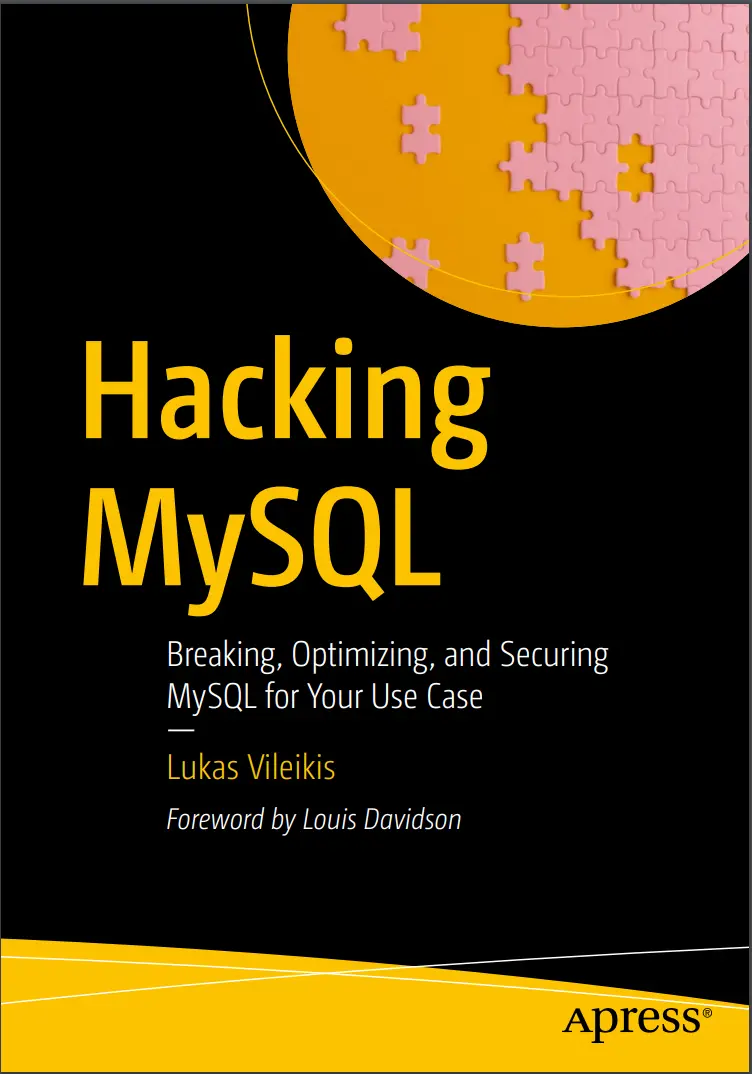
Hacking MySQL: Breaking, Optimizing, and Securing MySQL for Your Use Case
Автор: Vileikis Lukas
Дата выхода: 2024
Издательство: Apress Media, LLC.
Количество страниц: 382
Размер файла: 4,1 МБ
Тип файла: PDF
Добавил: codelibs
Проверить на вирусыTable of Contents....5
About the Author....12
Acknowledgments....13
Preface....14
Foreword....18
Part I: The Basics of MySQL....19
Chapter 1: The World of MySQL....20
The History of MySQL....20
The Architecture of MySQL....21
Basic Use Cases and Initial Considerations....23
Storage Engines....24
Other Storage Engines....25
Summary....26
Chapter 2: Individual Storage Engines....27
The Modern King of Storage Engines....27
InnoDB in MySQL and MariaDB....27
Storage Engines in Percona Server....36
Percona MyRocks and TokuDB....37
MyRocks....37
TokuDB....39
The Primary Contestant of InnoDB....40
The Early Days of MyISAM....40
MyISAM in the Present Day....41
Storage Engine Use Cases....42
The MEMORY and TempTable Storage Engines....42
The CSV Storage Engine....43
The ARCHIVE and BLACKHOLE Storage Engines....44
The MERGE Storage Engine....45
The Storage Engine for High Availability....46
Installing and Using NDB....47
The FEDERATED and EXAMPLE Storage Engines....50
Storage Engines Exclusive to MariaDB....51
Summary....53
Part II: Breaking MySQL....54
Chapter 3: What Breaks MySQL?....55
MySQL Use Cases....55
Problematic Use Cases....56
Performance Hiccups....57
Availability Issues....59
Security Problems....60
Understanding Your Data....61
Choosing the Proper Schema and Data Types....62
Character Sets and Collations....65
Your Architecture Is a Mess....67
Communicating with MySQL Through Software....69
Top Causes of Slow Query Performance....70
Summary....73
Chapter 4: How You Broke Your Queries....74
The Good, Bad, and the Ugly: Understanding Queries in MySQL....74
How You Broke Queries in MySQL....75
Types of Queries in MySQL....75
Factors Breaking DML Queries in MySQL....76
Factors Breaking DDL Queries in MySQL....78
Factors Breaking DCL and TCL Queries in MySQL....81
Why Are Queries Slow?....81
Devising the Perfect Schema Design....87
Understanding Data Types....90
Understanding Character Sets and Collations....93
Understanding Indexes....97
Understanding Partitions....99
Partitions and Big Data....102
NULL Values and Pruning in Partitions....103
Things to Avoid When Optimizing Queries in MySQL....105
Dont Blindly Trust Documentation....106
Summary....108
Chapter 5: Understanding Query Components....109
SQL Queries and Stored Procedures....109
Parsers and Optimizers....111
Queries and Error Messages....115
Common MySQL Error Codes....116
Factors Disliked by Your Queries....118
Isolate Your Columns!....119
Get Rid of Duplicate Indexes....119
Use EXISTS Instead of IN....120
Make Use of Stored Procedures and Triggers....120
SHOW STATUS and EXPLAIN....122
Summary....126
Chapter 6: Understanding Your Server....127
Efficiently Using Server Resources....127
Understanding and Simulating Errors....129
Server Components and Their Interaction with MySQL....132
Coding for MySQL Performance and Security....136
What Not to Do....140
Summary....141
Part III: Optimizing MySQL....143
Chapter 7: Optimizing Your Server for MySQL....144
Why Optimize Your Server for MySQL?....144
Common Webserver Issues Affecting MySQL....147
What Limits the Performance of MySQL?....149
Choosing Servers and Hard Drives....150
Configuring MySQL Parameters....151
Configuring MySQL IO for Your Operating System....156
Testing Your Hardware....158
Taking Advantage of ACID Properties....161
Summary....164
Chapter 8: Optimizing Storage Engines, Schemas, and Data Types....165
Why Optimize Storage Engines and Data Types?....165
Optimizing Storage Engines....166
Data Types in MySQL....169
String-Based Data Types....170
Numeric Data Types....170
Date, Time, Spatial, and JSON Data Types....171
Storage Requirements for Data Types....172
Choosing the Right Data Type....174
Optimizing Schemas and Data Types for Big Data....175
Summary....177
Chapter 9: Optimizing Queries....178
Why Optimize SQL Queries?....178
Optimizing Specific Types of Queries....180
The Query Cache....180
Optimizing INSERT Queries....182
Optimizing SELECT Queries....186
Optimizing Indexes and Constraints....191
Optimizing UPDATE Queries....196
Optimizing DELETE Queries....200
Optimizing Queries for Big Data, Avoiding Deadlocks, and Other Query Optimization Tips....201
Summary....203
Chapter 10: Optimizing MySQL for Big Data....204
Can MySQL Deal with Big Data?....205
MariaDB and Big Data: Operations with Big Data Sets....206
Inserting Big Data Into MariaDB....207
Reading Big Data with MariaDB....209
Updating Big Data in MariaDB....211
Deleting Big Data From MariaDB....212
Storage Engines and Big Data....213
ACID and Big Data....214
Big Data Pitfalls and Known Issues....215
Summary....217
Chapter 11: Indexing MySQL....218
Why Index? Indexes Available in MariaDB....218
What and When to Index?....222
Indexing Myths, Misconceptions, and Fragmentation Issues....225
Your Hardware, Database, and Indexes....227
Types of Indexes....229
B-Tree Indexes....230
Covering Indexes....237
Multicolumn (Composite) Indexes....241
Prefix Indexes....244
Spatial (R-Tree), Hash, and Clustered Indexes....245
Devising the Perfect Index Design....247
Indexing for Performance and Big Data....251
Summary....256
Chapter 12: Optimizing Partitions....257
Why Partition Data?....257
When to Partition Data?....258
Internals of Database Partitioning....260
Types of Partitioning in MySQL....262
Partitioning Tips: Subpartitioning, Limitations, NULL Values, and More....269
Summary....276
Chapter 13: Optimizing Backups and Recovery....277
Why, When, and How to Backup MariaDB?....277
Backup Types and Tools....280
Backup Compression and Security....286
Backing Up Big Data Sets....288
Recovering MariaDB....291
Recovering Big Data....292
Backup and Recovery Pitfalls....293
Pitfalls for Big Data....294
Summary....297
Chapter 14: Optimizing Replication....298
Understanding Replication....298
Configuring and Implementing Replication....299
Types of Replication....302
Replication Notes and Tips....305
Securing Replication....306
Summary....308
Chapter 15: Optimizing for Security....309
Understanding Security in MariaDB....309
Securing MariaDB upon Installation....313
General Security Measures....315
Summary....316
Part IV: Securing MySQL....317
Chapter 16: The World of Security in MySQL....318
General Security Guidelines and Measures Revisited....318
Access Control....321
User Security....325
MariaDB Components and Plugins That Keep Data Safe....327
Firewalling MariaDB....329
Summary....330
Chapter 17: Securing Your Database Instance....331
Security Guidelines for Specific Use Cases and Defense in Depth....331
Account Categories and Reserved Accounts....334
Password Management and Account Locking....335
SQL Injection, Input Sanitization, and MariaDB....338
Corner Cases of SQL Injection....341
Other Attacks Targeting Your Database....341
Summary....343
Chapter 18: Security and Big Data....344
Security, Big Data, and Code in the Initial Phases of Your SDLC....347
Data, Script Kiddies & Co.....349
What Happens If?....351
Summary....355
Appendix: Things You Wish You Knew, but Dont....357
Schrdingers Tables....357
Having Fun with ibdata1....358
Having Fun with Indexes....359
Query That Breaks MySQL 5.7....361
Reliably Using MyISAM....362
Building APIs and Interacting with Big Data....363
Preparing for the Future....365
Summary....365
Index....367
Your MySQL instances are probably broken. Many developers face slow-running queries, issues related to database architecture, replication, or database security—and that’s only the beginning. This book will deliver answers to your most pressing MySQL database questions related to performance, availability, or security by uncovering what causes databases to break in the first place.
At its core, this book provides you with the knowledge necessary for you to break your database instances so you can better optimize it for performance and secure it from data breaches. In other words, you’ll discover the sorts of actions, minor and major, that degrade databases so you can fix and ultimately preempt them. MySQL sometimes acts according to its own rules, and this book will help you keep it working on your terms. At the same time, you will learn to optimize your backup and recovery procedures, determine when and which data to index to achieve maximum performance, and choose the best MySQL configurations, among other essential skills.
Most MySQL books focus exclusively on optimization, but this book argues that it’s just as important to pay attention to the ways databases break. Indeed, after reading this book, you will be able to safely break your database instances to expose and overcome the nuanced issues that affect performance, availability, and security.
What You Will Learn
- Know the basics of MySQL and the storage engines innoDB and MyISAM
- Spot the ways you are harming your database’s performance, availability and security without even realizing it
- Fix minor bugs and issues that have surprisingly serious impact
- Optimize schema, data types, queries, indexes, and partitions to head off issues
- Understand key MySQL security strategies
Who This Book Is For
Database administrators, web developers, systems administrators, and security professionals with an intermediary knowledge of database management systems and building applications in MySQL


