-
1C
-
Agda
-
Agile/Scrum
-
Alef
-
APL
-
Assembler
-
AWK
-
Basic
-
Beta Programming Language
-
Big Data/DataScience
-
C
-
C#
-
C++
-
Cobol
-
Crystal
-
CSS
-
D
-
Dart
-
DataBase (SQL)
-
Delphi
-
F#
-
Flutter
-
Fortran
-
GameDev
-
Git
-
Go (Golang)
-
GPT/AI/ИИ
-
Hacking and Security
-
Haskell
-
HTML
-
Java
-
JavaScript (JS)
-
Julia
-
Kotlin
-
Machine Learning (ML)
-
Natural language processing (NLP)
-
.NET (.NET Core)
-
Pascal
-
PHP
-
Python
-
R
-
Ruby
-
Rust
-
Scratch
-
Swift
-
UML
-
UX/UI
-
Visual Basic
-
Wolfram
-
XML
-
АСУ
-
Проектирование/System Design
-
Сети/Network
-
Статьи
-
Схемотехника/электронные схемы
-
1C
-
Agda
-
Agile/Scrum
-
Alef
-
APL
-
Assembler
-
AWK
-
Basic
-
Beta Programming Language
-
Big Data/DataScience
-
C
-
C#
-
C++
-
Cobol
-
Crystal
-
CSS
-
D
-
Dart
-
DataBase (SQL)
-
Delphi
-
F#
-
Flutter
-
Fortran
-
GameDev
-
Git
-
Go (Golang)
-
GPT/AI/ИИ
-
Hacking and Security
-
Haskell
-
HTML
-
Java
-
JavaScript (JS)
-
Julia
-
Kotlin
-
Machine Learning (ML)
-
Natural language processing (NLP)
-
.NET (.NET Core)
-
Pascal
-
PHP
-
Python
-
R
-
Ruby
-
Rust
-
Scratch
-
Swift
-
UML
-
UX/UI
-
Visual Basic
-
Wolfram
-
XML
-
АСУ
-
Проектирование/System Design
-
Сети/Network
-
Статьи
-
Схемотехника/электронные схемы
Меню
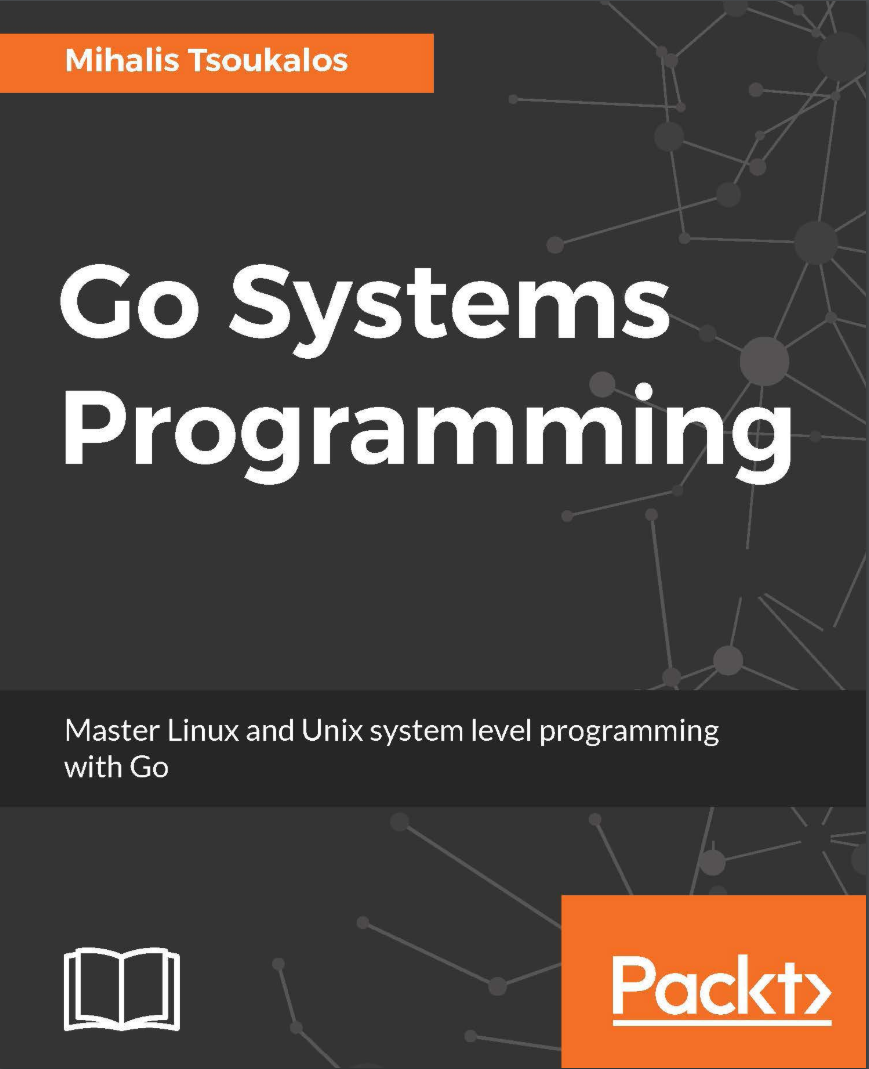
Go Systems Programming: Master Linux and Unix system level programming with Go
Автор: Tsoukalos Mihalis
Дата выхода: 2017
Издательство: Packt Publishing Limited
Количество страниц: 459
Размер файла: 2,4 МБ
Тип файла: PDF
Добавил: codelibs
Проверить на вирусы Дополнительные материалыCover....1
Title Page....2
Copyright....3
Credits....4
About the Author....5
About the Reviewer....6
www.PacktPub.com....7
Customer Feedback....8
Table of Contents....9
Preface....17
Chapter 1: Getting Started with Go and Unix Systems Programming....25
The structure of the book....26
What is systems programming?....26
Learning systems programming....28
About Go....29
Getting ready for Go....30
Two useful Go tools....31
Advantages and disadvantages of Go....35
The various states of a Unix process....36
Exercises....38
Summary....38
Chapter 2: Writing Programs in Go....39
Compiling Go code....39
Checking the size of the executable file....42
Go environment variables....43
Using command-line arguments....45
Finding the sum of the command-line arguments....46
User input and output....49
Getting user input....49
Printing output....51
Go functions....51
Naming the return values of a Go function....52
Anonymous functions....52
Illustrating Go functions....52
The defer keyword....55
Using pointer variables in functions....58
Go data structures....59
Arrays....59
Slices....61
Maps....64
Converting an array into a map....66
Structures....67
Interfaces....69
Creating random numbers....72
Exercises....74
Summary....75
Chapter 3: Advanced Go Features....76
Error handling in Go....76
Functions can return error variables....77
About error logging....79
The addCLA.go program revisited....81
Pattern matching and regular expressions....82
Printing all the values from a given column of a line....84
Creating summaries....85
Finding the number of occurrences....87
Find and replace....89
Reflection....90
Calling C code from Go....92
Unsafe code....93
Comparing Go to other programming languages....94
Analysing software....96
Using the strace(1) command-line utility....96
The DTrace utility....99
Disabling System Integrity Protection on macOS....102
Unreachable code....102
Avoiding common Go mistakes....104
Exercises....104
Summary....105
Chapter 4: Go Packages, Algorithms, and Data Structures....106
About algorithms....107
The Big O notation....107
Sorting algorithms....108
The sort.Slice() function....108
Linked lists in Go....110
Trees in Go....114
Developing a hash table in Go....116
About Go packages....120
Using standard Go packages....120
Creating your own packages....121
Private variables and functions....123
The init() function....123
Using your own Go packages....124
Using external Go packages....125
The go clean command....128
Garbage collection....128
Your environment....130
Go gets updated frequently!....132
Exercises....132
Summary....133
Chapter 5: Files and Directories....134
Useful Go packages....135
Command-line arguments revisited!....135
The flag package....135
Dealing with directories....138
About symbolic links....139
Implementing the pwd(1) command....140
Developing the which(1) utility in Go....142
Printing the permission bits of a file or directory....145
Dealing with files in Go....146
Deleting a file....146
Renaming and moving files....148
Developing find(1) in Go....150
Traversing a directory tree....151
Visiting directories only!....152
The first version of find(1)....153
Adding some command-line options....155
Excluding filenames from the find output....158
Excluding a file extension from the find output....160
Using regular expressions....161
Creating a copy of a directory structure....162
Exercises....167
Summary....167
Chapter 6: File Input and Output....168
About file input and output....169
Byte slices....169
About binary files....171
Useful I/O packages in Go....172
The io package....173
The bufio package....174
File I/O operations....176
Writing to files using fmt.Fprintf()....176
About io.Writer and io.Reader....177
Finding out the third column of a line....179
Copying files in Go....182
There is more than one way to copy a file!....182
Copying text files....182
Using io.Copy....182
Reading a file all at once!....184
An even better file copy program....186
Benchmarking file copying operations....189
Developing wc(1) in Go....194
Counting words....194
The wc.go code!....194
Comparing the performance of wc.go and wc(1)....199
Reading a text file character by character....200
Doing some file editing!....202
Interprocess communication....204
Sparse files in Go....204
Reading and writing data records....207
File locking in Go....210
A simplified Go version of the dd utility....213
Exercises....216
Summary....216
Chapter 7: Working with System Files....217
Which files are considered system files?....218
Logging in Go....218
Putting data at the end of a file....218
Altering existing data....220
About log files....222
About logging....223
Logging facilities....223
Logging levels....223
The syslog Go package....224
Processing log files....226
File permissions revisited....230
Changing file permissions....232
Finding other kinds of information about files....234
More pattern matching examples....237
A simple pattern matching example....237
An advanced example of pattern matching....240
Renaming multiple files using regular expressions....243
Searching files revisited....245
Finding the user ID of a user....245
Finding all the groups a user belongs to....247
Finding files that belong or do not belong to a given user....249
Finding files based on their permissions....252
Date and time operations....254
Playing with dates and times....254
Reformatting the times in a log file....256
Rotating log files....258
Creating good random passwords....261
Another Go update....263
Exercises....263
Summary....264
Chapter 8: Processes and Signals....265
About Unix processes and signals....266
Process management....266
About Unix signals....267
Unix signals in Go....268
The kill(1) command....268
A simple signal handler in Go....269
Handling three different signals!....271
Catching every signal that can be handled....273
Rotating log files revisited!....275
Improving file copying....278
Plotting data....282
Unix pipes in Go....289
Reading from standard input....290
Sending data to standard output....292
Implementing cat(1) in Go....293
The plotIP.go utility revisited....294
Unix sockets in Go....302
RPC in Go....303
Programming a Unix shell in Go....304
Yet another minor Go update....306
Exercises....306
Summary....307
Chapter 9: Goroutines — Basic Features....308
About goroutines....309
Concurrency and parallelism....309
The sync Go packages....310
A simple example....310
Creating multiple goroutines....311
Waiting for goroutines to finish their jobs....313
Creating a dynamic number of goroutines....315
About channels....317
Writing to a channel....317
Reading from a channel....319
Explaining h1s.go....320
Pipelines....321
A better version of wc.go....323
Calculating totals....326
Doing some benchmarking....330
Exercises....332
Summary....332
Chapter 10: Goroutines — Advanced Features....333
The Go scheduler....334
The sync Go package....334
The select keyword....334
Signal channels....337
Buffered channels....340
About timeouts....342
An alternative way to implement timeouts....344
Channels of channels....346
Nil channels....348
Shared memory....349
Using sync.Mutex....351
Using sync.RWMutex....355
The dWC.go utility revisited....358
Using a buffered channel....358
Using shared memory....361
More benchmarking....364
Detecting race conditions....365
About GOMAXPROCS....368
Exercises....370
Summary....370
Chapter 11: Writing Web Applications in Go....371
What is a web application?....372
About the net/http Go package....372
Developing web clients....372
Fetching a single URL....372
Setting a timeout....374
Developing better web clients....376
A small web server....379
The http.ServeMux type....382
Using http.ServeMux....382
The html/template package....386
About JSON....391
Saving JSON data....392
Parsing JSON data....394
Using Marshal() and Unmarshal()....396
Using MongoDB....398
Basic MongoDB administration....398
Using the MongoDB Go driver....401
Creating a Go application that displays MongoDB data....404
Creating an application that displays MySQL data....408
A handy command-line utility....411
Exercises....415
Summary....416
Chapter 12: Network Programming....417
About network programming....418
About TCP/IP....418
About TCP....418
The TCP handshake!....419
About UDP and IP....419
About Wireshark and tshark....420
About the netcat utility....422
The net Go standard package....422
Unix sockets revisited....423
A Unix socket server....423
A Unix socket client....425
Performing DNS lookups....427
Using an IP address as input....428
Using a host name as input....429
Getting NS records for a domain....431
Developing a simple TCP server....432
Developing a simple TCP client....435
Using other functions for the TCP server....437
Using alternative functions for the TCP client....439
Developing a simple UDP server....440
Developing a simple UDP client....442
A concurrent TCP server....444
Remote procedure call (RPC)....446
An RPC server....447
An RPC client....450
Exercises....452
Summary....453
Index....454
Go is the new systems programming language for Linux and Unix systems. It is also the language in which some of the most prominent cloud-level systems have been written, such as Docker. Where C programmers used to rule, Go programmers are in demand to write highly optimized systems programming code.
Created by some of the original designers of C and Unix, Go expands the systems programmers toolkit and adds a mature, clear programming language. Traditional system applications become easier to write since pointers are not relevant and garbage collection has taken away the most problematic area for low-level systems code: memory management.
This book opens up the world of high-performance Unix system applications to the beginning Go programmer. It does not get stuck on single systems or even system types, but tries to expand the original teachings from Unix system level programming to all types of servers, the cloud, and the web.
What you will learn
- Explore the Go language from the standpoint of a developer conversant with Unix, Linux, and so on
- Understand Goroutines, the lightweight threads used for systems and concurrent applications
- Learn how to translate Unix and Linux systems code in C to Golang code
- How to write fast and lightweight server code
- Dive into concurrency with Go
- Write low-level networking code
Who this book is for:
Intermediate Linux and general Unix programmers. Network programmers from beginners to advanced practitioners. C and C++ programmers interested in different approaches to concurrency and Linux systems programming.


