-
1C
-
Agda
-
Agile/Scrum
-
Alef
-
APL
-
Assembler
-
AWK
-
Basic
-
Beta Programming Language
-
Big Data/DataScience
-
C
-
C#
-
C++
-
Cobol
-
Crystal
-
CSS
-
D
-
Dart
-
DataBase (SQL)
-
Delphi
-
F#
-
Flutter
-
Fortran
-
GameDev
-
Git
-
Go (Golang)
-
GPT/AI/ИИ
-
Hacking and Security
-
Haskell
-
HTML
-
Java
-
JavaScript (JS)
-
Julia
-
Kotlin
-
Machine Learning (ML)
-
Natural language processing (NLP)
-
.NET (.NET Core)
-
Pascal
-
PHP
-
Python
-
R
-
Ruby
-
Rust
-
Scratch
-
Swift
-
UML
-
UX/UI
-
Visual Basic
-
Wolfram
-
XML
-
АСУ
-
Проектирование/System Design
-
Сети/Network
-
Статьи
-
Схемотехника/электронные схемы
-
1C
-
Agda
-
Agile/Scrum
-
Alef
-
APL
-
Assembler
-
AWK
-
Basic
-
Beta Programming Language
-
Big Data/DataScience
-
C
-
C#
-
C++
-
Cobol
-
Crystal
-
CSS
-
D
-
Dart
-
DataBase (SQL)
-
Delphi
-
F#
-
Flutter
-
Fortran
-
GameDev
-
Git
-
Go (Golang)
-
GPT/AI/ИИ
-
Hacking and Security
-
Haskell
-
HTML
-
Java
-
JavaScript (JS)
-
Julia
-
Kotlin
-
Machine Learning (ML)
-
Natural language processing (NLP)
-
.NET (.NET Core)
-
Pascal
-
PHP
-
Python
-
R
-
Ruby
-
Rust
-
Scratch
-
Swift
-
UML
-
UX/UI
-
Visual Basic
-
Wolfram
-
XML
-
АСУ
-
Проектирование/System Design
-
Сети/Network
-
Статьи
-
Схемотехника/электронные схемы
Меню
Event-Driven Architecture for Beginners using RabbitMQ and .NET: A comprehensive guide to distributed solutions with RabbitMQ and .NET
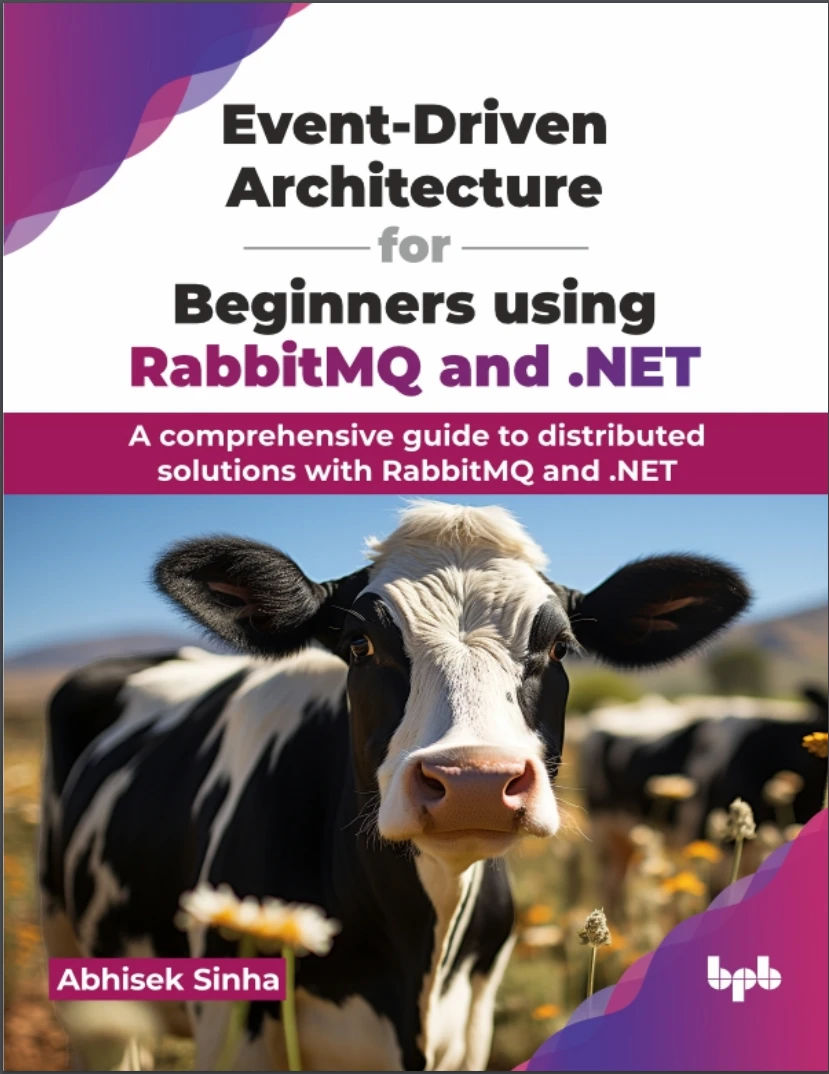
Автор: Sinha Abhisek
Дата выхода: 2024
Издательство: BPB Publications
Количество страниц: 293
Размер файла: 1,6 МБ
Тип файла: PDF
Добавил: codelibs
Проверить на вирусы Дополнительные материалыCover....2
Title Page....3
Copyright Page....5
Dedication Page....6
About the Author....7
About the Reviewer....9
Acknowledgement....10
Preface....11
Table of Contents....18
1. The Realization and Significance of Event-Driven Architecture....25
Introduction....25
Structure....25
Objectives....26
Event-Driven Architecture overview....26
Publisher/subscriber....28
Event streaming....29
When to use this architecture....30
Event-driven architecture example....31
Advantages of EDA....32
Loosely coupled....32
Immutability....33
Fault tolerance....34
Real-time....35
Scalability....35
Recovery....36
Asynchronous processing....37
Flexibility....38
Challenges of EDA....38
Complexity....39
Debugging and testing....39
Event management....40
Scalability....41
Data management....41
Security....42
Latency....42
Monitoring and maintenance....43
Evolving events....44
Comparing EDA with other architectural patterns....45
Monolithic architecture....45
Microservices architecture....46
Service-Oriented Architecture....47
Model-View-Controller architecture....48
Key components of EDA....49
Event emitter....50
Event listeners....51
Event bus....52
Event processing....53
Common use cases for EDA....54
Banking system....54
Media streaming platform....55
Supply chain management....56
Popular technologies and frameworks used in EDA....57
RabbitMQ....57
Apache Kafka....58
AWS Lambda....59
Azure event grid....61
Conclusion....62
2. Core Concepts of Event-Driven Architecture....64
Introduction....64
Structure....64
Objectives....65
Event producers....65
The role of event producers....65
Topics....68
Event consumers....69
The role of event consumers....69
Event bus....72
Types of event buses....73
Internal event bus....73
External event bus....73
How does the event bus work....74
Loose coupling....75
Event-based communication....77
Event ordering and idempotence....80
Event schema....81
Event sourcing....84
Command Query Responsibility Segregation....90
Conclusion....91
3. Designing Event-Driven Systems....94
Introduction....94
Structure....94
Objectives....95
Identifying the events....95
Identify the business processes....95
Identify the actions and events....96
Identifying triggers....98
Identifying events attributes....98
Categorizing events....100
Defining the event schema....102
Choosing an event bus....106
Deciding on event consumers....108
Addressing event ordering and idempotence....109
Testing and monitoring....112
Fault tolerance....114
Conclusion....117
4. RabbitMQ for Event-Driven Microservices....119
Introduction....119
Structure....119
Objectives....119
Advantages of RabbitMQ and .NET....120
RabbitMQ messaging patterns and concepts....123
.NET’s relevance to event-driven systems....130
RabbitMQ implementation for building event-driven .NET applications....132
Installing RabbitMQ server....132
Setting up a .NET project for event-driven architecture....135
Conclusion....138
5. Building Event-Driven System with RabbitMQ and .NET....140
Introduction....140
Structure....140
Objectives....140
Setting up RabbitMQ as messaging broker....141
Implementing event producers using .NET....147
Implementing event consumers using .NET....152
Error handling techniques for RabbitMQ event publishing....155
Reliable message delivery using RabbitMQ’s....172
Confirmations implementation in RabbitMQ....172
Transactions implementation in RabbitMQ....176
Conclusion....179
6. Secure RabbitMQ Messaging with .NET....181
Introduction....181
Structure....181
Objectives....182
Authentication for event producers and consumers....182
Authentication in event producers....182
Authentication for event consumers....187
Authorization for event producers and consumers....193
Authorization in event producers....193
Access control for producers....193
Authorization in event consumers....198
Authorization checks in code....198
Handle unauthorized access....199
Encrypting sensitive data in event payloads....205
Log aggregation and analysis for event tracing and auditing....215
Log aggregation....216
Implementing log aggregation....216
Log analysis....217
Log analysis in event-driven systems....218
Security and privacy considerations....218
Conclusion....225
7. Monitoring, Integration and Deployment in Event-Driven System....227
Introduction....227
Structure....228
Objectives....228
Monitoring and management....229
Monitoring tools and libraries....229
Management tools and libraries....231
Integration with other systems using REST and gRPC....232
Event sourcing and CQRS pattern in Event Driven Architecture....235
Event sourcing....235
Command Query Responsibility Segregation....236
Advantages of Event Sourcing and CQRS....237
Event sourcing and CQRS with RabbitMQ in C#....238
Microservices and Event-Driven Architecture....245
Microservices architecture....245
Microservices in Event-Driven Architecture....246
How to implement a microservices architecture....248
E-commerce Microservices Architecture overview....248
Deploying Event Driven System to a cloud environment....256
Conclusion....260
8. Case Studies, Pitfalls and Future Horizons....262
Introduction....262
Structure....262
Objectives....263
Case studies: Implementing Event-Driven Architecture....263
Case studies: Order processing system in e-commerce platform....264
Problem statement....264
Sequence diagram....264
Architecture design....264
Technology stack....271
Implementation details....271
Use cases and scenarios....271
Challenges and solutions....272
Results and outcomes....272
Lessons learned....272
Real-world examples of event-driven systems using RabbitMQ and .NET....273
Optimizing performance and scalability....275
Revisiting fundamental EDA concepts....277
Common pitfalls and how to avoid them....280
Future developments in event-driven architecture....283
Conclusion....285
Index....287
The key to event-driven architecture: A beginner's journey with RabbitMQ and .NET
Key Features
- Easy to understand guide for newcomers to event-driven architecture and .NET.
- Learn event-driven architecture concepts with .NET and RabbitMQ, from basic to advanced topics.
- Real-world case studies show how to implement event-driven architecture using .NET and RabbitMQ.
Description
By using .NET and RabbitMQ, developers can take advantage of the capabilities of both technologies to create event-driven systems that are optimized for performance and maintainability. This book aims to provide a comprehensive guide for individuals who wish to learn the implementation of event-driven architecture using .NET and RabbitMQ, from understanding the core concepts to implementing practical solutions.
It covers the fundamental concepts of event-driven architecture, including the publish-subscribe pattern and message queues, as well as practical implementation details such as setting up RabbitMQ and using .NET to build event-driven systems. The book also covers advanced topics such as scalability, reliability, and security, and includes real-world case studies to illustrate the challenges and solutions involved in implementing event-driven architecture.
Throughout the book, readers will learn about the concepts, tools, and techniques needed to design, implement and maintain an event-driven system using .NET and RabbitMQ. Additionally, readers will also get an understanding of how to address the challenges that arise while implementing such systems and best practices to overcome them.
What you will learn
- Architect robust event-driven solutions using RabbitMQ and .NET.
- Implement scalable and efficient distributed systems with confidence.
- Apply best practices for seamless integration and software development.
- Navigate complex decision-making processes in distributed solution strategies.
- Enhance expertise in orchestrating solutions for diverse software development roles.
Who this book is for
This guide is meticulously crafted to cater to a diverse audience, encompassing solution architects, integration architects, consultants, developers, advisors, CTOs, and other decision-makers.


