-
1C
-
Agda
-
Agile/Scrum
-
Alef
-
APL
-
Assembler
-
AWK
-
Basic
-
Beta Programming Language
-
Big Data/DataScience
-
C
-
C#
-
C++
-
Cobol
-
Crystal
-
CSS
-
D
-
Dart
-
DataBase (SQL)
-
Delphi
-
F#
-
Flutter
-
Fortran
-
GameDev
-
Git
-
Go (Golang)
-
GPT/AI/ИИ
-
Hacking and Security
-
Haskell
-
HTML
-
Java
-
JavaScript (JS)
-
Julia
-
Kotlin
-
Machine Learning (ML)
-
Natural language processing (NLP)
-
.NET (.NET Core)
-
Pascal
-
PHP
-
Python
-
R
-
Ruby
-
Rust
-
Scratch
-
Swift
-
UML
-
UX/UI
-
Visual Basic
-
Wolfram
-
XML
-
АСУ
-
Проектирование/System Design
-
Сети/Network
-
Статьи
-
Схемотехника/электронные схемы
-
1C
-
Agda
-
Agile/Scrum
-
Alef
-
APL
-
Assembler
-
AWK
-
Basic
-
Beta Programming Language
-
Big Data/DataScience
-
C
-
C#
-
C++
-
Cobol
-
Crystal
-
CSS
-
D
-
Dart
-
DataBase (SQL)
-
Delphi
-
F#
-
Flutter
-
Fortran
-
GameDev
-
Git
-
Go (Golang)
-
GPT/AI/ИИ
-
Hacking and Security
-
Haskell
-
HTML
-
Java
-
JavaScript (JS)
-
Julia
-
Kotlin
-
Machine Learning (ML)
-
Natural language processing (NLP)
-
.NET (.NET Core)
-
Pascal
-
PHP
-
Python
-
R
-
Ruby
-
Rust
-
Scratch
-
Swift
-
UML
-
UX/UI
-
Visual Basic
-
Wolfram
-
XML
-
АСУ
-
Проектирование/System Design
-
Сети/Network
-
Статьи
-
Схемотехника/электронные схемы
Меню
Data Structures and Algorithms in C++: Pocket Primer
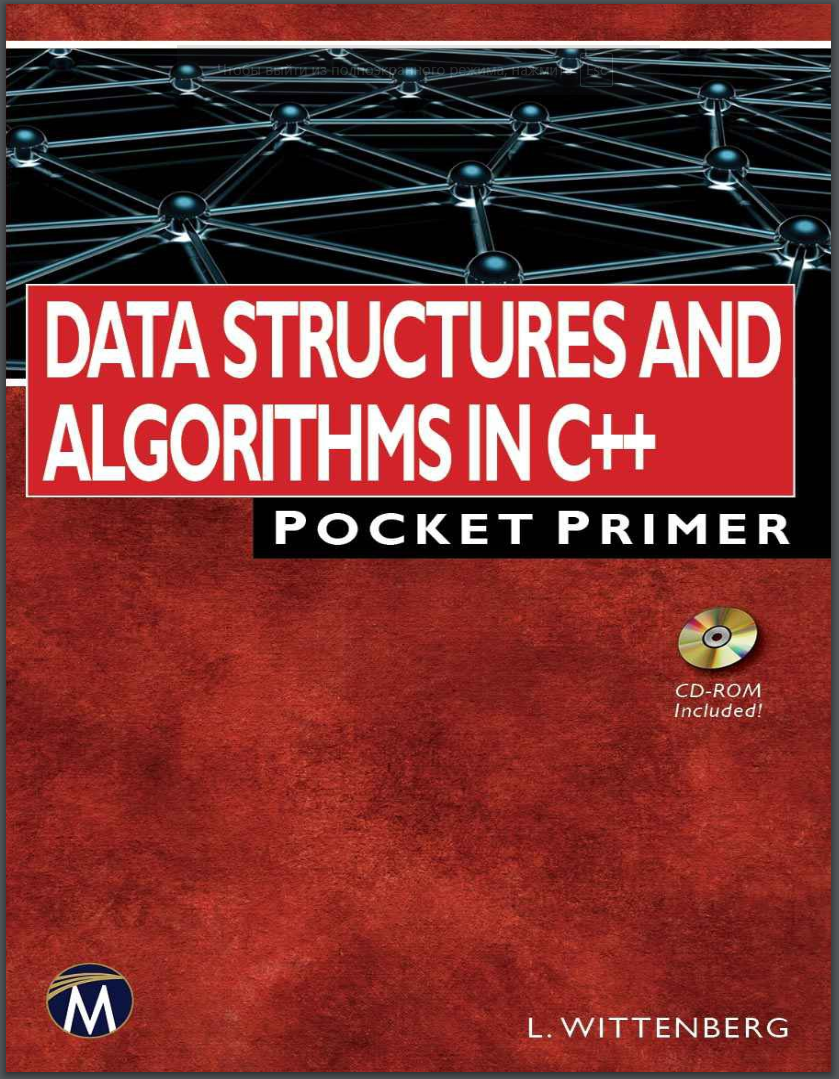
Автор: Wittenberg Lee
Дата выхода: 2018
Издательство: Mercury Learning and Information LLC.
Количество страниц: 155
Размер файла: 4,4 МБ
Тип файла: PDF
Добавил: codelibs
Проверить на вирусыTitle Page....4
Copyright....5
Contents....6
Preface....9
Acknowledgments....12
Chapter 1: C++ Review....13
1.1 The auto Keyword....13
1.2 Classes....13
1.2.1 Example: A Fraction Class....15
1.3 Pointers and Arrays....24
1.4 Inheritance....26
1.5 Templates....30
1.6 The Standard Template Library (STL)....31
1.6.1 Containers....31
1.6.2 Iterators....32
1.6.3 Algorithms....33
1.7 Putting It All Together: A Vector Class....33
1.7.1 Constructors/Destructors....34
1.7.2 Member Functions....36
1.7.3 Iterators....38
Chapter 2: Algorithm Analysis....40
2.1 Big-O Notation....41
2.1.1 Terminology....41
2.2 Efficiency of Vector Operations....43
2.3 Estimates and Comparisons....44
2.4 Fast Enough....44
Chapter 3: Linked Lists....46
3.1 The list Interface....47
3.2 List Implementation....47
3.2.1 Constructors/Destructors....49
3.2.2 Member Functions....50
3.2.3 Iterators....54
Chapter 4: Stacks and Queues....57
4.1 The stack and queue Interfaces....57
4.2 Example: Infix and Postfix....58
4.3 Stack and Queue Implementation....59
4.3.1 Constructors/Destructors....59
4.3.2 Member Functions....59
Chapter 5: Recursion....61
5.1 Recursive Definitions....63
5.2 Proof by Induction....64
5.3 Example: Binary Search....65
5.4 Example: Tower of Hanoi....66
5.5 Example: Recursive Descent Parsing....67
5.6 The Efficiency of Recursion....68
Chapter 6: Binary Trees....69
6.1 Traversals....69
6.2 Example: Expression Trees....70
6.3 Example: Binary Search Trees....71
6.4 The set and map Interfaces....75
6.5 Example: Associative Arrays....76
6.6 Example: Sparse Matrices....76
6.7 A Binary_Search_Tree Class....77
6.7.1 Constructors/Destructors....78
6.7.2 Member Functions....80
6.7.3 Iterators....84
6.8 Set and Map Implementation....85
6.8.1 Constructors/Destructors....87
6.8.2 Member Functions....87
6.8.3 Iterators....89
Chapter 7: Binary Trees (continued)....92
7.1 Height-Balanced Trees....92
7.2 General Trees....92
7.3 Heaps....93
7.4 The priority_queue Interface....96
7.5 Priority_Queue Implementation....96
7.5.1 Constructors/Destructors....97
7.5.2 Member Functions....97
Chapter 8: Sorting....100
8.1 Bubble Sort (Revised)....100
8.2 Selection Sort....101
8.3 Insertion Sort....101
8.4 Shell Sort....102
8.5 Heap Sort....102
8.6 Merge Sort....103
8.7 Quick Sort....104
8.8 The STL sort Function....106
Chapter 9: Hash Tables....107
9.1 Hash Functions....107
9.2 Collisions....108
9.2.1 Probing....108
9.2.2 Chaining....109
9.3 Load Factors and Efficiency....109
9.4 Rehashing....110
9.5 The unordered_set and unordered_map Interfaces....110
9.6 A Hash_Table Class....111
9.6.1 Constructors/Destructors....112
9.6.2 Member Functions....112
9.6.3 Iterators....116
9.7 Unordered_Set and Unordered_Map Implementation....118
9.7.1 Constructors/Destructors....119
9.7.2 Member Functions....120
9.7.3 Iterators....121
Chapter 10: Graphs....123
10.1 Graph Representations....124
10.1.1 Adjacency Matrix....124
10.1.2 Adjacency Lists....124
10.2 Traversals....125
10.2.1 Depth-First Search....125
10.2.2 Breadth-First Search....125
10.3 Example: Topological Sorting....126
10.4 Example: Shortest Path....126
10.5 A Graph Interface....129
10.6 Graph Implementation....129
10.6.1 Constructors/Destructors....130
10.6.2 Member Functions....130
Appendix A: A Programmer’s Library....134
Appendix B: STL Class Summary....136
Appendix C: Chunk Index....145
Index....148
This book takes a minimalist approach to the traditional data structures course. It covers only those topics that are absolutely essential; the more esoteric structures and algorithms are left for later study. Suitable for an introductory data structures course or self-study, this book is written from the ground up in C++ (not translated from a Java-based text), and uses features of the C++ Standard Template Library to illustrate important concepts. A unique feature of the text is its use of literate programming techniques (originally developed by Donald Knuth) to present the sample code in a way that keeps the code from overwhelming the accompanying explanations. Source code samples from the book are available on the companion files. This book is suitable for an undergraduate data structures course using C++ or for developers needing review.


