-
1C
-
Agda
-
Agile/Scrum
-
Alef
-
APL
-
Assembler
-
AWK
-
Basic
-
Beta Programming Language
-
Big Data/DataScience
-
C
-
C#
-
C++
-
Cobol
-
Crystal
-
CSS
-
D
-
Dart
-
DataBase (SQL)
-
Delphi
-
F#
-
Flutter
-
Fortran
-
GameDev
-
Git
-
Go (Golang)
-
GPT/AI/ИИ
-
Hacking and Security
-
Haskell
-
HTML
-
Java
-
JavaScript (JS)
-
Julia
-
Kotlin
-
Machine Learning (ML)
-
Natural language processing (NLP)
-
.NET (.NET Core)
-
Pascal
-
PHP
-
Python
-
R
-
Ruby
-
Rust
-
Scratch
-
Swift
-
UML
-
UX/UI
-
Visual Basic
-
Wolfram
-
XML
-
АСУ
-
Проектирование/System Design
-
Сети/Network
-
Статьи
-
Схемотехника/электронные схемы
-
1C
-
Agda
-
Agile/Scrum
-
Alef
-
APL
-
Assembler
-
AWK
-
Basic
-
Beta Programming Language
-
Big Data/DataScience
-
C
-
C#
-
C++
-
Cobol
-
Crystal
-
CSS
-
D
-
Dart
-
DataBase (SQL)
-
Delphi
-
F#
-
Flutter
-
Fortran
-
GameDev
-
Git
-
Go (Golang)
-
GPT/AI/ИИ
-
Hacking and Security
-
Haskell
-
HTML
-
Java
-
JavaScript (JS)
-
Julia
-
Kotlin
-
Machine Learning (ML)
-
Natural language processing (NLP)
-
.NET (.NET Core)
-
Pascal
-
PHP
-
Python
-
R
-
Ruby
-
Rust
-
Scratch
-
Swift
-
UML
-
UX/UI
-
Visual Basic
-
Wolfram
-
XML
-
АСУ
-
Проектирование/System Design
-
Сети/Network
-
Статьи
-
Схемотехника/электронные схемы
Меню
C# 10 Clean Architecture with .NET 6: A Beginner's Guide to Building Maintainable,Tastable, Scalable and Resilient Applications.
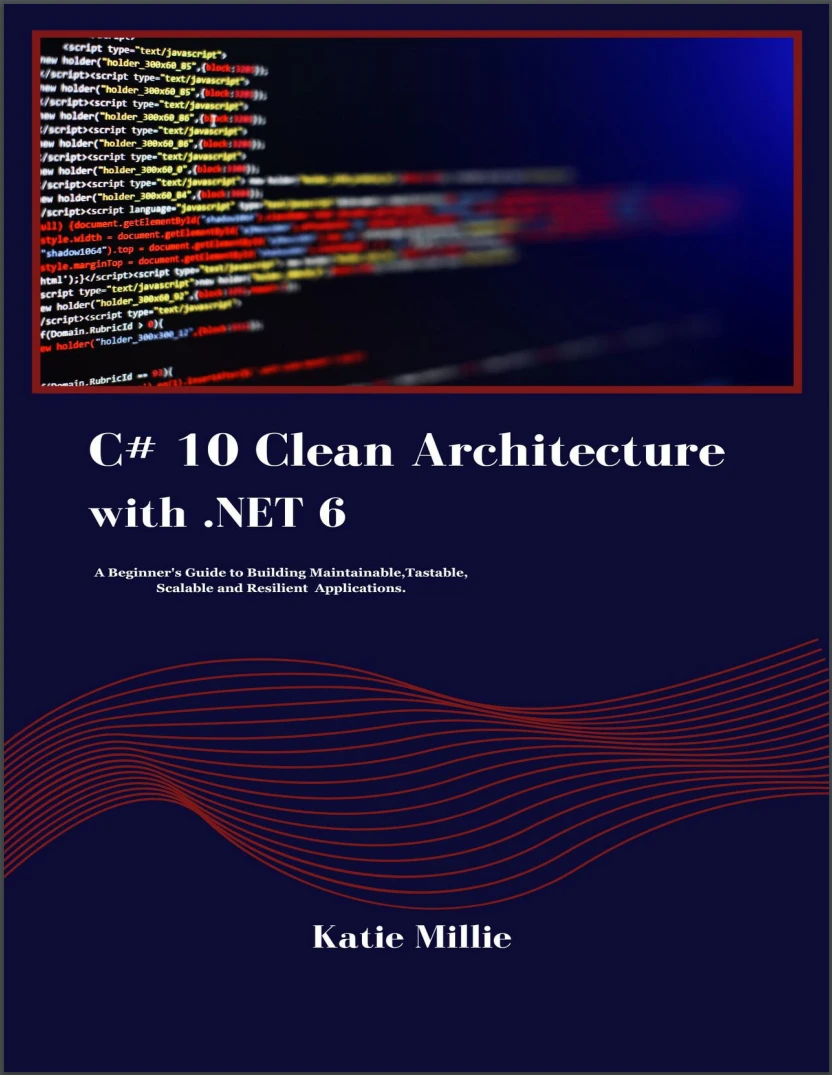
Автор: Millie Katie
Дата выхода: 2024
Издательство: Independent publishing
Количество страниц: 171
Размер файла: 558,5 КБ
Тип файла: PDF
Добавил: codelibs
Проверить на вирусыINTRODUCTION....5
Chapter 1 The Challenges of Traditional Software Development....7
Introducing Clean Architecture: Building Software that Endures....10
Chapter 2 Core Principles of Clean Architecture....14
The Dependency Rule: High-Level Modules Should Not Depend on Low-Level Modules....17
Abstractions: Focusing on What, Not How....20
Frameworks and Dependencies: Tools, not the Foundation....23
Applying Clean Architecture Principles in C# 10 Projects....25
Chapter 3 Unveiling C# 10 Features for Clean Architecture....30
Minimal Interfaces: Simplifying Abstraction and Encapsulating Functionality....33
Pattern Matching Enhancements: Increased Code Readability and Maintainability....36
Other C# 10 Features and their Synergy with Clean Architecture Practices....39
Chapter 4 Setting Up Your Development Environment for Clean Architecture....42
Configuring .NET 6 and C# 10 for Clean Architecture Development....43
Understanding Project Templates and Clean Architecture Structure....47
Chapter 5 Dependency Injection with .NET 6 in Clean Architecture....50
Implementing Dependency Injection in C# 10 with .NET 6....53
Benefits of Dependency Injection for Loose Coupling and Testability....58
Chapter 6 Building the Core Logic: The Business Rules Layer....63
Implementing the Business Rules Layer in C# 10 for Maintainability....66
Unit Testing the Business Rules Layer for Code Quality and Confidence....69
Chapter 7 The Presentation Layer: User Interface and Interactions....73
Consuming the Business Logic Layer from the Presentation Layer....76
Implementing Dependency Injection in the Presentation Layer for Flexibility....80
Chapter 8 Implementing Data Persistence with .NET....84
Defining Data Models and Mapping Entities for Persistence....87
Implementing Data Access Logic with Separation of Concerns....90
Unit Testing the Persistence Layer for Reliable Data Handling....94
Chapter 9 Clean Architecture with ASP.NET Core MVC 6....99
Consuming the Business Logic Layer from ASP.NET Core MVC Controllers....103
Implementing Dependency Injection in ASP.NET Core MVC Applications....106
Leveraging Minimal APIs for Concise and Efficient Controllers (New in .NET 6)....109
Chapter 10 Testing Strategies for Robust Clean Architecture Applications....111
Integration Testing: Testing Interactions between Layers....114
Leveraging Testing Frameworks (xUnit, NUnit) with C# 10 Features....117
Testing Considerations for Clean Architecture Projects with .NET 6....122
Chapter 11 Dependency Inversion Principle for Loose Coupling and Flexibility....127
The Repository Pattern for Data Access Abstractions....129
Implementing Clean Architecture for Microservices with C# 10 and .NET 6....134
Chapter 12 Best Practices and Design Patterns for Clean Architecture....139
Design Patterns for Clean Architecture: Adapters, Facades, and More....141
Maintaining Clean Architecture as Your Project Evolves with C# 10 and .NET 6....146
Chapter 13 The Future of Clean Architecture with C# and .NET....151
Continuous Integration and Continuous Delivery (CI/CD) for Clean Architecture Projects....155
Leveraging Clean Architecture for Long-Term Project Success with C# and .NET 6....158
Conclusion....163
Appendix....164
Glossary’s of terms....164
Sample Application Code Examples Demonstrating Clean Architecture with C# 10 and .NET 6....166
C# 10 Clean Architecture with .NET 6: Build Unbreakable, Testable, and Future-Proof ApplicationsTired of spaghetti code? Struggling with untestable applications that crumble under change? C# 10 Clean Architecture with .NET 6 is your path to code serenity.This comprehensive guide empowers you to leverage the latest features of C# 10 and .NET 6 to craft applications that areRock-Solid: Embrace the power of Clean Architecture, a battle-tested approach that separates your application's core business logic from ever-changing infrastructure concerns.Effortlessly Testable: Write clean, isolated unit tests that focus on pure business logic, ensuring your code functions as intended, every time.Future-Proof: Build applications that adapt and thrive as technologies evolve. Clean Architecture promotes loose coupling, allowing you to swap out infrastructure components without rewriting core logic.


