-
1C
-
Agda
-
Agile/Scrum
-
Alef
-
APL
-
Assembler
-
AWK
-
Basic
-
Beta Programming Language
-
Big Data/DataScience
-
C
-
C#
-
C++
-
Cobol
-
Crystal
-
CSS
-
D
-
Dart
-
DataBase (SQL)
-
Delphi
-
F#
-
Flutter
-
Fortran
-
GameDev
-
Git
-
Go (Golang)
-
GPT/AI/ИИ
-
Hacking and Security
-
Haskell
-
HTML
-
Java
-
JavaScript (JS)
-
Julia
-
Kotlin
-
Machine Learning (ML)
-
Natural language processing (NLP)
-
.NET (.NET Core)
-
Pascal
-
PHP
-
Python
-
R
-
Ruby
-
Rust
-
Scratch
-
Swift
-
UML
-
UX/UI
-
Visual Basic
-
Wolfram
-
XML
-
АСУ
-
Проектирование/System Design
-
Сети/Network
-
Статьи
-
Схемотехника/электронные схемы
-
1C
-
Agda
-
Agile/Scrum
-
Alef
-
APL
-
Assembler
-
AWK
-
Basic
-
Beta Programming Language
-
Big Data/DataScience
-
C
-
C#
-
C++
-
Cobol
-
Crystal
-
CSS
-
D
-
Dart
-
DataBase (SQL)
-
Delphi
-
F#
-
Flutter
-
Fortran
-
GameDev
-
Git
-
Go (Golang)
-
GPT/AI/ИИ
-
Hacking and Security
-
Haskell
-
HTML
-
Java
-
JavaScript (JS)
-
Julia
-
Kotlin
-
Machine Learning (ML)
-
Natural language processing (NLP)
-
.NET (.NET Core)
-
Pascal
-
PHP
-
Python
-
R
-
Ruby
-
Rust
-
Scratch
-
Swift
-
UML
-
UX/UI
-
Visual Basic
-
Wolfram
-
XML
-
АСУ
-
Проектирование/System Design
-
Сети/Network
-
Статьи
-
Схемотехника/электронные схемы
Меню
Building Applications with AI Agents: Designing and Implementing Multiagent Systems
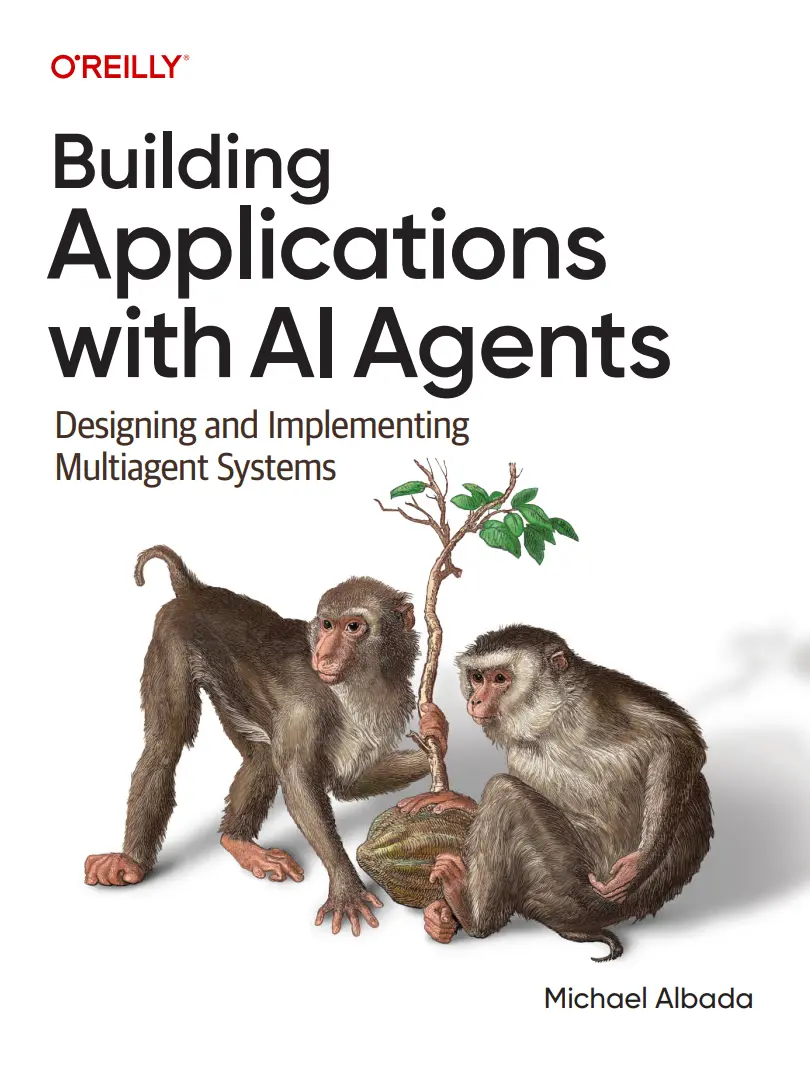
Автор: Albada Michael
Дата выхода: 2025
Издательство: O’Reilly Media, Inc.
Количество страниц: 355
Размер файла: 2,3 МБ
Тип файла: PDF
Добавил: codelibs
Проверить на вирусыCopyright....6
Table of Contents....7
Preface....15
What This Book Is About....16
What This Book Is Not....17
Who This Book Is For....17
Navigating This Book....17
Conventions Used in This Book....19
Using Code Examples....19
O’Reilly Online Learning....20
How to Contact Us....20
Acknowledgments....21
Chapter 1. Introduction to Agents....23
Defining AI Agents....23
The Pretraining Revolution....24
Types of Agents....25
Model Selection....27
From Synchronous to Asynchronous Operations....28
Practical Applications and Use Cases....29
Workflows and Agents....30
Principles for Building Effective Agentic Systems....33
Organizing for Success in Building Agentic Systems....34
Agentic Frameworks....35
LangGraph....35
AutoGen....36
CrewAI....36
OpenAI Agents Software Development Kit (SDK)....36
Conclusion....37
Chapter 2. Designing Agent Systems....39
Our First Agent System....39
Core Components of Agent Systems....42
Model Selection....43
Tools....46
Designing Capabilities for Specific Tasks....46
Tool Integration and Modularity....47
Memory....47
Short-Term Memory....48
Long-Term Memory....48
Memory Management and Retrieval....48
Orchestration....49
Design Trade-Offs....49
Performance: Speed/Accuracy Trade-Offs....49
Scalability: Engineering Scalability for Agent Systems....50
Reliability: Ensuring Robust and Consistent Agent Behavior....51
Costs: Balancing Performance and Expense....52
Architecture Design Patterns....54
Single-Agent Architectures....54
Multiagent Architectures: Collaboration, Parallelism, and Coordination....54
Best Practices....56
Iterative Design....56
Evaluation Strategy....57
Real-World Testing....59
Conclusion....61
Chapter 3. User Experience Design for Agentic Systems....63
Interaction Modalities....64
Text-Based....65
Graphical Interfaces....68
Speech and Voice Interfaces....72
Video-Based Interfaces....75
Combining Modalities for Seamless Experiences....76
The Autonomy Slider....77
Synchronous Versus Asynchronous Agent Experiences....80
Design Principles for Synchronous Experiences....80
Design Principles for Asynchronous Experiences....81
Finding the Balance Between Proactive and Intrusive Agent Behavior....81
Context Retention and Continuity....82
Maintaining State Across Interactions....83
Personalization and Adaptability....84
Communicating Agent Capabilities....85
Communicating Confidence and Uncertainty....86
Asking for Guidance and Input from Users....87
Failing Gracefully....87
Trust in Interaction Design....88
Conclusion....90
Chapter 4. Tool Use....93
LangChain Fundamentals....94
Local Tools....95
API-Based Tools....97
Plug-In Tools....100
Model Context Protocol....103
Stateful Tools....106
Automated Tool Development....107
Foundation Models as Tool Makers....107
Real-Time Code Generation....108
Tool Use Configuration....109
Conclusion....110
Chapter 5. Orchestration....111
Agent Types....112
Reflex Agents....112
ReAct Agents....112
Planner-Executor Agents....113
Query-Decomposition Agents....113
Reflection Agents....113
Deep Research Agents....114
Tool Selection....115
Standard Tool Selection....116
Semantic Tool Selection....119
Hierarchical Tool Selection....123
Tool Execution....127
Tool Topologies....127
Single Tool Execution....128
Parallel Tool Execution....129
Chains....129
Graphs....131
Context Engineering....134
Conclusion....135
Chapter 6. Knowledge and Memory....137
Foundational Approaches to Memory....138
Managing Context Windows....138
Traditional Full-Text Search....139
Semantic Memory and Vector Stores....141
Introduction to Semantic Search....141
Implementing Semantic Memory with Vector Stores....141
Retrieval-Augmented Generation....143
Semantic Experience Memory....144
GraphRAG....145
Using Knowledge Graphs....145
Building Knowledge Graphs....146
Promise and Peril of Dynamic Knowledge Graphs....152
Note-Taking....155
Conclusion....156
Chapter 7. Learning in Agentic Systems....157
Nonparametric Learning....157
Nonparametric Exemplar Learning....157
Reflexion....159
Experiential Learning....163
Parametric Learning: Fine-Tuning....168
Fine-Tuning Large Foundation Models....168
The Promise of Small Models....173
Supervised Fine-Tuning....175
Direct Preference Optimization....180
Reinforcement Learning with Verifiable Rewards....183
Conclusion....184
Chapter 8. From One Agent to Many....185
How Many Agents Do I Need?....185
Single-Agent Scenarios....185
Multiagent Scenarios....192
Swarms....199
Principles for Adding Agents....200
Multiagent Coordination....202
Democratic Coordination....202
Manager Coordination....203
Hierarchical Coordination....204
Actor-Critic Approaches....204
Automated Design of Agent Systems....206
Communication Techniques....211
Local Versus Distributed Communication....211
Agent-to-Agent Protocol....211
Message Brokers and Event Buses....214
Actor Frameworks: Ray, Orleans, and Akka....217
Orchestration and Workflow Engines....221
Managing State and Persistence....223
Conclusion....224
Chapter 9. Validation and Measurement....227
Measuring Agentic Systems....227
Measurement Is the Keystone....228
Integrating Evaluation into the Development Lifecycle....229
Creating and Scaling Evaluation Sets....229
Component Evaluation....231
Evaluating Tools....231
Evaluating Planning....232
Evaluating Memory....234
Evaluating Learning....235
Holistic Evaluation....236
Performance in End-to-End Scenarios....236
Consistency....238
Coherence....239
Hallucination....240
Handling Unexpected Inputs....241
Preparing for Deployment....242
Conclusion....243
Chapter 10. Monitoring in Production....245
Monitoring Is How You Learn....246
Monitoring Stacks....248
Grafana with OpenTelemetry, Loki, and Tempo....249
ELK Stack (Elasticsearch, Logstash/Fluentd, Kibana)....249
Arize Phoenix....250
SigNoz....251
Langfuse....251
Choosing the Right Stack....252
OTel Instrumentation....252
Visualization and Alerting....254
Monitoring Patterns....257
Shadow Mode....257
Canary Deployments....257
Regression Trace Collection....258
Self-Healing Agents....258
User Feedback as an Observability Signal....258
Distribution Shifts....259
Metric Ownership and Cross-Functional Governance....261
Conclusion....263
Chapter 11. Improvement Loops....265
Feedback Pipelines....267
Automated Issue Detection and Root Cause Analysis....272
Human-in-the-Loop Review....273
Prompt and Tool Refinement....276
Aggregating and Prioritizing Improvements....281
Experimentation....282
Shadow Deployments....283
A/B Testing....284
Bayesian Bandits....285
Continuous Learning....287
In-Context Learning....287
Offline Retraining....289
Conclusion....290
Chapter 12. Protecting Agentic Systems....293
The Unique Risks of Agentic Systems....294
Emerging Threat Vectors....295
Securing Foundation Models....297
Defensive Techniques....298
Red Teaming....300
Threat Modeling with MAESTRO....303
Protecting Data in Agentic Systems....305
Data Privacy and Encryption....305
Data Provenance and Integrity....307
Handling Sensitive Data....308
Securing Agents....310
Safeguards....310
Protections from External Threats....312
Protections from Internal Failures....314
Conclusion....318
Chapter 13. Human-Agent Collaboration....319
Roles and Autonomy....319
The Changing Role of Humans in Agent Systems....320
Aligning Stakeholders and Driving Adoption....321
Scaling Collaboration....322
Agent Scope and Organizational Roles....324
Shared Memory and Context Boundaries....325
Trust, Governance, and Compliance....327
The Lifecycle of Trust....327
Accountability Frameworks....328
Escalation Design and Oversight....331
Privacy and Regulatory Compliance....332
Conclusion: The Future of Human-Agent Teams....334
Glossary....337
Index....341
About the Author....354
Colophon....354
Generative AI has revolutionized how organizations tackle problems, accelerating the journey from concept to prototype to solution. As the models become increasingly capable, we have witnessed a new design pattern emerge: AI agents. By combining tools, knowledge, memory, and learning with advanced foundation models, we can now sequence multiple model inferences together to solve ambiguous and difficult problems. From coding agents to research agents to analyst agents and more, we've already seen agents accelerate teams and organizations. While these agents enhance efficiency, they often require extensive planning, drafting, and revising to complete complex tasks, and deploying them remains a challenge for many organizations, especially as technology and research rapidly develops.
This book is your indispensable guide through this intricate and fast-moving landscape. Author Michael Albada provides a practical and research-based approach to designing and implementing single- and multiagent systems. It simplifies the complexities and equips you with the tools to move from concept to solution efficiently.
- Understand the distinct features of foundation model-enabled AI agents
- Discover the core components and design principles of AI agents
- Explore design trade-offs and implement effective multiagent systems
- Design and deploy tailored AI solutions, enhancing efficiency and innovation in your field


