-
1C
-
Agda
-
Agile/Scrum
-
Alef
-
APL
-
Assembler
-
AWK
-
Basic
-
Beta Programming Language
-
Big Data/DataScience
-
C
-
C#
-
C++
-
Cobol
-
Crystal
-
CSS
-
D
-
Dart
-
DataBase (SQL)
-
Delphi
-
F#
-
Flutter
-
Fortran
-
GameDev
-
Git
-
Go (Golang)
-
GPT/AI/ИИ
-
Hacking and Security
-
Haskell
-
HTML
-
Java
-
JavaScript (JS)
-
Julia
-
Kotlin
-
Machine Learning (ML)
-
Natural language processing (NLP)
-
.NET (.NET Core)
-
Pascal
-
PHP
-
Python
-
R
-
Ruby
-
Rust
-
Scratch
-
Swift
-
UML
-
UX/UI
-
Visual Basic
-
Wolfram
-
XML
-
АСУ
-
Проектирование/System Design
-
Сети/Network
-
Статьи
-
Схемотехника/электронные схемы
-
1C
-
Agda
-
Agile/Scrum
-
Alef
-
APL
-
Assembler
-
AWK
-
Basic
-
Beta Programming Language
-
Big Data/DataScience
-
C
-
C#
-
C++
-
Cobol
-
Crystal
-
CSS
-
D
-
Dart
-
DataBase (SQL)
-
Delphi
-
F#
-
Flutter
-
Fortran
-
GameDev
-
Git
-
Go (Golang)
-
GPT/AI/ИИ
-
Hacking and Security
-
Haskell
-
HTML
-
Java
-
JavaScript (JS)
-
Julia
-
Kotlin
-
Machine Learning (ML)
-
Natural language processing (NLP)
-
.NET (.NET Core)
-
Pascal
-
PHP
-
Python
-
R
-
Ruby
-
Rust
-
Scratch
-
Swift
-
UML
-
UX/UI
-
Visual Basic
-
Wolfram
-
XML
-
АСУ
-
Проектирование/System Design
-
Сети/Network
-
Статьи
-
Схемотехника/электронные схемы
Меню
Beautiful C++: 30 Core Guidelines for Writing Clean, Safe, and Fast Code
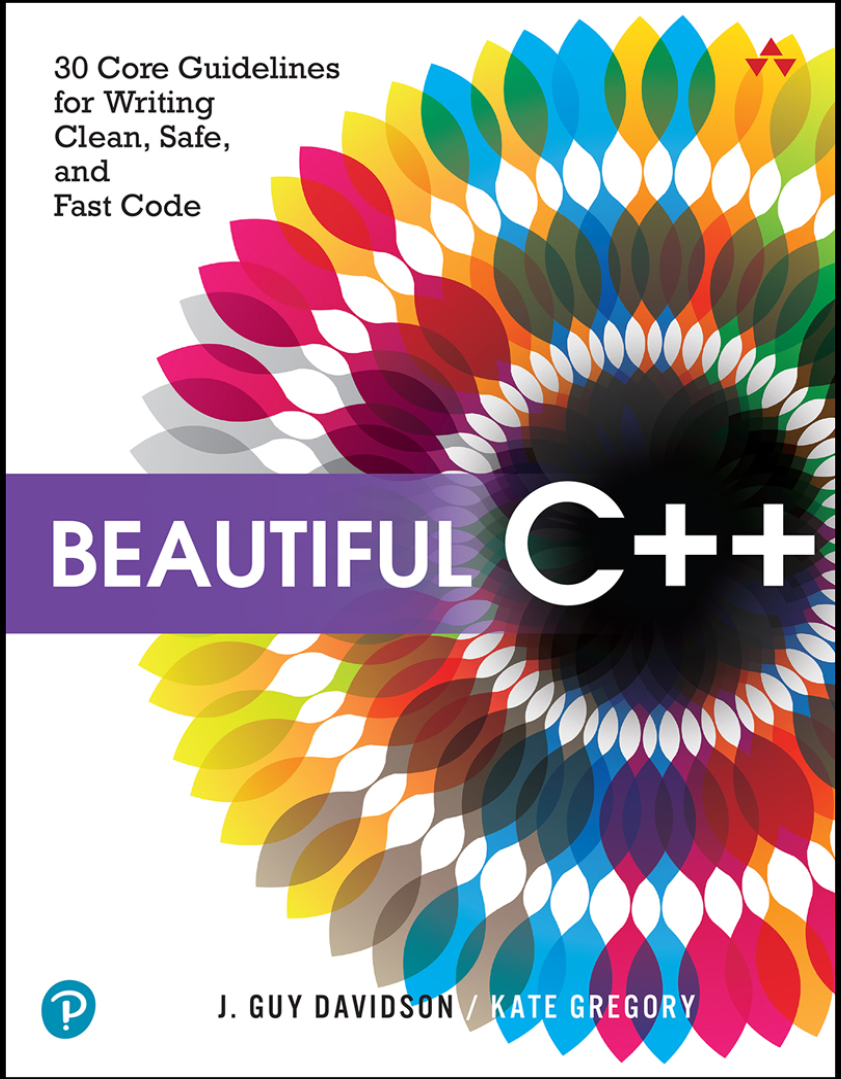
Автор: Davidson J. Guy , Gregory Kate
Дата выхода: 2022
Издательство: Addison-Wesley
Количество страниц: 773
Размер файла: 4,9 МБ
Тип файла: PDF
Добавил: codelibs
Проверить на вирусыAbout This eBook....2
Halftitle Page....3
Title Page....4
Copyright Page....5
Pearson’s Commitment to Diversity, Equity, and Inclusion....6
Contents....8
Selected C++ Core Guidelines....11
Foreword....15
Preface....16
About This Book....18
Access the Code....20
Acknowledgments....21
About the Authors....23
Section 1: Bikeshedding is bad....25
Chapter 1.1. P.2: Write in ISO Standard C++....26
What is ISO Standard C++?....26
Encapsulating variations....28
Learning the old ways....32
Staying on top of developments to the standard....34
Chapter 1.2. F.51: Where there is a choice, prefer default arguments over overloading....37
Introduction....37
Refining your abstraction: Additional arguments or overloading?....38
The subtleties of overload resolution....40
Back to the example....42
The unambiguous nature of default arguments....44
Alternatives to overloading....46
Sometimes you must overload....47
Summary....48
Chapter 1.3. C.45: Don’t define a default constructor that only initializes data members; use in-class member initializers instead....49
Why have default constructors anyway?....49
How do you initialize a data member?....50
What happens when two people maintain a class?....54
Summary....57
Chapter 1.4. C.131: Avoid trivial getters and setters....58
An archaic idiom....58
Abstraction....59
Mere Encapsulation....62
Class Invariants....67
Nouns and Verbs....69
Summary....70
Chapter 1.5. ES.10: Declare one name (only) per declaration....71
Let me introduce you....71
Backward compatibility....75
Writing clearer declarations....77
Structured binding....78
Summary....79
Chapter 1.6. NR.2: Don’t insist to have only a single return-statement in a function....80
Rules evolve....80
Ensuring cleanup....82
Using RAII....85
Writing good functions....89
Summary....91
Section 2: Don’t hurt yourself....92
Chapter 2.1. P.11: Encapsulate messy constructs, rather than spreading through the code....93
All in one gulp....93
What it means to encapsulate a messy construct....96
The purpose of language and the nature of abstraction....98
Levels of abstraction....102
Abstraction by refactoring and drawing the line....103
Summary....104
Chapter 2.2. I.23: Keep the number of function arguments low....105
How much should they earn?....105
Simplifying matters through abstraction....107
Do as little as possible, but no less....111
Real-life examples....113
Summary....115
Chapter 2.3. I.26: If you want a cross-compiler ABI, use a C-style subset....116
Creating libraries....116
What is an ABI?....117
Paring back to the absolute minimum....119
Exception propagation....121
Summary....123
Chapter 2.4. C.47: Define and initialize member variables in the order of member declaration....125
Summary....135
Chapter 2.5. CP.3: Minimize explicit sharing of writable data....137
Traditional execution model....137
Wait, there’s more....140
Avoiding deadlocks and data races....142
Setting aside locks and mutexes....145
Summary....148
Chapter 2.6. T.120: Use template metaprogramming only when you really need to....149
std::enable_if => requires....159
Summary....164
Section 3: Stop using that....166
Chapter 3.1. I.11: Never transfer ownership by a raw pointer (T*) or reference (T&)....167
Using the free store....167
The performance cost of smart pointers....170
Using unadorned reference semantics....172
gsl::owner....173
Summary....176
Chapter 3.2. I.3: Avoid singletons....178
Global objects are bad....178
Singleton Design Pattern....179
Static initialization order fiasco....179
How to hide a singleton....182
But only one of these should ever exist....184
Wait a moment…....186
Summary....188
Chapter 3.3. C.90: Rely on constructors and assignment operators, not memset and memcpy....189
Chasing maximum performance....189
The horrendous overhead of the constructor....190
The simplest possible class....191
What is the standard talking about anyway?....194
But what about memcpy?....197
Never underestimate the compiler....199
Summary....201
Chapter 3.4. ES.50: Don’t cast away const....202
Story time....202
Dealing with rather more data....203
The const firewall....205
Implementing a dual interface....206
Caching and lazy evaluation....208
Two types of const....210
Surprises with const....212
Summary....214
Chapter 3.5. E.28: Avoid error handling based on global state (e.g. errno)....215
Error handling is hard....215
C and errno....215
Return codes....217
Exceptions....218
....219
Boost.Outcome....219
Why is error handling so hard?....221
Light at the end of the tunnel....223
Summary....224
Chapter 3.6. SF.7: Don’t write using namespace at global scope in a header file....225
Don’t do this....225
Disambiguation....226
Using using....227
Where do the symbols go?....229
An altogether more insidious problem....232
Solving the problem of cluttered scope resolution operators....234
The temptation and The Fall....236
Summary....237
Section 4: Use this new thing properly....238
Chapter 4.1. F.21: To return multiple “out” values, prefer returning a struct or tuple....239
The shape of a function signature....239
Documenting and annotating....240
Now you can return an object....242
You can also return a tuple....245
Passing and returning by non-const reference....249
Summary....253
Chapter 4.2. Enum.3: Prefer class enums over “plain” enums....254
Constants....254
Scoped enumerations....257
Underlying type....259
Implicit conversion....261
Summary....263
Postscript....264
Chapter 4.3. ES.5: Keep scopes small....265
The nature of scope....265
Block scope....266
Namespace scope....268
Class scope....271
Function parameter scope....273
Enumeration scope....274
Template parameter scope....276
Scope as context....277
Summary....278
Chapter 4.4. Con.5: Use constexpr for values that can be computed at compile time....279
From const to constexpr....279
Default C++....282
Using constexpr....283
inline....288
consteval....290
constinit....291
Summary....292
Chapter 4.5. T.1: Use templates to raise the level of abstraction of code....294
Story time....294
Raising the level of abstraction....297
Function templates and abstraction....299
Class templates and abstraction....302
Naming is hard....304
Summary....305
Chapter 4.6. T.10: Specify concepts for all template arguments....307
How did we get here?....307
Constraining your parameters....310
How to abstract your concepts....314
Factoring via concepts....317
Summary....319
Section 5: Write code well by default....321
Chapter 5.1. P.4: Ideally, a program should be statically type safe....322
Type safety is a security feature of C++....322
Union....324
Casting....326
Unsigned....330
Buffers and sizes....333
Summary....335
Chapter 5.2. P.10: Prefer immutable data to mutable data....336
The wrong defaults....336
constness in function declarations....339
Summary....344
Chapter 5.3. I.30: Encapsulate rule violations....346
Hiding the unsightly things in life....346
Keeping up appearances....348
Summary....355
Chapter 5.4. ES.22: Don’t declare a variable until you have a value to initialize it with....357
The importance of expressions and statements....357
C-style declaration....358
Declare-then-initialize....359
Maximally delayed declaration....361
Localization of context-specific functionality....364
Eliminating state....367
Summary....369
Chapter 5.5. Per.7: Design to enable optimization....370
Maximizing the frame rate....370
Working further from the metal....372
Optimization through abstraction....376
Summary....379
Chapter 5.6. E.6: Use RAII to prevent leaks....380
Deterministic destruction....380
Leaking away files....383
Why are we bothering?....387
This all seems a bit much: Future possibilities....389
Where can I get this?....393
Envoi....396
Afterword....398
Index....400
Code Snippets....431
Writing great C++ code needn't be difficult. The C++ Core Guidelines can help every C++ developer design and write C++ programs that are exceptionally reliable, efficient, and well-performing. But the Guidelines are so jam-packed with excellent advice that it's hard to know where to start. Start here, with Beautiful C++.Expert C++ programmers Guy Davidson and Kate Gregory identify 30 Core Guidelines you'll find especially valuable and offer detailed practical knowledge for improving your C++ style. For easy reference, this book is structured to align closely with the official C++ Core Guidelines website.Throughout, Davidson and Gregory offer useful conceptual insights and expert sample code, illuminate proven ways to use both new and longstanding language features more successfully, and show how to write programs that are more robust and performant by default.
- Avoid "bikeshedding": stop wasting valuable time on trivia
- Don't hurt yourself by writing code that will cause problems later
- Know which legacy features to avoid and the modern features to use instead
- Use newer features properly, to get their benefits without creating new problems
- Default to higher-quality code that's statically type-safe, leak resistant, and easier to evolve
- Use the Core Guidelines with any modern C++ version: C++20, C++17, C++14, or C++11
There's something here to improve virtually every program you write, design, or maintain.


