-
1C
-
Agda
-
Agile/Scrum
-
Alef
-
APL
-
Assembler
-
AWK
-
Basic
-
Beta Programming Language
-
Big Data/DataScience
-
C
-
C#
-
C++
-
Cobol
-
Crystal
-
CSS
-
D
-
Dart
-
DataBase (SQL)
-
Delphi
-
F#
-
Flutter
-
Fortran
-
GameDev
-
Git
-
Go (Golang)
-
GPT/AI/ИИ
-
Hacking and Security
-
Haskell
-
HTML
-
Java
-
JavaScript (JS)
-
Julia
-
Kotlin
-
Machine Learning (ML)
-
Natural language processing (NLP)
-
.NET (.NET Core)
-
Pascal
-
PHP
-
Python
-
R
-
Ruby
-
Rust
-
Scratch
-
Swift
-
UML
-
UX/UI
-
Visual Basic
-
Wolfram
-
XML
-
АСУ
-
Проектирование/System Design
-
Сети/Network
-
Статьи
-
Схемотехника/электронные схемы
-
1C
-
Agda
-
Agile/Scrum
-
Alef
-
APL
-
Assembler
-
AWK
-
Basic
-
Beta Programming Language
-
Big Data/DataScience
-
C
-
C#
-
C++
-
Cobol
-
Crystal
-
CSS
-
D
-
Dart
-
DataBase (SQL)
-
Delphi
-
F#
-
Flutter
-
Fortran
-
GameDev
-
Git
-
Go (Golang)
-
GPT/AI/ИИ
-
Hacking and Security
-
Haskell
-
HTML
-
Java
-
JavaScript (JS)
-
Julia
-
Kotlin
-
Machine Learning (ML)
-
Natural language processing (NLP)
-
.NET (.NET Core)
-
Pascal
-
PHP
-
Python
-
R
-
Ruby
-
Rust
-
Scratch
-
Swift
-
UML
-
UX/UI
-
Visual Basic
-
Wolfram
-
XML
-
АСУ
-
Проектирование/System Design
-
Сети/Network
-
Статьи
-
Схемотехника/электронные схемы
Меню
API Design for C++. 2 Ed
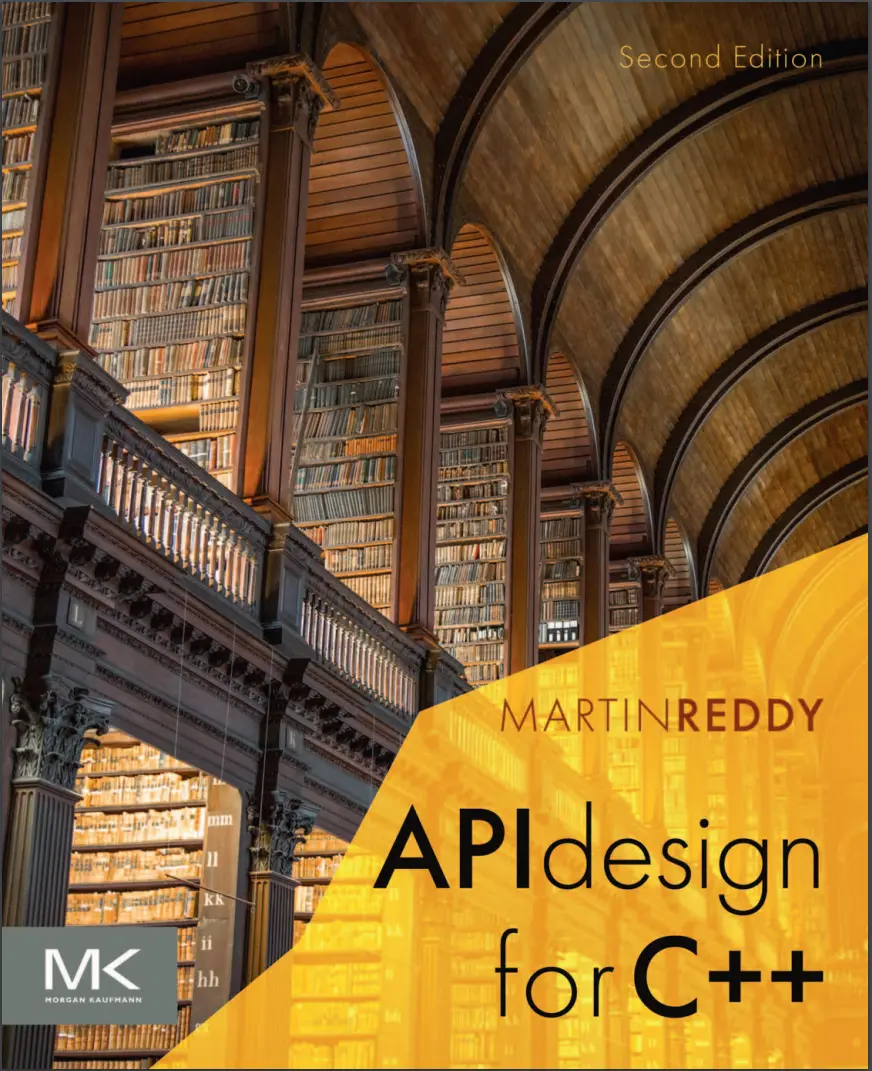
Автор: Reddy Martin
Дата выхода: 2024
Издательство: Morgan Kaufmann Publishers
Количество страниц: 650
Размер файла: 4,2 МБ
Тип файла: PDF
Добавил: codelibs
Проверить на вирусыFront Cover....1
API Design for C++....2
API Design for C++....4
Copyright....5
Contents....6
Author biography....12
Foreword....14
Preface....16
Preface to the second edition....16
What is application programming interface design?....16
Why should you read this book?....17
Who is the target audience?....18
Focusing on C++....18
Conventions....19
Book website....20
Acknowledgments....22
1 - Introduction....24
What are APIs?....24
Contracts and contractors....24
APIs in C++....26
What's different about API design?....27
Why should you use APIs?....30
More robust code....30
Code reuse....31
Parallel development....33
When should you avoid APIs?....34
API examples....36
Layers of APIs....36
A real-life example....39
Libraries, frameworks, and software development kits....40
File formats and network protocols....42
About this book....44
2 - Qualities....48
Model the problem domain....48
Provide a good abstraction....48
Model the key objects....50
Solve the core problems....52
Hide implementation details....54
Physical hiding: Declaration versus definition....54
Logical hiding: Encapsulation....56
Hide member variables....58
Hide implementation methods....61
Hide implementation classes....63
Minimally complete....65
Don't overpromise....66
Don't repeat yourself....67
Convenience APIs....68
Add virtual functions judiciously....71
Easy to use....73
Discoverable....73
Difficult to misuse....74
Consistent....77
Orthogonal....80
Robust resource allocation....83
Platform independent....86
Loosely coupled....88
Coupling by name only....90
Reducing class coupling....91
Intentional redundancy....92
Manager classes....94
Callbacks, observers, and notifications....97
Callback functions....98
Observers....100
Notifications....102
Stable, documented, and tested....103
3 - Patterns....104
Pimpl idiom....106
Using pimpl....106
Copy semantics....110
Pimpl and smart pointers....111
Advantages of pimpl....112
Disadvantages of pimpl....113
Opaque pointers in C....114
Singleton....116
Implementing singletons in C++....117
Singletons and thread safety....119
Singleton versus dependency injection....119
Singleton versus Monostate....121
Singleton versus session state....123
Factory Methods....124
Abstract base classes and interfaces....124
Simple factory example....126
Extensible factory example....128
API wrapping patterns....130
The Proxy pattern....131
The Adapter pattern....133
The Façade pattern....136
Observer pattern....138
Model–View–Controller....139
Implementing the Observer pattern....140
Push versus pull observers....143
4 - Design....146
A case for good design....146
Accruing technical debt....147
Paying back the debt....149
Design for the long term....151
Gathering functional requirements....152
What are functional requirements?....153
Example functional requirements....154
Maintaining the requirements....155
Creating use cases....155
Developing use cases....156
Use case templates....157
Writing good use cases....158
Requirements and agile development....160
Elements of API design....162
Architecture design....165
Developing an architecture....166
Architecture constraints....167
Identifying the major abstractions....169
Inventing the key objects....171
Architectural patterns....174
Communicating the architecture....176
Class design....177
Object-oriented concepts....178
Class design options....179
The SOLID principles....180
Using inheritance....180
Liskov substitution principle....182
Private inheritance....184
Composition....185
The open/closed principle....186
The Law of Demeter....188
Class naming....189
Function design....190
Function design options....190
Function naming....191
Function parameters....192
Error handling....196
5 - Styles....202
Flat C APIs....203
ANSI C features....204
Benefits of an ANSI C API....205
Writing an API in ANSI C....206
Calling C functions from C++....208
Case study: FMOD C API....209
Object-oriented C++ APIs....209
Advantages of object-oriented APIs....210
Disadvantages of object-oriented APIs....210
Case study: FMOD C++ API....211
Template-based APIs....212
An example template-based API....212
Templates versus macros....213
Advantages of template-based APIs....214
Disadvantages of template-based APIs....215
Functional APIs....216
Functional programming concepts....216
An example functional API....218
Advantages of functional APIs....219
Disadvantages of functional APIs....219
Data-driven APIs....220
Advantages of data-driven APIs....222
Disadvantages of data-driven APIs....224
Supporting variant argument lists....224
Case study: FMOD data-driven API....225
Data-driven Web services....226
Idempotency....227
6 - C++ usage....232
Namespaces....232
Constructors and assignment....234
Defining constructors and assignment....236
The explicit keyword....238
Const correctness....239
Method const correctness....239
Parameter const correctness....241
Return value const correctness....242
Templates....243
Template terminology....243
Implicit instantiation API design....246
Explicit instantiation API design....247
Operator overloading....250
Overloadable operators....251
Free operators versus member operators....252
Adding operators to a class....254
Operator syntax....256
Conversion operators....259
Function parameters....259
Pointer versus reference parameters....259
Default arguments....261
Avoid #define for constants....262
Avoid using friends....265
Exporting symbols....267
Coding conventions....270
7 - C++ revisions....274
Which C++ revision to use....274
C++11 API features....275
Move constructors and the Rule of Five....275
Default and deleted functions....279
Object construction....281
Initializer list constructors....284
Smart pointers....284
Enum classes....287
Override and final specifiers....289
The noexcept specifier....292
Inline namespaces....293
Type aliases with using....295
User-defined literals....296
Alternate function style....298
Tuples....299
Constant expressions....300
The nullptr keyword....302
Variadic templates....303
Migrating to C++11....305
C++14 API features....306
The auto return type....307
The deprecated attribute....308
Variable templates....309
Const expression improvements....310
Binary literals and digit separators....311
Migrating to C++14....311
C++17 API features....312
Inline variables....312
String views....314
Optional....316
Any....319
Variant....321
Nested namespaces....323
Fold expressions....324
Checking for header availability....326
Byte type....328
The maybe_unused attribute....328
Migrating to C++17....330
C++20 API features....330
Modules....331
Named Modules....331
Header units....333
The spaceship operator....334
Constraints and concepts....339
Abbreviated function templates....341
The consteval specifier....342
The constinit specifier....343
Migrating to C++20....344
C++23 API features....345
Expected values....346
Multidimensional subscript operator....347
Preprocessor directives....348
Migrating to C++23....350
8 - Performance....352
Pass input arguments by const reference....354
Minimize #include dependencies....356
Avoid “Winnebago” headers....356
Forward declarations....356
Redundant #include guards....359
Declaring constants....361
The constexpr, consteval, and constinit keywords....363
Initialization lists....364
Memory optimization....366
Don't inline functions until you need to....371
Copy on write....374
Iterating over elements....379
Iterators....379
Random access....380
Array references....381
Extern templates....382
Performance analysis....383
Time-based analysis....384
Memory-based analysis....387
Multithreading analysis....388
9 - Concurrency....390
Multithreading with C++....390
Terminology....392
Data races and race conditions....392
Thread safety....393
Reentrancy....394
Asynchronous tasks....395
Parallelism....395
Accessing shared data....396
Stateless APIs....396
Initializing shared data....398
Synchronized data access....400
Concurrent API design....401
Concurrency best practices....401
Thread-Safe Interface pattern....402
10 - Versioning....406
Version numbers....406
Version number significance....406
Esoteric numbering schemes....408
Creating a version API....409
Software branching strategies....411
Branching strategies....411
Branching policies....411
APIs and parallel branches....413
File formats and parallel products....414
Life cycle of an API....415
Levels of compatibility....416
Backward compatibility....417
Functional compatibility....418
Source compatibility....418
Binary/application binary interface compatibility....419
Binary incompatible API changes....420
Binary compatible API changes....421
Forward compatibility....422
How to maintain backward compatibility....424
Adding functionality....424
Changing functionality....425
Deprecating functionality....427
Removing functionality....429
Inline namespaces for versioning....430
API reviews....431
The purpose of API reviews....432
Prerelease API reviews....433
Precommit API reviews....435
11 - Documentation....438
Reasons to write documentation....438
Defining behavior....439
Documenting the interface's contract....441
Communicating behavioral changes....443
What to document....444
Types of documentation....446
Automated API documentation....446
Overview documentation....448
Examples and tutorials....449
Release notes....450
License information....451
Documentation usability....453
Inclusive language....455
Using Doxygen....457
The configuration file....457
Comment style and commands....458
API comments....459
File comments....460
Class comments....461
Method comments....462
Enum comments....463
Sample header with documentation....463
12 - Testing....466
Reasons to write tests....466
Types of API testing....469
Unit testing....470
Integration testing....473
Performance testing....475
Writing good tests....477
Qualities of a good test....477
What to test....479
Focusing the testing effort....481
Working with quality assurance....481
Writing testable code....482
Test-driven development....482
Stub and mock objects....485
Testing private code....489
Using assertions....492
Contract programming....493
Record and playback functionality....496
Supporting internationalization....498
Automated testing tools....499
Test harnesses....499
Code coverage....503
Bug tracking....506
Continuous build system....507
13 - Objective-C and Swift....510
Interface design in C++ and Objective-C....510
Data hiding in Objective-C....512
Objective-C behind a C++ API....514
C++ behind an Objective-C API....517
C++ behind a Swift API....520
14 - Scripting....524
Adding script bindings....524
Extending versus embedding....524
Advantages of scripting....525
Language compatibility issues....527
Crossing the language barrier....528
Script binding technologies....529
Boost Python....529
Simplified wrapper and interface generator....530
Python-SIP....530
Component object model automation....531
Common object request broker architecture....532
Adding Python bindings with Boost Python....533
Building Boost Python....533
Wrapping a C++ API with Boost Python....534
Constructors....536
Extending the Python API....537
Inheritance in C++....539
Cross-language polymorphism....541
Supporting iterators....542
Putting it all together....543
Adding Ruby bindings with SWIG....544
Wrapping a C++ API with SWIG....545
Tuning the Ruby API....547
Constructors....548
Extending the Ruby API....548
Inheritance in C++....549
Cross-language polymorphism....551
Putting it all together....552
15 - Extensibility....556
Extending via plugins....556
Plugin model overview....557
Plugin system design issues....560
Implementing plugins in C++....562
The plugin API....563
An example plugin....565
The Plugin manager....567
Plugin versioning....570
Extending via inheritance....572
Adding functionality....572
Modifying functionality....573
Inheritance and the standard library....574
Inheritance and enums....576
The Visitor pattern....577
Extending via templates....583
Policy-based templates....583
The curiously recurring template pattern....585
A: Libraries....588
Static libraries....588
Dynamic libraries....589
Dynamic libraries as plugins....591
Importing and exporting functions....592
The Dynamic Link Library entry point....593
Creating libraries on Windows....594
Useful Windows utilities....595
Loading plugins on Windows....595
Creating static libraries on Linux....596
Creating dynamic libraries on Linux....597
Shared library entry points....598
Useful Linux utilities....599
Loading plugins on Linux....600
Finding dynamic libraries at run time....601
Creating static libraries on macOS....602
Creating dynamic libraries on macOS....602
Frameworks on macOS....603
Text-based InstallAPI....604
Finding dynamic libraries at run time....605
References....606
Index....612
A....612
B....616
C....618
D....625
E....627
F....628
G....630
H....631
I....631
J....633
K....633
L....633
M....634
N....636
O....636
P....638
Q....640
R....640
S....641
T....644
U....646
V....646
W....647
X....648
Z....648
Back Cover....650
API Design for C++, Second Edition provides a comprehensive discussion of Application Programming Interface (API) development, from initial design through implementation, testing, documentation, release, versioning, maintenance, and deprecation. It is the only book that teaches the strategies of C++ API development, including interface design, versioning, scripting, and plug-in extensibility. Drawing from the author's experience on large scale, collaborative software projects, the text offers practical techniques of API design that produce robust code for the long-term. It presents patterns and practices that provide real value to individual developers as well as organizations. The Second Edition includes all new material fully updated for the latest versions of C++, including a new chapter on concurrency and multithreading, as well as a new chapter discussing how Objective C++ and C++ code can co-exist and how a C++ API can be accessed from Swift programs. In addition, it explores often overlooked issues, both technical and non-technical, contributing to successful design decisions that produce high quality, robust, and long-lived APIs. It focuses on various API styles and patterns that will allow you to produce elegant and durable libraries. A discussion on testing strategies concentrates on automated API testing techniques rather than attempting to include end-user application testing techniques such as GUI testing, system testing, or manual testing.
- Teaches the strategies of C++ API development, including design, versioning, documentation, testing, scripting, and extensibility
- Includes extensive code examples that illustrate each concept, with fully functional examples and working source code for experimentation available online
- Covers various API styles and patterns, with a focus on practical and efficient designs for large-scale, long-term projects
- Includes updated URLs and ensures all code examples continue to work with modern compilers and supporting tools


