-
1C
-
Agda
-
Agile/Scrum
-
Alef
-
APL
-
Assembler
-
AWK
-
Basic
-
Beta Programming Language
-
Big Data/DataScience
-
C
-
C#
-
C++
-
Cobol
-
Crystal
-
CSS
-
D
-
Dart
-
DataBase (SQL)
-
Delphi
-
F#
-
Flutter
-
Fortran
-
GameDev
-
Git
-
Go (Golang)
-
GPT/AI/ИИ
-
Hacking and Security
-
Haskell
-
HTML
-
Java
-
JavaScript (JS)
-
Julia
-
Kotlin
-
Machine Learning (ML)
-
Natural language processing (NLP)
-
.NET (.NET Core)
-
Pascal
-
PHP
-
Python
-
R
-
Ruby
-
Rust
-
Scratch
-
Swift
-
UML
-
UX/UI
-
Visual Basic
-
Wolfram
-
XML
-
АСУ
-
Проектирование/System Design
-
Сети/Network
-
Статьи
-
Схемотехника/электронные схемы
-
1C
-
Agda
-
Agile/Scrum
-
Alef
-
APL
-
Assembler
-
AWK
-
Basic
-
Beta Programming Language
-
Big Data/DataScience
-
C
-
C#
-
C++
-
Cobol
-
Crystal
-
CSS
-
D
-
Dart
-
DataBase (SQL)
-
Delphi
-
F#
-
Flutter
-
Fortran
-
GameDev
-
Git
-
Go (Golang)
-
GPT/AI/ИИ
-
Hacking and Security
-
Haskell
-
HTML
-
Java
-
JavaScript (JS)
-
Julia
-
Kotlin
-
Machine Learning (ML)
-
Natural language processing (NLP)
-
.NET (.NET Core)
-
Pascal
-
PHP
-
Python
-
R
-
Ruby
-
Rust
-
Scratch
-
Swift
-
UML
-
UX/UI
-
Visual Basic
-
Wolfram
-
XML
-
АСУ
-
Проектирование/System Design
-
Сети/Network
-
Статьи
-
Схемотехника/электронные схемы
Меню
Ultimate Neural Network Programming with Python: Create Powerful Modern AI Systems by Harnessing Neural Networks with Python, Keras, and TensorFlow
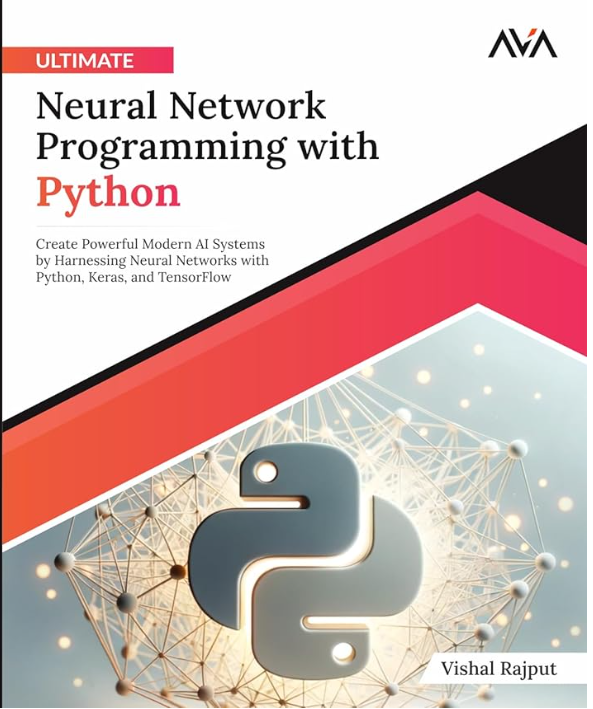
Автор: Rajput Vishal
Дата выхода: 2023
Издательство: Orange Education Pvt Ltd, AVA™
Количество страниц: 405
Размер файла: 4,2 МБ
Тип файла: PDF
Добавил: codelibs
Проверить на вирусы Дополнительные материалыCover Page....2
Title Page....3
Copyright Page....4
Dedication Page....5
About the Author....6
About the Technical Reviewers....7
Welcome note....9
Acknowledgements....13
Preface....14
Errata....17
Table of Contents....20
1. Understanding AI History....28
Structure....28
Evolution of AI....28
The early history of AI....28
The most crucial development in the History of AI....31
AI started evolving into new fields....32
AI starts taking its modern form....32
Understanding Intelligent Behavior....33
AI beats humans at chess....33
AI learning reasoning and language....34
AI starts playing poker....35
Conquering GO and Dota 2....36
An experience with ChatGPT....37
Difference between Artificial Intelligence, Machine Learning, and Deep Learning....39
Formally defining AI terms....40
Learning representations from data....42
Sub-Fields of AI....44
Artificial Intelligence (AI)....44
Machine Learning (ML)....45
Deep Learning (DL)....45
Early Models of Neuron-Inspired Networks....46
Understanding biological neurons....46
McCulloch-Pitts model of a neuron....47
Multilayer Perceptron (MLP)....48
Conclusion....52
2. Setting up Python Workflow for AI Development....54
Structure....54
Setting up Python Environment....56
Installing Python....56
Getting Anaconda for Data Science Environment Setup....57
Setting up a Virtual Environment....57
Installing packages....58
Setting up VS Code....58
Installing Git....60
Setting up GitHub with VS Code....61
Concepts of OOPS....65
Encapsulation....67
Accessing Variables....69
Inheritance....71
Conclusion....76
3. Python Libraries for Data Scientists....77
Structure....77
Web Scraping....77
Regex....83
Multi-Threading and Multi-Processing....91
Multi-Threading....91
Multi-Processing....93
Pandas Basics....95
Conclusion....109
4. Foundational Concepts for Effective Neural Network Training....111
Structure....111
Activation Functions....111
RBF, Universal Approximators, and Curse of Dimensionality....115
Radial Bias Function....115
Neural Networks are universal approximators....117
The curse of dimensionality....118
Overfitting, Bias-Variance, and Generalization....120
Overfitting problem....120
Regularization and effective parameters....122
Dropout....124
Early stopping and validation set....124
Bias-Variance trade-off....125
Generalization....126
Conclusion....127
5. Dimensionality Reduction, Unsupervised Learning and Optimizations....129
Structure....129
Dimensionality reduction....129
Principal component analysis (PCA)....129
T-SNE....132
Non-linear PCA....137
Unsupervised learning....137
Clustering....138
Semi-supervised learning....144
Generalizing active learning to multi-class....147
Self-supervised learning....150
Version space....153
Understanding optimization through SVM....158
Conclusion....165
6. Building Deep Neural Networks from Scratch....167
Structure....167
Coding neurons....167
A single neuron....167
Layer of neurons....168
Understanding lists, arrays, tensors, and their operations....171
Dot product and vector addition....172
Cross-product, transpose, and order....173
Understanding neural networks through NumPy....174
Neural networks using NumPy....174
Processing batch of data....175
Creating a multi-layer network....176
Dense layers....177
Activation functions....181
Calculating loss through categorical cross-entropy loss....187
Calculating accuracy s....194
Conclusion....197
7. Derivatives, Backpropagation, and Optimizers....199
Structure....199
Weights Optimization....199
Derivatives....204
Partial Derivatives....208
Backpropagation....209
Optimizers: SGD, Adam, and so on....220
Gradient-based optimization....221
Momentum-based optimization....222
RMSProp....222
Adam....223
Conclusion....242
8. Understanding Convolution and CNN Architectures....243
Structure....243
Intricacies of CNN....243
Local Patterns and Global Patterns....244
Spatial Hierarchies and Abstraction....244
Convolution Operation and Feature Maps....246
Pooling....248
Padding....248
Stride....249
Introduction to CNN-based Networks....253
Understanding the Complete Flow of CNN-based Network....254
VGG16....257
Inception Module: Naïve and Improved Version....258
ResNet....261
Other Variants of ResNet....263
FractalNet and DenseNet....264
Scaling Conv Networks: Efficient Net Architecture....266
Different Types of Convolutions....268
Depth-Separable Convolution....268
Conclusion....270
9. Understanding Basics of TensorFlow and Keras....272
Structure....272
A Brief Look at Keras....272
Understanding TensorFlow Internals....278
Tensors....278
Computational Graphs....281
Operations (Ops)....282
Automatic Differentiation....282
Sessions....283
Variables....283
Eager Execution....284
Layers and Models (Keras)....285
TensorFlow vs. PyTorch vs. Theano....285
TensorFlow vs. PyTorch....285
TensorFlow vs. Theano....286
TensorFlow: Layers, Activations, and More....287
Types of Layers....287
Dense Layer (Fully Connected Layer)....287
Convolution Layer....289
Max Pooling Layer....289
Dropout Layer....289
Recurrent Layer (LSTM)....290
Embedding Layer....290
Flatten Layer....290
Batch Normalization Layer....290
Global Average Pooling Layer....291
Upsampling/Transposed Convolution Layer....291
Activation Functions....291
Optimizers....294
Weight Initialization....294
Loss Functions....296
Multi-Input Single-Output Network with Custom Callbacks....297
Conclusion....302
10. Building End-to-end Image Segmentation Pipeline....303
Structure....303
Fine-tuning and Interpretability....303
Power of Fine-Tuning in Deep Learning....303
SHAP - An Intuitive Way to Interpret Machine Learning Models....304
Structuring Deep Learning Code....307
Project Structure....307
Python modules and packages....308
Documentation....309
Unit testing....310
Debugging....311
Logging....313
Building End-to-end Segmentation Pipeline....315
UNet and Attention Gates....316
Config....319
Dataloader....319
Model building....323
Understanding Attention block....324
Executor....332
Utils....335
Evaluation....338
main....341
Conclusion....345
11. Latest Advancements in AI....346
Structure....346
Transformers: Improving NLP Using Attention....346
Recurrent Neural Network (RNN)....346
Long-Short Term Memory (LSTM)....347
Self-Attention....348
Example to understand the concept:....348
Understanding Key, Query, and Value....350
Example to understand the concept:....350
Transformer Architecture....354
ChatGPT/GPT Overview....356
Object Detection: Understanding YOLO....357
Object Detector Architecture Breakdown....360
Backbone, Neck, and Head....361
Bag of Freebies (BoF)....363
CmBN: Cross-mini-Batch Normalization....365
Bag of Specials (BoS)....366
Cross-Stage Partial (CSP) Connection....367
YOLO A rchitecture S election....368
Spatial Pyramid Pooling (SPP)....369
PAN Path — Aggregation Block....370
Spatial Attention Module (SAM)....371
Image Generation: GAN’s and Diffusion models....372
Generative Adversarial Networks....372
Generative Discriminative models....373
Variational Autoencoders....375
GANs....376
Diffusion Models....380
DALL-E 2 Architecture....381
The Encoder: Prior Diffusion Model....383
The Decoder: GLIDE....385
Conclusion....386
Index....387
This book is a practical guide to the world of Artificial Intelligence (AI), unraveling the math and principles behind applications like Google Maps and Amazon.The book starts with an introduction to Python and AI, demystifies complex AI math, teaches you to implement AI concepts, and explores high-level AI libraries.Throughout the chapters, readers are engaged with the book through practice exercises and supplementary learnings. The book then gradually moves to Neural Networks with Python before diving into constructing ANN models and real-world AI applications. It accommodates various learning styles, letting readers focus on hands-on implementation or mathematical understanding.This book isn't just about using AI tools; it's a compass in the world of AI resources, empowering readers to modify and create tools for complex AI systems. It ensures a journey of exploration, experimentation, and proficiency in AI, equipping readers with the skills needed to excel in the AI industry.


