-
1C
-
Agda
-
Agile/Scrum
-
Alef
-
APL
-
Assembler
-
AWK
-
Basic
-
Beta Programming Language
-
Big Data/DataScience
-
C
-
C#
-
C++
-
Cobol
-
Crystal
-
CSS
-
D
-
Dart
-
DataBase (SQL)
-
Delphi
-
F#
-
Flutter
-
Fortran
-
GameDev
-
Git
-
Go (Golang)
-
GPT/AI/ИИ
-
Hacking and Security
-
Haskell
-
HTML
-
Java
-
JavaScript (JS)
-
Julia
-
Kotlin
-
Machine Learning (ML)
-
Natural language processing (NLP)
-
.NET (.NET Core)
-
Pascal
-
PHP
-
Python
-
R
-
Ruby
-
Rust
-
Scratch
-
Swift
-
UML
-
UX/UI
-
Visual Basic
-
Wolfram
-
XML
-
АСУ
-
Проектирование/System Design
-
Сети/Network
-
Статьи
-
Схемотехника/электронные схемы
-
1C
-
Agda
-
Agile/Scrum
-
Alef
-
APL
-
Assembler
-
AWK
-
Basic
-
Beta Programming Language
-
Big Data/DataScience
-
C
-
C#
-
C++
-
Cobol
-
Crystal
-
CSS
-
D
-
Dart
-
DataBase (SQL)
-
Delphi
-
F#
-
Flutter
-
Fortran
-
GameDev
-
Git
-
Go (Golang)
-
GPT/AI/ИИ
-
Hacking and Security
-
Haskell
-
HTML
-
Java
-
JavaScript (JS)
-
Julia
-
Kotlin
-
Machine Learning (ML)
-
Natural language processing (NLP)
-
.NET (.NET Core)
-
Pascal
-
PHP
-
Python
-
R
-
Ruby
-
Rust
-
Scratch
-
Swift
-
UML
-
UX/UI
-
Visual Basic
-
Wolfram
-
XML
-
АСУ
-
Проектирование/System Design
-
Сети/Network
-
Статьи
-
Схемотехника/электронные схемы
Меню
Ultimate Enterprise Data Analysis and Forecasting using Python: Leverage Cloud platforms with Azure Time Series Insights and AWS Forecast Components for Time Series Analysis and Forecasting with Deep learning Modeling using Python
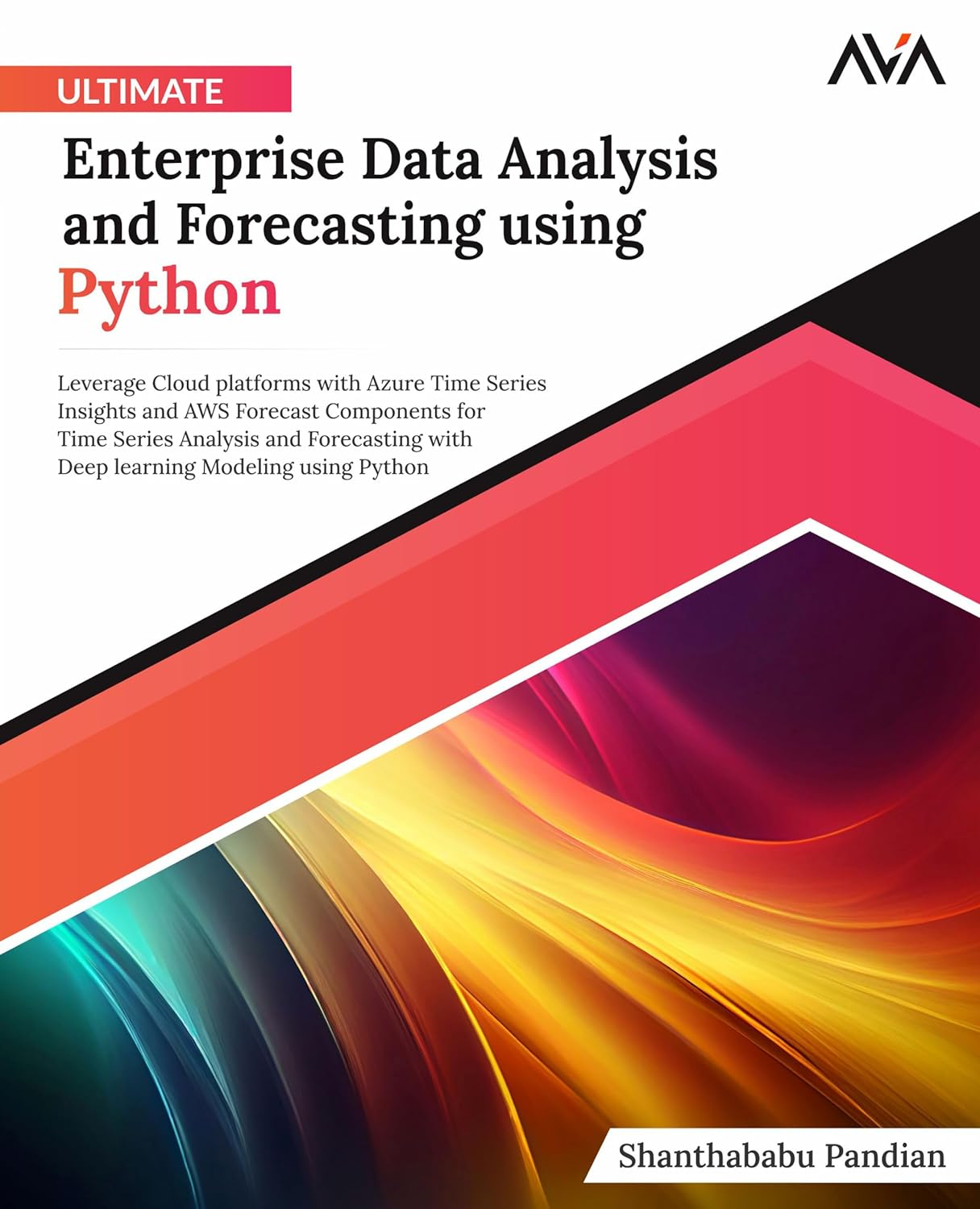
Автор: Pandian Shanthababu
Дата выхода: 2023
Издательство: Orange Education Pvt Ltd, AVA™
Количество страниц: 529
Размер файла: 10,0 МБ
Тип файла: PDF
Добавил: codelibs
Проверить на вирусы Дополнительные материалыCover Page....2
Title Page....3
Copyright Page....4
Dedication Page....5
About the Author....6
About the Technical Reviewers....8
Preface....9
Errata....14
Table of Contents....18
1. Introduction to Python and its key packages for DS and ML Projects....26
Introduction....26
Structure....26
Introduction to Python programming language....26
Key features of Python....27
Python programming IDEs and comparisons....28
Jupyter Notebook....28
PyCharm....29
Spyder....29
Installing Jupyter notebook....30
Python libraries....35
Pandas....35
Panel + Data = Pandas....35
Reshaping DataFrame....39
Combining DataFrame....46
Working with categorical data....55
Encoding....56
Date and time data....57
Converting data types....60
NumPy....61
Python statistics libraries....76
Working with various files in Python....77
Conclusion....81
Points to remember....81
2. Python for Time Series Data Analysis....83
Introduction....83
Structure....83
Data analysis and its benefits....83
Benefits....84
Advanced Analytics....85
Python - the best choice for data analytics....86
Time series data....86
Time series data management....88
Data lifecycle management (DLM)....90
Data acquisition or collection....91
Ingesting data....91
Transforming data....91
Storing data....92
Actionable information....92
Data remediation....92
Data cleansing and preparation....93
Handling missing and duplicate data....94
Handling uniform format....104
Handling categorical columns....107
Transformation of data....108
Handling time series data....115
Exploratory data analysis (EDA)....121
EDA for time series....128
Conclusion....132
Points to remember....133
3. Time Series Analysis and its Components....134
Introduction....134
Structure....134
Time series data analysis....135
Significance of time series data....137
Trend....138
Seasonality....139
Components of time series data....139
Stationarity versus non-stationarity....140
Augmented Dickey-Fuller (ADF)....141
Kwiatkowski–Phillips–Schmidt–Shin (KPSS) test....146
Converting non-stationary data into stationary....148
Conclusion....163
Points to remember....164
4. Time Series Analysis and Forecasting Opportunities in Various Industries....165
Introduction....165
Structure....165
Opportunity and scope of TSA&F....165
Scope of price prediction....168
Scope of forecasting in healthcare for diagnosis....169
Scope of predictive maintenance....171
Challenges with TSA&F....173
Case studies....175
Price prediction in retail and use case....175
EDA and Stationarity Analysis....178
Forecasting in healthcare for diagnosis and use case....180
Predictive maintenance and anomaly detection use case....185
Conclusion....189
Points to remember....189
5. Exploring various aspects of Time Series Analysis and Forecasting....191
Introduction....191
Structure....191
Understanding time series analysis (TSA)....191
Statistical analysis....192
The measure of central tendency....196
Measure of variability....196
Boxplots....198
Histogram....199
Inferential Statistics....200
Regression analysis....201
Linear model....201
Hypothesis testing....203
Confidence intervals....210
Confidence intervals assessment at the speed of the motor....211
Study the shapes of Time Series....212
Transforms for TSA&F....213
Box-Cox transformation....218
Overview of Naive forecasting....226
Conclusion....228
Points to remember....229
6. Exploring Time Series Models - AR, MA, ARMA, and ARIMA....230
Introduction....230
Structure....230
Overview and time series models....230
Statistical models for TSA&F....232
Autoregressive (AR) Model....233
Autoregressive (AR) Implementation....234
Analysis of the P-value....242
Auto-regression model for TSA&F with Python....245
Moving Average (MA) Model....255
Moving Average (MA) Implementation....256
ARMA Model....275
Auto-Regressive Integrated Moving Average (ARIMA)....276
Time Series Analysis and Forecasting Process Workflow....282
Pertinency of the model....283
Conclusion....283
Points to remember....284
7. Understanding Exponential Smoothing and ETS Methods in TSA....285
Introduction....285
Structure....285
Understanding Exponential Smoothing....285
Exponential Smoothing implementation using Excel....286
Exponential Smoothing types....293
Triple Exponential Smoothing Model for TSA&F using Excel....296
SES and DES Model implementation using Python....301
Error - Trend-Seasonality (ETS)....307
Exponentially Weighted Moving Averages (EWMA)....316
Benefits of EWMA....317
Limitations of EWMA....317
EWMA Model for TSA&F with Excel (simple method)....317
EWMA Model implementation using Python....320
Conclusion....322
Points to remember....323
8. Exploring Vector Autoregression and its Subsets (VAR, VMA, and VARMA)....325
Introduction....325
Structure....325
Understanding Vector Autoregression....326
VAR implementation using Python....328
1. Analyze the time series data and its characteristics....329
2. Test for data stationarity using the ADF method....332
Augmented Dickey-Fuller (ADF) test....332
3. Train-test split....335
4. Re-run the ADF test....336
5. Apply the VAR algorithm....339
6. Optimal order (p) selection process....340
7. Analysis of Serial Correlation of Residuals [ScoR]....344
8. Building forecast VAR model....345
9. Model evaluation....348
Vector Autoregression Moving - Average (VARMA)....349
VARMA implementation using Python....351
Vector Autoregression Moving-Average with Exogenous Regressors (VARMAX)....377
VARMAX implementation using Python....378
Seasonal Autoregressive Integrated Moving-Average (SARIMA)....382
SARIMA implementation using Python....382
SARIMAX implementation using Python....385
Fractional-Autoregressive-Integrated-Moving Average model (FARIMA)....387
Conclusion....388
Points to remember....389
9. Deep Learning for Time Series Analysis and Forecasting....391
Introduction....391
Structure....391
Deep learning in time series analysis....391
Neural Networks....394
Artificial neural networks (ANN)....400
Long short-term memory (LSTM)....402
Convolutional neural networks (CNN)....423
Recurrent Neural Network (RNN)....443
Backpropagation through time (BPTT)....445
Conclusion....456
Points to remember....457
10. Azure Time Series Insights....461
Introduction....461
Structure....461
Prerequisites....461
Understanding Azure - Time Series Insights (Azure-TSI) Gen2 component....462
Components of Azure TSI and its major jobs....463
Azure TSI – versions (Gen 1 and Gen 2)....464
Azure TSI – Capabilities....465
Exploring Azure TSI Data Storage....466
High-level architecture of Azure TSI....468
Creating Azure IoT hub instance....470
Creating Azure TSI Gen2 environment....478
Exploring Azure TSI Explorer....487
Conclusion....489
Points to remember....489
11. AWS Forecast....491
Introduction....491
Structure....491
Prerequisites....492
Understanding Amazon Forecast Service (AFS)....492
Workflow for Amazon Forecast Service....492
Data Preparations....493
Dataset Guidelines for Forecast....499
Quality of Data....502
Importing data....503
Training data....507
Forecast creation and selection....508
Retrieve the Forecast....509
Orchestration of Amazon Forecast....511
Conclusion....511
Points to remember....512
Index....513
Embark on a transformative journey through the intricacies of time series analysis and forecasting with this comprehensive handbook. Beginning with the essential packages for data science and machine learning projects you will delve into Python's prowess for efficient time series data analysis, exploring the core components and real-world applications across various industries through compelling use-case studies. From understanding classical models like AR, MA, ARMA, and ARIMA to exploring advanced techniques such as exponential smoothing and ETS methods, this guide ensures a deep understanding of the subject.It will help you navigate the complexities of vector autoregression (VAR, VMA, VARMA) and elevate your skills with a deep dive into deep learning techniques for time series analysis. By the end of this book, you will be able to harness the capabilities of Azure Time Series Insights and explore the cutting-edge AWS Forecast components, unlocking the cloud's power for advanced and scalable time series forecasting.
What you will learn
- Explore Time Series Data Analysis and Forecasting, covering components and significance.
- Gain a practical understanding through hands-on examples and real-world case studies.
- Master Time Series Models (AR, MA, ARMA, ARIMA, VAR, VMA, VARMA) with executable samples.
- Delve into Deep Learning for Time Series Analysis, demystified with classical examples.
- Actively engage with Azure Time Series Insights and AWS Forecast components for a contemporary perspective.
Who is this book for?
This book caters to beginners, intermediates, and practitioners in data-related fields such as Data Analysts, Data Scientists, and Machine Learning Engineers, as well as those venturing into Time Series Analysis and Forecasting. It assumes readers have a foundational understanding of programming languages (C, C++, Python), data structures, statistics, and visualization concepts. With a focus on specific projects, it also functions as a quick reference for advanced users.


