-
1C
-
Agda
-
Agile/Scrum
-
Alef
-
APL
-
Assembler
-
AWK
-
Basic
-
Beta Programming Language
-
Big Data/DataScience
-
C
-
C#
-
C++
-
Cobol
-
Crystal
-
CSS
-
D
-
Dart
-
DataBase (SQL)
-
Delphi
-
F#
-
Flutter
-
Fortran
-
GameDev
-
Git
-
Go (Golang)
-
GPT/AI/ИИ
-
Hacking and Security
-
Haskell
-
HTML
-
Java
-
JavaScript (JS)
-
Julia
-
Kotlin
-
Machine Learning (ML)
-
Natural language processing (NLP)
-
.NET (.NET Core)
-
Pascal
-
PHP
-
Python
-
R
-
Ruby
-
Rust
-
Scratch
-
Swift
-
UML
-
UX/UI
-
Visual Basic
-
Wolfram
-
XML
-
АСУ
-
Проектирование/System Design
-
Сети/Network
-
Статьи
-
Схемотехника/электронные схемы
-
1C
-
Agda
-
Agile/Scrum
-
Alef
-
APL
-
Assembler
-
AWK
-
Basic
-
Beta Programming Language
-
Big Data/DataScience
-
C
-
C#
-
C++
-
Cobol
-
Crystal
-
CSS
-
D
-
Dart
-
DataBase (SQL)
-
Delphi
-
F#
-
Flutter
-
Fortran
-
GameDev
-
Git
-
Go (Golang)
-
GPT/AI/ИИ
-
Hacking and Security
-
Haskell
-
HTML
-
Java
-
JavaScript (JS)
-
Julia
-
Kotlin
-
Machine Learning (ML)
-
Natural language processing (NLP)
-
.NET (.NET Core)
-
Pascal
-
PHP
-
Python
-
R
-
Ruby
-
Rust
-
Scratch
-
Swift
-
UML
-
UX/UI
-
Visual Basic
-
Wolfram
-
XML
-
АСУ
-
Проектирование/System Design
-
Сети/Network
-
Статьи
-
Схемотехника/электронные схемы
Меню
Test-Driven Development with PHP 8: Build extensible, reliable, and maintainable enterprise-level applications using TDD and BDD with PHP
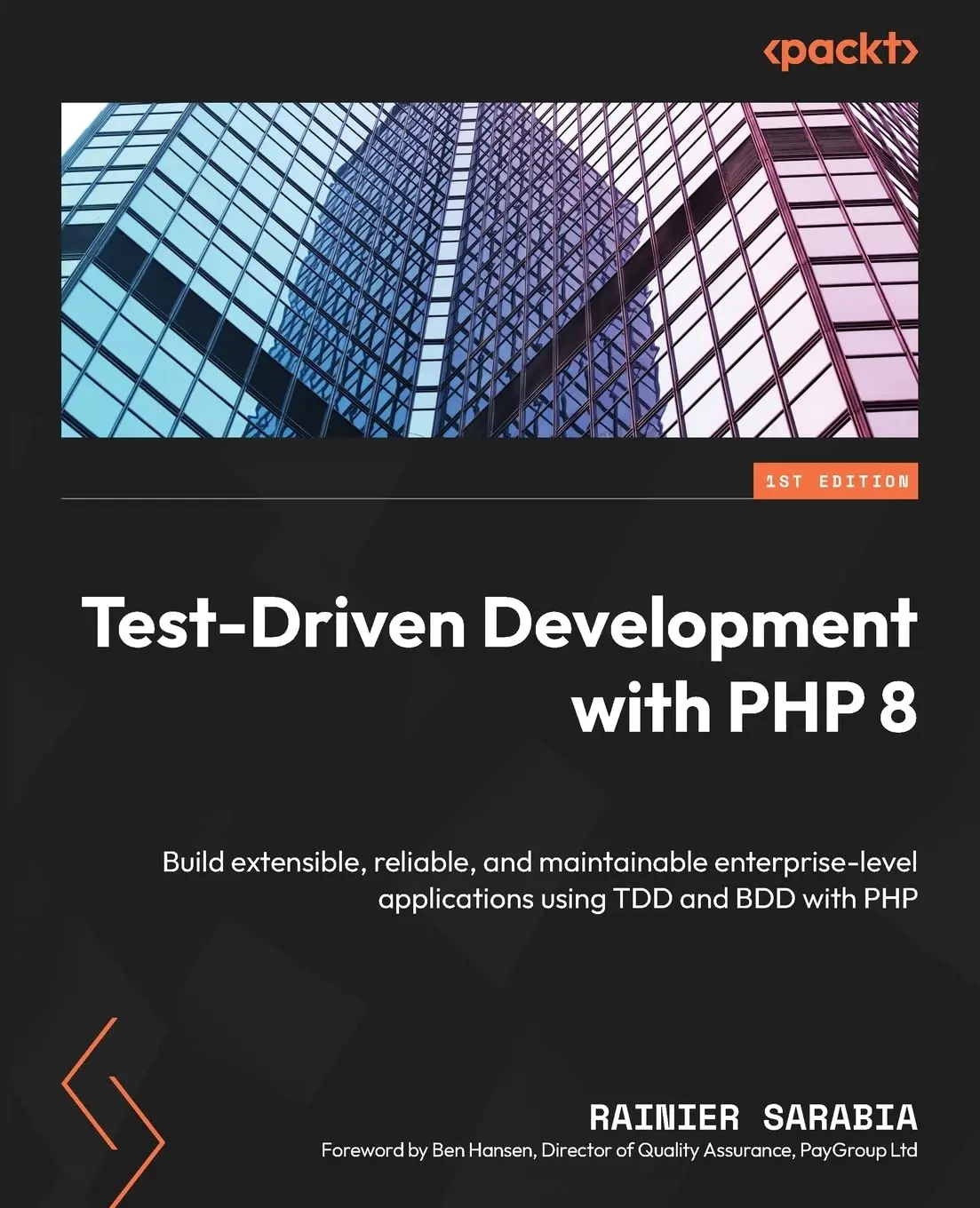
Автор: Sarabia Rainier
Дата выхода: 2023
Издательство: Packt Publishing Limited
Количество страниц: 362
Размер файла: 5,1 МБ
Тип файла: PDF
Добавил: codelibs
Проверить на вирусы Дополнительные материалыCover Page....2
Table of Contents....3
Preface....4
Part 1 – Technical Background and Setup....12
Chapter 1: What Is Test-Driven Development and Why Use It in PHP?....13
What is TDD?....14
Common misconceptions about TDD....15
Why should we even consider TDD?....18
What are we planning to achieve in this book?....22
Summary....23
Chapter 2: Understanding and Organizing the Business Requirements of Our Project....24
Technical requirements....26
The example business project....26
Breaking down the business requirements into software features....29
Summary....54
Chapter 3: Setting Up Our Development Environment Using Docker Containers....55
Technical requirements....56
What is a container?....56
Setting up our PHP development container....57
Running Docker containers....60
Summary....65
Chapter 4: Using Object-Oriented Programming in PHP....66
Technical requirements....67
Understanding OOP in PHP....67
Classes versus objects....70
Abstraction in OOP....76
Encapsulation in OOP....78
Inheritance in OOP....84
Polymorphism in OOP....86
Polymorphism with a PHP interface....88
PHP Standards Recommendations (PSRs)....92
Summary....94
Part 2 – Implementing Test-Driven Development in a PHP Project....95
Chapter 5: Unit Testing....96
Technical requirements....97
Defining unit tests....98
Test coverage....103
Using shell scripts to run tests....115
Types of tests....122
Integration test example....126
Summary....145
Chapter 6: Applying Behavior-Driven Development....146
Technical requirements....147
What is BDD?....148
Applying BDD using Behat and Gherkin....149
Writing PHP code based on Gherkin....155
Browser emulators and Mink....161
Why bother with Gherkin, then?....167
Summary....169
Chapter 7: Building Solution Code with BDD and TDD....170
Technical requirements....171
Implementing the Red-Green-Refactor pattern....172
Writing tests and solution code for the example project....178
Creating a Behat feature based on a Jira ticket....181
Passing the Behat registration feature....188
Summary....202
Chapter 8: Using TDD with SOLID Principles....203
Technical requirements....204
Jira to BDD to TDD....205
TDD with the Single-Responsibility Principle....213
TDD with the Open-Closed Principle....227
TDD with the Liskov Substitution Principle....239
TDD with the Interface Segregation Principle....245
TDD with the Dependency Inversion Principle....251
Summary....259
Part 3 – Deployment Automation and Monitoring....260
Chapter 9: Continuous Integration....261
Technical requirements....261
Running and passing all the Symfony application tests....262
Using Bitbucket Pipelines for CI....274
Summary....281
Chapter 10: Continuous Delivery....283
Technical requirements....284
Setting up an AWS EC2 instance....286
Creating an AWS CodeDeploy application....299
Installing Docker and other dependencies inside the AWS EC2 instance....303
Continuous delivery with Bitbucket Pipelines and AWS CodeDeploy....312
Summary....326
Chapter 11: Monitoring....328
Technical requirements....328
Setting up New Relic APM for PHP....329
Going through the application performance data....332
Summary....339
Index....341
Why subscribe?....353
Other Books You May Enjoy....355
Packt is searching for authors like you....359
Share Your Thoughts....359
Download a free PDF copy of this book....361
PHP web developers end up building complex enterprise projects without prior experience in test-driven and behavior-driven development which results in software that's complex and difficult to maintain. This step-by-step guide helps you manage the complexities of large-scale web applications. It takes you through the processes of working on a project, starting from understanding business requirements and translating them into actual maintainable software, to automated deployments.
You'll learn how to break down business requirements into workable and actionable lists using Jira. Using those organized lists of business requirements, you'll understand how to implement behavior-driven development (BDD) and test-driven development (TDD) to start writing maintainable PHP code. You'll explore how to use the automated tests to help you stop introducing regressions to an application each time you release code by using continuous integration.
By the end of this book, you'll have learned how to start a PHP project, break down the requirements, build test scenarios and automated tests, and write more testable and maintainable PHP code. By learning these processes, you'll be able to develop more maintainable, and reliable enterprise PHP applications.
What You Will Learn:
- Understand how to start a software project
- Discover how to use Jira as a tool to organize your tasks
- Explore when and how to write unit, integration, and functional tests using PHPUnit
- Write behavior-driven tests using Behat
- Apply SOLID principles to help you write more testable code
- Get the most out of your automated tests by using continuous integration
- Use continuous delivery to help you prepare your application for deployment
Who this book is for:
This book is for PHP software developers looking to implement TDD and BDD in their projects. An understanding of object-oriented programming is required to get the most out of this book. Professional software development experience will also be beneficial to understand real-life business cases.


