-
1C
-
Agda
-
Agile/Scrum
-
Alef
-
APL
-
Assembler
-
AWK
-
Basic
-
Beta Programming Language
-
Big Data/DataScience
-
C
-
C#
-
C++
-
Cobol
-
Crystal
-
CSS
-
D
-
Dart
-
DataBase (SQL)
-
Delphi
-
F#
-
Flutter
-
Fortran
-
GameDev
-
Git
-
Go (Golang)
-
GPT/AI/ИИ
-
Hacking and Security
-
Haskell
-
HTML
-
Java
-
JavaScript (JS)
-
Julia
-
Kotlin
-
Machine Learning (ML)
-
Natural language processing (NLP)
-
.NET (.NET Core)
-
Pascal
-
PHP
-
Python
-
R
-
Ruby
-
Rust
-
Scratch
-
Swift
-
UML
-
UX/UI
-
Visual Basic
-
Wolfram
-
XML
-
АСУ
-
Проектирование/System Design
-
Сети/Network
-
Статьи
-
Схемотехника/электронные схемы
-
1C
-
Agda
-
Agile/Scrum
-
Alef
-
APL
-
Assembler
-
AWK
-
Basic
-
Beta Programming Language
-
Big Data/DataScience
-
C
-
C#
-
C++
-
Cobol
-
Crystal
-
CSS
-
D
-
Dart
-
DataBase (SQL)
-
Delphi
-
F#
-
Flutter
-
Fortran
-
GameDev
-
Git
-
Go (Golang)
-
GPT/AI/ИИ
-
Hacking and Security
-
Haskell
-
HTML
-
Java
-
JavaScript (JS)
-
Julia
-
Kotlin
-
Machine Learning (ML)
-
Natural language processing (NLP)
-
.NET (.NET Core)
-
Pascal
-
PHP
-
Python
-
R
-
Ruby
-
Rust
-
Scratch
-
Swift
-
UML
-
UX/UI
-
Visual Basic
-
Wolfram
-
XML
-
АСУ
-
Проектирование/System Design
-
Сети/Network
-
Статьи
-
Схемотехника/электронные схемы
Меню
Test Driven Development in Ruby: A Practical Introduction to TDD Using Problem and Solution Domain Analysis
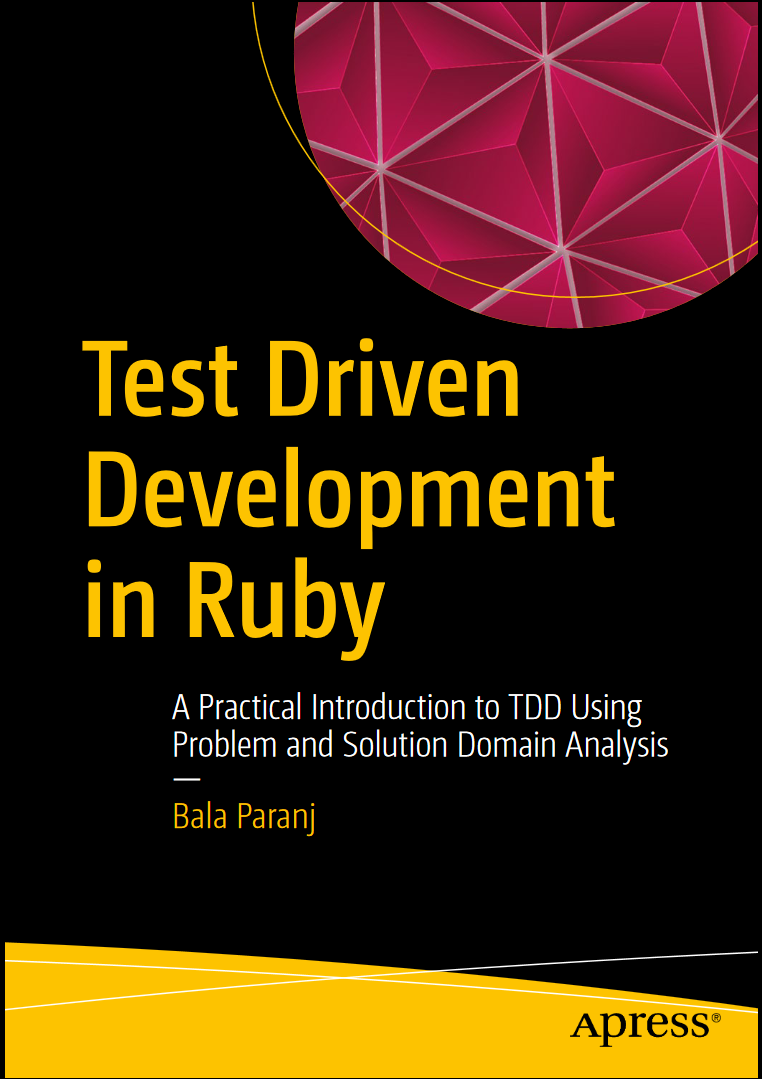
Автор: Paranj Bala
Дата выхода: 2017
Издательство: Apress Media, LLC.
Количество страниц: 302
Размер файла: 2,8 МБ
Тип файла: PDF
Добавил: codelibs
Проверить на вирусыContents
About the Author
About the Technical Reviewer
Foreword
Acknowledgments
Introduction
Chapter 1: The Basics
Terminology
Kata
Coding Kata
Domain
Problem Domain
Solution Domain
Domain Expert
Domain Knowledge
Defining the Problem Domain and the Solution Domain
Learning TDD
Learning by Coding Kata
Learning Retrospective
Intent vs. Implementation
Intent
Implementation
Intent and Implementation
Music
Lyrics
Home Plan
Separate Intent from Implementation
Sheep Example
Test API Example
Bowling Game Example
Precision in Language and Meaning
Tests Are Executable Documentation
Shift in Mental State
Overview of TDD
Test Driven Development
The Five Steps of TDD
Failing Test
Writing a Failing Test
Minimal Implementation
Refactoring
Separation of Intent from Implementation
Ping Pong Pair Programming Technique
Black Box Perspective
Shift in System and Mental States
Importance of Discipline
Overcoming Difficulty
Problem-Solving Skills
Four Phases of Problem Solving
Understand the Problem
Devise a Plan
Carry Out the Plan
Look Back
Subskills of Test Driven Development
Problem Domain Analysis
Solution Domain Analysis
Alternative Representations
Divide and Conquer Strategy
Designing Test Cases
Sum a List of Numbers
Sequence of Test Cases
Starter Test
Next Test
Story Test
Assertion
Test Driving Calculator
Canonical Test Structure
Given
When
Then
Arrange, Act, Assert
Calculator
Addition
Subtraction
Common Mistakes
Common Mistakes in the TDD Cycle
Mistakes in Step One
Mistakes in Step Two
Mistakes in Step Three
Mistakes in Step Four
Mistakes in Step Five
Base Conversion
Problem Statement
Problem Domain Analysis
Solution Domain Analysis
Algorithm
Code
Code Reflecting Test Data
Multiple Assertions
Vowel Checker
Forgetting to Test the Negative Case
Not Testing the Boundary Conditions
Not Updating the Tests
Implementation-Aware Tests
Summary
Chapter 2: Katas
Fibonacci Sequence
Problem Statement
Problem Domain Analysis
Solution Domain Analysis
Assumptions
Test-Driven Fibonacci
Fizz Buzz
Problem Statement
Problem Domain Analysis
Solution Domain Analysis
Test-Driven FizzBuzz
No if-else Constraint
No if Constraint
Implementation-Independent Tests
Crossing the System Boundary
Mocking as a Design Technique
Abstraction Levels in a System
Testing Random Behavior
Testing Time-Dependent Behavior
Simulating User Input
Open Closed Principle
Difference Reduction
Defect Localization
Stack
Basic Stack
Test Precisely and Concretely
Make Your Code Robust
The Sieve of Eratosthenes
Algorithm
Prime Factors
Problem Statement
Problem Domain Analysis
Solution Domain Analysis
Summary
Chapter 3: Techniques in TDD
Obvious Implementation
Fake It Till You Make It
Triangulation
Addition
Sum a List of Numbers
Problem Domain Analysis
Solution Domain Analysis
Initial Condition
Steps to Solve the Problem
Algorithm Description
Assumptions
Test Cases
Solution Domain Analysis Redux
Reduction
Problem Statement
Example....1
Example....2
Steps to Solve the Problem
Iterative Construct
Initial Conditions
Euclidean Algorithm
Test-Driven GCD
Transformation Priority Premise
Refactorings and Transformations
Transformation List
Counter
Problem Statement
Problem Domain Analysis
Solution Domain Analysis
Steps to Solve the Problem
Algorithm
Logical Design
Skeleton Code
Terminating Condition
Initial Condition
Pseudo Code
Test-Driven Counter
Factorial
Summary
Chapter 4: Importance of Test Cases
Problem Statement
Problem Domain Analysis
Solution Domain Analysis
Algorithm Description
Code
Summary
Chapter 5: Character-to-Number Conversion
Problem Statement
Discussion
Solution Domain Analysis
Test Cases
Summary
Chapter 6: Conway’s Game of Life
Problem Statement
Problem Domain Analysis
Assumptions
Solution Domain Analysis
Moore Neighborhood
Test Cases
Test-Driven Game of Life
Application Statement
Refactor Solution
Code Review
Summary
Chapter 7: Gilded Rose
Form vs. Structure
Problem Statement
Initial Setup
Form
Structure
DeMorgan’s Laws
Making Temporal Dependency Explicit
Improving the Structure
Express Intent
Tell-Don’t-Ask Principle
Inheritance
Implementing the New Feature
Express Domain Concepts
Retrospective
Summary
Chapter 8: Dealing with Third-Party APIs
Subscription Plan
Create a Plan
Delete a Plan
Stripe Customer
Subscribe a Customer to a Plan
Test-Driven Stripe Library
Integration Tests
Unit Tests
Make Your Code Robust
Summary
Chapter 9: Pair Ranking
Problem Domain Analysis
Solution
Summary
Index
Learn the basics of test driven development (TDD) using Ruby. You will carry out problem domain analysis, solution domain analysis, designing test cases, and writing tests first. These fundamental concepts will give you a solid TDD foundation to build upon. Test Driven Development in Ruby is written by a developer for developers.The concepts are first explained, then a coding demo illustrates how to apply the theory in practice. At the end of each chapter an exercise is given to reinforce the material. Complete with working files and code samples, you'll be able to work alongside the author, a trainer, by following the material in this book.
What You Will Learn
- Carry out problem domain analysis, solution domain analysis, designing test cases, and writing tests first
- Use assertions
- Discover the structure of a test and the TDD cycle
- Gain an understanding of minimal implementation, starter test, story test, and next test
- Handle refactoring using Ruby
- Hide implementation details
- Test precisely and concretely
- Make your code robust
Who This Book Is For
Experienced Ruby programmers or web developers with some prior experience with Ruby.


